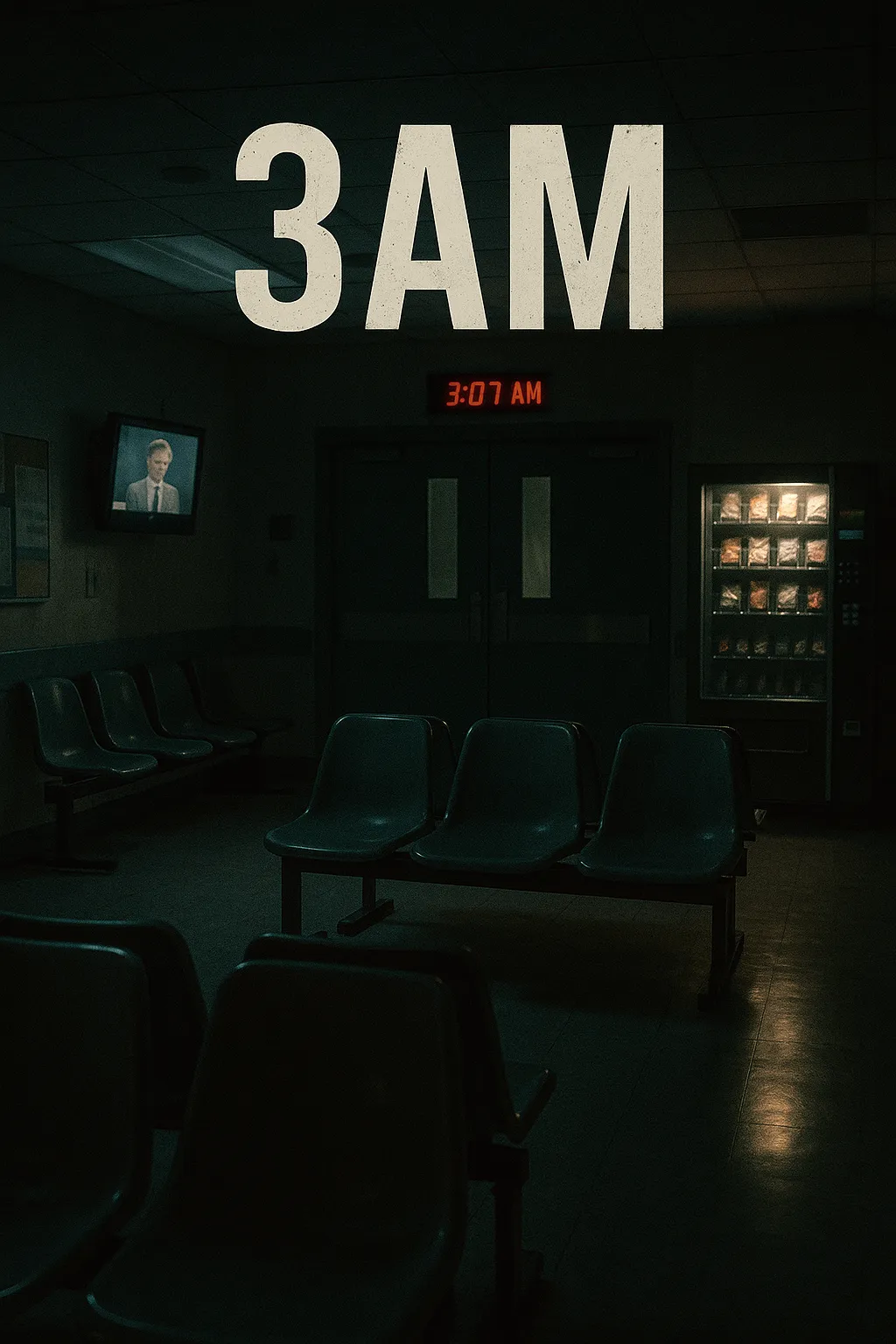
3am
The vending machine in the corner had a flicker. Not a hum — a flicker, like it was thinking about dying but hadn't committed. Every eleven seconds. Sam had counted.
The waiting room at St. Francis was built for maybe forty people. At 3:07 in the morning, it held two. Sam in a molded plastic chair near the window, and a woman across the room with her shoes off, feet tucked under her on the seat like she'd been here long enough to stop caring what it looked like.
A muted television above the reception desk played an infomercial for a food dehydrator. The man onscreen held up a piece of beef jerky like he'd solved something. The closed captions were three seconds behind.
Sam's phone sat face-down on the armrest. It hadn't buzzed in over an hour. The last text was still there if it got flipped over — still unanswered.
The woman had a paper coffee cup she wasn't drinking from. She'd been holding it the same way for twenty minutes, both hands wrapped around it like it was January and she was outside. It was seventy-two degrees in here.
A nurse came through the double doors. Both of them looked up — the same quick motion, identical. The nurse checked her clipboard, glanced at the empty rows of chairs, and walked to the reception desk without a word. Wrote something. Left.
The woman exhaled. Not a sigh. Smaller. She looked at her coffee, then at the vending machine, then at Sam. First real eye contact in the forty minutes they'd been the only two people in this room.
She said it to the space between them, not quite to Sam, not quite to nobody.
She meant the vending machine. The flicker.
Sam looked at it. Eleven seconds. There it went.
Sam picked up the phone.
The screen lit up. One text, from Dana. Four words: Do you need me?
Sam read it twice. Set the phone back down, but face-up this time.
Across the room, Margot was watching. She looked away a beat too late.
Bad news or good news?
Neither. Someone asking if I need them.
Margot nodded.
Those are hard to answer.
The thermostat clicked somewhere behind the wall. Pipes, ventilation, the distant chime of an elevator nobody was riding.
Margot set the coffee cup on the floor beside her chair. She pulled one knee up, rested her chin on it. Her fingers found the hem of her jeans and started working a loose thread there.
You been here long?
Couple hours. You?
Since eleven. Ish. I stopped looking at the clock around midnight because it was making me insane.
Four hours. Sam looked at Margot's bare feet, the socks balled up inside her shoes under the chair. Four hours in a plastic seat.
She said it like she was offering something — not information, just proximity.
Sam looked at the cup on the floor beside Margot's chair. Lid still on, no steam.
What are you drinking that you won't drink?
Margot glanced down at it like she'd forgotten it was there.
Coffee. From the machine by radiology. It tastes like someone described coffee to a robot.
So why hold onto it?
Margot looked at Sam straight on for the first time.
Gives my hands something to do.
Sam's phone lit up on the armrest. Not a buzz — just the screen waking itself, Dana's text still there. Sam turned it over again without looking.
Margot watched this. She pressed her thumbnail into the seam of her knee, back and forth.
You hungry?
Starving, actually.
There's a vending machine right there and I have four dollars in quarters. I've been saving them because I thought I'd want something eventually but it turns out I don't want anything.
She said it all in one breath, like a kid offering to share lunch.
Sam stood up. Legs stiff — the plastic chairs did that to you. The walk to the vending machine was maybe fifteen feet but it felt like crossing some kind of line, closing the distance between their two camps of chairs.
Margot dug into her jacket pocket and held out a fistful of quarters without getting up. Sam took them. Her fingers were cold.
Sam stood in front of the machine, studying the options through the glass. Half the spirals were empty. There was a brown scuff on the glass at about hip height, like someone had kicked it once.
Peanut butter crackers. Nobody's ever been made sadder by peanut butter crackers.
Sam fed the quarters in. The machine took its time, the spiral turning slowly. Two packs of crackers dropped. Sam grabbed both and walked back.
But not back to the original seat. Sam sat two chairs from Margot. Close enough to hand her the crackers without throwing them. Neither of them acknowledged the migration.
They ate. The cellophane was loud in the empty room. Margot ate one cracker in four precise bites, turning it like a steering wheel. Sam finished three before she'd gotten through one.
She didn't text again.
Sam looked at her.
Sorry. Your phone. The person who asked if you needed them. She didn't follow up.
Sam set the cracker pack on the armrest.
She knows me. She asked once. That's what she does.
Margot nodded. She folded the empty cracker wrapper into a neat square, then into a smaller square.
My sister called four times before I picked up. Then she cried harder than I did, and I had to talk her down for twenty minutes in the parking garage.
She laughed. Short, bitten-off.
That sounds mean. It's not mean. She loves me. She just — she needs to be the one falling apart, and there's only room for one of us to do that right now.
The double doors opened. A different nurse this time — younger, scrubs with cartoon dogs on them. She stood in the doorway looking at a clipboard, and the room went airless. Margot went still.
The nurse looked up, scanned the empty rows.
No one moved. No one was Ostrowski. The nurse waited three seconds, checked something off, and disappeared back through the doors.
Margot's hand was gripping the side of her chair. She let go, finger by finger.
Every time those doors open.
Yeah.
A long beat. The TV had switched to a commercial for life insurance. Margot saw it too. Their eyes met and Margot exhaled a sound that wasn't quite a laugh.
Can I ask you something that's none of my business?
Sam set the last cracker down on the wrapper.
Only if I get to ask you one first.
Margot's eyebrows went up. She shifted in her chair, both feet dropping to the floor for the first time — bare soles on linoleum. She winced at the cold but didn't pull them back.
That's not how this works. I called it.
Fair's fair. You asked about Dana without asking. I get one.
Margot considered this. She pressed her thumb into the hollow of her own collarbone, a slow circle.
Fine. But I reserve the right to not answer.
Same rules apply to yours.
Deal.
Sam leaned forward, elbows on knees. Looked at the double doors across the room. They were the kind with narrow vertical windows, and beyond them just a corridor of fluorescent light leading somewhere neither of them could go yet.
Who are you here for.
Margot went still. Not the stillness from when the nurse came through — that was reactive. This was chosen. She sat with it, her bare feet flat on the floor, her hands open on her thighs. The life insurance commercial ended. A mattress ad started.
My husband.
Sam didn't say sorry. Didn't nod.
Margot's hand found her own wrist, fingers circling it loosely.
She stopped.
I don't know what it is, actually.
You came, though.
Yeah. I came.
Somewhere deep in the building, an intercom paged a Dr. Asante to the third floor. The sound was muffled, half-swallowed by walls and distance.
Your turn. Ask me what happened to him and I'll tell you I don't fully know, which is the truth. They said cardiac event on the phone, which is a phrase that sounds like it belongs on a calendar.
She almost laughed.
You don't have to apologize for laughing.
I know. But I keep doing it and then feeling like shit about it.
She pulled her feet up onto the chair again, crossed them under her. Then uncrossed them. Then just sat with her knees drawn up, arms around her shins, chin resting there.
Okay. My turn.
Sam's phone lit up on the armrest. Just the screen cycling awake on its own, Dana's text still glowing there. Sam reached over and pressed the button on the side. The screen went dark.
Who are you here for, Sam?
Sam didn't answer right away. The mattress commercial ended and another one started — a woman jogging through a field, selling a medication whose side effects took longer to list than its benefits.
Margot waited. She didn't push.
The thermostat clicked behind the wall. Somewhere down a hallway, a phone rang four times and stopped.
Okay.
That was it. She didn't say take your time or you don't have to. Just okay.
Two years.
Margot's head turned slightly.
That's — I haven't talked to him in two years. My father. He's the one. He fell at his house and a neighbor called it in and they called me because apparently I'm still in his phone, which. Yeah.
It came out wrong. The two years first, then the him, then doubling back for the fall. Like reading a story from the middle.
How bad.
They won't say. Or they did say and I wasn't — I drove here. I don't remember the drive.
Margot's bare feet found the floor again. She sat forward, arms on her knees.
The complicated part isn't the fall.
Sam stopped. Picked up the cracker wrapper and folded it once, badly, then just held it.
Dana's my girlfriend. She texted. And I can't text her back because if I say yes she'll come, and then I have to be a person who's going through something, and I don't know if I am. Going through something. He fell. People fall. But I drove here at one in the morning and I haven't talked to him since — so what does that make me.
It wasn't a question. Sam's hands were still on the cracker wrapper.
Margot didn't move.
The silence went on long enough that the building filled it — the pipes, the ventilation, the elevator chiming for nobody. Then Margot laughed. It surprised both of them. It came from somewhere low and real, and she pressed her forehead to her knee and her shoulders shook, and Sam stared at her, and then Sam was laughing too. It lasted maybe five seconds.
Margot lifted her head. Her eyes were wet.
Yeah.
That's not complicated, Sam. That's just — I don't know what that is. It's Tuesday.
Sam looked at the ceiling. Fluorescent panels, one of them buzzing faintly off-key from the others.
I keep thinking they're going to come through those doors and say his name and I won't feel the right thing.
Margot said it carefully.
Frank.
Frank.
Mine's Joel.
Sam nodded. They sat with it — Frank and Joel, two men somewhere past those double doors, being kept alive or not by people who did this every night.
The double doors opened. Wren stood there, clipboard against her hip, pen clicking against the metal clip. She looked at the room — the two of them, the empty chairs, the shoes under Margot's seat.
Family for Joel Kessler?
Margot was on her feet before the sentence finished, one hand gripping the chair back, bare feet on linoleum. She looked at Sam.
That's me.
She crouched and shoved her feet into her shoes without the socks. Grabbed the cold coffee cup from the floor with both hands, then set it on the seat of her chair. Stood up.
She was already moving toward the doors. She stopped and turned back.
Margot.
She looked back once, fast, from the threshold. Wren held the door. Then Margot went through and the doors swung shut behind her and the room was just Sam.
The vending machine flickered.
Sam picked up the phone. Dana's text, three hours old now: Do you need me? The cursor blinked in the empty reply field.
Sam leaned back in the chair. The cold coffee cup sat on the seat where Margot had left it. Under her chair, the balled-up socks.
The waiting room was the same room it had been five hours ago — same chairs, same ceiling, same fluorescent panel buzzing off-key. But there was a Margot-shaped absence and thirty-eight empty chairs.
Sam looked at the phone. Dana's text. The cursor blinked.
Sam typed: Yes.
Sent it. Set the phone down.
The socks were still under Margot's chair. Sam didn't pick them up. There was no lost and found at 3 AM. There was no front desk person to give them to.
The phone buzzed. Once.
Dana: On my way.
Two words. No question mark, no hesitation. Sam closed his eyes and breathed out through his teeth and it was just air.
Outside the window, the parking lot was starting to go gray at the edges. Not dawn yet. But the sodium lights looked weaker than they had an hour ago.
Sam stood up. Legs stiff, back aching from the plastic chair. Walked to the window and stood there with both hands in jacket pockets, looking out at the lot where Margot had talked her sister down from crying four hours ago. Where Sam had parked at one in the morning and sat in the car for six minutes before going in.
Frank was somewhere in this building. Two years of silence and a fall and a neighbor who knew to call 911 and a phone that still had Sam's name in it.
Sam went back to the chair. Sat down.
Dana would be here in twenty minutes, maybe thirty. She'd bring something — a sweatshirt, or water, or nothing, just herself. And Sam would have to say the words out loud to someone who already knew the whole story, which was harder than saying them to a stranger in the dark. Margot got the easy version.
The double doors stayed shut. The TV cycled to a rerun with a laugh track. Nobody changed the channel because nobody had changed the channel in hours and the remote was probably behind the reception desk or dead or both.
Sam's phone sat face-up on the armrest. Answered. Done.
A man came through the far entrance — fifties, windbreaker, eyes wrecked red. He stood in the middle of the room like he'd forgotten why he'd come out here. Then he walked to the water fountain, drank for a long time, and went back through the double doors without looking at Sam or the empty chairs or any of it.
Sam sat in the chair next to Margot's. The cold coffee cup on the seat. The socks under the chair.
Somewhere in the building, Frank was in a bed. Sam tried to picture it — the bed, the room, the machines — and instead got Frank's left hand. The crooked pinky he'd broken playing softball the summer Sam was nine. It had healed wrong because he wouldn't go to a doctor about it, said it was fine, said it didn't hurt, and it stayed bent fifteen degrees for the rest of his life.
Sam looked at that pinky in the dark behind closed eyes for a while.
Outside the window, the parking lot was going gray. The sodium lights looked thinner, like the dark was letting go of things one at a time — the curb, the sidewalk, the hood of Sam's car three rows back.
Dana would be here soon. She'd walk in and she'd see Sam's face and she'd know most of it before Sam said a word, because that's what two years with someone bought you. And Sam would have to say it all again — Frank, the fall, the two years, the not-knowing — to someone who already knew the whole story.
Sam opened the phone. Not Dana's text. The contacts. Scrolled to F. Frank's number sat there, unchanged, the same ten digits from before the silence. Sam's thumb hovered over it. Not to call — Frank wasn't answering phones tonight. Just to see it. To confirm it was real, that the man with the crooked pinky still existed as a sequence of numbers Sam had never deleted either.
Headlights swept across the parking lot. Could be anyone. Could be Dana.
Sam closed the phone. Put it down. The vending machine flickered. The double doors stayed shut. The sky kept getting lighter.