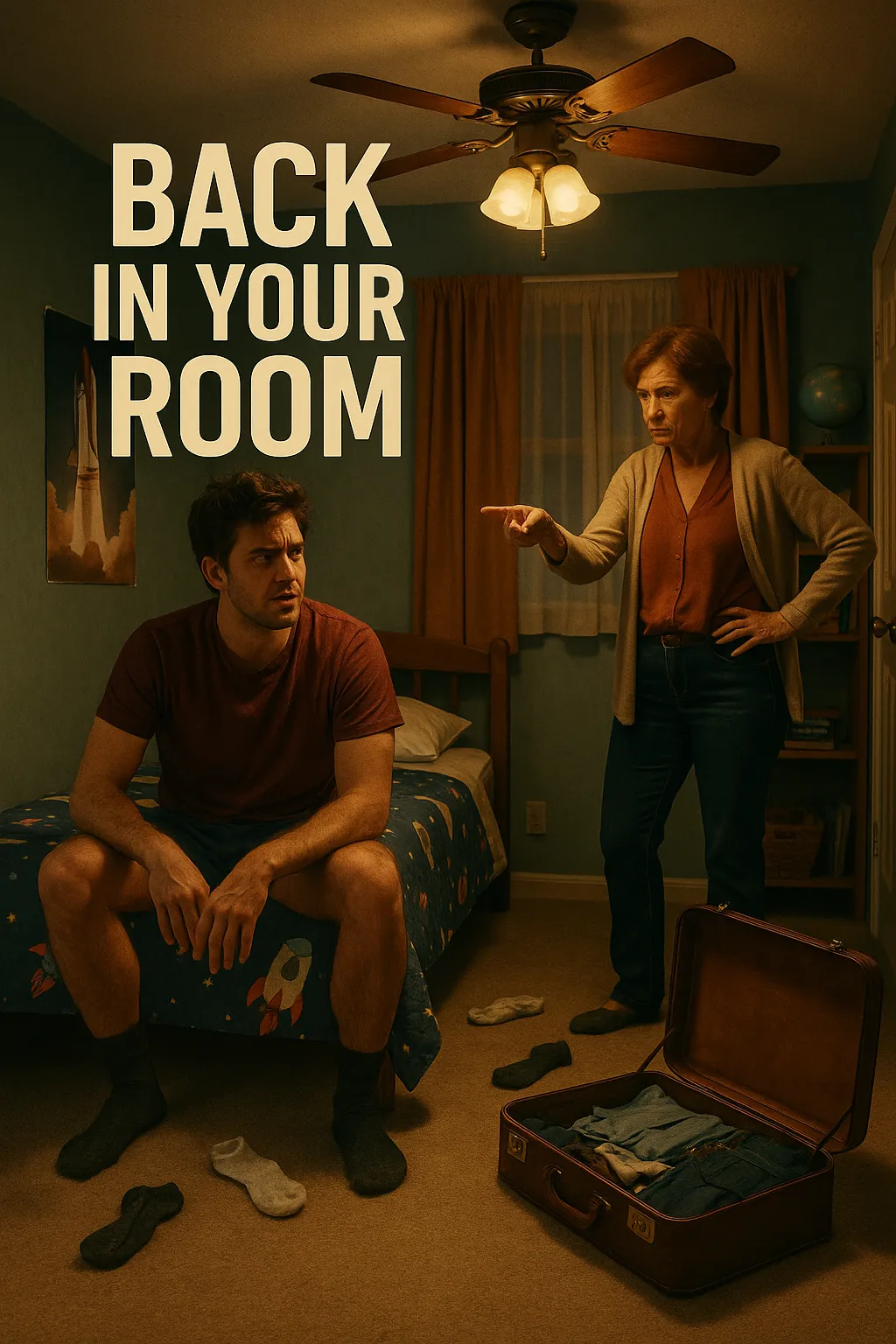
Back in Your Room
The ceiling fan had a wobble. It had always had a wobble — a lazy, ticking asymmetry that Jamie had once convinced a thirteen-year-old version of themselves was the sound of the house breathing. Twenty-five years later, lying on a single mattress with a rocket ship duvet cover that nobody had thought to replace, the wobble was just a wobble.
Jamie stared at it for three seconds, then reached for the phone on the carpet. 6:47 AM. A text from the estate agent, sent at 11:53 the previous night: 'Hi Jamie, just to confirm the deposit won't be refundable as per clause 4.2. Happy to discuss!' The exclamation mark was doing a lot of heavy lifting.
From downstairs, the kettle clicked off. Then cupboards. Then Radio 4, low enough to be deniable.
Jamie swung both legs off the bed and a foot caught the open suitcase on the floor, scattering socks and a phone charger across the carpet. The charger cord reached just far enough to the outlet behind the old desk — the one with 'MR. BUNGLE RULES' scratched into the underside, a secret that had survived three coats of paint and one parental inspection.
The desk was too small now.
Jamie pulled on yesterday's jeans and went downstairs.
The kitchen was warm and smelled like toast. Linda stood at the counter in a quilted dressing gown, spreading butter with surgical precision. Three places were set at the table. Three mugs. Three side plates. She'd been awake since five — which meant the dishwasher had already been run, which meant the downstairs bathroom had fresh towels, which meant the house was already running on her schedule.
"Oh! You're up. I wasn't sure if you'd want — I did a full pot, it's just there. The milk's the green top, I remembered you said you were doing — is it oat now? I got oat as well, it's in the fridge door."
Jamie sat down in what had apparently become their chair again. Third from the left. Same as 1998.
She said this with a small, practised smile that covered something Jamie couldn't quite read.
Through the kitchen window, Roy was standing at the far end of the garden in his slippers, looking at the tap on the side of the house. Just standing there. Not fixing it, not turning it. Just looking at it like he was trying to remember what he'd come out for.
Linda followed Jamie's gaze, then moved to block the sightline with her body, reaching up to a shelf for the marmalade that was already on the table.
"He's checking the pressure. We've had a thing with the pressure."
The back door opened. Roy came in, wiping his hands on his trousers even though they were dry. He looked at Jamie, then at the three place settings, and something moved across his face — not surprise, exactly. More like a recalibration.
"Right. You're here then."
"I'm here then."
He stopped. His hand went to the back of his neck. He looked at the toast.
"Anyway. Is that the last of the marmalade?"
She was already moving.
Jamie drank the tea. It was perfect — strong, not too much milk, the exact way Linda had always made it. The mug said 'World's Best Dad' in faded letters. Nobody mentioned it.
Jamie set the mug down. The 'World's Best Dad' lettering faced Roy, who either hadn't noticed or had decided not to.
"So what was the thing with the tap?"
Roy's knife stopped mid-scrape on his toast. Not a freeze — more like a skip, a record needle catching before it found the groove again.
"What thing."
"You were out there for a while. Mum said there's been a pressure issue?"
Linda's hand found the dishcloth on the counter. She folded it into quarters, then thirds, then quarters again.
"There is a pressure issue. The mains feed comes in through the — it runs along the..."
He trailed off. His eyes went to the window, to the garden, to the spot where he'd been standing. Linda filled the silence before it could settle.
"He's been onto the water board about it. Haven't you, Roy. They're sending someone."
"I don't need you to — I'm perfectly capable of explaining a tap, Linda."
The sharpness landed. Linda smoothed the dishcloth flat on the counter and left it there, turning to the sink where nothing needed washing.
"I could have a look at it later, if you want. I'm not doing anything."
The wrong sentence. Jamie heard it leave and wanted it back. I'm not doing anything. Thirty-eight years old, sleeping under a rocket ship duvet, and not doing anything.
"You don't know anything about plumbing."
"I've had a flat for twelve years, Dad. Flats have taps."
"Had a flat."
It sat there between them on the table, next to the butter dish and the side plates and the neat geometry of Linda's place settings. Roy didn't look up. He hadn't meant it as cruelty — Jamie could see that. Roy's hand went to the back of his neck, and he rubbed at something that wasn't there.
"I didn't mean —"
"No, you're right."
Radio 4 murmured something about rainfall projections. Linda reached across and turned it up, just slightly, giving the silence somewhere to hide.
"Jamie, there's more bread if you want it. And I was going to do a shop later — is there anything you need? For your room? I thought maybe new sheets, the ones on there are a bit —"
"The sheets are fine, Mum."
"They're from BHS. BHS closed down."
"They still work as sheets."
Roy pushed his chair back. The legs caught on the tile and stuttered, a small ugly sound. He stood, picked up his plate — then looked at it like he wasn't sure where it went. A beat. Two. Then he crossed to the dishwasher, opened it, and placed the plate on the top rack with the careful precision of someone following instructions they'd given themselves.
"I'll be in the garage."
The back door closed behind him. Not a slam. Just closed. Jamie and Linda sat in the kitchen listening to the forecast, and for a moment neither of them moved. Then Linda picked up Roy's mug — still half full — and poured the tea down the sink.
"He gets up too early. He's tired by nine."
She said it to the sink. Jamie watched her rinse the mug, dry it, and place it back in the cupboard — not in the drying rack, but away, as though it had never been used. As though three had always been two.
Jamie crossed the kitchen and went out the back door. Linda said something about the shop — Tesco or Sainsbury's, did it matter — but the door was already closing.
The garage side door was ajar. Jamie pushed it open and stepped onto concrete that was cold through socks. No shoes. Hadn't thought about shoes.
Roy was at the workbench with a pipe fitting in one hand and a catalogue open in front of him. Not frozen this time — moving, busy, turning the fitting over and checking it against something on the page. But the page was wrong. Jamie could see from the doorway that the catalogue was open to bathroom taps, and the fitting in Roy's hand was for a compression joint. Fifteen millimetre. The kind that connected to the mains.
"Shut the door. You're letting the cold in."
Jamie shut it. The garage tightened around them — workbench along the back wall, pegboard above it with tool outlines drawn in marker. Roy didn't look up.
"Mum's doing a shop. She wanted to know if you need anything."
"She knows what I need. She does the list."
Jamie leaned against the door frame and a shelf bracket dug into one shoulder blade. The silence had a texture out here — no Radio 4, no kettle, just the strip light buzzing and Roy's thumb moving across the catalogue page like he was reading braille.
"What's the fitting for?"
"The tap."
"I thought the water board was coming."
Roy's thumb stopped on the page. He set the fitting down and lined it up with the edge of the catalogue, precise, deliberate, the way he used to line up his knife and fork when he was deciding whether to say something.
"Your mother tells people things so they'll stop asking. You know that."
Jamie did know that. Had known it since age fourteen, when Linda told the neighbours Jamie had glandular fever rather than explain the two-week suspension.
"So what's actually wrong with it?"
"The isolator valve's seized. Probably limescale. I need to cut the supply, swap the valve, reconnect. Twenty-minute job."
He said it fluently, all of it, no gaps. Jamie felt the relief before recognising it as relief — Dad knows this, Dad's fine, the tap thing was just a moment — and then felt ashamed of needing it so badly.
"Problem is the stopcock's round the side and the cover's rusted shut. I need someone to hold the pipe steady while I solder. That's a two-person job. Nothing to do with —"
He picked the fitting up again. Put it down. Picked it up.
"I was going to ask Dennis next door but his knees are gone."
"I can hold a pipe, Dad."
"You'll need proper shoes. And not that — whatever that is you're wearing. There's overalls on the hook."
Jamie looked where Roy pointed. A set of navy overalls hung from a peg near the door, stiff with age. Below them, a pair of steel-capped boots that Jamie recognised with a lurch — the ones Roy had bought for Jamie's first summer job, the warehouse placement that lasted six days before Jamie quit to go to a festival.
"You kept these?"
"They're good boots. Barely worn."
Jamie pulled the boots out from under the bench. They fit. Of course they fit — feet don't change at eighteen. The leather was cold and the laces were stiff but they fit, and Roy glanced over just long enough to check before turning back to the catalogue.
"Right. The stopcock cover — I'll need the breaker bar. It's on the — it should be on the..."
His eyes went to the pegboard. Scanned left. Scanned right. The breaker bar outline was there, drawn in black marker, but the hook was empty. Roy's jaw tightened and he gripped the edge of the workbench with both hands, just for a second, before letting go.
"This one?"
It was on the shelf behind the door, half-buried under a rag. Jamie held it up. Roy stared at it like it had betrayed him.
"That's not where it goes."
"No."
Roy took it. Hung it on its hook. Took it down again and weighed it in his hand, testing the balance the way he tested everything — as if tools had opinions and you had to earn them.
"Your room. I should've — your mother wanted to change it. After you went to London. Make it into a — she had ideas. Fabric samples. The whole bit."
"Why didn't you?"
Roy turned the breaker bar over in his hands. The strip light caught the chrome and threw a line of light across the pegboard, across all those careful outlines, every tool accounted for.
"Didn't see the point. You'd have come back and had nowhere to sleep."
Jamie opened their mouth. Closed it. Twenty years ago Roy had decided this would happen — not the failure, not the blown-up lease and the non-refundable deposit, but the return. The room had been waiting because Roy had kept it waiting.
"Dad —"
"Right. Stopcock's round the left side of the house. You carry the toolbox, I'll get the torch. And don't drag it — that's a Stanley, not a suitcase."
He pulled a pencil stub from behind his ear and marked something on the catalogue page — a part number, circled twice. Then he tucked the pencil back and headed for the side door, breaker bar over one shoulder, moving like a man who knew exactly where he was going.
Jamie picked up the toolbox. It was heavier than expected. The steel-capped boots were warm now.
The boots were loud on the kitchen floor — steel caps on tile, announcing everything. Jamie stood in the doorway in Roy's old overalls and the boots that still fit, and Linda looked up from the table where she was writing a shopping list with a pen that was already dying, its ink ghosting to nothing mid-word.
"Oh good, you can tell me if you want anything from — I'm doing Sainsbury's, I think. Or Tesco. Tesco's got the parking."
"The water board's not coming, is it."
Linda's hand went to the tea towel draped over her shoulder. She folded it lengthways, smoothed it flat on the counter, folded it again.
"I don't know what your father's been — he gets ideas about things, Jamie. The pressure has been funny. I'm not making it up."
"He told me. Seized isolator valve. Limescale. He knew the whole repair off the top of his head."
Linda set the tea towel down and pressed both palms flat on the table, either side of the shopping list.
"Well. Good. Then he doesn't need the water board, does he."
"That's not what I'm asking."
"What are you asking."
"He couldn't find the breaker bar. It was on the shelf behind the door and he couldn't — he stood there looking at the pegboard like he'd never seen his own garage. And last night, with the catalogue, he had it open to the wrong page. Bathroom taps. He needed a compression fitting and he was looking at bathroom taps."
Linda picked up the pen and pressed it to the corner of the list. The nib left a dry crease in the paper, nothing more. She kept pressing.
"He's seventy-one, Jamie. People misplace things."
"He called you Margaret."
The pen stopped. Linda's face did something complicated — a flinch that started at the mouth and moved nowhere, held in place by years of practice. She put the pen down carefully, parallel to the edge of the list.
"When."
"In the garage. Just now. He said 'Margaret, where's the — ' and then he caught himself and said my name instead. Like he was switching channels."
Linda sat very still. Then something in her face let go — not into tears, not into confession. Into exhaustion.
"It's not all the time. Some days he's completely — you wouldn't know. Last Thursday he rewired a plug and explained the whole thing to me, live and neutral and earth, like I hadn't heard it four hundred times. Sharp as anything. And then Friday he put his reading glasses in the fridge and couldn't remember the word for 'letterbox.'"
"How long."
"Eighteen months. Maybe longer. I didn't — it started small. He'd lose a word here and there. Everybody does that. I do that. Then it was the names. Then it was the routes — he drove to Halfords last March and ended up in the retail park in Didcot. Sat in the car park for forty minutes before he rang me."
Jamie pulled out a chair and sat down. The legs caught on the tile.
"Has he seen anyone? A doctor?"
"He won't go. I've tried. I've — you don't try with your father, Jamie, you just hit the wall at different speeds."
"You should have told me."
"Told you what? Ring up my son who's just lost his flat and his — ring you up and say, hello love, your father's forgetting things, could you add that to the list?"
She wiped the clean counter by the kettle. Long, slow strokes, the cloth moving over nothing.
"You had enough on your plate."
"Is that why you said I could come home."
The cloth stopped mid-stroke. Linda didn't turn around. The kitchen was very quiet — no Radio 4 now, someone had turned it off and Jamie couldn't remember when.
"You needed somewhere to stay."
"Mum."
"You needed somewhere to stay. And I needed — I can't do the stopcock on my own. I can't do any of the — he goes out to the garage and I don't know if he's fixing something or if he's just sitting there. I check on him. I pretend I'm bringing him tea and I check. Every time."
"Every time."
"Three, four times a day. And he knows. He knows I'm checking and he hates it and I hate it and we just — we do this, Jamie. Every day. We do this."
She turned around. Her eyes were dry but her mouth was set in a way Jamie had never seen — not upset, not brave. Tired in a way that went past sleeping.
"You could've just asked me to come home. You didn't have to wait for me to fall apart first."
"I didn't ask. You rang me. You rang me at eleven o'clock on a Tuesday and said you'd lost the deposit and I said come home, and yes, Jamie, part of that was — yes. But I would have said it anyway. I would have said it if your father was running marathons. You're my son. You rang. I said come home."
Jamie looked at the three place settings still on the table from breakfast. The 'World's Best Dad' mug was back in the cupboard. Two mugs in the drying rack. One put away.
"I'll help with the stopcock. And I'll — I'm here now. Whatever that's worth."
Linda opened the drawer by the fridge — the one that stuck, that had always stuck — and found a working pen. She didn't go back to the list. She stood there holding it, looking at the shopping list full of dry creases and invisible words, and then she put the pen in her cardigan pocket and left the drawer open.
"He likes the Hobnobs with the dark chocolate. Not the milk. He'll say either but he means the dark."
From the garage, the sound of Roy's breaker bar ringing against something metal — testing, measuring, making sure it still worked the way it was supposed to. Jamie listened until it stopped, then stood and tried to cross the kitchen quietly. The steel caps made it impossible.
Linda left for the shops at half ten. The house made different sounds without her in it — the fridge humming, the boiler ticking through its cycle, the garage silent for once. Roy hadn't come back inside.
Jamie sat at the kitchen table with a cold mug of tea and a phone almost dead. The search bar was already open. Jamie typed 'early signs memory loss' with one thumb and hit return.
The NHS page loaded in fragments. Difficulty following conversations. Losing track of familiar routes. Confusion about time and place. Repeating questions. Misplacing objects and being unable to retrace steps. Changes in mood or personality, particularly frustration or withdrawal.
Jamie opened the notes app and typed a list. Halfords — Didcot. Breaker bar. Wrong catalogue page. Margaret. The word 'letterbox.' Then locked the phone and set it face down on the table.
The back door opened. Roy came in smelling of WD-40 and cold air, and went straight to the sink to wash his hands. He dried them on his trousers, looked at the kettle, and switched it on without asking if Jamie wanted one.
"She's gone Sainsbury's. She always goes Sainsbury's. Says she's deciding between that and Tesco but it's been Sainsbury's for eleven years."
He got two mugs down and dropped a teabag in each. His hands were steady. He looked like himself — competent, unhurried, a man who knew where things were.
"What were you reading."
"Nothing. News."
Roy poured the water. Brought both mugs to the table and sat down across from Jamie, in Linda's chair. He never sat in Linda's chair.
"I know what she told you."
Jamie said nothing.
"I know what she does. The tea. Three, four times a day, like I can't hear her coming across the gravel. I know what it looks like. I know what you were looking up just now because I've looked it up too, Jamie. I'm not — I know what's happening."
He placed both hands flat on the table, either side of his mug.
"Dad —"
"Don't. I'm saying something."
Jamie closed their mouth.
"Some days I'm fine. Better than fine. I could strip that whole tap assembly down and rebuild it left-handed. Other days I stand in a room and I don't know what the room is for. Not what I came in for — what the room is for. Like someone took the label off it."
His hand went to the back of his neck. Then he caught it, brought it back down, wrapped it around the mug instead.
"Your mother thinks if she manages it hard enough it won't get worse. That's how she does everything. Manage it, schedule it, write it on a list. And I let her because it means neither of us has to say what it actually is."
"What is it, Dad."
"I don't know. That's the point. I don't know and I won't know until someone who isn't your mother or a search engine tells me."
He looked at Jamie. The look held.
"I'll go. To the doctor. I'll go if you take me."
"Yeah. Okay. Yeah, I'll take you."
"Not your mother. She'll talk for me. She'll sit there and list every bloody thing I've forgotten since last Easter and I'll be sat there like a — no. You. You just sit there. That's all I need."
"I can do that."
Roy nodded once. He picked up his tea, drank it, and set the mug down with the handle turned away — a small, finished gesture, like closing a ledger.
"Right. That stopcock's not going to shift itself. You still got those boots on?"
"Yeah."
"Good. Bring the toolbox. And the torch — the big one, not the wind-up thing she got from the Lakeland catalogue."
He stood and went out through the back door, leaving it open behind him. Jamie sat for a moment in the kitchen, in Linda's chair, across from the empty seat where Roy had just asked his child for something he couldn't ask his wife. Then Jamie picked up both mugs, rinsed them, and left them in the drying rack.
The boots were loud on the path outside. Roy was already crouched by the side of the house, breaker bar in hand, waiting. He didn't look up when Jamie arrived. He just pointed at the rusted cover and said —
"Hold that steady. Don't let it twist."
Jamie knelt on the cold ground and held the pipe with both hands. Roy fitted the breaker bar to the stopcock cover and leaned his weight into it. For a long moment nothing moved. Then the rust gave way with a crack that echoed off the side of the house, and Roy let out a breath that sounded like he'd been holding it for longer than the bolt.
The cover was off. Roy shone the torch into the cavity and grunted — satisfied or unsatisfied, impossible to tell. He reached in and worked the old valve back and forth, testing its resistance, then pulled it free and held it up to the light. Limescale had furred the inside nearly shut.
"There's your problem. Eighteen months of that building up. Maybe longer."
He set the old valve on the ground beside him and reached into his coat pocket. Out came a new valve — the right size, fifteen millimetre compression — still in its packaging. He'd had it ready. Jamie watched him tear the plastic with his teeth and hold the new fitting next to the old one, checking the match.
"When did you buy that?"
"Last week. Screwfix. Click and collect."
He fitted the new valve into the cavity and gestured for Jamie to hold the pipe steady again. Jamie shifted their weight on the cold ground and gripped the copper.
"Mum told me about Didcot."
Roy's hands kept moving. He didn't look up. The spanner turned a quarter rotation, then another, precise and unhurried.
"Course she did."
"She said you sat in the car park for forty minutes."
"Thirty-five. She rounds up."
He leaned into the spanner. The valve seated with a faint click.
"The A4130. I've driven it a hundred times. Halfords is off the retail park, you come off the bypass, it's right there. I've bought light bulbs from that Halfords. I've bought wiper blades. I've had arguments with a sixteen-year-old about brake fluid in that Halfords."
"What happened?"
"I got to the roundabout and I didn't know which exit. Not like — not like when you hesitate and then it comes back. It wasn't there. The whole route just... I was looking at the signs and they were just words. Like reading a word you've seen a thousand times and suddenly it's just shapes."
He stopped turning the spanner. Held it still against the fitting, both hands wrapped around the handle, knuckles pale.
"So I took the wrong one. Ended up in Didcot. Pulled into the first car park I saw and sat there with the engine running because I thought if I turned it off I might not remember how to start it again."
"Jesus, Dad."
"I rang your mother after a bit. Told her the traffic was bad. She came and got me. Drove my car back. Neither of us said anything about it for three days and then she hid the spare keys and I pretended not to notice."
He went back to the valve. Quarter turn. Quarter turn. His hands knew this.
"Has it happened again? The driving?"
"I don't drive anymore. Not since March. Your mother does the driving and I do the — I sit there and I tell her she's in the wrong lane and she lets me because it means I'm still..."
He trailed off. This time he didn't reach for his neck. He just let the sentence go, like setting something down that was too heavy, and after a moment he picked up the torch and angled it deeper into the cavity.
"Hand me the PTFE tape. It's in the toolbox, yellow lid."
Jamie found it and passed it over. Their hands were close in the dark space, both working around the same pipe. Roy wound the tape around the thread — six wraps, even tension, no overlap. He'd done this a thousand times.
"Last month I put a saucepan on the hob and went to watch the news. Your mother found it dry and smoking. I told her I'd been distracted. Week before that I couldn't remember Dennis's surname. Next door Dennis. Forty years. Stood in the kitchen trying to — and it was just behind glass. Right there but I couldn't get to it."
He said it without being asked, feeding it out between turns of the spanner the way information sometimes loosens when hands are busy. Jamie held the pipe and said nothing.
"Patterson. His name's Dennis Patterson. I know that now. I knew it the next morning. But the gap — that's the thing. The gap is getting longer."
Roy tightened the final connection and sat back on his heels. He looked at the new valve, then at the old one on the ground with its furred insides, and put the spanner back in the toolbox himself — in the correct slot, without looking.
"Turn it on."
Jamie reached in and opened the stopcock. Water moved through the pipe under their hand — a low hum that travelled up through the copper and into the wall of the house. Roy cocked his head, listening, then nodded once.
"No leak. Twenty-minute job. Would've been fifteen if the cover wasn't rusted to hell."
He started packing the toolbox. Old valve, tape, torch, spanner — each piece returned to its place. Jamie stood and brushed the dirt off the overalls. Roy stayed crouched for a moment, one hand resting on the closed toolbox lid, looking at the pipe as if checking it would hold.
"Dad. The doctor. Do you want me to ring, or do you want to do it?"
"You ring. If I ring I'll have to explain it to the receptionist and she'll put me on hold and by the time someone picks up I'll have talked myself out of it."
"I'll ring tomorrow morning."
Roy nodded. He stood — slowly, one hand on the wall — and Jamie offered a hand. Roy took it. His grip was strong. He held on, then let go and brushed the dirt off his trousers.
From inside the house, the sound of the front door and a rustle of carrier bags. Linda was back. Roy picked up the toolbox before Jamie could reach for it and walked toward the garage, the old valve still in his other hand. At the corner of the house he stopped.
"Don't tell her I told you about Didcot. She thinks she's the only one who worries and I'd like to leave her that."
He went into the garage. Jamie stood by the open stopcock cavity, listening to the water hum through the wall, and then went inside to help Linda with the shopping.
Linda was unpacking the shopping when Jamie came in from the side of the house. The overalls caught on the drawer handle by the door — the one that had always stuck out too far — and Jamie had to stop and unhook the fabric before stepping through.
"There's a Hobnob situation. They only had milk chocolate so I got both and he can have whichever he wants."
She was putting tins away in the cupboard above the kettle, standing on the balls of her feet to reach the back shelf. Jamie took the remaining tins from the bag and stacked them beside her — labels out, without thinking about it.
"Kettle's not long boiled if anyone wants one."
Jamie flicked the kettle back on and got three mugs down. Roy's got the strong one, bag left in. Linda's got the splash of milk first, teabag dunked twice and removed. Jamie got whatever was left.
Roy came in from the garage while the tea was still steeping. He'd changed out of his work shirt into a jumper Jamie didn't recognise — newer, something Linda must have bought him. He looked at the three mugs on the counter and said nothing about them. He picked his up and took it to the table.
"Tap's done. New valve's in. No leak."
"Oh, lovely. Was it the — what was it, the pressure thing?"
"Seized isolator valve. Limescale."
He said it clearly, looking at her. Linda folded an empty carrier bag into a neat triangle and put it in the drawer with the others.
"Well. Good. I'll cancel the water board then."
A small silence. Roy drank his tea. Linda wiped her hands on her trousers even though they were dry, and sat down across from him. Jamie brought the other two mugs to the table and took the third chair — the one by the window that had always been Jamie's, the one with the scratch on the left arm from a fork, aged seven, cause unknown, punishment swift.
"Jamie helped. Held the pipe while I soldered. Good hands."
Jamie looked at Roy. Roy looked at his tea. The compliment sat in the kitchen like something that had been delivered to the wrong address but was staying anyway.
"Right. What does everyone want for tea tonight. And don't say anything because I've already bought mince."
"Spag bol."
"Jamie?"
"Spag bol's good."
"Spag bol it is. Your father does the garlic bread, I do the rest. That's the system. Don't interfere with the system."
Roy's mouth moved — not quite a smile, but the architecture of one. He looked out through the kitchen window at the garden, where the tap stood at the end of the path, fixed now, connected to pipes that ran through the wall to a valve he'd fitted himself. He looked at it for a long time.
"I'll ring the GP tomorrow morning. Get an appointment."
Jamie said it to the table, to no one in particular. Linda's hands went still on her mug. Roy set his tea down.
"After your tea."
"After my tea. Tomorrow. Yeah."
Linda looked from Jamie to Roy. Roy didn't look back at her, but he moved his hand across the table — not far, an inch or two — and left it there, palm down, beside the dark chocolate Hobnobs she'd bought even though they only had milk. She'd bought both. She always bought both.
Outside, it had started to rain. The kind of fine rain that doesn't look like much through the window but soaks everything it touches. It ran down the glass and pooled on the sill and none of them got up to close the window.
Three mugs on the table, going cold.