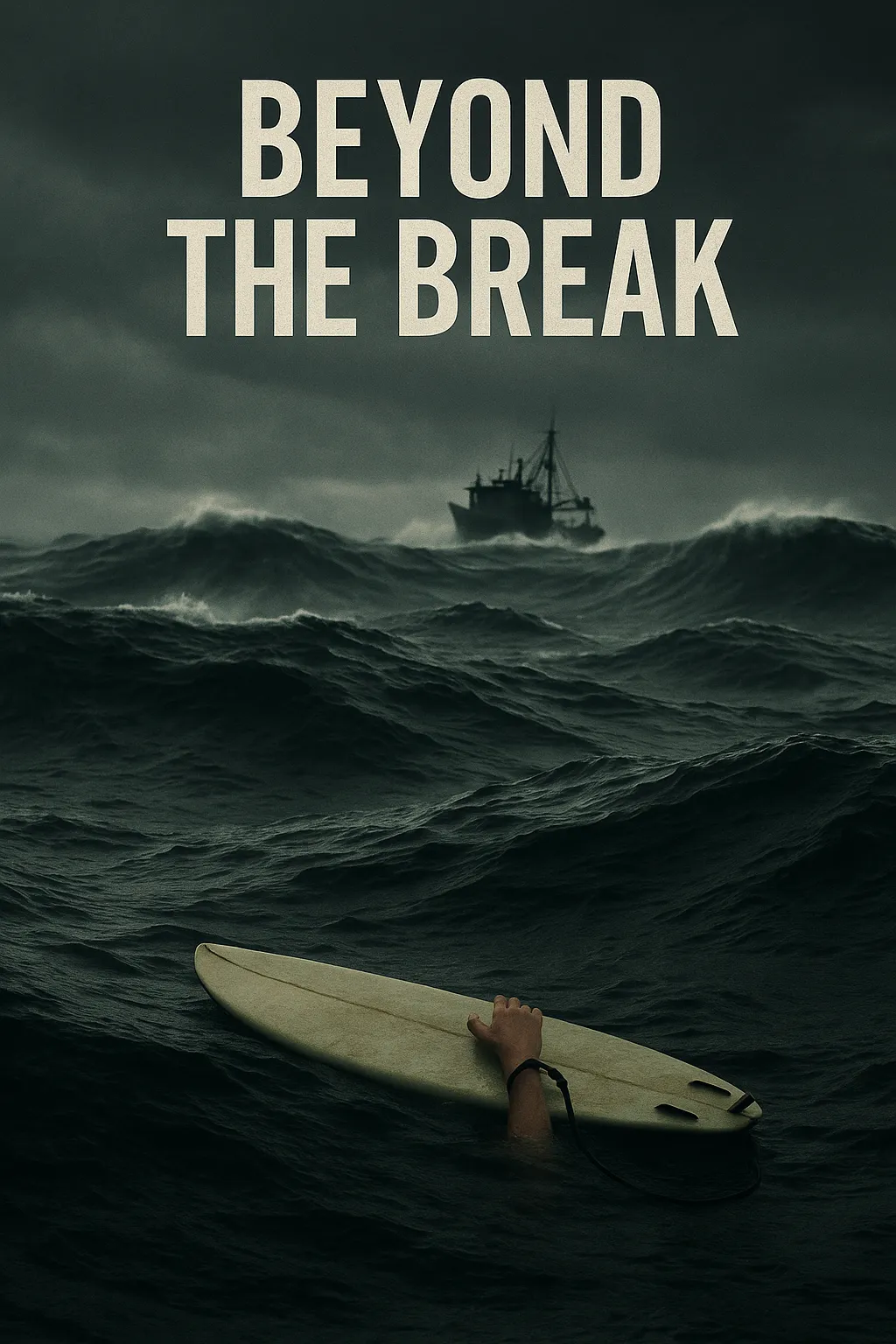
Beyond the Break
The rip had him before he knew it. One moment Matt was sitting on his board watching a set roll through, the next the water under him was moving like a conveyor belt and the beach was pulling away like someone had yanked the carpet. He paddled across it — textbook, angle left, don't fight the current — but the channel was wide and fast and the sets kept breaking on his head and by the time he punched through the impact zone he was already past the reef.
Now he sat on his board in open ocean and the shore was a smudge.
Three-metre swell. He'd ride up a face and at the top he could see Gerringong headland, the white strip of Werri Beach, the car park where he'd left the Hilux with the windows down. Then the swell would pass under him and he'd sink into a trough and there was nothing but grey-green walls of water on every side.
His legs dangled in water that was maybe sixteen degrees. Not cold enough to kill him fast. Cold enough to take pieces — coordination first, then grip strength, then the ability to kick properly. He'd been a surf lifesaver at Cronulla for three summers. He knew the math. Forty minutes in this temperature before his swimming became useless. He'd already been out here for what felt like ten.
He kept the board. That was the one good decision he'd made. His arms were draped over it and it held his chest out of the water and that was maybe a thousand calories an hour he wasn't spending treading.
On the next rise he saw the boat. A centre console, white hull, maybe five hundred metres south and inside the reef line. Two figures on it. One was pointing at him.
Matt raised one arm and waved it in a wide arc, slow and deliberate. Not a greeting. The international signal for I am in the shit.
His voice went nowhere. The wind took it and the swell swallowed it and the boat was too far. But they'd seen him. The figure was still pointing.
On the boat, Dave had one hand on the wheel and the other shading his eyes. The surfer was outside the reef, sitting on his board, rising and dropping with the sets. Two kilometres out, easy. Maybe more. The reef between them was a minefield of brown water and white explosions — shallow bombora that would gut a hull in seconds.
Steve was behind him, one hand on the radio, the other braced against the gunwale.
Yeah.
Dave didn't say the other part. Ten minutes ago he'd clipped something on the way out of Kiama harbour — a thud through the hull that Steve had written off as chop. Dave had checked the bilge since. There was water in it. Not a lot. Enough that it shouldn't be there.
To reach the surfer he'd have to go south around the reef, out through the heads, then north in open water. A kilometre and a half in this swell, maybe twenty minutes if the boat held together. If.
Steve had the VHF to his mouth, working channel 16.
Static. Then static. Then a woman's voice from Marine Rescue Kiama, calm and procedural, asking them to confirm position.
On the beach, Jenny had the binoculars pressed so hard against her face they'd leave marks. She could see the board. She could see Matt's arms over it. She could see the fishing boat sitting inside the reef doing nothing, and she didn't understand why they were just sitting there.
Her phone was in her other hand. Triple zero. She'd been on hold for ninety seconds. It felt like her whole life.
Matt hauled the board out from under his chest. It was heavier than it should have been, or his arms were weaker — same result. He got the nose up and swung it overhead, left then right, the distress signal he'd practised on flat sand at Cronulla with a foam rescue board that weighed nothing.
The leash yanked his ankle sideways. The board caught wind and torqued and his left hand opened — just opened, like it had quit on him — and the board was gone, spinning flat across the surface of the trough.
He lunged. Got the leash with his right hand, hauled it back, dragged the board against his chest and held it there while the next swell lifted him six metres and his heart hammered in his ears.
He didn't try again.
From the top of the swell he could see the boat. White hull, two figures. It hadn't moved. The reef stretched between them and the boat sat on the other side of it, engine idling or engines off, he couldn't tell. One of the figures had an arm raised.
Then the trough took him and they were gone.
On the Doris May, Steve lowered the binoculars.
He just waved his board. He's signalling.
Dave ran his tongue along his bottom lip.
Marine Rescue said thirty-five minutes for the Kiama boat.
Steve put the handset down on the console. Neither of them spoke.
Under Dave's feet, the bilge pump kicked on. He felt it through the deck — that low electrical hum that meant the automatic float switch had tripped. Steve looked at the deck, then at Dave.
What's that.
Bit of spray.
Steve held his eyes for a second. Then he picked up the handset again and turned back to the radio.
On Werri Beach, Jenny got through. She was already talking before the operator finished the greeting — surfer, rip, two kilometres out, there's a boat but it's not going to him, please, she said, please. The operator asked her to slow down. Jenny pressed the phone against her cheek until the screen went hot against her skin.
Through the binoculars she'd seen Matt lift the board. She'd seen it spin away from him. She'd seen him grab it back. She didn't know what any of it meant except that he was still moving.
In the water, Matt got his breathing under control. His left hand was tingling — pins and needles from the wrist down, grip strength maybe sixty percent of what it was ten minutes ago. His legs felt thick and slow in the cold. The board held him and the current held the board and both of them drifted northeast, away from the reef, away from the boat, away from anything solid.
He could swim. He could pick a direction and paddle and burn whatever he had left. Or he could stay on the board and conserve and hope thirty-five minutes was a number someone on that boat had heard from someone who was coming.
The swell lifted him. The boat was still there. The arm was still raised.
Matt let go of the board with both hands. He pushed himself up so his torso was free and the board rocked under his hips and he raised both arms overhead, crossing them, uncrossing them.
The cramp hit his left forearm like a fist closing inside the muscle and his hand curled into a claw and stayed there. He brought it down against his chest and the board tipped and he went sideways into the water — face, mouth, salt — and came up coughing with one arm hooked over the rail and his legs kicking at nothing.
He got back on. It took a long time. His left hand wouldn't flatten against the wax so he used his forearm, levering his chest up, dragging one knee across the deck. He lay there with his cheek on the fibreglass and breathed.
The sound was different down here. In the troughs the wind dropped and the water made a low, hollow noise against the underside of the board — a sound like someone blowing across the mouth of a bottle. His own breathing was louder than the ocean.
On the Doris May, Steve had the handset against his ear and his free hand flat on the console. He hadn't moved in thirty seconds.
Pump's been on twice now.
Dave didn't look at the bilge hatch.
It does that in chop.
No it doesn't.
The swell rolled under them and the Doris May pitched and water sloshed in the hull — a sound like it was finding a new level. Steve looked at the deck. Dave looked at the surfer.
Dave.
We clipped something coming out of Kiama.
Steve's hand came off the console.
How bad.
Pump's handling it. For now.
For now.
Neither of them looked at the surfer. The swell lifted the bow and dropped it and the pump hummed under the deck.
If we go around the reef in this and the hull opens up, that's three blokes in the water instead of one.
Dave gripped the wheel. Out past the reef, the surfer was a dark shape on a white board, rising and falling. Twenty minutes around. Twenty minutes back. Forty minutes on a hull he wouldn't bet his dog's life on.
Marine Rescue's thirty minutes out now. Maybe twenty-five.
And if he's face down when they get here.
On Werri Beach, Jenny saw the arms go up. She saw the splash. She saw the surfer disappear behind a swell and she stopped breathing until he reappeared, flat on the board, not moving. She pressed the binoculars against her face until she could feel her own skull through the rubber eyecups.
In the water, Matt opened and closed his left hand. Three fingers responded. The pinkie and ring finger stayed curled against his palm. He tucked the hand under his chest.
The current had him. He could feel it in the way the kelp smell faded — he was moving offshore, away from the bottom, into deeper water where the temperature would drop another degree and then another. The board hummed its hollow note beneath him. He couldn't hear the boat's engine anymore.
Matt rolled off the board sideways, a controlled drop, and the cold hit him like a slap across every inch of skin at once. He went under. The ocean closed over his head and it was quiet — no wind, no swell noise, just the thick pressure of water against his eardrums and the muffled thud of his own heart.
He forced his left hand open against his thigh. Pushed the fingers straight. The cramp fought him and he held it and the cold got into the muscle and the muscle gave up before he did.
He came up gasping and grabbed the rail with both hands. Both hands worked. He hung there off the side of the board, chest heaving, and the shivering started before he'd taken his third breath.
Getting back on took everything. His wetsuit dragged and his arms shook and he ended up draped across the board. He made a fist with his left hand, pressed it hard against the wax. The pinkie curled in with the others. Not strong. But there.
On the Doris May, Steve stood at the bilge hatch. He'd pulled it open without asking. The water inside sloshed port to starboard as the swell rolled the hull — maybe two inches of it, catching light where it shouldn't be.
Steve stared at the water for a long time. Then he closed the hatch and straightened up.
Dave said nothing. His hand found the throttle and stayed there.
Marine Rescue Kiama, Doris May. Be advised, we have water ingress in the bilge from a hull strike leaving Kiama. Bilge pump cycling. We are not confident in our ability to make a long run in current conditions. Over.
Dave's hand tightened on the throttle. The VHF crackled and the woman from Marine Rescue came back — copy that, Doris May, confirm you are declaring a secondary emergency — and Steve said yes, he was, and gave their position, and Dave watched the surfer rise on a swell and disappear and rise again.
Dave let go of the throttle. His hands hung at his sides.
I told them the truth.
The pump kicked on under the deck. Third time. They both heard it and the hum ran for eight seconds and stopped.
On Werri Beach, Jenny had the phone in both hands now, thumbs white against the case. The operator had patched her to Marine Rescue and a man was telling her that a vessel was on scene and that the Kiama boat was en route and she should stay on the line. She dug her toes into the wet sand until she hit the cold underneath.
The boat's right there. Why won't they go to him.
The man on the line said something about reef conditions and vessel safety and Jenny stopped listening because through the binoculars she could see the board and Matt was on it but he wasn't sitting up anymore. He was flat. He was just flat on it.
In the water, Matt lay with his cheek on the board and watched the horizon tilt. Up. Down. The shivering had settled into his chest — not the surface shaking of cold skin but a tremor in the ribs that made his breathing stutter. He'd been a lifesaver. He knew what that meant. He made himself not know it.
A sound reached him from somewhere south. Not an engine. A horn — two short blasts, then a long one. He couldn't tell if it was the fishing boat or something further away or something his ears were inventing. The swell buried the sound, then gave it back, then buried it again.
He turned his head. The movement cost him and he lay still after it, breathing hard from turning his head. South of him, past two walls of grey water, he caught a flash of white hull. Still there. Still on the wrong side of the reef.
His board drifted. The current pulled and he let it because fighting it wasn't a choice anymore. He pressed his left fist against the wax again. The pinkie stayed. The ring finger had gone soft. He stopped testing.
Matt got the zipper with his right hand. His left was useless for this — three fingers and two of those were lying about their strength — so he reached behind his neck and found the cord and pulled. The zipper ran halfway down his back and stopped. He twisted, got it again, pulled harder. The wetsuit peeled open across his shoulders and the cold went into him like a knife between the ribs.
He worked his right arm free. Then the left, hauling the neoprene down past an elbow that didn't want to bend. The top half of the suit hung from his waist, black against the board, and his bare chest and shoulders were white in the grey light and the wind found every part of him at once.
He didn't wave it. He didn't have that in him. He pulled the right sleeve off the rest of the way and held it in his fist and let the wind take it — black neoprene snapping like a flag off the side of the board. His arm shook. He wedged his elbow against the rail and locked it there and the wetsuit sleeve whipped and cracked and he kept it up because it was the only thing he could still do.
On the Doris May, Steve had one hand braced on the centre console and the other holding the VHF handset against his thigh. The deck shifted under him — not the pitch and roll of swell, but something looser, the boat moving in a way it hadn't been moving twenty minutes ago.
Steve raised the binoculars with one hand, awkward, pressing them against his brow.
Dave didn't look. He was watching the reef to starboard, the brown water surging over the rocks twenty metres out. He had the wheel quartered into the swell and the throttle at half, running south along the reef edge, and every wave that rolled under them sent a shudder through the hull that he felt in his teeth.
Half off. He's waving it. Dave, he's waving his bloody wetsuit at us.
The pump kicked on. Fourth time. The hum ran under the deck and Dave ran his tongue along his bottom lip and he held the wheel and didn't look down. The sound lasted longer this time — ten seconds, twelve — before it cut out.
Steve put the binoculars down on the console. He stood with his feet apart, hands at his sides. When he spoke there was nothing in his voice at all.
Dave's hand was on the throttle. The reef was ending — he could see the last brown patch fifty metres ahead where the rocks dropped off into deep water. South of that was open ocean, and open ocean was where the hull would either hold or it wouldn't. Twenty minutes around. Twenty minutes back. The pump would cycle six more times, eight, ten. Or it would stop cycling because the water got above the switch and then it wouldn't matter.
I know.
Steve.
Steve picked up the handset.
Dave looked at him. Steve looked back. The VHF crackled — copy, Doris May, we strongly advise you hold position and await rescue vessel — and Steve reached over and turned the volume down.
Dave pushed the throttle forward. The Doris May surged and the bow came around south and the first open-water swell hit them on the quarter and the boat climbed it and dropped hard off the back and something in the bilge made a sound like a fist hitting fibreglass from inside.
On Werri Beach, Jenny was kneeling. She didn't remember kneeling. The sand was wet through her jeans and the wind was pulling her hair across the binoculars and she kept brushing it back. The man from Marine Rescue was still talking on the phone, which she'd put on speaker in the sand beside her knee, and his voice was small and calm and useless.
Through the binoculars she could see the fishing boat moving. It was heading south, away from Matt, and she didn't understand. She watched it pitch over a swell and disappear into a trough and come back smaller. Going the wrong way. She grabbed the phone out of the sand.
Her voice cracked on the first word and she started again.
The man said something about the reef and an alternate approach and Jenny's hand closed around the phone so hard the case flexed. She stood up. Her knees were shaking.
In the water, Matt's arm gave out. The wetsuit sleeve dropped onto the board and lay there, black and heavy with water. He couldn't pick it up again. He pulled it against his chest instead, the neoprene against his bare skin, and it was cold and useless and he pressed his face into it because it smelled like his garage.
The shivering had gone past shivering. His whole torso was seizing in waves, ribs locking, lungs stuttering, teeth clamped together so tight he could hear them. He tried to pull the wetsuit back on and got the left arm halfway into the sleeve before his hand refused to push through the cuff. He left it. Half on, half off, the suit bunched around his waist and one arm, the rest of him bare to the wind.
An engine. South. He heard it between the swells — a low, hammering note, diesel, working hard. It faded when the water rose around him and came back when it dropped and each time it came back it was louder or he needed it to be louder and he couldn't tell the difference anymore.
He didn't lift his head. He pressed his cheek against the board and listened. The engine sound broke apart in the wind and reassembled and broke apart again. His eyes were open but the salt had turned everything to smear and he closed them and the dark was easier.
On the Doris May, the swell was bigger outside the reef. Three metres, maybe three and a half, and the boat climbed each face with the engine screaming and dropped off the back with a slam that sent water sheeting across the deck. Dave had both hands on the wheel and his feet braced wide and every slam he waited for the sound — the bad sound, the one from the bilge — and twice he heard it and kept going.
Steve was at the bow, one hand on the rail, scanning north. The spray was constant. He wiped his face with his forearm.
Dave didn't answer. He could feel it — the boat was heavier, sitting lower, the throttle response sluggish in a way that had nothing to do with the swell. The reef was behind them. Open water ahead and to the north, where the surfer was, if the surfer was still on his board, if the surfer was still anything.
Dave brought the wheel around to the northeast. The swell caught them on the beam and the Doris May rolled hard to port and hung there for a second that lasted long enough for Dave to understand what it would feel like when she didn't come back. Then she rolled upright and he corrected and the engine caught and they were running northeast into the grey.
Steve had the binoculars up and the swell lifted them and he saw it — the board, white against grey water, riding up the face of a set wave. Nobody on it.
Steve lowered the binoculars.
Dave pushed the throttle forward and the Doris May dug her stern in and the engine note changed and the water in the bilge shifted and he felt the whole boat shudder. The board was three hundred metres north. Maybe four. The swell kept hiding it.
Fifty metres left. Fifty metres left, Dave.
Dave corrected. The boat climbed a face and at the top Steve grabbed the console with both hands and pointed. The board was below them in the trough, upside down now, fin catching light. And in the water beside it, an arm. One arm hooked through the leash, the rest of Matt below the surface, hair fanning in the wash like kelp.
Dave killed the throttle. The Doris May wallowed sideways into the trough and the stern dipped and water came through the sole hatch — not a trickle, a pulse — and Dave didn't look at it.
Steve was already over the side. He went in boots and all, hit the water and went under and came up swearing, and the cold was a different thing when you chose it. He swam. Six strokes, eight, and the swell dropped him into the trough with the board and the arm and the rest of what was attached to it. Matt's face was in the water. Steve grabbed his hair and pulled his head up and Matt's mouth opened and he took a breath that sounded like tearing fabric.
His eyes didn't open. But he breathed. He breathed again.
Steve got an arm under Matt's chest and kicked toward the boat. Matt's skin was white and his lips were grey and his left hand was still tangled in the leash, three fingers locked around it — not grip, just the last shape his hand had been able to make. The wetsuit hung off him in a black tangle, one arm in, the rest dragging. Steve kicked and the swell pushed them and the Doris May was right there, low in the water, lower than she should have been, Dave leaning over the gunwale with both arms out.
They got him over the side the way you land a body — no technique, just pulling. Dave grabbed Matt's right arm and Steve pushed from the water and Matt came over the gunwale and fell onto the deck and lay in two inches of bilge water that had come up through the sole. He didn't move. His ribs were going — fast, shallow, the shivering so deep it looked like convulsions.
Steve hauled himself back over the transom and landed on his knees on the wet deck. He looked at Matt. He looked at the water coming through the sole hatch. He looked at Dave.
Dave was already at the wheel. He brought the bow around to the south and opened the throttle and the engine caught and held and the Doris May moved, heavy and wrong, the stern sitting low enough that the wash from each swell lapped over the transom.
Matt's cheek was against the deck. The fibreglass vibrated under him — engine, hull, water. Bilge water lapped against his jaw. He couldn't open his eyes and he couldn't stop shaking and he could feel the boat moving under him, the way it climbed and fell, and there were voices above him that he couldn't separate from the wind.
His right hand found the deck and his fingers spread against it. Solid. The water sloshed against his wrist and it was warmer than the ocean or his skin was colder than both. He pressed his palm flat and held it there.
On Werri Beach, Jenny saw the white hull. It was heading south, back toward Kiama, and it was lower in the water than before and there was a dark shape on the deck that she couldn't resolve through the binoculars and the distance and her own shaking hands. She started running south along the wet sand. No shoes. Phone in one hand. The binoculars swung from her neck and hit her chest with each stride and she left her bag where it was, half-buried by the tide line with a paperback splayed open in it.
On the Doris May, the bilge pump ran without stopping. Dave kept the throttle at three-quarter and watched the harbour entrance grow larger through the spray and didn't look at the water around his feet. Steve sat on the deck beside Matt with one hand on his shoulder, not talking, just keeping the hand there. Matt's shaking had settled into something rhythmic and constant. His three good fingers were still pressed against the deck.
The harbour wall came up on the port side. Dave brought her in slow, the stern dragging, and the water in the bilge was above the sole boards now and the engine coughed once and held. He could see the ambulance on the wharf. He could see people. He brought the Doris May alongside the concrete wall and cut the engine.
The paramedics came over the gunwale before the lines were even tied. Two of them, a man and a woman, and they moved with the kind of efficiency that made everything else on the boat look like it had been happening underwater. Shears through the wetsuit. A foil blanket that crackled when they wrapped it around him. An IV line into his right arm because his left hand was still curled into its last shape and nobody tried to open it.
Matt saw the sky. Grey, flat, close. He saw faces. He felt the IV go in, cold threading up his forearm, and the shears cutting through neoprene, and then he was on a stretcher and the stretcher was on the wharf and the concrete was steady under him.
Jenny came down the boat ramp at a dead sprint. She'd driven. Someone's car — she didn't remember whose or how she'd gotten the keys or which roads she'd taken. Her feet were black from the sand and the car's pedals and she pushed past a man in a high-vis vest and dropped to her knees beside the stretcher and put both hands on Matt's face and held them there.
Matt's eyes found her. His mouth moved.
She pressed her forehead against his and stayed there. The paramedic worked the IV around her and didn't ask her to move.
On the Doris May, the water was over the sole boards and climbing. Dave stood at the console with the engine off and the bilge pump still running its losing fight. Steve was on the wharf, wet clothes dripping on concrete, watching the ambulance crew load Matt. He had his hands in his pockets and his shoulders up around his ears and he hadn't said a word since they'd tied off.
Dave stepped off the boat onto the wharf. The Doris May shifted when his weight left her — a small lurch to port, the gunwale dipping to the waterline. He watched it.
The stern went first. Water came over the transom in a quiet pour and the back of the boat settled and the bow lifted and the bilge pump choked and stopped. Dave's name was on the stern in faded blue letters — DORIS MAY, KIAMA — and the letters went under one at a time. The console disappeared. The centre rod holder. The VHF aerial, last, tilting slowly until the harbour swallowed it.
A diesel rainbow spread across the surface where the boat had been.
Steve looked at Dave. Dave looked at the oil on the water.
Dave.
Dave put his hands in his pockets. His knuckles were still white from the wheel.
The ambulance doors closed. The siren started, then faded south toward Shoalhaven hospital. On the wharf, the diesel rainbow thinned and spread and the harbour water lapped against the concrete and somewhere out past the breakwall the swell was still running, three metres, grey and green, the same as it had been an hour ago.