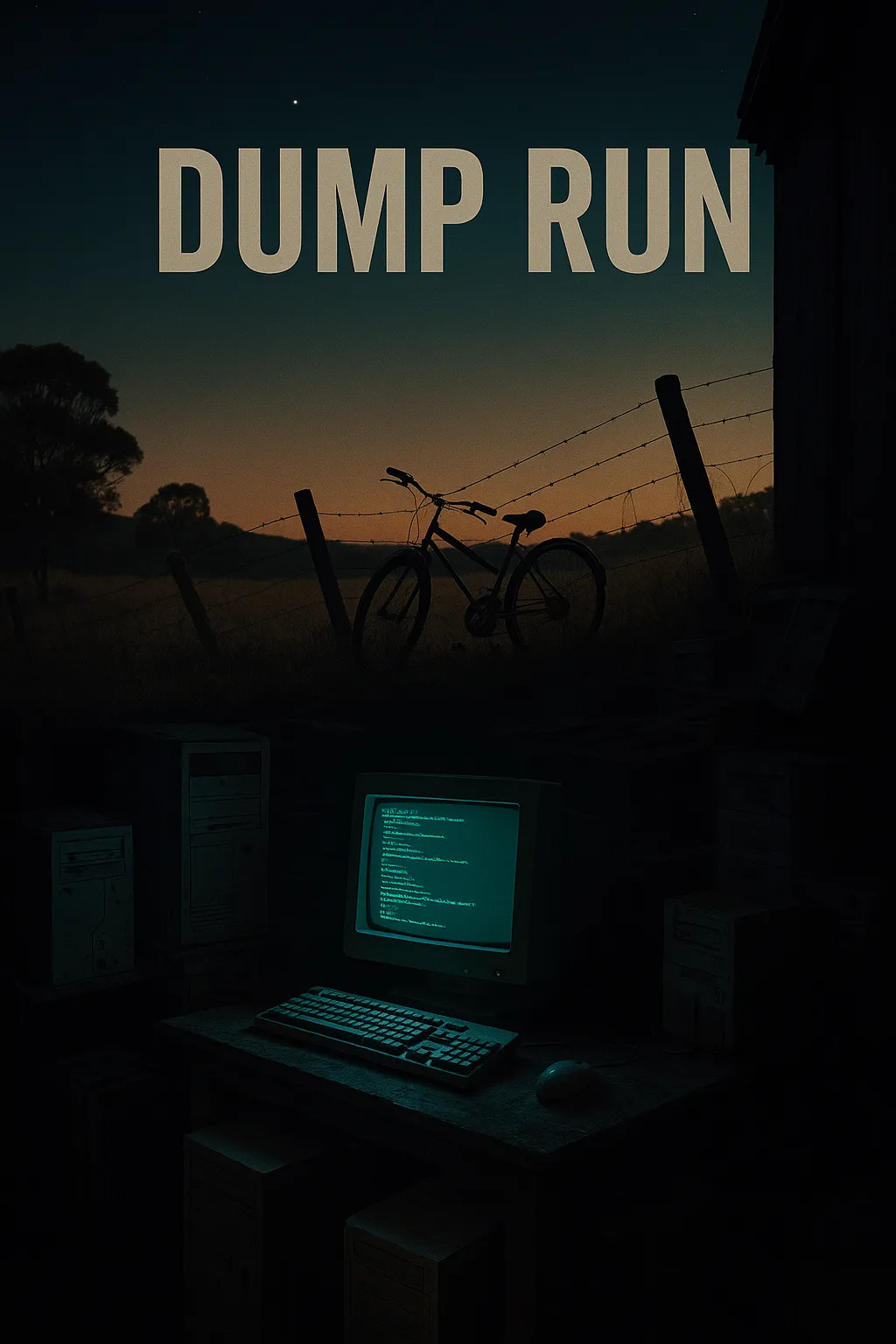
Dump Run
The Compaq had taken three weeks to get running. Matt sat in front of it now, 2am, the monitor throwing pale blue across the walls of his room. The house was silent except for the CRT's hum and the frogs going outside, hundreds of them, like they owned the valley.
Line 42. He'd been staring at it for an hour. The program was supposed to bounce a ball around the screen — that was it, that was the whole thing — and instead it just crashed. Every time. The cursor blinked on the error line.
He leaned back in the chair, a plastic garden chair because his desk chair had cracked in January. The QBasic book was open on the bed behind him, spine broken at chapter six. He'd found it at the Salvos in Berry, sandwiched between a Tom Clancy and a book about feng shui. Two dollars.
He read the error again. ILLEGAL FUNCTION CALL. He read line 42 again. He read the book's example again. They looked the same to him. They were not the same.
The door opened. Lisa stood there in her nightie, squinting against the monitor light.
Mum says turn it off.
Tell her I'm almost done.
She said you'd say that. She said tell you the power bill came.
Matt looked at the screen. Lisa was twelve and unimpressed.
Five minutes.
Lisa left the door open. The cold poured in from the hallway and Matt got up to close it and when he sat back down he looked at line 42 and saw the semicolon.
A semicolon where a comma should be. That was it. The whole time.
He fixed it. He ran the program. A white ball bounced across a black screen, rebounding off the edges in clean straight lines. It was ugly and simple and he had made it from nothing.
Lisa was still in the hallway. He could hear her getting water in the kitchen.
She appeared in the doorway with a glass of water, watched the ball bounce for about four seconds.
Cool.
She padded back down the hall. Her door closed. Matt turned back to the screen and watched the ball bounce. He watched it for a long time.
He saved the file. He turned off the monitor but left the tower running because it sometimes wouldn't boot again if he shut it down completely. The fan clicked and whirred in the dark. He pulled the blanket off his bed and slept in the garden chair because he didn't want to leave the room.
The tip was a twenty-minute ride on the bike, most of it downhill going and all of it uphill coming back. Matt had a backpack and two bungee cords and the morning was already warm enough that his shirt stuck to him by the time he leaned the bike against the cyclone wire fence — the kind that had given up being straight years ago and now just suggested a boundary.
Dave's ute was parked by the shed with both doors open, ABC radio going. Matt could see him in the sorting area, tossing things into skips with the steady rhythm of a man who'd done the same job so long his body didn't consult him about it anymore.
Dave looked up. He wore the same hat he always wore, canvas with a faded unit patch on it that Matt had never asked about.
Yeah?
Dave jerked his thumb toward the shed.
The shed was corrugated iron and smelled like dust and old oil. In the back corner, set apart from the general wreckage, sat two grey towers side by side on a pallet. One had ACCOUNTS written on it in faded texta. The other was unmarked, smaller, with a CD drive — an actual CD drive — in the front panel.
Matt crouched in front of them. He pressed the power button on the unmarked one. No mains in the shed.
These are Pentiums.
That good or bad?
That's good. That's really good.
Dave poured tea from a thermos into the cap and drank it standing.
You know what you're actually doing with all this? Or you just collecting?
Matt looked up from the back of the tower.
Dave took another sip from the thermos cap.
He meant it. Matt could hear that he meant it.
Listen. You can take both if you want. But if your mum gives me a look next time I see her at the co-op, they're going straight back on the ute. Fair?
Matt paused.
She's fine with it.
Dave looked at him, then nodded.
He rode home into the hill with the backpack empty and the sun on his neck and the CD drive sitting in his head.
The ride back was all uphill and he walked the bike for the last stretch, the road soft with gravel and cowshit. By the time he leaned it against the water tank his legs were shaking.
He pulled the Compaq away from the wall and unscrewed the side panel with a butter knife because the screws were Phillips and the only screwdriver in the house was a flathead that lived in the kitchen drawer. The case came off with a pop and a smell of hot dust.
He knew what was in there. He'd built it. But knowing and seeing were different things when you were trying to figure out whether two Pentium towers from Gerringong would give you anything you didn't already have.
The motherboard was a no-name Socket 7 with two RAM slots, one filled. 32 megs. The hard drive was a Seagate, 1.2 gig, and it made a sound when it spun up like a cat purring through a cardboard tube. The CPU fan had a wobble he'd never fixed. No CD drive. That was the thing. No CD drive meant everything came in on floppies, and floppies meant the Salvos book and whatever he could type in by hand.
He wrote a list on the back of an envelope from the kitchen bench. Socket 7. 32MB. 1.2GB HDD. Onboard video. No CD. He stared at it.
The Gerringong towers were Pentiums. If they had more RAM — even 64 megs — he could run something bigger than QBasic. The book's last chapter mentioned Turbo Pascal, maybe C. Languages that needed more than what he had.
The question was whether to strip the Compaq for parts or keep it running. If the towers from Dave were dead — bad capacitors, fried boards, anything — and he'd already gutted the Compaq, he'd have nothing. Three machines in pieces and no machine that worked.
Lisa was in the doorway. He hadn't heard her.
I'm checking what's inside.
Mum says you left the gate open and the heifers got into the lucerne.
Matt closed his eyes. The heifers in the lucerne meant bloat, and bloat meant walking them for hours, and hours meant the whole afternoon gone.
She's pretty angry.
He put the panel back on the Compaq without screwing it in and went outside. The sponge in the kitchen sink was brown and coming apart at the edges, sitting in a puddle of grey water. Mum was already down at the paddock. He could see her from the back door, moving along the fence line with the dog.
He didn't go back to the Compaq until after dark. The heifers were fine. Mum hadn't said a word to him the whole time, which was worse than yelling. They'd moved the cattle in silence, just the dog working between them, and when it was done she'd gone inside and he'd stood in the yard for a while.
Now he sat with the envelope on his knee and drew a diagram of what he'd need. Two columns — HAVE and NEED. The HAVE column was short. The NEED column ran off the bottom of the envelope and he flipped it over and kept going on the other side, writing over the address window, the red OVERDUE stamp.
He left before the sun cleared the ridge. The bike chain needed oil and clicked with every rotation, loud in the empty road. Fog sat in the valley like it had nowhere else to be.
The tip gate was padlocked. Dave's ute wasn't there. Matt sat on the grass verge with his back against the cyclone wire and waited. A magpie worked the gravel near his feet, turning stones with its beak like it had a system.
Twenty minutes. Thirty. He pulled the envelope from his back pocket and looked at the two columns again. HAVE and NEED. The red stamp on the other side bled through the paper just enough to shadow the H in HAVE.
Dave's ute came down the road at quarter to eight, unhurried. He pulled up, got out, looked at Matt sitting there.
Early start.
Yeah. Was wondering if I could test those towers before Monday. See if they're worth taking.
Dave unlocked the gate, pulled it wide. He walked to the shed without answering and Matt followed. The towers were where he'd left them, back corner on the pallet. Dave dragged a power board out from under the workbench and kicked the cord toward the nearest outlet.
Go on then.
Matt pulled the smaller tower off the pallet and set it on the bench. He plugged it in. He pressed the power button and the fan caught first try — a clean spin, no stutter — and then a single POST beep, high and short.
He stood there with his hand on the case, feeling it run. The BIOS screen came up. Pentium 166. 64MB RAM. The numbers sat on the screen in white text on black and he read them twice.
That face mean good or bad?
Sixty-four megs.
Dave unscrewed his thermos cap and poured.
The ACCOUNTS tower was slower to wake. Two presses. A pause. Then the fan caught and the beep came through — same pitch, clean. Pentium 133. 32MB. No CD drive on this one but the hard drive spun up solid.
Two working machines. He leaned both hands on the workbench and stared at the two BIOS screens glowing side by side. The shed smelled like dust and old oil and the thermos tea Dave was drinking.
You talk to your mum yet?
Matt looked at the bench.
I'm going to.
Dave drank from the thermos cap.
I'll tell her tonight.
Dave looked at him. Not unkind. Just clear.
I'm not doing your dirty work for you. You want the machines, you sort it with her. That's the deal.
Matt nodded. Dave went out to start his morning. Matt stood in the shed a while longer, looking at the two towers on the pallet. The smaller one had a scratch along the top panel where someone had dragged something across it.
The ride home was all uphill. The cows watched him pass.
Dinner was chops and frozen vegetables and nobody talked much. Lisa had her library book propped against the sauce bottle. Mum ate standing at the bench. There was a brown stain on the laminate near the stove that had been there since before Matt could remember. It wasn't grease or sauce. It was just a stain.
Matt pushed peas around his plate. Every version of the conversation sounded like asking for something. Every version was asking for something.
Lisa finished first and took her plate to the sink. She ran the water longer than she needed to, looking at neither of them, then went down the hall. Matt heard her door close.
Mum wiped the stovetop. Matt stood up.
Dave's got two computers at the tip. Pentium towers from an office in Gerringong. He said he could drive them up Monday.
Mum's hand stopped on the stovetop. She didn't turn around.
Two.
They're better than what I've got. Faster. One's got a CD drive.
And the one you've already got?
I'd strip it. Swap the best parts into one machine and the rest goes back to Dave.
She turned around then.
One machine.
One machine. One power cord. Same as now.
You left the gate open yesterday, Matt.
He didn't have anything for that.
You already should be doing the morning feed.
Silence. The tap dripped. Outside, a truck geared down on the Princes Highway, far off.
I know.
One machine. The rest goes back. And if I find out you've lied to Dave about any of this—
I won't.
She held his eyes. Then she folded the cloth and hung it over the tap.
Morning feed. Five-thirty. No excuses.
She went to the lounge room. Matt stood in the kitchen. The fluorescent tube above the sink buzzed at a frequency he could feel in his teeth. He could hear the television come on — low volume, just enough to fill a room.
He went to his room and sat on the floor with his back against the bed frame. The Compaq's fan turned in the dark. He had until Monday to figure out which parts to keep and which to let go. One machine from three. The best board, the best drive, the CD. He could see it already — the layout on the motherboard, where the RAM would sit, what would fit and what wouldn't.
He set his alarm for five-fifteen and put it on the floor next to his head.
Sunday. Five-fifteen came and went and he did the feed in the dark, the torch beam swinging across the paddock while the cows stood waiting like they'd always known he'd show up eventually. Mum's light was on in the kitchen when he came back. She didn't say anything. A mug of tea sat on the bench near the door, still hot.
He showered and went to his room and closed the door. The Compaq sat against the wall, fan turning. The side panel was still loose from before. He could hear Lisa's radio down the hall — some Sunday morning countdown, tinny and far away.
He knelt in front of the tower and pressed the power button on the monitor. The CRT ticked and brightened. The QBasic prompt sat where he'd left it, cursor blinking. He'd never shut the machine down. Couldn't risk it.
He loaded the bouncing ball program. The white dot tracked its clean diagonals across the black screen. He watched it hit the corners. He'd written that. Every line of it, out of the book and then not out of the book — the parts he'd changed, the speed variable, the way it wrapped when it hit the bottom edge. Small and stupid and his.
He saved everything to floppies. Both programs, the half-finished number guessing game, the notes file where he'd been copying syntax he wanted to remember. Four disks. He labelled each one with a biro, pressing hard so the ink would take on the plastic.
Then he shut it down. He typed the command and pressed enter and the fan spun down and the drive clicked once and the monitor went to black. Morning light through the curtain. The hum gone.
He unscrewed the side panel the rest of the way with the butter knife and set it against the wall. The motherboard was right there — the no-name Socket 7 with its dust and its jumper wires and the RAM slot he'd bent back into shape with a pair of pliers in the first week. He knew this board the way he knew the paddock gates. Every workaround. Every thing that almost didn't work but did.
He pulled the RAM. 32 megs. He pulled the hard drive — the Seagate, still warm, ticking as it cooled. He disconnected the power supply and the ribbon cables and laid everything out on the carpet in a grid, each piece on its own square of space.
He sat back on his heels and looked at it. Three weeks of his life, laid out in components that would fit in a shoebox. Tomorrow Dave would bring the Pentium towers and he'd have to choose. The 166 board with 64 megs and the CD drive. The ACCOUNTS tower's hard drive if it was bigger than the Seagate. His power supply if theirs were shot. One machine from three.
He got the QBasic book from the bed and opened the back cover. Blank page. He wrote the specs in small neat letters — what the Compaq had, what the 166 had, what the ACCOUNTS tower had. Three columns. He drew lines between the parts he wanted to keep, arrows pointing toward a single column on the right. The machine that didn't exist yet.
The 166 motherboard. 64 megs, maybe more if the Compaq's stick was compatible. The CD drive. The Seagate if the Pentium drives were smaller. His power supply as a backup. He circled the final column twice.
A knock on the door frame. Lisa stood there, still in her pyjamas, holding a piece of toast with Vegemite.
She looked at the grid of parts on the carpet, then at the empty Compaq case against the wall.
I'm building something better.
She took a bite of toast and considered this. She looked at the pieces on the floor like she was seeing a puzzle she hadn't been asked to solve.
Can I have the old case? For the chickens.
What?
Like a nesting box. If you're not using it.
Matt looked at the empty Compaq case. It was a stupid idea. The chickens wouldn't use it.
Sure.
She left. He heard her go back to the kitchen, her radio still playing down the hall.
Monday. Dave's ute came up the drive at four with the two towers in the tray, wrapped in a moving blanket. Matt helped him carry them in. Dave saw the components on the carpet — rearranged now, sorted into three groups with gaps between them where the new parts would go — and stopped in the doorway.
You've already pulled it apart.
Had to. To know what fits.
Dave set the smaller tower down next to the grid. He looked at the three columns pencilled in the back of the QBasic book, open on the bed. Then he went back out for the second tower and didn't say anything else about it.
Mum stood at the end of the hallway while Dave carried the ACCOUNTS tower past her. She nodded at him once. Dave nodded back. That was the whole conversation.
By six, the towers were open on the floor and the grid had tripled. Three motherboards, three power supplies, drives and cables and RAM sticks laid out in rows. Matt knelt in the middle of it with the QBasic book and a biro, crossing out his diagram and redrawing it as he tested each stick, each connection. The 166 board took the Compaq's 32-meg stick in its second slot without complaint. He seated it, pressed until the clips caught, and powered the board on the bench with the leads from the smaller tower's power supply.
POST beep. BIOS screen. 96MB RAM.
He read the number three times. Ninety-six. More than any machine he'd touched.
The rest went fast. CD drive from the smaller tower. The Seagate was bigger than both Pentium drives so it stayed. Power supply from the ACCOUNTS tower — cleaner cables, quieter fan. He used a twenty-cent coin on the case screws because it fit the slots better than anything else in the house, and by nine o'clock there was one machine on the desk and two gutted shells on the floor.
He pressed the power button. The fan caught — steady, no wobble, no catch. POST beep on the first try. The BIOS screen filled with numbers that were his now. Pentium 166. 96MB. CD-ROM detected. Seagate 1.2GB.
He loaded the first floppy. QBasic came up. He ran the bouncing ball — faster on this board, the diagonals tighter. He watched it for maybe ten seconds. Then he closed it and opened a blank file.
He started typing. Not from the book. The gate program — the one he'd been mapping in his head during the morning feeds, the one that tracked which paddock gates were open and flagged when cattle could reach the lucerne. Variables for each gate. A loop that checked combinations. IF GATE3 = OPEN AND GATE7 = OPEN THEN PRINT "Heifers can reach lucerne." Simple. Ugly. Real.
It crashed twice. He fixed it twice. The third run printed the warning in white text on black and he stared at it.
A sound behind him. Mum, in the doorway, arms crossed. She looked at the screen, at the two dead towers on the floor, at the one machine humming on the desk.
Five-thirty.
She pulled his door closed on her way out. Her footsteps went down the hall. Her bedroom door shut. Lisa long asleep, the dog shifting on the porch, a truck somewhere on the highway.
Matt turned back to the screen. He added another gate. He added another paddock. The cursor blinked and he followed it, line by line, into the territory past the edge of the book where the only authority was whether the thing ran or not.