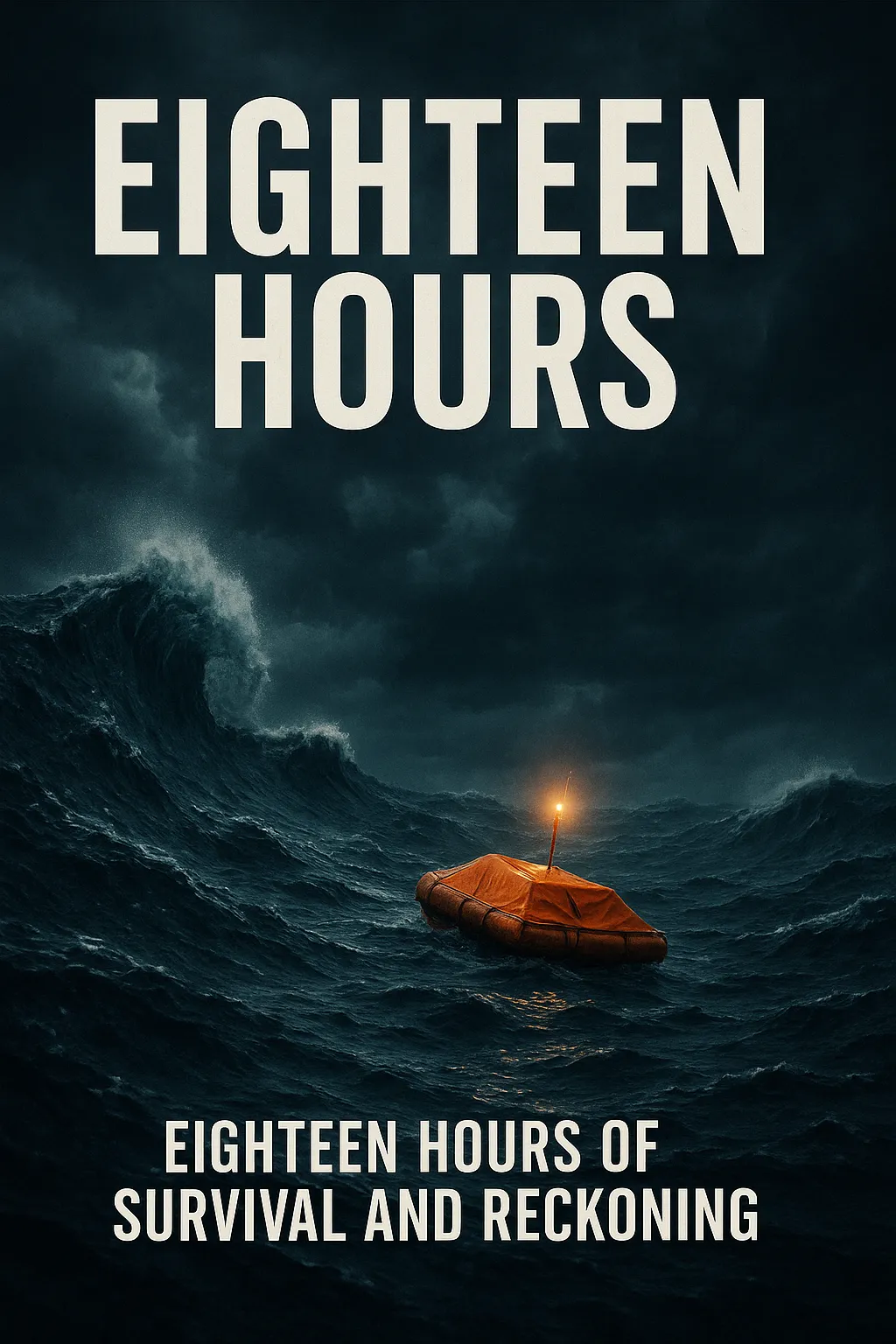
Eighteen Hours
The yacht went down in under four minutes. Craig had always thought sinking would be slow — a dignified settling, water rising in the cabin like a bath. It wasn't. The wave that broke the hull came from a direction he didn't think waves could come from, and then the ocean was inside the boat and the boat was inside the ocean and he was somewhere between the two, clawing at the life raft canister with fingers that had stopped being fingers about an hour before.
The raft inflated with a sound like a car crash played backwards. He fell into it like a man falling into a skip bin — graceless, sideways, one leg still in the water. The cold had his foot. He kicked free and rolled onto the floor and lay there with his face against the rubber, breathing.
Bass Strait. Eight-metre swell. Eleven o'clock at night.
He found the EPIRB in the dark by feel — a small brick with a light on top that strobed once every few seconds. Each flash was a message to a satellite that was a message to Canberra that was a message to whoever was on shift tonight that said: someone is dying here, or close to it, and here are his coordinates. He pulled the tab and the strobe kicked on and he held it above his head like some stupid orange torch and thought, Right. Now we wait.
The raft lurched. He grabbed the lifeline strap and held on while the floor tilted thirty degrees and water sloshed over the entrance. The canopy was up but the wind was getting under it, snapping the fabric like a sail. He didn't blame it.
He'd watched the barometer fall for six hours before the hull broke. Six hours. The needle dropping like it owed money. And he'd kept sailing, because he'd seen worse. He hadn't seen worse. He'd seen half this and been scared then too, but that was a different Craig, the one on the boat with the working radio and the dry clothes and the confidence of a man who hadn't yet been proven wrong.
The survival pack was clipped to the inside of the raft. He got it open with his teeth because his hands were done, just done, and laid the contents out on the rubber floor between waves. A foil blanket. Six sachets of water. Seasickness tablets. Flares — two parachute, three handheld. A small knife. A sponge. Fishing line, which — yeah. He'd get right on that.
He wrapped the foil blanket around himself. It crinkled. He sounded like a baked potato. He felt like a baked potato — soft, steaming, rapidly cooling.
He said it to no one. To the raft. To the EPIRB strobing its patient little SOS into a sky that couldn't hear him.
He'd activated the beacon at 2307. Nearest port was Eden, maybe Lakes Entrance. A rescue helicopter couldn't fly in this. A ship could, but ships were slow and the strait was wide and nobody was just sitting around waiting for Craig to fuck up his life. Morning at the earliest. Afternoon if the weather held bad. Eighteen hours if he was lucky. Longer if he wasn't.
The raft dropped into a trough and his stomach went with it. For a moment there was silence — real silence, the wind blocked by walls of water on every side — and then the next swell picked them up and the world was noise again. He bailed with the sponge. Three squeezes. Four. The water came back. He bailed some more.
Somewhere out there, a satellite had received his signal and passed it along to a building in Canberra where someone — some poor bastard doing the graveyard shift — was pulling up his registration. Craig Dempsey. Vessel: Leeway. 12-metre sloop. Solo passage, Melbourne to Devonport. They'd look at the weather overlay and the sea state data and they'd say to each other what anyone would say.
Stupid bastard.
He pulled the foil tighter and pressed his back against the raft's inflated wall and listened to the ocean try to get in. The EPIRB strobed. The sponge floated past his knee. His hands were white and he couldn't feel four of his fingers and the raft smelled like new plastic and salt and something chemical, like the inside of a new car if the new car was trying to kill you.
He closed his eyes. The dark was the same.
The grab bag. He'd forgotten the grab bag.
It was wedged under his left thigh where he'd been sitting on it for the last — what, ten minutes? Twenty? Time had gone soft. He dragged it out and unclipped the top with his teeth again because his thumbs had joined his fingers in whatever protest they were staging. Inside: a handheld VHF, a ziplock bag of energy bars, a head torch with a crack down the lens. He left the bars. He left the torch. He pulled out the radio.
It was a Standard Horizon, black plastic, rubber antenna. He'd bought it secondhand from a bloke in Williamstown who swore it was waterproof. Craig turned it over. The screen lit green — three bars of five on the battery. Channel 16.
He keyed the mic. The raft pitched and he jammed his feet against the far tube to brace, the radio in one hand, his teeth clamped together so hard he could hear them.
Mayday, mayday, mayday. This is sailing vessel Leeway. Leeway. Leeway. EPIRB activated at twenty-three-oh-seven. Solo crew in life raft. Position approximately —
He didn't know his position. Not anymore. The GPS was on the chart table, which was forty metres down and falling. He gave the last coordinates he remembered, which were probably wrong by now because the current had him and the wind had him and he was just cargo.
Over.
Static. The green glow of the screen lit the canopy from below, turning the orange fabric murky — the colour of old rust, of dried blood on a bandage. He waited. The swell picked the raft up, held it, set it down.
Nothing.
He keyed again.
Mayday, mayday, mayday. Sailing vessel Leeway. Anyone receiving, over.
The static shifted. A voice underneath it, or the suggestion of a voice, buried in the noise. Then gone.
Craig pressed the radio against his forehead and closed his eyes. The plastic was cold. Everything was cold. His feet had stopped reporting in. He couldn't tell if they were still inside his boots or if the boots had filled with water and his feet had just accepted their new aquatic lifestyle.
He tried a third time.
The voice came back mid-sentence, cutting through the static — rough, partial, but there.
Craig's hand was shaking. Not from cold. Or not only from cold.
Copy, Leeway. We have your beacon. Can you confirm, are you injured? Over.
Was he injured. He thought about that. His left shoulder had done something when the boom came across — a sound he didn't want to think about. His shin was bleeding, or had been. His core temperature was heading somewhere he'd rather it didn't.
Shoulder's not great. Nothing critical. Cold. Over.
Understood, Leeway. Conditions are preventing helicopter deployment at this time. We have a vessel being tasked but it is some hours away. Recommend you conserve battery on your handheld. Check in every thirty minutes on sixteen. Do you copy? Over.
Some hours away. Craig had once called a plumber who'd said the same thing. The plumber showed up eleven hours later, drunk.
Copy. Every thirty on sixteen. Over.
Stay with your raft, Leeway. We have you. Out.
We have you. He turned the radio off. The green glow died and the dark rushed back in and he was alone again with the noise of the sea and the snap of the canopy and the smell of new rubber.
Three bars out of five. Every thirty minutes. He did the math and then stopped doing the math because the math was a bastard and he didn't need it right now.
He put the radio in the ziplock bag with the energy bars, sealed it, wedged the bag between the raft tube and his hip where the water couldn't get it. Then he picked up the sponge and started bailing again. Squeeze, wring, squeeze, wring. The water came back. It always came back.
Somewhere out there, a woman he'd never meet was looking at a dot on a screen. The dot was him. He was a problem on her shift, a set of coordinates drifting south-southeast, and she would track him until morning or until the dot stopped moving, whichever came first.
He laid the flares out on the raft floor between his knees. Two parachute, three handheld. The parachute flares were the size of his forearm — red casings, pull-cord ignition, good for maybe forty seconds each at altitude. The handhelds were smaller, stubbier, the kind you'd hold above your head while the phosphorus burned down toward your fist. He'd used one once, years ago, in a safety course at Sandringham. The instructor had said hold it downwind and he'd held it upwind and singed his eyebrows and everyone had laughed.
Five small fires against the entire Strait.
He sorted them. Port side, starboard side. Parachute flares on the left for long range — aircraft, distant ships. Handhelds on the right for close work, for when he could see lights or hear engines. Port and starboard.
The raft dropped into a trough and the flares slid toward the entrance. He lunged and caught the nearest parachute flare with his right hand, the movement wrenching through his shoulder like a cable pulled taut. The other four scattered across the wet rubber. He gathered them back one-handed, breathing through his teeth.
Right. Pockets.
He put the two parachute flares inside his jacket, one in each inner pocket against his chest where the foil blanket crinkled against them. The handhelds went into his trouser cargo pockets, two on the right, one on the left. They were heavy and awkward and they pressed against his thighs and he didn't care. Everything stayed on his body now. Nothing loose in the raft. The sea took anything that wasn't held.
He started bailing again. The sponge was saturated and his right hand couldn't close all the way around it — the squeeze came out weak, half a squeeze, water dribbling rather than streaming over the side. He switched to pressing it flat against the floor with his palm and dragging it to the edge. Slower. Still worked.
First light was — what. Six hours away? Seven? He'd activated the beacon at 2307. Call it midnight now, or close enough. Dawn in Bass Strait in winter came late and grey. Six-thirty, maybe seven. He had to stay alive until six-thirty and then he had to fire the first flare at the right moment, not too early when the light would wash it out, not too late when whatever ship or plane might be searching had already passed his grid.
So don't waste them.
He pressed the sponge flat. Dragged. Lifted. Water ran down his wrist and back into the raft.
The shoulder was getting worse. The deep kind, the structural kind, that sat underneath everything else. He'd been keeping his left arm still against his ribs, but every swell shifted him and every shift moved the joint and every movement sent a shock up through his neck that made his vision go tight at the edges. He needed to not think about it. He thought about it.
Mia.
He pressed his tongue against the roof of his mouth and held still.
His daughter. Twenty-three, lived in Northcote, worked at a place that roasted coffee and charged eleven dollars for it. She had his face and her mother's sense and she hadn't called him in six weeks, which was — fine. That was fine. He'd earned that silence by saying the wrong thing enough times that the other person stopped waiting for the right one.
Someone in Canberra or Melbourne would be making a phone call, or deciding whether to make one yet, or waiting until there was something to say that wasn't your father is in a raft and we don't know. Mia might be asleep. Mia might be at a bar. Mia might be sitting on her couch with her phone face-down.
The EPIRB strobed once, orange light filling the canopy for a half-second and then gone. In the afterimage he could see the flare plan laid out like a timeline — dawn, midday, the handhelds saved for the sound of engines.
He picked up the sponge and pressed it flat against the floor and dragged.
The ziplock bag was wedged where he'd left it, between the tube and his hip. He pried the seal open by pinching it between his wrists — his fingers had stopped taking requests — and fished out an energy bar. The wrapper said APRICOT & COCONUT in cheerful letters, the font of someone who had never been in a life raft.
He tried to tear the corner. The wrapper didn't tear. He tried again, pinching harder, and the bar shot out of his grip and landed in the inch of water sloshing across the raft floor.
He stared at it.
The bar drifted toward the entrance on the next surge. He caught it with his boot, dragged it back, picked it up. The wrapper was wet. His hands were wet. Everything in the southern hemisphere was wet.
He bit into the corner of the wrapper and pulled. It opened. The taste of foil and synthetic apricot hit his tongue at the same time, and for a moment he wasn't sure which was the food.
He broke off a piece the size of his thumb. It took a while. The bar had the consistency of a roofing tile that someone had once shown a photograph of an apricot. He put it in his mouth and chewed and his jaw seized halfway through — a deep cramp that locked his teeth together with the chunk still between them. He sat there, waiting for the muscle to release, breathing through his nose.
The cramp let go. He chewed. Swallowed. The lump went down like a stone and sat somewhere behind his sternum, heavy and foreign. His stomach considered it.
The raft climbed a swell. Hung at the top. Dropped.
Craig leaned sideways and dry-heaved over the edge of the entrance. Nothing came up — there wasn't enough in him to come up — but his whole core contracted and the shoulder screamed and he stayed bent over the black water with his eyes streaming until the spasm passed. Salt spray hit his face. He spat once. Twice.
Stay down. Stay the fuck down.
He sat back against the tube. Wiped his mouth with the back of his wrist. The half-eaten bar was still in his left hand, which surprised him — his left hand was barely his anymore, just a thing attached to the bad shoulder, but it had held on. The knuckles were translucent in the dark, the veins raised and blue, like a diagram from a first-aid manual.
He took another bite. Smaller this time. Chewed slowly, working his jaw in careful circles, and swallowed before the next swell could make the decision for him. It stayed. He took another. That stayed too. Three bites, maybe a hundred and fifty calories. He wrapped the rest of the bar in its torn foil and put it in his jacket pocket, opposite the parachute flare. One pocket to keep him alive now, one pocket to keep him alive later.
He reached for a water sachet. Tore the corner. Took two mouthfuls — lukewarm, plasticky, extraordinary. He folded the sachet over and pressed it under his thigh. Five unopened, plus this one. Call it five and a half. Eighteen hours divided by five and a half was — he could have one every three hours and change. If he didn't throw up. If the sachets didn't puncture. If, if, if.
Water was pooling again around his ankles. He picked up the sponge with his right hand and pressed it to the floor but his palm couldn't flatten it — the tendons had shortened or stiffened or quit, and the sponge just sat there under his curled fingers, absorbing nothing. He switched to pushing it with the heel of his hand. Slow, clumsy work. A tablespoon at a time over the edge.
The EPIRB strobed. In the flash he saw the raft floor — the ziplock bag, the sponge trail, his own boots in two inches of black water. Then dark.
He shouldn't have keyed it. He knew that. The schedule was every thirty minutes and it hadn't been thirty minutes — it had been maybe twenty, maybe fifteen, he'd lost the edges of time somewhere between the last swell and this one. But his right hand had found the ziplock bag and his teeth had found the seal and the radio was in his palm before the thinking part of him caught up.
The screen lit green. He didn't look at the battery.
Maritime Safety, Maritime Safety, this is Leeway. Over.
He waited. The canopy snapped twice, hard, like someone shaking out a bedsheet in a gale. Water ran down the inside of it and pooled where his hip met the floor.
Leeway, Maritime Safety. You're early.
Two words that carried the tone of a shift supervisor watching more than one dot.
Yeah. I know. Sorry. Wanted to — confirm status of the tasked vessel. Over.
A pause. Not static — a deliberate pause.
Vessel is en route. Current ETA is zero-nine-thirty. Conditions are not improving. Over.
Ten hours.
Copy that. Left shoulder's worse. Mobility's down in both hands. Core temp — I don't know. I'm shivering but not as much as I should be. Over.
The shivering part was true and it scared him more than the shoulder. He'd read somewhere — or been told, or imagined being told — that when the shivering slowed it meant the body was losing the argument.
Copy, Leeway. Keep moving your extremities. Stay hydrated. Can you confirm you're still managing water ingress? Over.
Managing is generous. I'm bailing with a sponge and the sponge is winning. Over.
Nothing from the other end.
Sue.
He said it before he knew he was going to. Her name, which he shouldn't have had — she'd never offered it. Maybe he'd caught it in the background of a transmission, someone calling to her from across the operations room. Maybe he'd invented it.
Leeway, say again?
Nothing. Disregard. I'll check in at the scheduled time. Leeway out.
He turned the radio off. Bagged it. The dark came back.
Ten hours. The raft rose. The raft fell. He pressed the sponge to the floor with the heel of his hand and it barely compressed — his tendons had locked into a half-curl that wouldn't straighten and wouldn't close. He pushed the sponge to the edge and tipped it over the side with his wrist. It bobbed in the black water for one sick second before he snatched it back.
Mia would get the call soon, if she hadn't already. Not from Sue — from someone further down the chain, someone whose job it was to say words like condition and monitoring and at this time. Mia would be in bed. She kept her phone on the bedside table with the ringer off because she said the notifications gave her anxiety, which Craig had once made a joke about, which was one of the reasons she hadn't called in six weeks.
She'd call her mother first.
He pressed his forehead against his knees. The foil blanket crinkled. The parachute flares in his jacket pockets pressed against his ribs. He could feel the plan — first light, midday, handhelds for engines — but it was starting to feel like something drawn on paper, clean and theoretical, by a version of him who could still close his hands.
You hit the beacon.
He said it into his knees, into the wet denim and the foil and the dark.
You hit the beacon. So you want to be here. So be here.
The raft dropped into a trough and the silence came — that deep, walled silence where the swells blocked the wind and the world shrank to the size of the canopy and the sound of his own breathing. In the silence he could hear the water moving under the floor. Not waves. Just water, finding its level.
Then the next swell took them up and the wind hit the canopy and the noise was back and he was Craig again, in a raft, in the Strait, with ten hours between him and a boat that might or might not be real.
His feet were gone. Not painful — gone. He tried to curl his toes inside his boots and got nothing back, not even the memory of the movement. His hands he could still feel, but only because they hurt. The shoulder was a country he'd stopped visiting. His eyes were raw from salt and somewhere behind all of it was a tiredness so deep it felt like gravity — like the sea was pulling him down not through the raft but through himself, into a sleep that would be warm and dark and very easy.
No.
He opened his eyes. He hadn't realized they were closed.
He was already talking before he knew he'd started.
The raft climbed. Held. Fell. He braced with his forearms against the tubes, his curled hands useless against his chest.
I wasn't coming to Tasmania for the sailing. I need you to know that. There's a bloke in Beauty Point who refits old yachts and he said he had six months of work if I wanted it. Fibreglass, teak, whatever. Actual work. Wages-in-a-bank-account work.
He stopped. The wind moved the canopy above him in slow, irregular pulses.
I was going to get a rental. One of those little weatherboard places up the hill from the river. Nothing flash. Just — walls. A kitchen. Somewhere to put a kettle.
He put his hand against his face. The fingers were cold and rigid against his cheek.
The swell passed under him.
I had the whole speech ready. In the shower, you know. The way you practise things. I was going to say — I know I've been difficult. I was going to use that word. Difficult. Like it covers it.
Like difficult is what you call a man who moved four times in three years and forgot your formal and showed up to your mother's place at one in the morning because he needed to explain something that could not, absolutely could not, wait until morning.
He was quiet for a while. The water in the raft floor moved against his shins.
I was going to say I know I got the gene for sailing and not the gene for staying. And I was going to ask if you'd let me try staying. Just for a bit. Just to see.
His shoulder sent a sharp pulse up through his neck and he held still until it passed.
But I looked at the forecast and I knew. I knew it was turning. And I went anyway because the window was closing and I thought I could make it and I always think I can make it and that's — yeah. That's it, isn't it.
The raft rose on the next swell and for a moment he could hear the wind from every direction at once, a sound so large it erased thought.
When it dropped again, he spoke into the silence.
He sat with that. The water rose around his ankles. He didn't reach for the sponge.
But I hit the beacon, Mia. I want you to know that too. When it came to it, I hit the fucking beacon.
He breathed. The cold air burned his throat and he breathed again.
The tiredness was there. It had been there for hours but now it pressed in close. His vision softened at the edges. His hands lay in his lap, half-curled, still.
He found the sponge by feel. Pressed it to the floor with his wrist. Tipped it over the edge. One motion. He didn't count the water that came back.
He woke up and didn't know he'd been asleep.
The raft was tilted. Water had risen past his calves. The foil blanket had come unwrapped on one side and the cold was inside his clothes now, not against them but in them, married to his skin. He didn't know how long. Minutes. An hour. His body had made the decision without him and he hated it for that and was grateful in a way he couldn't name.
He reached for the sponge. His right hand hooked it on the second try — the fingers wouldn't uncurl, so he trapped it against his thigh and dragged it to the floor and leaned on it with his forearm. Water squeezed out the sides. He scraped it to the edge and tipped it. The motion was new. Everything before this had been hands. Now it was arms, weight, the parts of him that still answered.
He did it again. Again. The water didn't care. He did it again.
The radio was still in the ziplock bag against his hip. He pressed the bag against the raft tube and peeled the seal back with his wrist. The screen lit green. Two bars.
Maritime Safety, Leeway. Over.
Static. The canopy above him had torn at some point — a ragged slit near the apex where the wind had finally won. Through it he could see nothing. Black on black.
Leeway, Maritime Safety. Go ahead.
Still here. Canopy's torn. Water ingress is — yeah. Hands aren't working. Over.
He waited. Through the tear in the canopy, the wind found him directly for the first time in hours. It was a specific kind of cold — thin, cutting, going straight through the foil and the wet layers beneath.
Copy, Leeway. Rescue vessel has revised ETA to zero-eight-forty-five. Conditions easing at their end. Can you manage the canopy tear? Over.
Zero-eight-forty-five. Forty-five minutes earlier than the last estimate. He tried to do something with that number — subtract, calculate, feel — and couldn't. It was just a number.
Negative on the canopy. I can't — I don't have the grip. I'll manage. Over.
Leeway, conserve your battery. Next check-in at oh-six-thirty. We'll be here. Over.
He almost turned it off. His wrist was already moving to the dial.
The static held. He could hear the open channel, the faint hum of a room on the other side of it — a room with lights and coffee and dry floors and people whose hands worked.
Go ahead, Craig.
Craig. Not Leeway. He pressed the radio against his chest. Held it there.
Nothing. I'm good. Leeway out.
He turned the radio off. Bagged it. Wedged it back against his hip. Two bars. Maybe enough. Maybe not. He'd find out at oh-six-thirty or he wouldn't.
The cold came through the canopy tear in steady pulses. He pulled the foil blanket back across his chest and held it there with his forearms crossed. His left arm was just weight now — he positioned it with his right and it stayed where he put it, obedient and foreign.
Time passed. He knew it passed because the swells changed — longer intervals, the raft spending more time in the troughs. The wind was dropping or shifting or both. He couldn't tell if that was good. Easing at their end, Sue had said. Not at his.
His mother was sitting across from him in the raft.
She was wearing the blue cardigan she'd worn every winter in the house in Frankston, the one with the pulled thread on the left cuff that she never fixed because she said it gave it character. She was looking at him the way she'd looked at him when he was nine and had come home with a dead bird he'd found under the bottlebrush, cupped in his hands, wanting her to fix it.
He reached for her and his hand hit the raft tube and she was gone and the sound that came out of him wasn't a word.
He sat with that. The raft rose. Fell. The water around his legs was cold in a way that had stopped registering as temperature and started registering as pressure, as the sea reminding him it was still in the room.
He ate the rest of the energy bar. He didn't taste it. He chewed with the slow mechanical patience of a man feeding a machine he didn't particularly like but needed running. He drank half a water sachet. Folded it. Put it back.
Then he bailed. Forearm on sponge, sponge to edge, tip. The water came back. He did it again. At some point his right hand started shaking — not from cold but from something else, a tremor that ran from his wrist to his elbow in fast, irregular pulses. He watched it. His hand, shaking. Still his.
The grey came slowly.
He didn't notice it at first. The dark just became less — the black water in the raft floor turned dark green, and then he could see his own boots, and then the swells outside the entrance had faces, long ridges moving east, scarred with foam. He could see them. After hours of feeling the sea move under him, he could see it, and it was enormous, and it was ordinary, and it didn't know he was there.
The raft was orange.
He'd known that. He'd known it when he fell into it, when the canopy went up, when the EPIRB strobed against the fabric. But in the dark it had been a fact, and now it was a colour — the orange of the raft against the grey-green water, vivid and obscene, designed by someone in an office to be seen from the air.
He reached into his jacket pocket. The parachute flare was there, where he'd put it hours ago. He hooked it out with his curled fingers, braced it between his knees, and looked at the pull-cord. His hands couldn't grip it. He knew that. He'd known it for a while.
He bit the cord. Pulled his head back. The flare kicked in his lap and the rocket left the casing with a sound like tearing linen and climbed — he watched it through the tear in the canopy, a red star rising into grey sky, trailing smoke, impossibly bright against the nothing above Bass Strait. It hung there. Forty seconds. He counted them without meaning to. Then it died and the smoke drifted east and the sky was grey again and empty.
One flare gone. One parachute left. Three handhelds in his pockets.
The EPIRB was pinging. It had been pinging all night. It would keep pinging into a sky that was, finally, turning.
He leaned his forearm on the sponge. Pressed. Tipped it over the edge.