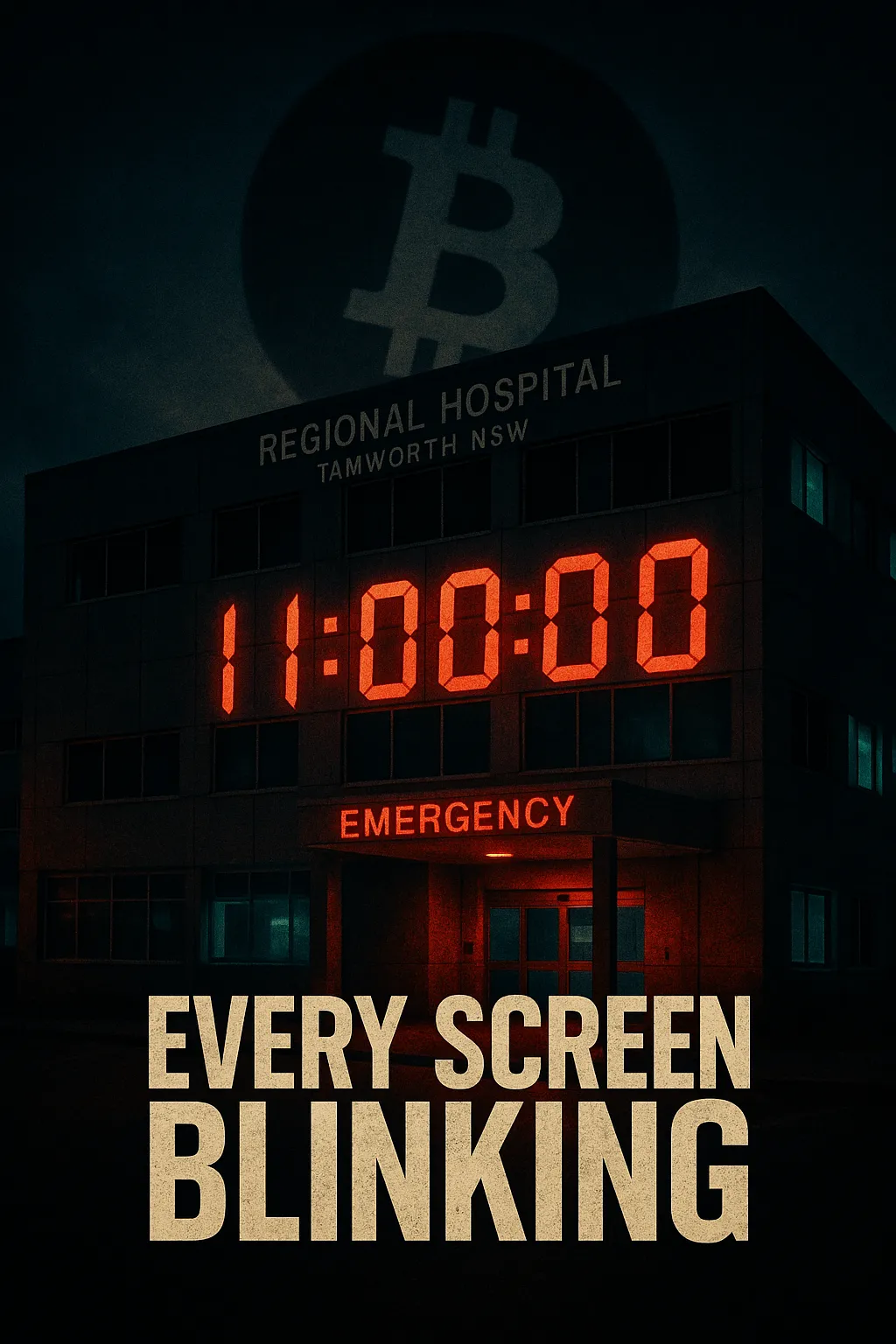
Every Screen Blinking
The fluorescent tube above Greg's desk had been flickering for three weeks. He'd put in the maintenance request himself, which was the kind of thing that happened when you were the administrator of a regional hospital — you filed your own tickets and then didn't action them. The tube buzzed and caught, buzzed and caught, and on every screen in the building the same red text pulsed.
YOUR FILES ARE ENCRYPTED. 2,000,000 USD IN BITCOIN. The wallet address. A countdown timer: 11:47:22. The lock screen had replaced everything — every terminal, every workstation, every monitor mounted on every wall of every ward. Greg had walked past six of them on his way back from the ICU and hadn't been able to look at a single one straight on.
His desk phone rang. He let it go. It rang again. He let that go too.
The door opened without a knock. Donna Keech filled the frame — not a big woman, but she had a way of standing that made doorways feel like they'd been built wrong. She had a laminated card in one hand and a pen behind her ear.
Sharon Molloy's on phenytoin. You know what phenytoin is?
I know what phenytoin is.
Then you know it's the kind of drug you let the computer check twice. Sharon's sixty-three, she's renal, and my nurse has been calculating doses by hand with a pen and a laminated card for nine hours. Nine hours, Greg.
Greg said nothing. Donna didn't need him to say anything. She needed him to hear the number.
I've got fourteen patients up there. Three ventilated. We're charting on paper, we're running drip rates off memory, and I've got two grad nurses who've never worked without a pump library in their lives. I need you to fix this.
Do you.
She held his gaze, then turned and walked back toward the corridor. Her shoes squeaked on the lino. The door didn't close all the way behind her.
Greg sat down. The chair creaked. On his monitor, the countdown timer had ticked to 11:43:58 while Donna was talking, and he'd been watching it over her shoulder the whole time.
A knock at the half-open door. Karen Voss, head of IT — though tonight that title felt like calling someone the captain of a sinking boat. She looked like she hadn't slept.
I've got an update. Sort of.
Come in.
She came in but didn't sit. She stood near the filing cabinet.
Radiology's completely gone. Pathology's gone. The pharmacy management system is — it's not responding at all. Backups are encrypted too, which means they were inside the network for a while before they triggered it. Weeks, probably.
Weeks.
That's eight hours.
Yeah.
She stood there.
Is there any way to get the pharmacy system up independently? Just that one?
No. It's all the same domain. It's — no.
Right. Okay. Stay close, yeah? I'll need you when the health district calls.
Karen nodded and left. She pulled the door shut behind her properly, which Donna hadn't, and Greg noticed that because he was noticing everything tonight that didn't matter.
His mobile buzzed on the desk. A text from Ray Druitt. Greg read it twice.
Greg. Heard about the trouble. Just want to make sure the children's ward money is safe.
Greg started a reply. Typed four words. Deleted them. He put the phone in his pocket.
The fluorescent tube above him buzzed and caught. On the monitor, the wallet address blinked. Eleven hours and forty-one minutes. Fourteen patients. Two million dollars that belonged to every person in this town who'd ever bought a raffle ticket or a sausage sandwich outside Bunnings on a Saturday morning.
He pulled the incident folder toward him and opened it to a blank page.
Greg stared at the blank incident page for maybe ten seconds before he pushed back from the desk. The chair rolled into the wall behind him. He was up and across the office and pulling the door open before he'd decided to do it, and the corridor was empty except for the sound of shoes on lino somewhere around the corner toward the server room.
He caught her at the vending machine alcove near the stairwell. She had her back to him, one hand flat against the wall.
She turned.
Yeah?
Come back in. I need to ask you something.
She followed him back. This time she sat when he pointed at the chair. She sat very straight, both feet on the floor, hands flat on her thighs.
You said they were inside the network for weeks.
That's what it looks like. Yeah.
How'd they get in.
Karen's breathing changed. Not louder — shallower.
We won't know that until the forensic team does their analysis. Could be a vulnerability in the VPN, could be a credential stuffing attack, could be —
Karen.
She stopped.
I'm not asking what it could be. I'm asking if you know.
The vending machine hummed through the wall. Someone paged Dr. Llewellyn on the overhead.
There was a phishing email that went around about three weeks ago. Targeted. Looked like it came from eHealth NSW. A few staff may have interacted with it.
A few staff.
It was reported. I flagged it internally. I put in a ticket with the security team in Newcastle and I never heard back.
You flagged it.
Yes.
Is there a record of that.
She looked at the window behind him — the car park, the dark, the red glow of the emergency sign on wet bitumen.
There was an incident report. I'm not sure where it ended up in the system. Given that the system is currently —
Encrypted. Right.
Neither of them said anything for a while. Down the corridor, the stairwell door banged open and someone walked through fast, their footsteps receding upward.
Greg leaned back in his chair.
I reported it straight away. Within minutes. I changed my credentials, I ran a scan, I did everything right. And I put the ticket in and nobody — Greg, nobody actioned it. Three weeks. I chased it twice.
Greg closed his eyes. He pressed his thumb and forefinger into the bridge of his nose and held them there.
I know what it looks like.
Does anyone else know this.
No.
The forensic team. When they get here. They're going to find the entry point.
I know.
Greg opened his eyes. Karen was looking straight at him now.
Okay. I need you to write down everything. The email, when you clicked it, when you reported it, who you reported it to, the ticket numbers if you remember them. Everything. And I need it before the Sydney team lands.
On paper, I assume.
It wasn't funny. They both almost laughed anyway, and the almost was worse than if they had.
Karen stood. She was at the door when Greg spoke again.
Her hand was on the door handle. She didn't turn around.
I'll check.
She left. The door clicked shut. Greg sat alone with the countdown timer — 11:34:07 — and the knowledge that when the forensic team pulled this thing apart, the story of tonight was going to be worse than a hospital that got hacked. It was going to be a hospital that got warned and did nothing. And the person who'd have to explain that to Ray Druitt, and to Donna, and to every family in the waiting room upstairs, was sitting in this chair.
Greg pulled a yellow legal pad from the second drawer and uncapped a pen. The board disclosure. He'd written dozens of these over the years — water damage, asbestos finds, the time a locum surgeon left a swab in a patient and the family found out from a nurse's boyfriend at the pub. Those had been bad. This was different. This was the kind of disclosure that ended careers, and he wasn't sure yet whose.
He wrote the date. Then he wrote CONFIDENTIAL — BOARD EYES ONLY across the top and underlined it twice. The pen was a cheap Bic and it skipped on the downstroke.
He got as far as 'At approximately 2:15am on' before the door opened without a knock. Donna. Karen two steps behind her, a folded piece of paper held against her sternum.
Donna crossed to the desk and set her clipboard down on top of Greg's legal pad. Deliberate.
I'm in the middle of something.
Donna glanced at the legal pad under her clipboard.
Karen stayed near the door. She'd unfolded the paper and refolded it, the crease softening. Greg could see handwriting on it — tight, small, filling most of the page. The timeline he'd asked for.
Donna, I hear you. I've got a call in to the health district and I'm trying to get something on paper for the board before Ray—
The sentence sat there. Greg put the pen down.
I haven't decided anything.
Good. Because I want you to understand something. Jess Barlow — one of my grads — she's been on shift eleven hours. She calculated a heparin dose twenty minutes ago and got it right. Checked it three times, got it right. Then she went into the pan room and threw up. Eleven hours, Greg. She's twenty-two.
Greg looked at the clipboard Donna had set on his pad. A handwritten medication chart, columns ruled in blue pen, doses in black, check marks in red. Every entry initialled twice. It looked like something from the 1970s.
What do you need from me right now. Specifically.
I need a pharmacist on the floor. Not on call — on the floor, standing next to my nurses, checking every calculation before it goes into a patient. And I need it now, not at ten when your Sydney people show up to poke around the computers.
I'll call Armidale. See if they can send someone down.
Donna picked up her clipboard. The legal pad was visible again — CONFIDENTIAL, the date, the half-sentence trailing off.
Karen looked at the paper in her hands, then at Greg.
I've been looking at whether we can stand up a standalone pharmacy terminal outside the domain. Air-gapped. It wouldn't have the patient data but it'd give you a drug interaction checker at least.
How long.
Karen's voice changed — faster, higher, the technical ground where she felt safe.
Do it.
Donna looked at Karen.
Donna turned back to Greg.
The question wasn't aimed at Karen. It was aimed at Greg. But Karen flinched.
Because I've had Karen working on containment and assessment. Which is also what keeps your patients—
Donna lifted the clipboard an inch off her hip. The handwritten chart.
She walked out. The door stayed open. The corridor light was that particular hospital yellow that made everyone look unwell.
Karen hadn't moved. She was still holding the folded paper. Greg could see now that the bottom of the page had a different quality to the handwriting — looser, slanting.
She set the paper on his desk, next to the legal pad, next to the pen that skipped.
Karen. The air-gapped terminal. Can you actually do that?
Yeah. I think so. I've got my old laptop in the car.
Then do that first. The timeline can wait.
She left. The door clicked shut.
Greg picked up Karen's timeline. Her handwriting was neat and small, each entry timestamped. The phishing email. The click. The immediate report. The credential change. The ticket to Newcastle — ticket number and all. Chased once on the 5th. Chased again on the 11th. No response either time. At the bottom, below a gap, in that looser hand: I did report it. I need you to know that.
He set it down and looked at his own legal pad. CONFIDENTIAL — BOARD EYES ONLY. The half-sentence. At approximately 2:15am on. He picked up the Bic and wrote nothing. The countdown on his monitor ticked past 11:16.
Greg picked up the desk phone and dialled the health district's after-hours line. He knew the number by heart.
Four rings. A click. Hold music — a flute piece that sounded like it belonged in a dentist's waiting room. He pressed the receiver harder against his ear and stared at the wall above his monitor where someone had pinned a fire evacuation map that was two years out of date.
The music cut.
Greg. I was about to call you.
Then you've heard.
Got the brief from eHealth twenty minutes ago. How's the ICU holding up?
Neville, I need to talk about the ransom.
A pause on the line.
Go on.
Two million US. Bitcoin. The timer's under eleven and a half hours. I've got fourteen ICU patients, three ventilated, pharmacy system's gone, nurses doing drug calcs by hand. My IT manager's trying to stand up an air-gapped terminal but that's a bandaid on a chest wound. I need to know what my authority is here.
Your authority is to manage the clinical situation until the forensic team arrives at ten. That's the position.
That's not what I asked. I asked about payment authority.
The official position from Health is that we don't pay ransoms. You know that. It's in the framework.
The framework doesn't have fourteen patients in it, Neville. The framework was written by someone in Macquarie Street who's never had to calculate a phenytoin dose with a Bic pen.
I understand the pressure you're under.
Don't tell me not to pay and also not to let anyone die. Those aren't compatible instructions, Neville.
The flute hold music bled through for half a second — Neville had put his hand over the receiver. Greg could hear a muffled voice in the background, someone else in the room. Then Neville came back.
I'm telling you this as a friend, not as your director. If you pay that ransom with community-raised funds — the children's ward money, Greg — without board authorisation, without ministerial sign-off, there is no version of this where you survive it. Even if it works. Even if the decryption key is real. You will be the administrator who handed two million dollars of community money to criminals.
And if someone dies tonight because the system was down and I had the ability to bring it back up?
Hold the line until ten. That's what I can tell you.
Can you get me a pharmacist? Armidale, anywhere. Someone who can physically be on the ICU floor checking calculations.
I'll make some calls. No promises at this hour.
Neville. If a patient deteriorates before ten and I can point to a phone call where I asked for authorisation and was told to hold the line — you understand how that reads.
Nothing on the line for five seconds. Six.
I'll call you back within the hour. Don't do anything before then.
The line went dead. Greg set the receiver down.
From upstairs, muffled through the ceiling, an alarm sounded. Not the fire alarm — a clinical alarm, the kind that meant a monitor, except the monitors were down, which meant someone had rigged something manual, which meant Donna's nurses were improvising systems that didn't exist twelve hours ago.
Greg stood up. He was halfway to the door when his mobile buzzed on the desk behind him. He stopped. The alarm upstairs went quiet.
Greg turned back to the desk. He picked up the receiver, dialled Armidale Base from memory, and got the switchboard on the second ring.
This is Greg, administrator at Tamworth Base. I need to speak to whoever's running your pharmacy department tonight. It's urgent.
Hold music. Different from the district's — this one was tinny pop. He pulled Karen's timeline toward him while he waited and read it again. The ticket numbers. The dates she chased.
A woman's voice came on, mid-forties by the sound of it, the particular alertness of someone who'd been dozing in an office chair.
Megan, I'm going to be straight with you. We've had a cyberattack. Every system's down. My ICU nurses are calculating drug doses by hand and I need a pharmacist physically on my floor. Tonight.
A pause. He could hear her sitting up.
How many patients?
Fourteen. Three ventilated.
Christ. Okay — I can't leave, I'm the only one on tonight. But let me call around. Gunnedah might have someone, or I can try the locum agency. How long do you need coverage?
Until ten a.m. at least. Longer if the systems don't come back.
I'll see what I can do. Give me twenty minutes.
My mobile's the best number. I might not be at my desk.
He read out the number. She read it back. He hung up and wrote Megan - Armidale pharmacy - chasing on the legal pad below his half-finished board disclosure. The pen skipped again on the second word. He threw the Bic in the bin and found another in the drawer. This one was a Papermate with a chewed cap and blue ink instead of black.
He took the stairs. One flight up, through the fire door, and the smell hit first — hand sanitiser and something burnt, like someone had been running a microwave too long. A bedside monitor in Bay 3 had been jury-rigged to a car battery. He stared at it.
Donna was at the nurses' station with two others, bent over a drug reference book thick enough to stop a door. The pages were fanned open and marked with torn strips of paper towel. She looked up when she heard him.
I've got Armidale trying to find me a pharmacist. She's calling around now.
Donna closed the reference book with her finger holding the page.
It's four in the morning, Donna. I can't conjure one out of thin air.
Bay 6. Mrs. Hadley. Seventy-one. We've had to restart her dopamine infusion twice because the pump lost its programming when the network dropped. Each time we restart it, there's a gap. The gap matters.
She let that sit. Then she opened the book again and went back to the page she'd been on.
Greg didn't leave. He stood at the edge of the nurses' station where the bench met the wall, close enough to see the handwritten obs charts stacked in a plastic tray. Dozens of them. Each one a patient whose vitals were being tracked in biro because the hospital had been reduced to the technology of his father's generation.
Donna looked at the two nurses beside her. One of them — not Jess, an older woman Greg recognised from surgical — gave a small nod and took the reference book. Donna stepped around the station and walked Greg three metres down the corridor, out of earshot.
She spoke quietly. Not softly — Donna didn't do soft — but with the particular economy of someone who'd been rationing her words for hours.
The district's told me to hold until ten.
That's not what I asked.
From Bay 3, the jury-rigged monitor let out a single tone. One of the nurses moved toward it without hurrying, which meant it wasn't critical, which meant they'd already learned to triage the sounds of equipment that shouldn't exist.
If I pay, it's the children's ward fund. All of it. That's Ray Druitt's money. That's the town's money.
So don't tell me whose money it is.
A door opened at the far end of the corridor. Jess came out of the pan room carrying a kidney dish. She walked past them without making eye contact, her face damp, and disappeared into Bay 2.
Greg watched Jess go. Then he looked back at Donna.
Donna didn't answer immediately. That was new. In every conversation they'd had tonight she'd been ready before he finished the question. Now she looked down the corridor toward the bays, toward the sounds of ventilators and the scratch of pens on paper and the low murmur of a nurse talking to a patient who probably couldn't hear her.
I can hold. I don't know if they can.
She went back to the station.
Greg's mobile rang in his pocket. He pulled it out. Not Megan from Armidale. Not Neville. The screen said RAY DRUITT and the corridor suddenly felt very narrow.
Greg answered on the second ring. He didn't move from the corridor. Donna was six metres away at the nurses' station and she didn't pretend not to listen.
Ray.
A dog barked on Ray's end, distant. The creak of a screen door.
I've been calling your office for an hour.
I'm on the ICU floor.
The fund, Greg.
I haven't touched it.
That's not... what I'm hearing. I'm hearing... there's talk of paying.
Who told you that.
Doesn't matter who told me. Three years, Greg. Three years of this town putting its hand in its pocket. Every pub raffle, every cake stall, every business that put a tin on the counter. That money has a purpose.
Greg leaned against the corridor wall. The paint was cold through his shirt.
Then I need to hear you say it's not on the table.
Donna had stopped turning pages. She was completely still at the station.
I can't tell you that.
Nothing from the phone.
Say that again.
I've got fourteen people up here, Ray. Three on ventilators. My nurses are doing drug calculations with a textbook and a pen. If one of them gets a decimal point wrong at five in the morning because they've been awake since yesterday — I can't take anything off the table. I won't lie to you about that.
Ray's voice dropped so low Greg had to press the phone harder against his ear.
I understand. I mean, I don't. But I hear you.
I'm coming in.
Ray, it's four in the morning.
Forty minutes.
The line went dead. Greg lowered the phone.
Donna was standing now. She'd come around the station.
Ray Druitt.
He's coming in. Forty minutes.
Good. Then he can help me restart Mrs. Hadley's dopamine.
She went back to the station. Greg stood in the corridor and his mobile rang again. He pulled it out and answered.
Greg, it's Megan. Armidale. I've got you someone.
Tell me.
Tilda Okonkwo. She's a locum pharmacist, she's been doing a stint at Gunnedah. I caught her on her mobile — she said yes before I finished the sentence. She's getting in her car now.
How long.
Gunnedah to Tamworth, this time of night — hour and a bit? She said she'd bring her own references and a thermos of coffee. Her words.
Greg wrote the name on the back of his left hand with the pen he'd brought from downstairs. The ink bled into the creases of his knuckles.
Don't thank me yet. Just — keep those nurses standing, yeah? I'll stay by the phone if you need dosing advice before Tilda gets there.
He hung up. Donna was watching from the station.
Pharmacist. Gunnedah. Hour and a bit out.
Name.
Tilda Okonkwo.
I'll tell the floor.
She turned to the two nurses behind her and said something Greg couldn't hear. One of them — the older woman from surgical — closed her eyes for a second and nodded.
Greg stepped closer to the station. He kept his voice low.
Donna looked at him. Red-edged eyes.
From Bay 2, Jess's voice — steady, careful, reading numbers aloud to the surgical nurse who'd followed her in. Checking a dose. The scratch of a pen confirming it.
Greg looked at the name bleeding into his knuckles. One hour. Ray in forty minutes. Karen somewhere downstairs loading a pharmacy database onto a laptop that had never been inside a hospital network. On the wall behind the nurses' station, someone had taped up a sheet of A4 with MANUAL OBS SCHEDULE printed in marker, the times listed in fifteen-minute blocks through to 10am. Below it, a second sheet — just a list of extension numbers for departments that no longer had working phones, crossed out one by one.
He stayed on the floor.
At ten past five, Tilda Okonkwo came through the fire doors carrying a backpack and a thermos, car keys still in her right hand. She was humming — tuneless, half a melody that didn't go anywhere — as she scanned the corridor and found Greg standing at the nurses' station.
You're Greg. Where do you want me.
She dropped the backpack on the counter and unzipped it without waiting for an answer. Drug references, a calculator, a pen case. Donna appeared from Bay 4 and stood watching. Tilda glanced at the handwritten medication charts fanned across the station, at the drug reference book with its paper-towel bookmarks, at Karen's laptop glowing on a meal tray down the corridor in Bay 6.
How long have they been running like this.
Since eleven last night.
Tilda picked up the nearest chart — Mrs. Hadley, Bay 6 — and read it standing. Her finger tracked each entry. She didn't speak for thirty seconds. Then she set it down and looked at Donna.
I'm not rubber-stamping anything I haven't verified myself. That means I slow you down before I speed you up. You okay with that.
That's why you're here.
Tilda took the thermos and the pen case and walked into Bay 6 without being directed. Donna watched her go, then looked at Greg.
At twenty to six, the fire doors banged open again. Ray Druitt. Muddy boots, checked shirt buttoned wrong at the collar. He'd driven forty minutes in the dark and the drive hadn't calmed him down.
Donna stepped into his path before he reached the station.
Ray looked at her, then past her at the corridor. The bays. The sounds.
And this is my floor. You can talk to Greg right here.
Ray looked at Greg.
Show me.
Greg looked at Donna. She held for a moment, then stepped aside. Greg walked Ray down the corridor. Past Bay 3, where the car battery sat under the monitor. Past Bay 4, where a nurse Greg didn't recognise was hand-ventilating a patient with a bag valve mask, counting breaths under her breath. Bay 6. Through the glass, Tilda was bent over Mrs. Hadley's chart, her pen moving, her lips still. The dopamine pump beside the bed had a handwritten label taped to it: RESTART #3 — 04:47.
Ray put his hand on the corridor wall. Just rested it there, flat.
From Bay 2, Jess's voice carried into the corridor. She was talking to the patient — murmuring about the morning, about the light coming soon, her voice cracking once before she caught it and kept going.
I need you not to fight me tonight. Whatever I decide.
Ray looked through the glass at Mrs. Hadley. At the handwritten label on the pump. At Tilda checking doses.
I'm not... giving you the fund. I can't do that. But I can make calls. People who'll answer at this hour. If you need warm bodies in this building, I can get you warm bodies.
Make the calls.
Ray pulled out his phone and walked back toward the fire doors, already scrolling. He paused at the threshold and turned back.
Greg. If someone dies tonight and you had the money — I'll still hold you responsible. But I'll know what it cost you.
He pushed through the doors. Greg's mobile buzzed in his pocket — the screen said NEVILLE PARKER. He pulled it out, looked at it, and thought about the paper trail he'd built. The call he'd made. The record. Then he declined it and put the phone back.
He went to Bay 6. Tilda was cross-referencing Karen's standalone terminal against her own references, the thermos open beside her, steam rising. She'd found an error — not in the nurses' calculations, but in the database Karen had loaded. A dosing interaction flag that was out of date.
She said it to Donna, who had followed Greg down the corridor.
Donna closed her eyes. Just for a second.
By six, the first grey light was pressing against the windows at the end of the corridor. It was going to be a clear day, warm by afternoon — the forecast Greg had glanced at on his phone twelve hours ago, back when weather was the kind of thing he checked. Ray was in the waiting room with his phone, calling in favours from people who'd been asleep twenty minutes ago. Karen was on the floor now, crouched beside the meal tray in Bay 6, updating the pharmacy database line by line while Tilda read corrections over her shoulder. Jess came out of Bay 2, saw Greg standing in the corridor, and stopped.
Mrs. Chen's sats are stable. I checked the calculation twice. Tilda confirmed it.
Good. That's good, Jess.
She nodded once and went back in.
His mobile buzzed again. Neville. He answered this time, standing in the corridor where anyone could hear.
Greg. I've been trying to reach you. The minister's office has been in contact with the department. The position remains that payment is not authorised.
I've got a pharmacist on the floor. I've got a board member in the waiting room making calls. My nurses have held the line all night. I need you to hear this, Neville — we're holding. But I'm not promising you past ten.
The forensic team is confirmed for ten. If there's a clinical deterioration before then, the framework provides for—
Neville. I'll call you if something changes.
He hung up. Donna was leaning against the station, watching him.
The framework.
Yeah.
Donna pushed off the counter and went back to work. Greg stayed at the station. Karen's timeline was in his pocket, folded so small it was barely there. The forensic team would find what they'd find. The truth about the phishing email, about Newcastle, about the ticket nobody actioned — that was coming whether Karen was ready or not. He couldn't protect her from it. He wasn't sure he should.
From Bay 6, Tilda started humming again. Greg went to the window at the end of the corridor and looked at the car park. A magpie was walking across the bitumen near the ambulance bay, pecking at nothing.