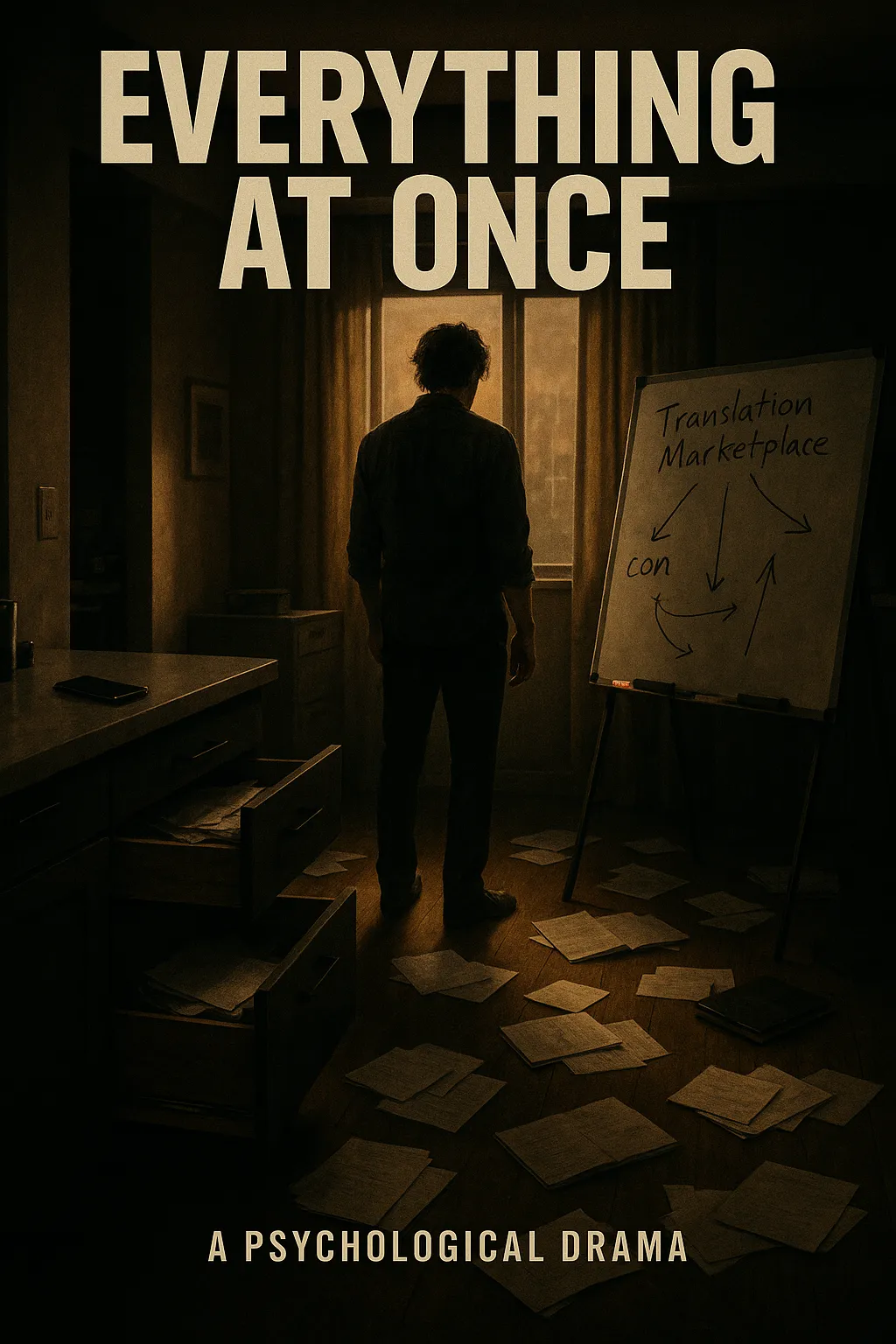
Everything at Once
The apartment looked like someone had been planning a revolution or a surprise party. Every drawer in the kitchen was open. Three notebooks lay across the counter, two of them new, bought at 2 AM from the CVS on Delancey because the first one had run out of pages and Jamie needed — needed — to get the pricing model down before it dissolved. A whiteboard leaned against the wall by the window, still wrapped in plastic from the hardware store, waiting.
Jamie stood at the counter in boxers and a sweater that smelled like Tuesday, eating apple slices off a cutting board and flipping through notebook number two. The handwriting started neat on page one and turned into something seismographic by page eleven. Didn't matter. Jamie could read it. Jamie could read all of it, could see the whole thing like a building viewed from above, every room connected, every hallway leading somewhere.
The idea was good. Not in the way ideas are good at 2 AM and embarrassing by morning — good in the way that survived daylight, survived coffee, survived Jamie staring at it from four different angles while pacing the length of the apartment. A platform connecting freelance translators with small businesses who couldn't afford agency rates. The market was there. The tech was simple. Jamie had filled nine pages with competitor analysis and hadn't even opened a laptop yet.
The phone buzzed on the counter. Rachel. Jamie picked it up, looked at the name, set it back down face-first. It buzzed again. And again. Three calls in ten minutes meant Rachel was in triage mode, which meant someone had told her something, which meant — no. Jamie bit into an apple slice and pulled up the whiteboard instead. Tore the plastic off. Uncapped a marker.
The phone buzzed a fourth time. Jamie picked it up.
Hey, Rach. I'm alive, I'm eating fruit, I'm not on a rooftop.
A pause that lasted long enough for Jamie to hear Rachel choosing her words.
I'm great. I'm genuinely, actually great. I've been working on something and I want to tell you about it but I know if I tell you about it right now you're going to do that thing where you go quiet and then ask me if I've been sleeping.
Have you been sleeping?
Jamie laughed. A real one. Wrote TRANSLATION MARKETPLACE across the top of the whiteboard in block letters while cradling the phone against one shoulder.
Some. Enough. I'll call you later, okay? I love you.
Jamie hung up before Rachel could steer the conversation where she wanted it to go. Felt a small flare of guilt, already fading. Texted Tom: come over, I want to show you something. bring coffee. the good kind not the bodega shit. Deleted the exclamation point after "something." Added it back. Sent it with two.
Tom showed up forty minutes later with two oat milk lattes and a face that was trying very hard to be normal. His eyes moved around the apartment — the open drawers, the notebooks, the whiteboard — and then came back to Jamie without mentioning any of it. He smiled. It was a real smile, mostly.
So what's the thing?
Jamie walked Tom through all of it. The platform, the pricing tiers, the gap in the market, the three competitors who were overcharging and underdelivering. Talked for eleven minutes without stopping, pacing between the whiteboard and the counter, picking up notebooks and flipping to specific pages, reading figures out loud. Tom listened. Nodded in the right places. Asked one good question about user acquisition that proved he was actually tracking.
It's not a bad idea, honestly. The translator thing. Have you thought about who'd build it?
Jamie grinned. This was the part. This was where it got good.
Jamie set the notebook down. The idea was still there, the platform, the pitch, but it had moved to the back of the room.
Did Rachel call you?
Tom's latte paused halfway to his mouth. He set it on the counter carefully, thumb pressed to the lid.
She texted me.
Jamie waited.
Tom exhaled through his nose.
Jamie nodded slowly.
What'd she say?
Tom put his hands flat on the counter, palms down.
Like last time.
Her words.
Jamie turned the marker over between two fingers, end to end. The thing about Rachel was that she had categories. She had Last Time and The Time Before That and The Bad One, and she filed everything Jamie did into one of them, and once you were filed you were already the outcome. Jamie could feel the edge of a thought about pattern recognition, about how the people who loved you could mistake the map for the territory — but it slid sideways before it finished forming.
And she asked you to, what. Watch me? Report back?
Tom held Jamie's gaze with the kind of steadiness that took effort.
I texted you because I wanted to show you the platform. Not because I needed checking on.
I know.
Do you?
Tom pulled his phone from his pocket, opened it, and slid it across the counter to Jamie. Rachel's texts were right there. Three of them. The last one read: Just be normal with him. Don't make it a thing. Just be there.
Jamie read it twice. The cap of the marker cracked under thumb pressure — a small plastic sound.
"Just be normal with him." Jesus Christ, Rach.
I'm not here for her. I want you to know that.
You're here for both of us. That's fine. That's — I get it.
Jamie slid the phone back. The whiteboard was still there behind him, TRANSLATION MARKETPLACE in block letters, and it still looked right. That was the part nobody understood. The ideas didn't stop being good just because of the diagnosis. Sometimes they were good AND he hadn't slept. Both things. At the same time.
The platform idea. Separate from everything else. Is it good or were you being nice?
Tom looked at the whiteboard. Looked back.
Nadia knows a developer. Or she knows someone who knows one. She said she'd connect me.
Nadia from two nights ago?
Yeah.
Tom picked up his latte. Took a sip. Set it down again.
Don't do that. Don't go quiet on me like Rachel goes quiet. If you have a thing, say the thing.
I don't have a thing. I just — how well do you know her?
Well enough. She gets it. She's not looking at me like I'm a problem to solve, which is more than I can say for the rest of the roster right now.
Tom looked at the open drawers behind Jamie like he was seeing them for the first time. Or letting himself see them.
Jamie turned back to the whiteboard. Picked up the marker.
He uncapped the marker, wrote USER ACQUISITION under the header in smaller letters, then circled it twice. The circle wasn't quite round. He traced it again.
Did you see the Knicks last night? Brunson went off. Forty-two in three quarters.
Tom was leaning against the counter with his arms crossed — not tight, just folded, like he didn't know what else to do with them.
Forty-two, Tom. In three quarters. He sat the fourth. That's — okay, but actually, that's kind of what I'm talking about with the platform, right? You don't bench your best guy when he's hot. You let him play.
The marker was back at the whiteboard. Jamie wrote BRUNSON = MOMENTUM next to the pricing model, drew an arrow connecting them to nothing yet, and kept talking.
The whole point of the tiered system is that when a translator is performing, when they're getting five-star reviews and repeat clients, you don't cap them at the same rate as someone who just signed up. You let them run. The platform takes a bigger cut on the higher tier but the translator still nets more, so everybody —
A knock at the door. Not a buzzer — a knock. Which meant someone had gotten into the building, climbed three flights, and arrived without calling first.
Jamie looked at Tom. Tom was looking at his hands.
You gave her the code.
She already had the code.
Jamie opened the door. Rachel stood in the hallway holding a paper bag from the deli on the corner and wearing the face she wore when she'd already decided how this was going to go. She looked past Jamie into the apartment — one quick sweep, there and back — and then she smiled at him.
I brought soup.
I didn't ask for soup.
She was already moving past him into the kitchen.
She set the bag on the counter next to notebook number two. Her eyes passed over the whiteboard — TRANSLATION MARKETPLACE, USER ACQUISITION, BRUNSON = MOMENTUM — and she didn't react. She opened the bag and took out a container and a plastic spoon, moving with the steady efficiency of someone unpacking for a long stay.
You called four times this morning. I called you back. I told you I was eating fruit. And now you're here with soup.
Rachel peeled the lid off the container. Steam rose between them.
I am good.
I know. I just wanted to see you.
She pulled out a chair at the small table by the window and sat down. Crossed one ankle over the other. Folded her hands in her lap. Everything measured, everything placed. Jamie had seen her do this exact thing in hospital waiting rooms.
Jamie turned to Tom, who had moved to the far end of the counter — not away from either of them, exactly, but out of the direct line between.
Tom's mouth opened. Closed.
She texted me in the car.
And you didn't say anything.
I didn't know what to —
No, that's — okay. That's fine.
It wasn't fine. Jamie could feel the architecture of it — Rachel's calls, Tom's visit, the soup, the chair, the folded hands — assembling around him like scaffolding. But the platform was still on the whiteboard. The numbers were still right. He picked up notebook number three and held it up.
Can I show you something? Both of you. Just — give me five minutes. Five minutes and then you can do the whole concerned-family thing, I won't even fight it. But look at this first.
Rachel's hands tightened in her lap. A small thing. She loosened them deliberately.
I'd love to see it.
And Jamie knew — knew with the same clarity that let him see the whole platform from above, every room connected — that she had no intention of looking at the notebook. That the five minutes were a concession she was making so the real conversation could start after. He knew this the way he knew the Knicks score and the pricing tiers and his own handwriting getting looser across the pages. He knew it and it didn't change anything because the notebook was right there and the idea was still good and he was going to show them anyway.
Jamie didn't sit down. He stayed at the whiteboard with the notebook open in one hand, but he wasn't looking at the notebook anymore. He was looking at Rachel's hands in her lap, and he was thinking about Dr. Linden's office — the ficus in the corner, the noise machine in the hallway, the way Linden always had a glass of water waiting like therapy was a restaurant.
When did you call Linden?
Rachel's chin lifted half an inch. Her fingers found the edge of the soup container and adjusted it on the counter, lining it up with nothing.
Jamie.
Was it before or after the four phone calls? I'm just trying to get the timeline straight.
Yesterday. I called her yesterday.
Tom shifted his weight toward the door. Not leaving — just making himself smaller.
And what did she say? Did she give you the whole checklist? Sleeping, eating, spending money, grandiose ideation — did she use that one? Grandiose?
She can't tell me anything. You know that. She can listen.
Right. She can listen. So you talked.
Rachel stood up. Not fast — she rose the way she did everything, with the weight already distributed, the decision already behind her.
I told her you haven't slept in three days. I told her you bought a whiteboard at midnight. I told her you sound like you're narrating a TED Talk every time you open your mouth. Yes. I called your doctor. I would do it again.
The apartment was very quiet. Jamie could hear the refrigerator humming and a siren on Delancey, far away, getting farther.
Did you ask Tom to come over, or was that his idea?
Tom's hands were flat on the counter.
I know I texted you. I'm asking if you would've come anyway.
Tom didn't answer. Which was an answer.
Jamie set the notebook on the counter. Carefully. He wanted to throw it but he set it down because throwing it would become evidence, would go into the file Rachel was building in her head — agitation, check, escalation, check.
The idea might be good.
Might be.
I'm not qualified to — Jamie, I don't care about the idea right now. I care about you.
Those are the same thing. That's what you don't — they're the same thing right now.
He turned to the whiteboard. TRANSLATION MARKETPLACE. USER ACQUISITION. BRUNSON = MOMENTUM. The arrow going nowhere. He picked up a new marker, blue, and then he put it down again without writing anything.
Would you have wanted me to call you first? Before Linden?
Yes.
And what would you have said?
Jamie opened his mouth. Closed it. Because the honest answer was he would have said don't, and she knew that, and he knew that she knew that, and the whole thing collapsed into a loop he couldn't argue his way out of.
I would have said I'm fine.
Yeah.
And I am fine. That's the part you can't — I am actually fine, Rachel. I know what this looks like from out there. I know exactly what it looks like. Three notebooks and no sleep and a whiteboard and oh god he's doing it again. I can see it. I can see the whole picture you're seeing. And I'm telling you that this time the picture is wrong.
Rachel looked at the ceiling. Held it for a beat. When she came back down her eyes were wet and she blinked once, hard.
You said that last time too.
The refrigerator hummed. Tom stood in the corner of the kitchen with his arms crossed over his chest, watching the floor between them.
Jamie picked up his phone from the counter. Nadia's last text was right there — a link to someone's LinkedIn, a developer named Marcus, and a string of emojis that felt like a dare.
The words came out before Jamie had fully decided to say them. That was happening more lately — the gap between thinking and speaking had gotten very thin.
Give me back the building code.
Rachel's hand stopped on the soup container.
What?
The entry code. You walked in here without buzzing. You walked into my building and up three flights and knocked on my door like it was your apartment. I want you to forget the code.
You gave me that code two years ago.
And now I'm un-giving it.
Tom stepped between the counter and the table, not quite toward either of them — just occupying the middle of the room like a man crossing a street who'd forgotten where he was going.
Jamie.
I'm not being dramatic. I'm setting a boundary. Isn't that what Linden would say? Healthy boundaries?
He could hear how it sounded. He could hear the clipped precision of it, the way he was building his case like a closing argument, and he knew that precision was the thing that scared them most — not the ranting, not the pacing, but the moments when he sounded completely reasonable while asking for something that might not be.
Rachel let go of the soup container. She stood very still for a moment, and then she did something Jamie didn't expect — she sat back down.
Okay what?
Okay. I won't use the code.
No conditions. No 'but.' She just sat there with her hands on the table, palms down, like she was bracing for something. Jamie had been ready for a fight. He had the next three moves mapped — the part about autonomy, the part about how she'd called his doctor, the part where he'd list every time she'd overstepped and make it sound like a pattern instead of love. All of it evaporated.
Just like that.
You asked me. So okay.
Her voice had gone very even. Not the scripted slowness — flatter than that, like she'd stopped performing calm and arrived at the real thing underneath, which was worse. Tom had moved to the window. He stood with his back to the glass, hands behind him on the sill, watching them both.
You don't get to just agree with me. That's not — you came here with soup and a plan and now you're just giving up?
What do you want me to do, Jamie?
Because what he wanted was for her to fight so he could win. And she knew that. And she'd just taken it off the table.
I want you to look at the whiteboard.
Rachel turned her head. She looked at it for a long time. Longer than Jamie expected. Her eyes moved across the board left to right, top to bottom, the way she'd read a letter.
Tell me about the pricing tiers.
Jamie couldn't speak for a second. Because she was doing it — she was actually doing what he'd asked, and it was either the first honest thing that had happened all day or it was the most sophisticated version of the intervention yet, and he couldn't tell. He genuinely could not tell.
He picked up the notebook. His hands were steady. He talked for four minutes about the three-tier model and Rachel listened and asked one question about payment processing that was better than anything Tom had asked. Tom stayed at the window. At some point Jamie noticed Tom had taken out his phone and was holding it face-down against his thigh, and Jamie didn't know if he was texting Rachel or resisting texting Rachel or just holding it because his hands needed a job.
When Jamie finished, Rachel nodded once.
It's a real idea.
I know it's a real idea.
Will you call Linden yourself? Not because I'm asking. Because you have a real idea and you want to be the person who built it. And that person needs to be sleeping.
The room went still. Outside, a truck downshifted on Delancey and the building's old pipes ticked somewhere behind the walls.
That's good. That's a really good angle. Use the thing I care about to get me to do the thing you care about.
It's not an angle.
It's a little bit of an angle.
Rachel's face broke for half a second — not tears, not collapse, just a fracture in the evenness where she looked like his sister instead of his case manager.
Jamie looked at the whiteboard. At the notebooks on the counter. At Tom by the window, who met his eyes and didn't smile, didn't nod, just looked back.
I'll think about it.
Okay.
She stood up. Picked up her bag from the floor. Left the soup on the counter. At the door she stopped with one hand on the frame and looked at him over her shoulder.
The payment processing question — look into Stripe Connect. It handles the split payouts.
She left. Her footsteps faded down the stairwell — three flights, steady, gone.
Tom hadn't moved from the window. Jamie's phone buzzed on the counter. He glanced at it. Nadia: a thumbs-up emoji and then Marcus is in. Tomorrow 3pm, coffee shop on Rivington. Bring your A game.
Jamie's thumb hovered over the reply. The apartment was quiet in a way it hadn't been all day.
Jamie set the phone down without replying to Nadia. The screen went dark. Tom was still at the window, but he'd shifted — his back wasn't against the glass anymore. He was facing the room, shoulders forward.
What are you actually thinking right now.
Tom pressed his thumbs into his eye sockets. Held them there. When he dropped his hands his face looked uncovered, like he'd taken off a pair of glasses he didn't wear.
I think you're the smartest person I know and I think you haven't slept in three days.
Those aren't mutually exclusive.
No. They're not.
Tom crossed the room. Not to the door — to the chair Rachel had been sitting in. He pulled it out and sat down. The soup container was still on the counter behind him, untouched. A paper napkin from the deli bag had fallen on the floor at some point and neither of them had picked it up.
You wrote BRUNSON = MOMENTUM on a whiteboard, Jamie.
That's — it was an analogy.
I know it was an analogy. I know what you meant. I'm telling you what it looks like.
Jamie's hands opened and closed at his sides. Nothing in them. He wanted to pick up the notebook, the marker, anything — give his fingers a job. He didn't.
So you agree with Rachel.
I think Rachel's scared and I think she's not wrong to be scared and I think the platform idea is actually good and I don't know what to do with all of that at the same time. That's what I'm actually thinking.
Jamie sat down. Not in a chair — on the floor, back against the kitchen island, legs out. He hadn't planned to. His body just went down. From here the whiteboard was at an angle and he could see his own handwriting getting larger and looser toward the bottom, the letters leaning like they were trying to leave the board.
It'll be four days by tomorrow at three.
Tom looked at him.
The meeting with Marcus. Tomorrow at three. It'll be four days without sleep by then. I can do that math.
So call Linden.
If I call Linden she's going to adjust my meds and I'm going to lose this. Whatever this is. The speed of it. The — I can see the whole thing, Tom. Every piece. I haven't been able to see like this in months. You want me to call someone who's going to put a bag over my head.
Tom leaned forward in Rachel's chair, elbows on his knees.
Can you see the meeting going well on four days without sleep?
Jamie tipped his head back against the island. The ceiling had a water stain he'd never noticed — or had noticed and forgotten, or had noticed and filed somewhere in the vast expanding architecture of things he was tracking, which now included Stripe Connect and Brunson's three-quarter stat line and the exact rhythm of Rachel's footsteps going down the stairwell, twenty-two steps, he'd counted without meaning to.
What if I call Linden and she says I'm fine.
Then you're fine.
And what if she doesn't.
Tom didn't answer that one. He just stayed where he was, leaned forward, close enough that Jamie could see the stubble on his jaw and a small cut near his ear where he'd nicked himself shaving. He wasn't smiling.
If I go to the meeting and it goes bad — if Marcus looks at me and sees what you see — then I'll call her. After.
And if it goes well?
Then it goes well and I was right.
Jamie.
I know.
A siren on Delancey. Different from the earlier one — shorter, more clipped, already fading. Jamie's phone lit up on the counter above him. He didn't look at it.
I'll come to the meeting. I'll sit there and I won't say anything about sleep or Rachel or any of it. I'll be there for the platform. But you call Linden before we go. Not after. Before.
Jamie closed his eyes. The inside of his eyelids was not dark — it was the whiteboard, the tiers, the pricing model, Marcus's LinkedIn photo, a coffee shop on Rivington he'd never been to, and underneath all of it, very far down, Rachel saying you said that last time too in a voice that wasn't angry, wasn't sad, was just accurate.
Fine.
Fine you'll call?
Fine I'll call. Tomorrow morning. Before the meeting. I'll call and I'll tell her what's going on and if she says come in I'll — I'll think about it.
That's not the same as going.
It's what I've got.
Tom stood up. He looked down at Jamie on the floor and his face did something Jamie couldn't read — not pity, not the watchful concern, just an expression Jamie had never seen there before and couldn't name from this angle, looking up.
Eat the soup.
He left. The door clicked shut. Jamie sat on the floor of his apartment with three notebooks on the counter and a whiteboard full of arrows and a container of soup going cold and his phone lighting up again — Nadia, probably, or Rachel, or the world continuing to happen at the speed it happened — and he didn't move.
The apartment after Tom left was just the apartment. Three notebooks on the counter. Whiteboard. Soup. Jamie on the floor with his back against the kitchen island, legs stretched out on linoleum that needed mopping. There was a brown stain near the baseboard under the sink that had been there since he moved in. He'd never figured out what it was.
His phone lit up. Nadia: Don't forget, 3pm sharp. Marcus hates when people are late lol
He stared at the message until the screen went dark. Then he stood up — knees popping, a sound that belonged to someone older — and went to the counter and opened the soup. It was cold. He ate it standing with Rachel's plastic spoon, and it tasted like salt and something else, maybe celery.
He washed the spoon. He didn't know why. He threw the container away and washed the spoon and set it on the drying rack next to a mug from two days ago that had a skin of coffee dried to the bottom.
The whiteboard was still there. He walked over and stood in front of it. TRANSLATION MARKETPLACE. USER ACQUISITION. BRUNSON = MOMENTUM. The arrow connecting the pricing tiers to the empty space where the developer roadmap would go. Tomorrow that space would have Marcus's input in it, or it wouldn't.
He picked up the eraser — a balled-up sock he'd been using — and wiped BRUNSON = MOMENTUM off the board. It left a blue smear across the white surface. He looked at the smear for a while. Then he put the sock down on the counter.
His phone buzzed again. Rachel. A link to Stripe Connect's documentation page and nothing else.
He opened the link. Read two paragraphs about split payouts and platform fees. It was exactly what he needed for the tier model. He bookmarked it and closed the browser and his thumb was over Rachel's name in his messages and he almost typed something — thank you, or I'm sorry, or don't call my doctor again, or all three in some order that wouldn't make him a liar.
He locked the phone. Set it face-down on the counter.
The bed was made. It had been made for three days — the comforter pulled tight, the pillows arranged, untouched. He sat on the edge. The mattress gave under him. The fitted sheet had come off the far corner and he could see the mattress pad underneath, yellowed and pilled.
He should sleep. He knew he should sleep the way he knew the pricing tiers were right and Rachel was scared and Tom would come tomorrow. Knowing wasn't the problem.
He lay back. The ceiling was close and water-stained. His mind was still going — Stripe Connect, Marcus, the three-tier model, Rachel's knuckles in her lap, Tom saying you wrote BRUNSON = MOMENTUM on a whiteboard, Jamie — all of it moving through him like a frequency he couldn't turn down, only ride.
He closed his eyes. The ideas kept coming. They pressed against the inside of his skull, hot and fast, overlapping, urgent, each one connected to the last by a logic that felt airtight from in here. Stripe's fee structure. The way Tom had sat in Rachel's chair like he was trying it on. A freelance translator in Bogotá who didn't exist yet but would, who'd open the app and see the tiers and understand immediately that someone had built this for people like her.
He reached for his phone on the nightstand. It wasn't on the nightstand. It was on the kitchen counter where he'd left it.
He didn't get up.
He lay there with his shoes still on and his eyes closed and the apartment settling around him — pipes ticking, the building doing whatever buildings do at night — and he thought about calling Linden in the morning. He thought about what he'd say. He thought about the word episode and how it sounded like something on television, something with a beginning and an end and a runtime you could check.
His shoes were still on. He should take off his shoes.
He didn't take off his shoes.