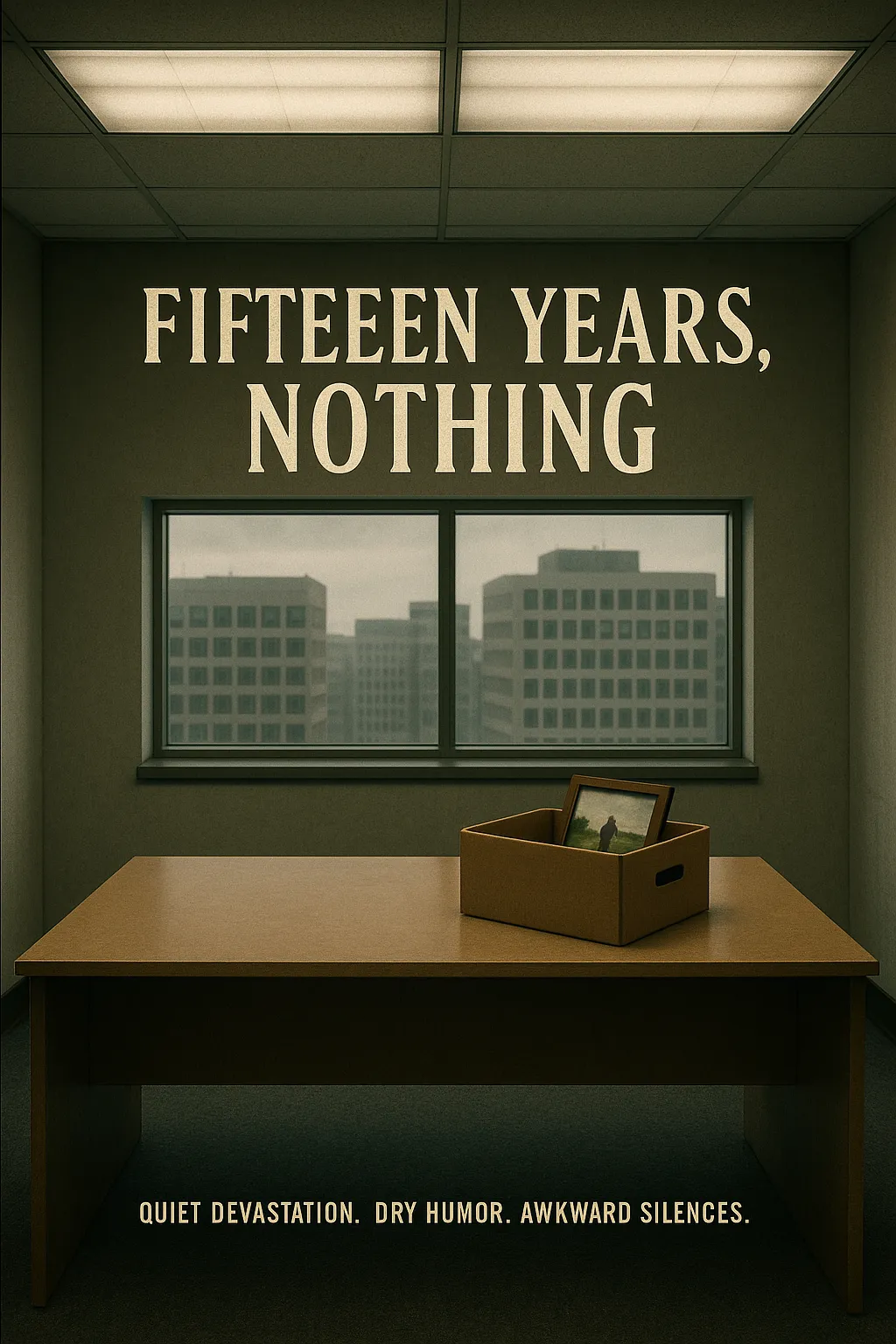
Fifteen Years, Nothing
The lift doors opened on the fourth floor at 8:47, same as every morning for fifteen years, except Chris had never noticed the smell before. Industrial carpet and recycled air and something faintly sweet from the vending machine alcove. The kind of smell you stop registering after the first week. Funny that it came back now.
Chris carried a flattened cardboard box under one arm. It had held reams of A4 once. Now it was going to hold whatever fifteen years looked like when you folded it up and took it home.
The open plan stretched out under fluorescent light. Forty-odd desks arranged in pods of four, half of them occupied this early. Nobody looked up. The same nobody-looked-up as any other Tuesday, which was the thing about it — there was no way to tell if people were ignoring the day or just hadn't started performing yet.
Chris's desk was the second one in from the window, pod seven. Eleven years in this exact spot. Before that, four years on the third floor back when third floor was still Claims. The mug was where it always was. The monitor had a sticky note on it — Chris's own handwriting, a password reminder for a system they'd already been locked out of as of Friday.
Three desks away, Murray was already in. He was always already in. He sat with his back quarter-turned, reading something on his screen with the careful attention of a man who had decided, very early this morning, what he was going to look at and for how long.
Chris set the box down and opened the top drawer. Paracetamol. A phone charger for a phone two phones ago. Three pens from a conference in Harrogate that Chris could no longer place the year of. A photograph of Chris's mother, tucked behind a stack of Post-its, smiling at no one for god knows how long.
Jordan appeared at the edge of the pod, holding a mug that still had the Wilko sticker on the bottom. Two weeks in. Still keen enough to make eye contact.
Jordan gestured vaguely at the desk that would be theirs on Monday. Right now it held a keyboard, a monitor, and a small succulent in a pot that said THANKS FOR BEING AWESOME, which had belonged to someone called Priya who left in 2019. Nobody had moved it. Nobody had watered it either.
"All yours by end of day. I'll have it cleared."
Jordan nodded too many times.
They hovered a moment, then retreated to the hot-desk area by the printer, where new people sat until they earned a permanent spot. Chris had earned this one in 2013. It had taken four months and a restructure.
The noticeboard by the kitchen was visible from here. Chris could see the usual clutter — a fire warden list, a poster about the mental health first aider, someone selling a Fiat Punto. There was a space in the bottom left corner where farewell cards usually went. Helen's had been there for two weeks. Big gold letters. SORRY TO SEE YOU GO. Helen had been here three years.
The space was blank.
Murray coughed quietly at his desk. Did not turn around.
Chris picked up the mug — white, no logo, a brown ring inside that no amount of washing had touched since about 2016 — and walked to the kitchen.
The kitchen was a generous word for it. A counter, a kettle, a fridge with a passive-aggressive sign about labelling your milk. Chris filled the kettle and flicked it on and leaned against the counter to wait, because that was what you did. Fifteen years of waiting for kettles. There was probably a calculation for how much of a life that was. Chris didn't want to do it.
The noticeboard was right there. Chris didn't look at it. Looked at the kettle instead, at the little orange light.
Someone had pinned up a flyer for a bake sale. Friday. Proceeds to the social fund. The social fund that paid for farewell cards and leaving drinks and those supermarket cakes with the icing that tasted like sugared plastic. Chris had put into that fund every month for fifteen years. Direct debit. It probably hadn't been cancelled yet.
The kettle clicked off. Chris made tea with the efficiency of someone who could do it without sight — bag, water, thirty seconds, squeeze, milk, bin. The spoon went back in the sugar jar at the wrong angle and Chris fixed it, because someone had to.
Gavin from Underwriting came in, nodded the way you nod at someone you've seen every day for a decade without ever learning what they do outside of work.
"Alright."
"Alright."
Gavin opened the fridge, took out a Tupperware, and left. He hadn't looked at the noticeboard either, but then he wouldn't have been looking for anything on it.
Chris stood in the doorway with the tea and watched the floor fill up. Nine o'clock now. People arriving in ones and twos, shrugging off coats, logging in. The day assembling itself around a shape that still included Chris for another seven hours. Jordan was at the hot desk by the printer, smiling across the room — a quick, uncertain thing — before looking back down.
Murray had got up from his desk. He was at the water cooler, filling a glass with great concentration, his back to the kitchen. He'd have had to walk past Chris to get there. Must have gone the long way round, past the filing cabinets.
On the noticeboard — Chris looked now, couldn't help it — the mental health first aider poster smiled out from between the fire warden list and the bake sale flyer. DENISE KOWALSKI, HR. HERE IF YOU NEED TO TALK. Chris had never spoken to Denise about anything except a P45 query in 2011. Seemed late to start.
Chris took the tea back to the desk. The box was still there, still flat, still empty. The photograph of Mum was face-down in the open drawer where Chris had left it. The day was not going to announce itself. That much was clear.
Chris was at the desk, tea going cold, when the thought arrived. Not a generous thought, exactly. More like a reflex — the same one that had kept the sugar jar straight and the kitchen rota updated for a decade. Someone new. Someone sitting alone by the printer. Someone who didn't know where the good mugs were.
Chris picked up the mug and walked over to the hot desk.
"Want a tea? I'm making one."
Jordan looked up from the keyboard with the startled gratitude of someone who'd been pretending to be busy.
"Oh — yes, please. That'd be lovely. If you're sure. Only if you're already — yeah. Thank you."
"How do you take it?"
"Milk, one sugar. Sorry — is that okay? I can do it myself, honestly, I didn't mean to—"
Chris was already walking back to the kitchen.
Chris made the tea. Two mugs this time. The kettle was still warm enough that it barely needed reboiling.
When Chris set the mug down on the hot desk, Jordan had a little notebook open. The page was half-filled with neat handwriting. Chris caught a fragment upside down: radiator half eleven.
"I've been writing down the things people tell me. About the office, I mean. So I don't forget. Someone said the radiator by pod seven goes mad if you don't bleed it before half eleven."
Chris knew this. Chris had bled that radiator every Tuesday and Thursday for years, until it became one of those things that just happened, that nobody saw or scheduled or thanked anyone for.
"That's right. Before half eleven or it clanks all afternoon."
Jordan wrote this down too.
"Is there other stuff like that? Things that aren't, like, written down anywhere but someone should know?"
Fifteen years of knowing which drawer stuck, which phone extension was mislabelled, who to call when the third-floor printer jammed because the official IT number just rang out. All of it in Chris's head. None of it in a document.
"Yeah. There's a fair bit, actually."
Jordan's pen was ready. Chris sat on the edge of the hot desk — not quite sitting down, not quite staying — and started talking. The radiator. The printer code that wasn't the one on the sticker. The fact that Facilities would ignore your first email but always answer the second if you CC'd someone called Brenda. Jordan wrote it all down in that small, careful hand, nodding, and Chris kept going, and for about four minutes it felt like something was being handed over rather than thrown away.
Then Jordan looked up from the notebook.
"Can I ask — sorry, this is probably — was it good? Working here?"
The question sat there between them. Jordan's pen had stopped moving. Behind them, the fourth floor hummed along — keyboards, a phone ringing twice and stopping, someone's chair squeaking as they leaned back. Murray was at his desk, scrolling.
Chris picked up the cold tea and took a sip.
Jordan nodded, and wrote something else down, and didn't push it. Chris stood up from the edge of the desk. Through the glass partition, Gavin was walking past with a folder under his arm — brisk, purposeful, a man in transit between two points with no time for a third. He glanced sideways at Chris and Jordan, then kept walking.
Chris unfolded the box. It took a moment to remember how — the flaps interlocked in a way that required a specific sequence, and the first attempt collapsed. Second try held. Chris set it on the desk beside the keyboard and opened the top drawer.
The paracetamol went in the bin. The phone charger — micro-USB, genuinely ancient — went in after it. The Post-its went in the box, because Post-its were Post-its. The Harrogate pens Chris lined up on the desk, three in a row, uncapped each one to test it. Two were dead. The third still worked, barely, leaving a thin scratchy line on the back of an envelope. Chris put the working one in the box and binned the other two.
The photograph of Mum was still face-down where Chris had left it earlier. Chris picked it up and looked at it properly for the first time in — how long? The edges were soft with age. She was standing in the garden at the old house, squinting into the sun, holding a mug. Chris didn't remember taking the photo. Didn't remember putting it in the drawer, either, but that must have been early days, third floor, when the desk still felt temporary.
Chris placed it face-down in the box, on top of the Post-its.
The second drawer had less in it. A cardigan that Chris kept for when the air conditioning was set to what felt like a punishment. A broken umbrella, compact, the kind you buy at a train station when it's already raining. Chris opened it and one spoke stuck out sideways like a dislocated finger. It had been broken since 2020. Chris put it in the bin.
Under the cardigan, pushed to the back of the drawer, was a farewell card. Not Chris's. Sanjay's. Sanjay from Compliance, who'd left in 2017. The card had been signed — twelve, maybe fifteen names in various colours of biro. GOOD LUCK IN YOUR NEXT CHAPTER. Someone had written keep in touch!! with two exclamation marks. Someone else had drawn a small cake. Chris turned it over. On the back, in pencil: Sanj — your last day drinks are Thurs 4pm, Kitchen 2.
Chris didn't know how it had ended up in this drawer. Maybe someone had asked Chris to hold onto it before the presentation, and then Sanjay had left early, or the drinks had moved, or something had come up. Seven years in a drawer. All those signatures. Keep in touch.
Chris set the card on the desk, outside the box.
Murray's chair creaked. Chris didn't look up, but caught the movement in peripheral vision — Murray half-turning, then stopping, then reaching for his water glass instead. The glass was already empty. He held it for a moment anyway before setting it back down.
The bottom drawer was mostly empty. A hole-punch that belonged to the company. A stapler that might have. Chris left both and closed the drawer.
That was it, then. The box held: Post-its, one pen, a cardigan, and a photograph. Fifteen years.
Gavin appeared from the direction of the stairwell, moving at his usual pace — just fast enough to discourage anyone from falling into step beside him. He slowed as he passed pod seven. Didn't stop. But he slowed, and his eyes went to the box on the desk, and then away, and then he was past, already talking to someone in Underwriting about a file.
Over by the printer, Jordan was writing in the notebook again. The page Chris could see was nearly full now. Chris watched them write for a moment, then turned back to the box.
Sanjay's card sat on the desk beside the keyboard, next to the password reminder for a system Chris could no longer access. Two pieces of paper, both useless, both still here.
Chris took the stairs. The lift would have been faster but the stairs meant not standing in a metal box deciding what to say. Three flights down, hand on the railing, the box left on the desk upstairs with Sanjay's card sitting beside it like a question nobody had asked.
The third floor corridor was quieter than the fourth. Narrower, too — Chris had forgotten that. Four years down here and the main thing that came back was the sound: the way voices carried differently off the lower ceiling tiles, a murmur rather than the fourth floor's open hum.
HR was at the far end, past the old Claims section that was now something called Client Experience. The door was open. Denise Kowalski was at her desk, typing with the focused intensity of someone who had heard footsteps and decided not to look up.
Chris knocked on the open door anyway.
Denise looked up. Her hand went to the lanyard around her neck, turning the plastic ID holder over and over between her fingers with a faint click.
"Chris. Hi. Come in — sit down, if you want."
There was a poster on the wall behind her. MERIDIAN VALUES: INTEGRITY. COLLABORATION. RESPECT. Someone had stuck a smiley-face sticker over the full stop after RESPECT. It had been there long enough to yellow.
Chris didn't sit.
"I've been paying into the social fund. Direct debit. Fifteen years."
"I know."
"Helen got a card. She was here three years."
Denise's hand stilled on the lanyard. She looked at a point somewhere past Chris's left shoulder.
"I put in a request. For your farewell. Three weeks ago. I put in the form, the budget line, the room booking for Kitchen 2."
"And?"
Denise pulled her chair forward, closer to the desk, as though the desk itself could share the weight of what she was about to say.
"The optics."
"I'm sorry. I should have told you. I've been — I couldn't work out how to say it, and then it was today, and—"
Chris watched her. Denise's fingers had found the lanyard again, worrying the edge of the plastic sleeve where the lamination was starting to peel.
"Helen got a card."
Denise closed her eyes for a moment.
Chris's weight shifted. One hand found the door frame.
The corridor hummed with something electrical — a server cupboard, maybe, or the vending machine around the corner. Chris had never noticed it from inside the office. Only from the doorway, half in and half out.
"I wanted to do something. I want you to know that."
"But you didn't."
Denise didn't answer. The lanyard was still in her hand.
Chris turned to leave. Got two steps into the corridor.
Chris stopped. Didn't turn around. The vending machine hummed. Someone on the third floor laughed at something, distant and ordinary.
"Yeah. It is, though."
Chris took the stairs back up to the fourth floor. Fourteen steps per flight, three flights. Chris had counted them once, years ago, and the number had never left.
Chris came up the last flight and pushed through the fire door onto the fourth floor. The air hit different from this end — warmer, the radiators along the east wall doing their work unchecked. Pod seven's radiator was already starting to tick. It was ten past eleven.
Chris didn't go back to the desk. Turned left instead, toward the filing cabinets that nobody used anymore but nobody had moved, the ones Murray walked past every time he wanted to avoid the kitchen route. The carpet here was a shade darker — less foot traffic, or a different batch from a replacement years ago. Chris had never worked out which.
Past the window where you could see the car park. Chris's car was in the third row, same spot as always because nobody else wanted to walk that far from the entrance. Four floors up, it looked like a toy. There was a scratch on the roof from a shopping trolley that you couldn't see from here. Chris stood at the window for a moment. A woman in a red coat crossed the car park carrying a laptop bag. She didn't work here. Must have been cutting through.
The pod nearest the window — pod twelve — was empty. It had been empty since the last restructure. Four monitors, four keyboards, four chairs pushed in at angles that suggested someone had tidied them once and then stopped caring. A mug on one desk with a dried brown ring inside. Nobody's mug now.
Chris kept walking. Past Underwriting, where Gavin was on the phone, one hand flat on his desk, speaking in the clipped cadence of a man working through a checklist. He didn't look up. His screen showed a spreadsheet with half the cells highlighted yellow.
Past the printer alcove, where the code on the sticker still read 4471 instead of 4417, and where Jordan was standing with a sheet of paper, frowning at the keypad. Chris almost said something. Kept walking.
The noticeboard. Chris looked. Looked away.
Past Kitchen 2, which was locked, which was always locked unless someone booked it. There was a whiteboard on the door for reservations. The last entry was from March: DENISE K — FAREWELL — 2PM. Below it, in different ink: CANCELLED. Chris hadn't seen this before. Hadn't had reason to walk past Kitchen 2.
The fourth floor was filling up toward lunch. Conversations layered over each other — someone arguing gently about a deadline, someone else laughing at a video on their phone with the volume just low enough to pretend they weren't. A chair rolled across plastic matting. The photocopier exhaled. Eleven years of this sound, and Chris could have mapped every source with closed eyes.
Chris came around the long way and back to pod seven. The box was where Chris had left it. Post-its, one pen, a cardigan, a photograph face-down. Sanjay's card was still on the desk beside the dead password reminder.
Murray was at his desk. He wasn't looking at his screen. He was looking at nothing in particular — the middle distance between his monitor and the wall — and when Chris sat down, he turned.
His face was the same face it always was. Tired around the eyes. A day's worth of not saying something sitting in the set of his jaw.
Murray stood up. He was holding a biscuit — a single Bourbon, still in its wrapper — and he set it on the edge of Chris's desk without ceremony, the way you'd put down a pen you'd borrowed.
"It's quarter past eleven."
"Well."
Murray sat back down. Didn't turn to his screen. Just sat there, hands on the armrests of his chair, facing slightly toward Chris for the first time all morning.
Chris picked up Sanjay's card. Opened it. All those signatures, the small drawn cake, keep in touch with its two exclamation marks. Seven years in a drawer. Chris closed it and placed it back in the second drawer — the one it had lived in — and shut it.
The radiator in pod seven clanked once, loud, and then began its steady metallic ticking. Half eleven. Nobody got up to bleed it.
Jordan appeared at the edge of the pod, notebook in hand, pen behind one ear. They looked at Chris, then at the radiator, then back.
"Valve's on the left side, near the floor. Quarter turn. You'll need a flathead."
Jordan wrote it down. Then looked up.
Chris nodded. Jordan went to find a flathead screwdriver, and Chris knew they wouldn't find one in the supply cupboard because it was in the second kitchen drawer, but Jordan would work that out eventually, or they wouldn't, and either way the radiator would keep clanking until someone learned.
Chris picked up the box. It weighed almost nothing.
Murray was looking at his screen again, scrolling slowly through something. As Chris stood, Murray's hand moved to his water glass — still empty — and then dropped to the desk.
Chris stood there with the box. Three desks away. Eleven years.
Neither of them said goodbye. Murray's screen scrolled. Chris's pass was in the box, on top of the cardigan, ready to hand in at reception. The radiator clanked again — twice, then a third time — filling the silence with its small, mechanical demand that somebody do something.
Chris walked to the lift and pressed the button. The doors opened. Inside, it smelled like carpet and recycled air. The sweetness from the vending machine was gone — someone must have restocked it, or the machine had finally died. Chris stepped in and pressed G and watched the fourth floor narrow to a sliver and then close.
The lobby was empty except for the receptionist, who took Chris's pass without looking at the name on it. She dropped it into a drawer with a small plastic sound — the same drawer, probably, that held all the others. Chris didn't wait for a receipt or a thank you or whatever was supposed to happen. The automatic doors parted and the car park air hit cold and damp.
Chris walked to the third row. The scratch on the roof caught the light — a thin white line from a shopping trolley, years old, that you could only see from this angle. Chris had never parked anywhere else.
Chris put the box on the passenger seat. A cardigan sleeve spilled over the edge.
The building looked like every other building on the business park. Four floors of tinted glass. You couldn't tell which windows were the fourth floor from out here. Couldn't see the noticeboard, or the empty pod, or Kitchen 2 with its whiteboard. Couldn't see Murray at his desk, scrolling through nothing.
Chris's phone buzzed. A text from an unknown number.
Hi, it's Jordan. Sorry to bother you. Do you know where the flathead screwdriver is?
Chris sat in the car for a moment with the engine off, looking at the message. Then typed: Second kitchen drawer, left of the sink. Quarter turn anticlockwise. Don't force it.
Chris started the engine. The pen rolled off the passenger seat into the footwell. Chris left it there.
The barrier lifted without needing the pass. It had always been on a sensor. Chris indicated left, out of habit, though there was nobody behind to signal to, and pulled onto the road.