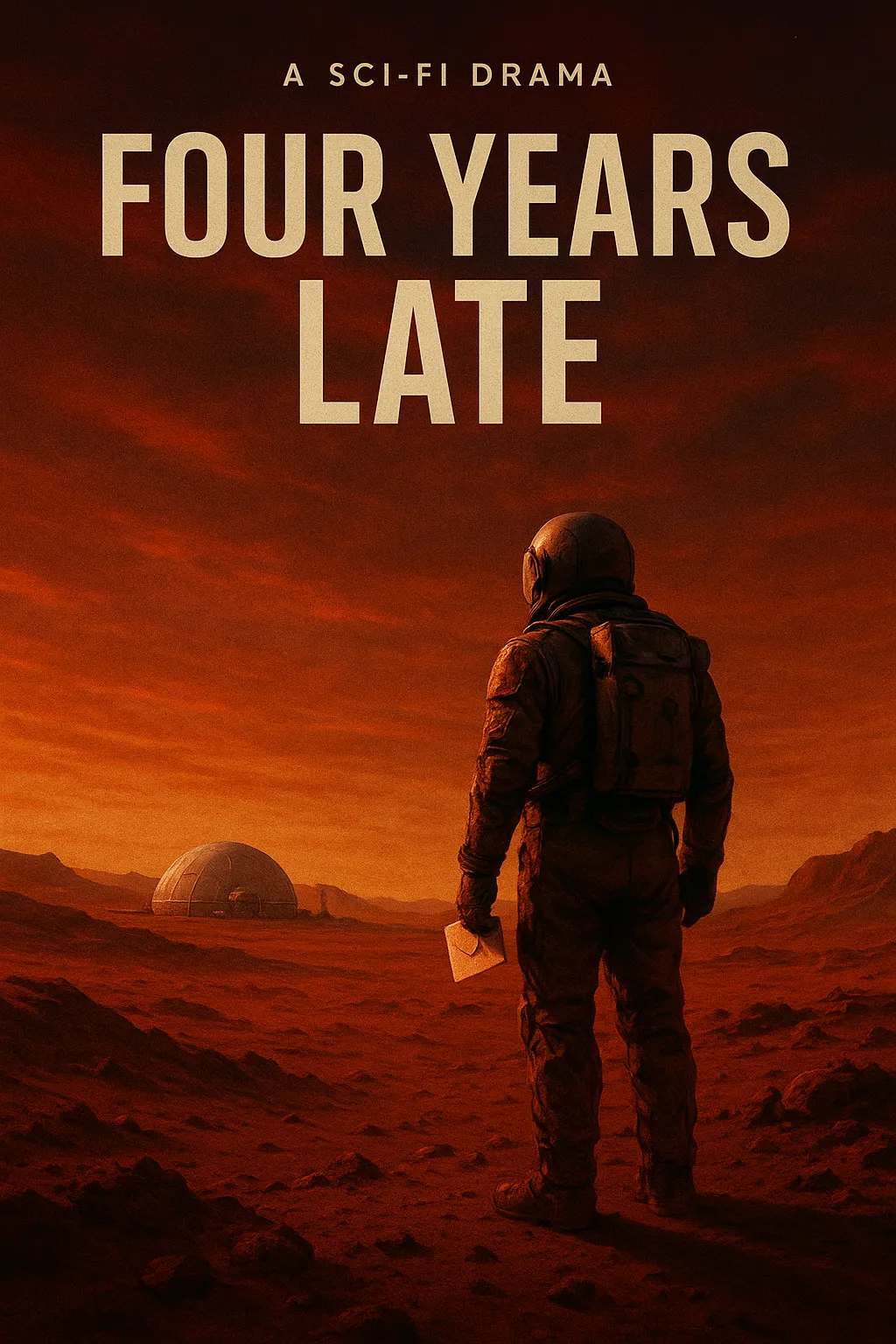
Four Years Late
Sol hadn't been inside the Communications Hub in three years. The door stuck the same way it always had — a half-second delay, then a pneumatic sigh, like the room was deciding whether to let him in.
Low ceiling. Warm plastic smell. A bank of relay monitors along the far wall casting everything in pale blue. Brynn sat behind the counter with her boots up, reading something on a tablet, and she didn't look surprised to see him. She'd sent the notification to his quarters an hour ago. Most people would have come sooner.
She set the tablet down and swung her boots off the counter.
He crossed the room. It was maybe fifteen steps but he felt each one, the way you feel stairs when you're carrying something heavy. Brynn reached below the counter and produced a small envelope — not paper, but the stiff recycled polymer the colony used for everything. Inside it, he could feel the shape of a data chip, thumb-sized, hard-edged.
"Earth-origin personal mail. Came in on last night's relay batch. Logged at origin about four years, two months ago."
She held the envelope out across the counter. Sol took it. The chip's edges pressed into his palm through the polymer.
He didn't ask who it was from. Brynn watched him not ask.
"No."
A beat passed. Brynn leaned her forearms on the counter, casual, like they were just two people talking.
Sol put the envelope in his jacket pocket. He could still feel the chip's shape through the fabric, a small hard fact he couldn't unfeel.
"Thanks, Brynn."
She nodded. Didn't push. Didn't wish him well or ask if he was okay. She just picked her tablet back up, and the dismissal was kinder than anything she could have said.
Sol walked back across the fifteen steps. The door sighed open. The corridor outside split left toward the residential quarter — his bunk, his small desk, the privacy to open the chip and hear whatever was on it. Right led to the greenhouse modules and the last two hours of his shift. Kess would be there, elbow-deep in the hydroponic trays, and she'd look up and say something ordinary, and he'd have to be ordinary back.
He turned right.
The greenhouse was twenty minutes into its afternoon cycle when Sol came through the double seal. Grow-lights had shifted from blue-white to amber, and the air was thick and green, the kind of warm that made you forget the planet outside was trying to kill you.
Kess was three rows in, crouched beside a hydroponic tray with a conductivity meter in one hand and a look on her face like the chard owed her money.
She didn't look up.
"Seemed like the beans couldn't wait."
He pulled on his work gloves and moved to the adjacent row, where the snap peas were climbing their trellis lines in slow, determined spirals. The envelope sat in his jacket pocket, hung on the hook by the seal door. Ten feet away. He could feel it like a sound in another room.
They worked. Kess hummed something tuneless. Sol checked root systems, trimmed dead runners, logged nutrient levels on the row tablet. The work was good. The work was always good. It asked nothing of you except your hands.
He was wrist-deep in the pea tray, fingers sorting through root tangles, when he said it.
The conductivity meter beeped. Kess tapped a reading into her tablet.
"Yeah?"
"From Earth. Personal."
He kept his hands in the roots. Easier to say things when you were looking at something alive that wasn't looking back.
Kess set the meter down on the edge of the tray. She was watching him now — he could feel it the way you feel weather changing.
"Four years."
"Four years."
She pushed her sleeves up past her elbows, fingers working the cuffs higher even though they had nowhere left to go. Then she turned back to the chard.
That was it. She didn't ask. The greenhouse breathed around them — filters cycling, water moving through lines, roots drinking in the dark — and they worked until the lights shifted again.
Sol didn't go to Brynn. He'd thought about it all morning — walking back into the Communications Hub, asking what metadata came attached to the chip, whether the sender's name was in the log. But that would make it real in a direction he wasn't ready for. So instead, during the midday nutrient check, he said it sideways.
Kess was repotting starter plugs at the propagation bench, her fingers dark with substrate. She had a spray bottle in one hand and a look of concentration that meant the seedlings were being difficult.
"Can I ask you something about comms protocol?"
"You can ask me anything about comms protocol. I'll know none of the answers."
"When personal mail comes in from Earth — does Brynn see who sent it?"
Kess set the spray bottle down. She didn't look up, but her hands stopped moving.
"Sender name, origin city, relay timestamp. She logs it all for the manifest. Doesn't read the content, though. That's encrypted to the recipient's biometric."
"So she'd know the name."
"She'd know the name."
Sol pulled a tray of pea shoots toward him and started thinning the weakest stems. Pinch and pull. Pinch and pull. The small violence of making room.
"The sender's last name would be the same as mine."
Kess's hands went to her sleeves. Pushed them up. They were already up.
"Okay."
She gave him the steady, practical attention she gave the plants when they weren't thriving.
"I haven't opened it."
"I know."
"How do you know?"
She nodded toward his jacket, hanging by the seal door. The pocket where the chip sat, visibly untouched since yesterday.
He almost laughed. Didn't, quite.
"You want to know what I think."
"Not particularly."
"Good. I think you should read it."
The grow-lights shifted. The amber deepened toward the red end of the cycle, and for a moment everything in the module looked like it was lit by a sun that was closer than it should be. Sol's hands, dark with soil. The tray of pea shoots. Kess's face.
"Four years ago, someone sat down and wrote something to me. And I'm standing here thinning pea shoots."
"The pea shoots will be here tomorrow."
Sol wiped his hands on his work pants. Crossed the module. Took the jacket off the hook and felt the chip's edge through the pocket, the same small hard shape it had been yesterday, carrying the same words it had carried for four years and two months and however many hours it took him to stop pretending he wasn't going to read them.
He didn't look back at Kess. The seal door opened, and he walked through it.
The bunk. The desk. Sol sat down and put the chip in the reader.
The screen asked for biometric confirmation. He pressed his thumb to the sensor and a loading bar filled, and then a face appeared — a young man, mid-twenties, dark hair cut short, sitting in what looked like a kitchen. Behind him, a window with actual weather in it. Gray sky. Rain on glass.
Sol's hand found his mouth.
The young man on the screen looked directly into the camera. His eyes were Sol's eyes — the same deep brown, the same slight asymmetry. He opened his mouth, closed it, opened it again.
A laugh that wasn't really a laugh. Matteo rubbed the back of his neck and looked away from the camera, then back.
"I don't know if you still check these. I don't know if you ever checked these. I asked at the relay office and they said personal mail gets delivered whether you want it or not, so. Lucky you."
The rain on the window behind him. Sol could hear it, faintly, under Matteo's voice — a sound that hadn't existed on Mars in four billion years.
"I'm not — I want to be clear, I'm not asking you to come back. I know how that works. I looked it up. Return transit, reacclimation, all of it. I'm not asking for that."
He was fidgeting with something below the camera's frame. His sentences came in pieces, each one started like he'd rehearsed it and then abandoned halfway through for something more honest.
"I got married. That's — I mean, that's not why I'm sending this, but it happened. Her name's Dara. She's a structural engineer. She thinks I'm funny, so, you know. Questionable judgment all around."
Sol sat very still. On the screen, Matteo's expression shifted — the humor falling away like something he'd been holding up with both hands.
"We have a daughter. Lucia. She's — hold on."
Matteo reached off-screen and came back with a photograph, holding it up to the camera. A baby, dark-haired, mid-laugh, one fat hand reaching for something outside the frame. Sol leaned forward in his chair before he knew he was doing it, as if he could get closer, as if the screen weren't a wall and the wall weren't two hundred million kilometers thick.
"Almost one. She does this thing where she grabs your finger and just — holds on. Won't let go. Dara says she gets that from me."
He set the photograph down. Looked at the camera again. The rain had stopped behind him, or he'd closed the window.
When Matteo spoke again, the fragments were gone. Whatever wall he'd been building the sentences around, he'd stopped building it.
Matteo breathed. Sol could hear it — just breath, just air moving in a kitchen on Earth four years ago.
"Then Lucia came. And I'd hold her and think — how did he do it. How did he hold something like this and then get on a ship. And I don't mean that as — I'm not trying to — "
He stopped. Started again.
The message ended. No goodbye, no sign-off — just Matteo looking into the camera, and then the screen went to the relay service timestamp. Four years, two months, eleven days.
In the desk drawer, under a manual he'd never read, there was a photograph. He hadn't opened that drawer in a long time. He didn't open it now.
Lucia. Almost one, Matteo had said. So almost five now. Walking. Talking. Whole sentences.
He played it again.
Brynn was eating something from a foil pouch when Sol walked in. She set it down and wiped her fingers on her pants, already reaching below the counter.
"Figured you'd be back."
"I want to send a reply."
Brynn pulled out a blank recording tablet and set it on the counter between them.
"Audio, video, text — all the same on my end. You record it yourself, bring it back, I queue it for the window."
"Seven days."
"Seven days."
Sol picked up the tablet. Lighter than he expected. He turned it over in his hands, feeling the smooth edges, the slight warmth from the counter where it had been sitting.
"Brynn."
"Yeah."
He set the tablet back down. Put both hands flat on the counter.
Brynn's thumbnail found her front teeth. A quick tap, two three, then she stopped.
"Okay."
"He has a daughter. Lucia. She was almost one when he recorded it."
He hadn't planned to say that. But Brynn was sitting with the first thing, and she hadn't flinched, and something about the way she waited made the second thing possible.
"How old now."
"Almost five."
Brynn looked at him. Then she picked up her foil pouch, took a bite, chewed, swallowed. The ordinariness of it was a kindness.
"You ever sent a reply to Earth before?"
"No."
"Don't try to say everything. Whatever you think needs four years to travel — cut it in half. Then cut it again. Make it light enough that it can still mean something when it gets there."
Sol picked up the tablet.
"You know where I am."
He walked out. Left, toward his quarters.
Module B was the older greenhouse — lower ceiling, narrower rows, the herb trays crammed in where someone had once planned a second propagation bench. A stripe of Martian light came through the viewport slit and fell across the basil.
Kess was on her knees between the rosemary and the thyme, replacing a drip line. She had soil on her jaw and a wrench in her teeth and she looked up when the seal opened.
She took the wrench out of her mouth.
"Thanks."
He sat down in the row across from her. Not on a stool, not at the bench — on the floor, back against the tray housing, legs out in front of him. Kess watched him do it and didn't say anything. She set the wrench down and wiped her hands on her knees.
"I opened it."
"Yeah."
"It was a video. From my son."
Kess went still. Not performatively — just the way a person stops when they're recalibrating what kind of conversation they're in.
"Matteo. His name is Matteo."
"How old."
"He was twenty-five when he recorded it. So twenty-nine now. Maybe thirty. I'd have to — yeah. Twenty-nine or thirty."
He rubbed his face with both hands. Held them there a moment.
"He got married. Woman named Dara. Structural engineer. He said she thinks he's funny."
She said it to the drip line she'd picked back up, threading it through her fingers without actually working on it.
"No. God, no. Terrible sense of humor. Gets it from his mother."
Something moved across his face that wasn't quite a smile.
"They have a daughter. Lucia."
"You have a granddaughter."
Sol nodded.
"Do you know what she looks like."
"He held up a photo. Dark hair. She was laughing at something. Almost one."
"Almost one then."
"Almost five now."
He said it and then he just sat with it. Almost five. Four years of a person he'd never met, compressed into the distance between one number and another.
Kess set the drip line down.
Sol's hands were on his knees. He looked at them.
"Do you."
Sol opened his mouth. Closed it. Tried again.
"I don't — I called it other things. Checking the relay schedule and telling myself it was habit. Keeping a photo I don't look at. Working late so I'd be tired enough to sleep without — "
He stopped. Pressed his thumb into the heel of his other hand, hard, like he was trying to feel something simpler.
"Yeah. I think about them."
Kess didn't move closer. Didn't touch his arm or tell him it was okay. She sat in her row and he sat in his and the space between them was two feet of greenhouse floor and she left it exactly as it was.
"I have seven days to figure out what to say back."
"What are you going to tell him."
"I don't know. Something. Something that's — I don't know."
He got up. It took him a second — hands on the tray housing, one knee, then standing. He looked older doing it than he had sitting down.
"Sol."
He turned.
"Lucia's a good name."
He stood there. Then he said it back — "Lucia" — just to hear it in his own voice, in the air, in a room where someone else knew it now. And then he went to find somewhere quiet enough to be worth failing in.
Six days he carried the tablet. It sat on his desk next to the reader that still held Matteo's chip, and every night he picked it up and every night he set it back down. On the third day he turned it on and stared at the blank recording screen for eleven minutes and then turned it off. On the fifth day he said "Hey" to it and then deleted the file and went to bed.
Now it was the sixth day. Forty-nine hours until Brynn needed it. He sat at the desk with the tablet propped against the wall and his hands in his lap and the room around him small and quiet and his.
He pressed record.
For a few seconds, nothing. Just Sol looking at the camera the way his son had looked at the camera — trying to find where to start when there was no good place.
"So I got your — yeah. I got it."
He rubbed the back of his neck. Dropped his hand. Picked at something on the desk surface that wasn't there.
"I don't know how to do this. I've been carrying this thing around for almost a week and I keep thinking I'll figure out what to — but I'm not going to. So."
He looked away from the camera. Looked back.
"Dara sounds. I mean, a structural engineer. That's — good. That's real. And she thinks you're funny, which — you're not, you know that. You got that from your mother. She wasn't funny either and she thought she was and that was the whole — "
He stopped. Swallowed.
"Lucia."
Just the name. He sat with it. His jaw worked like he was chewing something he couldn't get down.
"I work in a greenhouse. I don't think I ever — I grow snap peas and herbs and chard, and I check root systems, and I'm good at it. I'm good at keeping things alive. That's not — I'm not trying to make a point, I just. You asked if I think about you and I'm trying to tell you when."
"I think about you when I'm checking the roots. I think about you when I — "
He caught himself. The rhythm of it, the performance. He closed his eyes for a second.
"I think about you all the time. I just got good at calling it other things. Checking the relay schedule and saying it's habit. Working late so I'd sleep. You know."
A breath. Unsteady.
"You asked if the distance is the same from both sides."
He opened his mouth to answer it. Closed it. His hand found the edge of the desk and held on.
"No. I don't think it is. I don't think that's how it works. I think I made it and you got it and those aren't the same thing and I'm not going to sit here and tell you they are."
"You said you used to think you were the reason. You weren't. But I don't know how to explain what was, because I've had years to figure that out and I still — "
His hand went flat on the desk. He stared at it like it belonged to someone else.
"I was afraid of something. I don't have a good word for it. I thought the distance would make it smaller. It didn't make it smaller."
"Tell Lucia — no. Don't tell Lucia anything. She's five. She doesn't need some — just. When she grabs your finger. Hold on."
He sat there. The recording was still running. He could hear the faint hum of the station's ventilation, the only weather this place had.
"I'm going to send this before I delete it again."
He stopped the recording.
He opened the desk drawer. The photograph was where it always was, face-down under the manual. He picked it up and looked at it for a long time. Then he set it back on the desk, face-up, and left it there.