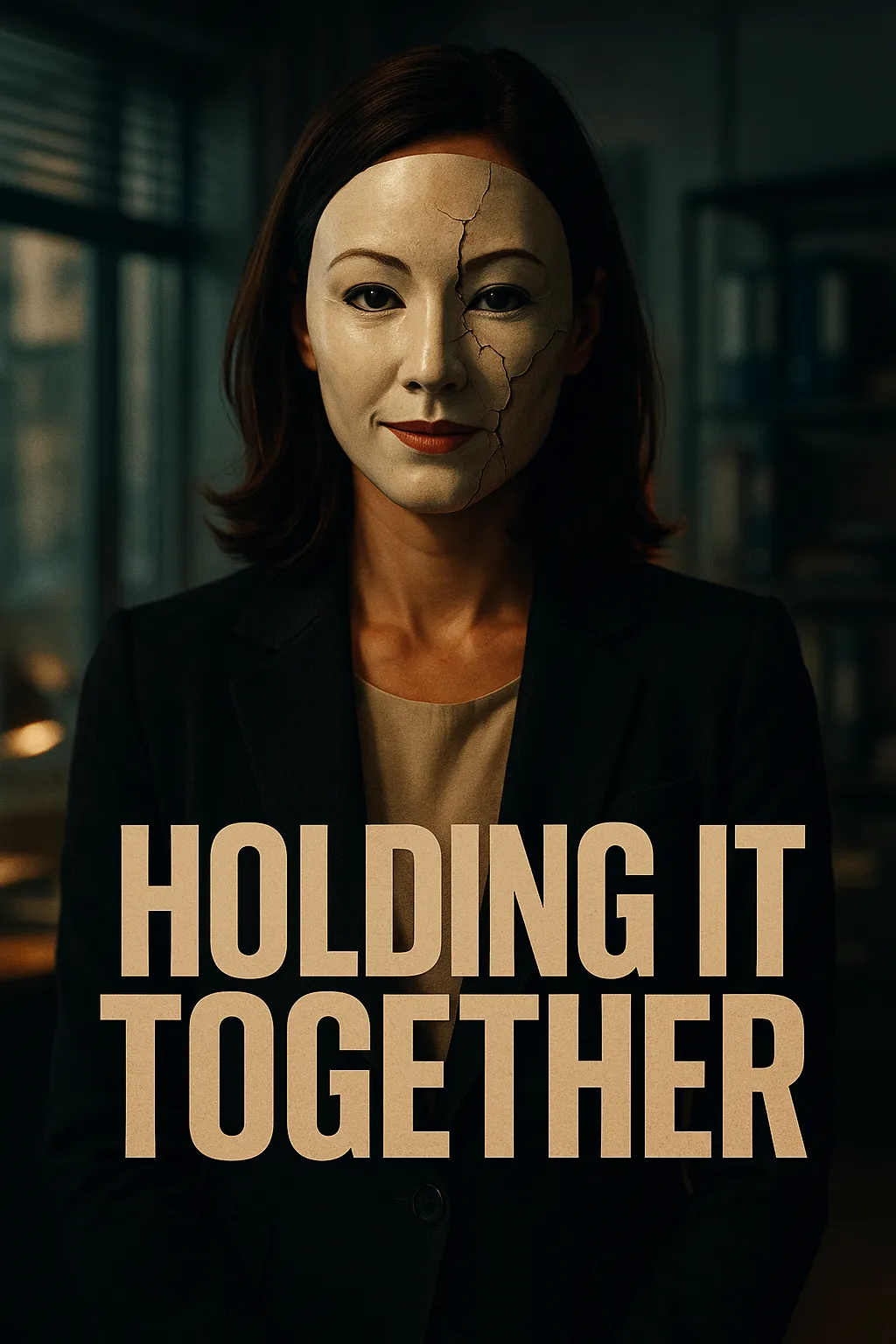
Holding It Together
The bathroom tile was cool through their slacks. Sable sat with their back against the tub, legs stretched toward the door, phone in hand, fully dressed for a day they were not yet vertical for.
Their thumbs moved across the screen with the easy rhythm of someone running five minutes ahead of schedule.
The message to Ren:
Send. Lock screen. The phone went dark and caught their reflection — a slice of jaw, one eye, the collar of a shirt they'd ironed at eleven the night before because the wrinkle near the second button would have eaten them alive by noon.
Bag packed, outfit chosen since last night. And in the fridge, lunch in a glass container Sable had washed immediately after packing it. Not because it needed washing. Because the thought of it sitting in the sink — food residue slowly drying, becoming harder to clean, becoming a task instead of a non-event — would have followed them to work. A low-grade hum under every conversation, every slide deck, every smile. So they'd washed it. And dried it. And put it away. And then taken it back out to pack the lunch.
Grounding, their therapist would say. Sable called it hiding in a room with a lock on the door.
Their phone buzzed.
"Oat latte. Extra shot. You're an angel and I'm a disaster. See you at 9."
Sable's mouth moved. Not quite a smile. They read the message twice — not because they needed to, but because Ren's texts always sounded like Ren, and for a second that was nice, and then it wasn't, because Ren sounding like Ren meant Ren would look at them today with those warm, careful eyes and ask how they were doing, and Sable would say fine, and it would be a performance so practiced it had its own muscle memory, and Ren would almost believe it, and the almost was the part that was getting dangerous.
They stood up. Knees cracking. Forty-five minutes on a tile floor would do that.
The mirror over the sink showed someone ready. Sharp blazer, clean lines, hair deliberate. The kind of person who had a morning routine, not a morning negotiation. Sable studied the reflection the way they'd study a proof before sending it to a client — checking for errors, for anything that might betray the process behind the product.
Nothing visible. There never was.
On the counter, half-hidden under a folded washcloth, sat a business card. Dr. Adaora Osei, Clinical Neuropsychologist. The appointment was for two weeks from Thursday. Sable had made it three times and cancelled it twice. This was attempt number three, and they hadn't told anyone it existed — not Ren, not their mother, not even the version of themselves that showed up to work every day and made it look easy.
Because that version didn't need a neuropsychologist. That version was fine. That version was, by every metric that mattered to anyone with authority over Sable's career, exceptional.
Sable picked up their bag. Turned off the bathroom light. Locked the apartment door behind them — testing the knob once, then once more, then making themselves walk away before a third check could root them to the welcome mat.
The morning was bright and ordinary and did not care what it cost to walk into it.
Sable didn't start the car.
They sat behind the wheel with their bag on the passenger seat and their keys in the ignition and their hands in their lap, and they looked at the garage wall — a flat expanse of painted concrete, unremarkable, the kind of surface that existed only to be ignored — and they let it hold their attention the way a dock holds a rope someone forgot to untie.
The car smelled like the vanilla air freshener clipped to the vent, which Sable had bought because the previous one — pine — had started to smell like a memory they couldn't place, and unplaceable memories were the kind of thing that could eat an afternoon. The vanilla was fine. Neutral. It smelled like a decision that had already been made.
Outside, a neighbor walked a small dog past the parking structure entrance. The dog stopped to investigate a crack in the sidewalk. The neighbor waited. Sable watched them with the detached interest of someone in an aquarium — life on the other side of something transparent and hard.
Their phone buzzed in the console. They didn't look at it.
The dashboard clock read 8:11. The drive was twenty-two minutes without traffic, twenty-nine with. The coffee stop added eight. Sable had told Ren they were grabbing coffee on the way, which meant the coffee stop wasn't optional, which meant they needed to leave by 8:21 to arrive unhurried, 8:29 to arrive on time, 8:34 to arrive with an apology. These numbers lived in their body like a second pulse.
They sat with it. The math, the vanilla, the garage wall. The check engine light glowing its small steady amber on the dash — on for three weeks now, not knowing preferable to knowing.
Their phone buzzed again. This time Sable glanced down.
Two notifications. Ren's was a photo — a selfie at their desk, dark circles visible even through the filter, captioned with a single skull emoji. The other was an email from Kieran Ashe, subject line: Quick thought re: Bellweather.
Sable opened Kieran's email. They read it once quickly, then again slowly, the way they read anything that might change the shape of their week.
"Sable — Been thinking about the Bellweather rebrand since Friday's presentation. Your spatial work on the identity system was genuinely the best thing I've seen come out of this office in two years. I want to put you on the pitch team for their Phase 2 expansion. Bigger scope, more visibility, C-suite audience. I think you're ready. Let's talk today. — K"
Sable's chest tightened — not dread, not yet, something closer to the feeling of a belt notched one hole too far. The praise landed warm and then immediately load-bearing, the word "visibility" sitting in the sentence like a stone in a shoe. C-suite audience. More eyes. More surface area to monitor.
They locked the phone. The screen went dark and there was their face again — composed, professional, someone anyone would trust with a C-suite pitch. Sable set the phone face-down on the console.
8:19. Two minutes of grace left before the math started costing them.
They turned the key. The engine caught. The check engine light held its amber glow, patient and indifferent, and Sable pulled out of the garage into morning light that was, again, offensively beautiful.
Sable pulled out of the garage and made it three blocks before their thumb was already hovering over the contact. Dr. Osei's office. The number sat in their recent calls like a bruise they kept pressing — two outgoing, two cancelled, the pattern so clean it was almost funny.
They hit the call button at a red light on Calder Street. Not because they were ready. Because if they waited until they felt ready, the appointment would evaporate for the third time, and Sable had made a deal with themselves somewhere around minute thirty on the bathroom floor: they would call before the coffee stop. Not after. Before. Because after the coffee stop there would be Ren's face and the oat latte handoff and the walk into the building, and by then the mask would already be load-bearing and they would not take it off to make a phone call.
The line rang twice. Three times. Sable's hands were at ten and two, and the left one was going numb — not clenched, just bloodless, like the circulation had quietly decided to be somewhere else.
A voice picked up, warm and administrative.
"Hi, Margot. This is Sable — I have an appointment on the fourteenth? I was calling to —"
The sentence stalled. Sable watched the red light hold. A cyclist crossed the intersection, unhurried, and for a moment the only sound was the turn signal they didn't remember activating, ticking its small metronome.
"— to confirm. I was calling to confirm the time."
"Of course! Let me pull that up. Sable... yes, I have you at 2:15 on Thursday the fourteenth with Dr. Osei. Does that still work?"
The light turned green. Sable didn't move. A horn behind them — short, not angry yet — and they eased off the brake, merging into the flow of Highland Avenue with the phone on speaker in the console mount.
The word came out before the cancellation could.
"Great! We'll send a confirmation email. And Dr. Osei asked me to remind you — there's an intake questionnaire attached. If you can fill it out beforehand, it helps her make the most of your time together."
"Got it. Thank you, Margot."
They ended the call. The car was quiet. The turn signal was still going — tick, tick, tick — and Sable reached over and cancelled it, and the silence that replaced it was enormous.
An intake questionnaire. Which meant checkboxes. Which meant: Do you find it difficult to maintain eye contact? Do you rehearse conversations before having them? Do you experience sensory overwhelm in environments others find manageable? Sable could see the form already, could feel the specific nausea of reading a description of yourself written by someone who had never met you and getting every answer right. Like being identified in a lineup you didn't know you were standing in.
They pictured Kieran's face. Not angry — worse. Recalibrating. That micro-pause before speaking that meant someone was reassembling their model of you. Sable, who they'd just offered the Bellweather pitch. Sable, whose spatial work was the best thing he'd seen in two years. Sable, who apparently needed — what? Accommodations. Extra time. A different kind of lighting. The word "gifted" quietly replaced by the word "compensating."
The coffee shop was two blocks ahead. Sable could see the green awning. They set the phone face-down on the passenger seat — not in the console, not where they could see the screen — and realized their left hand had feeling again. The numbness had migrated somewhere behind their sternum, a dull cold spot, like swallowing an ice cube whole.
They pulled into the lot. Cut the engine. The check engine light died with it, and for a few seconds Sable just sat in the tick of cooling metal, keys in hand, not yet the person who was about to walk in and order an oat latte with an extra shot and know exactly how to hold it so the sleeve didn't slip when they handed it over.
Not yet. But soon.
The bell over the door was B-flat. Sable knew this the way they knew the drive was twenty-two minutes without traffic — not because they'd sought the information but because their brain collected things without asking and never threw anything away.
Inside: exposed brick, chalkboard menu, four occupied tables, the espresso machine doing its rhythmic industrial shudder. The ambient noise sat at exactly the level where it filled gaps without pressing. Sable had been coming here for eighteen months and had never considered trying anywhere else.
The barista — Tomás, mid-twenties, gauge earrings, always wiped the counter twice after pulling a shot — looked up.
"Hey! Oat latte, extra shot, and a — let me guess — cortado?"
"You're getting scary good at that."
It cost almost nothing anymore. The coffee-shop voice, the smile that invited but didn't open. Muscle memory.
Sable stepped to the side to wait and their gaze landed on a woman at the window table. Late twenties. Laptop open, oversized headphones resting around her neck like a piece of armor she'd temporarily set down. On her canvas bag, pinned at an angle that suggested it had been placed there on purpose and never adjusted, a small enamel pin: an infinity symbol in rainbow gradient, and underneath, in block letters so small you'd have to be standing exactly where Sable was standing to read them — ACTUALLY AUTISTIC.
Sable looked for one second. Then they looked at the chalkboard menu, which they had memorized in November.
The woman was typing something. Unhurried. She had a matcha in a ceramic mug — she'd asked for ceramic, not paper, which meant she was staying, which meant she'd chosen this place too, for whatever reasons people chose places. Her headphones were the expensive noise-cancelling kind. She wasn't wearing them and she wasn't hiding them and she wasn't performing any particular relationship to them. They just sat around her neck, obvious, like a fact about her she'd stopped explaining.
Sable studied the chalkboard. Turmeric latte. Lavender cold brew. Things they would never order.
The phrase "C-suite audience" surfaced, unbidden, in Kieran's voice. Then "visibility." Then the specific weight of the word "ready," which in Kieran's email had meant one thing and in Sable's chest meant something else entirely — not a door opening but a stage getting bigger, more lit, more watched.
Tomás set the two cups on the counter. Sable reached for them — oat latte in the left hand, cortado in the right, the sleeve on Ren's cup adjusted with a quarter-turn so the seam wouldn't catch their fingers on the handoff.
"Every day, like clockwork."
He meant it as a compliment. Sable took it as one. Both of these things were true and neither was the whole truth, and Sable turned toward the door with a cup in each hand, which meant passing the window table, which meant passing the bag with the pin, which meant not looking at it again. They did not look at it again.
The woman glanced up as Sable passed. Not at Sable specifically — at the movement, the way you'd register a shape crossing your peripheral vision. Her eyes were dark, direct, briefly curious, and then she was back to her screen. Eight seconds, maybe. The whole interaction. If you could call it an interaction. If you could call the act of existing three feet from someone who had pinned a word to their bag that you couldn't say in your own therapist's office an interaction.
Sable pushed through the door. The bell rang behind them — same note, different weight, the way a room sounds after someone's said something no one's going to address. The parking lot was bright. Their car sat where they'd left it, ticking faintly as it cooled, and Sable stood on the sidewalk holding two coffees and not moving yet.
8:26. Fine on time. Fine on everything.
Sable got back in the car and set Ren's latte in the cupholder. Their cortado went between their knees, too hot to drink, warm enough to feel through their slacks.
They opened the browser on their phone. Typed: Dr. Osei intake questionnaire neuropsych. The autocomplete offered it after four letters, which meant they'd searched this before. They didn't remember when.
The PDF loaded. Twelve pages. The first two were demographic — name, date of birth, insurance, emergency contact. Sable scrolled past them the way you skip the terms of service, looking for the part that would cost something.
Page three. Section header: Early Development. Did you meet developmental milestones on time? Were there concerns about speech, motor skills, or social engagement in early childhood? Describe your experience of school, including any difficulties with attention, organization, or peer relationships.
Sable read each question the way they read client briefs — once for content, once for subtext. The questions weren't asking what they said they were asking. "Describe your experience of school" didn't mean describe your experience of school. It meant: when did you start pretending, and how long did it take before you forgot you were doing it.
Page five. Current Functioning. Rate the following on a scale of 1 to 5. Sable's eyes moved down the list the way a safecracker listens to tumblers.
I find it difficult to maintain eye contact during conversation. I rehearse what I will say before social interactions. I notice sensory details that others seem to ignore (sounds, textures, lighting). I experience significant fatigue after social situations, even enjoyable ones. I have been told I am "too sensitive" or "too intense." I develop systems or routines to manage tasks that others handle intuitively.
Sable set the cortado on the dash. They needed both hands free, though they weren't doing anything with them. The phone sat in their lap, screen still lit, and they looked at it the way you look at a letter you've already opened but haven't unfolded yet.
The scoring rubric was visible at the top of the section. A small note in italics: 1 = Never, 2 = Rarely, 3 = Sometimes, 4 = Often, 5 = Almost Always. Clinical, neutral, the kind of language designed to flatten experience into data. But Sable could see the architecture underneath — the distance between "sometimes" and "often" was where diagnoses lived. Three was a person having a rough year. Four was a pattern. Five was a structure.
They could answer this honestly. They could also answer it the way they answered everything — calibrated, aware of the audience, tuned to what the system expected. Not lying. Just... editing. The same skill that made client presentations seamless. Read the room. Sense what the question wants. Deliver the version that produces the desired outcome.
The problem was that Sable didn't know which outcome they desired.
A 3 across the board and Dr. Osei would see someone high-functioning with some anxiety. Reasonable. Manageable. The kind of person who books a neuropsych eval because they read one too many Twitter threads. A 5 across the board and — what. A name for it. Documentation. Something on a chart that couldn't be un-charted.
Sable scrolled back up to the first rated question. I find it difficult to maintain eye contact during conversation. They thought about Ren. About the specific effort of meeting Ren's gaze and holding it for the right duration — not too short, which read as evasive, not too long, which read as intense. The calculation that happened every time, invisible, costing nothing anyone could see and something Sable couldn't measure.
They didn't answer it. They scrolled down again. I develop systems or routines to manage tasks that others handle intuitively. The lunch container, washed and dried and put away and taken back out. The ironed shirt. The twenty-two minutes without traffic, twenty-nine with. The coffee order memorized, the bell catalogued, the sleeve adjusted on a cup that wasn't theirs.
Through the windshield, the coffee shop window was visible. The woman was still at her table. Sable could see the shape of her headphones, now up over her ears. Someone at the next table must have gotten loud. She hadn't moved, hadn't flinched, hadn't apologized. Just put them on.
Sable looked at her for longer than they meant to. Not at the pin — they couldn't see it from here. At the gesture. The ordinary, unperformative act of needing something and just doing it.
The screen dimmed in their lap. The questionnaire grayed out behind the auto-lock, and Sable let it go dark. They picked up the cortado from the dash. It had cooled to the temperature where you could actually taste it — bitter, round, the crema already dissolving into the shot.
8:31. They were going to be exactly on time. Ren would be at their desk. Kieran would want to talk about Bellweather. The day would ask what it always asked, and Sable would give what they always gave, and somewhere in the next thirteen days they would either fill out this questionnaire honestly or they would fill it out perfectly, and those could not be the same thing.
They put the car in reverse. Ren's latte shifted in the cupholder, and Sable reached over and steadied it — a quick grip, automatic, the kind of care that didn't register as care because it looked like efficiency.
The parking lot gave way to Highland Avenue. The cortado sat between their legs, half-finished. The questionnaire sat in their phone, untouched. Both would be waiting when Sable was ready, which was not a thing Sable expected to be.
Sable didn't go to the office. They drove past the consultancy entrance, past the parking structure, past the turn they'd taken every morning for three years, and kept going until Highland Avenue appeared again like a sentence they'd started and couldn't finish. The coffee shop lot had a different car in their usual spot. They parked one space over and sat with the engine running, Ren's latte long gone, their cortado a cold residue in the cup between their knees. Kieran's email still on the phone. They'd read it enough times that the words had gone flat, the way a name stops sounding like a name if you say it too many times.
They went inside. Tomás was restocking paper cups behind the counter, his back half-turned, a sleeve of them telescoped in each hand. He glanced over his shoulder.
"Back already?"
"Forgot something."
They hadn't forgotten anything. Tomás didn't ask what. He set down the cups and moved to the machine, already reaching for a portafilter, because Sable coming back meant another cortado, and the logic of regulars was its own kind of care. Sable let him make it. The sound of the grinder filled the room and they were grateful for it — a noise loud enough to excuse not thinking.
The window table was empty. The woman with the pin was gone. Her ceramic mug sat in the bus bin, a crescent of matcha foam drying on the rim. Sable looked at it the way you look at a door someone just walked through — not the door itself but the space where the person was. She'd been sitting right there an hour ago, headphones on, not apologizing, not performing anything, existing at a volume Sable couldn't even imagine. And now just the mug. Proof she'd been real.
Sable took the cortado to a back table. They sat facing the wall, which was a choice they didn't examine. Their phone was in their hand. Not the email. Not the questionnaire. The contact card for Kieran Ashe, with the small green phone icon that would make this a conversation instead of a thing they were carrying alone.
They called. Kieran picked up on the second ring.
"Sable. I was hoping you'd call. Did you get a chance to read my —"
"I did. Yeah. I wanted to talk about it before the day got away from us."
The coffee-shop voice. Smooth, unhurried, a half-register lower than their actual speaking voice. Sable could feel the switch happen — not a decision, just a reflex, like blinking when something comes at your face.
"Good. Because I meant what I said. The Bellweather identity work — the spatial logic you built into that system — I've shown it to three people and they all had the same reaction. It's the kind of thinking that wins rooms."
"That's — thank you. That means a lot coming from you."
It did. That was the thing. Kieran wasn't performing generosity. His voice had the specific texture of someone who'd found something they wanted to champion, and the sincerity of it landed in Sable's chest like a hook — not cruel, just impossible to remove without tearing something.
"Phase 2 is a different animal. Bigger budget, longer runway, but the pitch is to their whole C-suite. Maren, their CEO, is — she's sharp. She doesn't want polish. She wants to feel like the team gets it at a structural level. That's why I want you in the room. Not presenting from a deck. Presenting from the thinking."
Sable's thumb found the edge of the table and pressed. Presenting from the thinking. Which meant no script. No rehearsed choreography of slides and transitions. It meant standing in front of a room full of executives and letting them see how their mind actually worked — the spatial reasoning, the pattern recognition, the thing that made the Bellweather system good — which was the same architecture that made the questionnaire on their phone a mirror they couldn't look into sideways.
"When's the pitch?"
"The eighteenth. Friday. I know it's tight, but honestly, most of the thinking is already done. It's your thinking. I just need you to walk them through it the way you walked me through it — that thing you do where you make the connections visible. You don't leave gaps for people to get lost in."
Sable closed their eyes. Friday the eighteenth. Four days after Thursday the fourteenth. Four days after Dr. Osei.
"I'm in."
"Yeah?"
"Yeah. Send me what you have and I'll start mapping it out."
"I'll have the brief to you by noon. And Sable — I know I'm asking a lot. But I've watched you work for three months and I've never seen you miss. Not once. That's rare."
The call ended. Sable set the phone on the table, screen up this time, and looked at it. Kieran's contact photo — a candid from the office holiday party, mid-laugh — faded as the call timer disappeared. Three minutes and forty-one seconds. In three minutes and forty-one seconds, Sable had agreed to stand in the most visible room of their career, four days after an appointment that might change what the word 'career' meant.
At the counter, Tomás was looking out the window at something in the parking lot, one hand resting on the espresso machine. The shop was almost empty. A song Sable didn't recognize was playing — acoustic, unhurried, the kind of music chosen to suggest that no one here was in a rush.
Sable opened the questionnaire. Not the email, not the intake instructions — the PDF itself, already loaded, still on page five. The rated questions. They didn't reread them. They already lived in the body like the drive times, like the coffee orders, like the bell they were not going to catalogue again. Their thumb hovered over the first answer field. The cursor blinked in the empty box beside a question about eye contact — a question they'd already answered three times in their head, each time with a different number, each number a different life.
They typed 5. The blue circle filled the field. Small, definitive, the color of a bruise just before it fades. Sable looked at it. They could feel the specific gravity of the number — not a 3, which was a person who sometimes struggled. Not a 4, which was a pattern someone might investigate. A 5 was a structure. A 5 was: this is how I am built, and I have been building around it my entire life, and I am very, very good at building.
They didn't change it. They scrolled to the next question. Their thumb was steady. The cortado cooled beside them, untouched, and outside the window the parking lot held its ordinary light, and somewhere across town Ren was at their desk waiting for a latte that wasn't coming, and Sable owed them a text, owed them an explanation, owed them something closer to the truth than 'grabbing coffee on the way in' — but that was the next thing. This was this thing. One question at a time. The way you cross a room you're not sure has a floor.
Sable answered the questions the way you walk down stairs in the dark — slowly, one at a time, hand on the wall. Page six. Page seven. Some answers came fast, the number already living in their fingers before the question finished loading. Others took long enough that the screen dimmed and they had to tap it awake, the brightness a small accusation each time.
Page eight asked about friendships. Whether they found it easier to connect with people through shared tasks than through unstructured socializing. Sable thought about Ren — not the version of Ren who texted skull emojis and called herself a disaster, but the version who went still and quiet when she sensed something wrong, who held eye contact one beat past comfortable, reading. The version Sable performed hardest for, because that version could see.
They typed 5. Scrolled down.
Page ten. Sensory processing. Do you avoid certain fabrics, foods, or textures? Do you notice sounds others don't comment on? Sable thought about the B-flat bell, the wrinkle on the shirt, the pine air freshener replaced by vanilla because a smell had started meaning something it shouldn't. They thought about the specific frequency of the office HVAC system that no one else seemed to hear, the one that sat just behind every conversation like a second voice saying nothing.
-
- 4 — no. 5.
Somewhere around page eleven, the mask didn't arrive. Sable was sitting at the back table with a cold cortado and a questionnaire that was almost done, and the thing that usually showed up — the editor, the calibrator, the part of them that read every room including the room of their own mind and adjusted — just wasn't there. Not broken. Just quiet.
The bell over the door rang. Sable didn't look up. They were reading the last question on page eleven — Do you feel you present a different version of yourself in professional or social settings than you experience internally? — and the answer was so obvious it was almost boring, a 5 so predetermined it felt like filling in their own name.
A shadow fell across the table. Sable's thumb stopped.
Sable looked up. Ren stood with her bag over one shoulder, coat still on, which meant she'd come straight here. Not from the office — from wherever she'd gone when Sable didn't show. Her face was open and a little tired and not surprised, which was worse than surprised, because surprised would have meant she'd expected Sable to be fine.
"Yeah. I do."
Ren looked at the table. The phone, screen up, the questionnaire visible — not readable from where she stood, just a shape of text and small blue circles. She didn't ask what it was. She pulled out the chair across from Sable and sat down and took off her coat with the slow economy of someone settling in.
Sable's hand moved toward the phone. The instinct was so automatic it had its own momentum — turn it over, close the screen, cover the evidence. Their fingers touched the edge of the case. They stopped. Left it.
Ren was watching. Not the phone. Sable's hand.
"No."
"You drove past, though. Tomás texted me that you came back here. I figured if you wanted to disappear you wouldn't have come back to the place where everyone knows your order."
Sable almost laughed. It came out as a breath through the nose, barely audible, and they looked down at the phone — at the blue 5 in the last answer field, small and definitive on the screen between them.
The sentence started and then didn't.
Ren waited. She'd gone still in the way she went still — no blinking, eyes steady, the patience of someone who'd learned that Sable's silences had rooms inside them.
"A neuropsych assessment. I've cancelled it twice."
The words sat in the air between them. Sable could feel the shape of more — the explanation, the context, the careful framing that would make this into a story with clean edges. It was right there, ready to be assembled. They let it sit unassembled.
Ren's hand was on the table, not reaching, just there.
One word. No follow-up questions, no recalibration, no micro-pause while she rebuilt her model of who Sable was. Just okay — the sound of someone who had already been standing on the other side of a door, waiting, not knocking.
"I don't know how to talk about it."
"That's fine. I'm not going anywhere."
Sable picked up the cortado and drank what was left of it. Room temperature, bitter, the texture slightly gritty. They swallowed it anyway.
At the counter, Tomás was pulling a shot for no one, the machine grinding its familiar shudder. Outside, the parking lot held its ordinary afternoon light. Sable's phone sat between them on the table, page eleven of twelve, mostly answered, mostly honest. Not finished. Ren's coat was draped over the back of her chair, and she was looking at Sable with an expression that wasn't careful and wasn't diagnostic and wasn't performing anything at all, and Sable didn't look away from it.