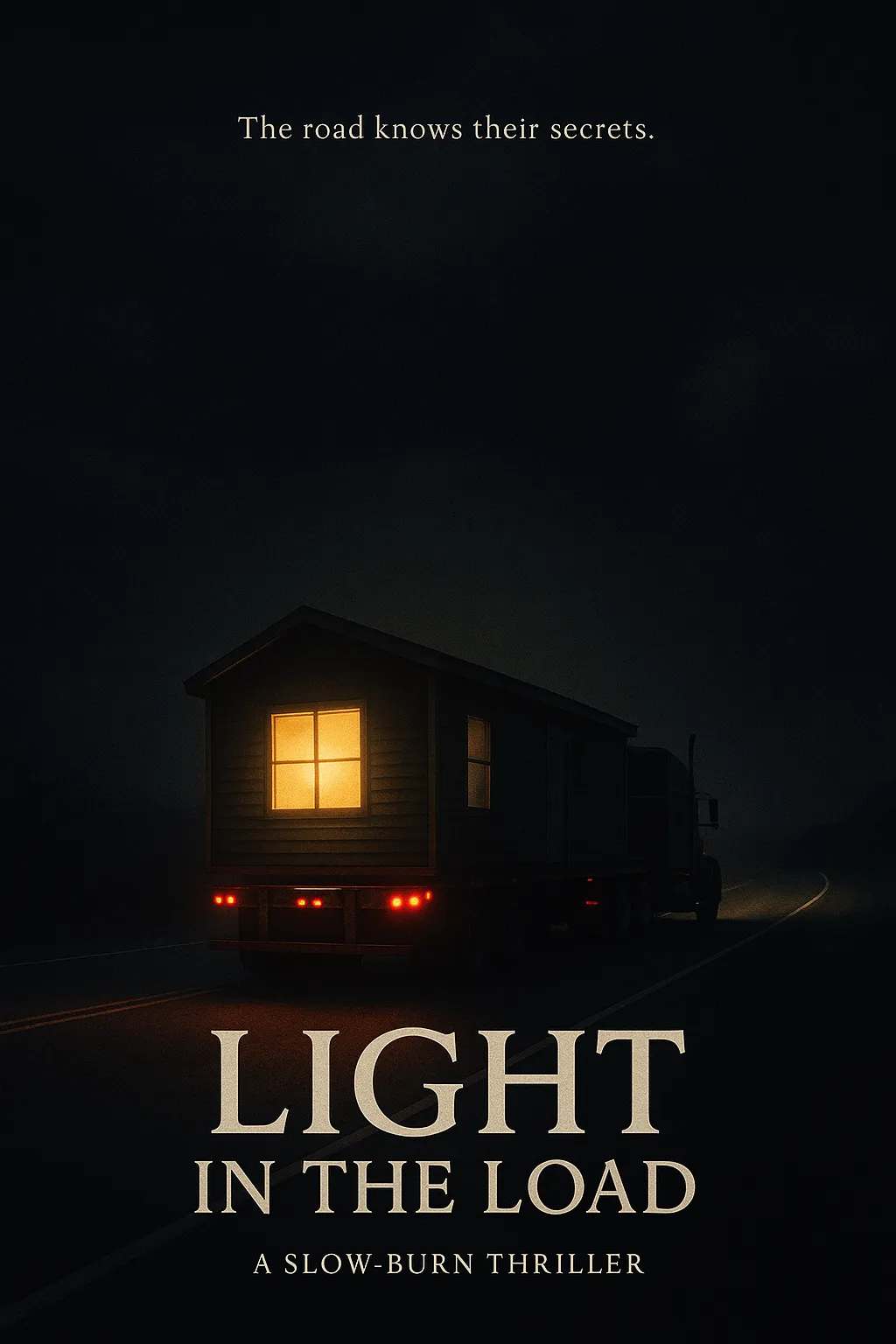
Light in the Load
The coffee had gone cold somewhere around Thermopolis. Dale drank it anyway, one hand on the wheel, the mug balanced on his thigh the way his ex-wife used to tell him would ruin his jeans. She'd been right about that. Wrong about most everything else.
Eleven years on a flatbed and he'd hauled pipe, turbine blades, a disassembled carousel once out of Tulsa. The prefab was nothing special — a two-bedroom modular unit, factory-sealed, strapped and chained on the trailer behind him. The kid at the yard in Casper had torn the inspection tag off the door himself, handed Dale the manifest, and that had been that. Thirty-eight thousand pounds of someone's future living room doing sixty-two on a dark highway.
He checked his mirrors out of habit. Left, right, left. The trailer sat heavy and stable. No sway. Good chains. He'd checked them twice at the fuel stop in Riverton because the wind had been picking up and because that was what you did.
He reached for the thermos wedged behind the passenger seat, steering with his knee for a two-count. The truck drifted right and his boot found the rumble strip — that familiar braille stutter through the cab floor. He corrected without thinking about it. Unscrewed the thermos cap. Poured.
Checked his mirrors again.
There was a light on inside the prefab unit.
Second window back, left side. A warm, steady glow — not a reflection, not headlights bouncing off glass. He knew what a reflection looked like after eleven years of checking mirrors in the dark. This was coming from inside.
Dale watched it for a long time. The road was empty and straight enough to forgive that. His heart rate didn't change on the first look, or the second. On the third it did.
The unit had no power. Factory-sealed meant factory-sealed — no generator, no hookup, plastic still over the door handle when he'd walked the load before leaving Casper. The kid with the clipboard had been chewing sunflower seeds and talking about the Broncos. Normal night. Normal load.
Dale set the thermos down without pouring from it. His eyes went back to the mirror. Still there. Steady. Like a lamp someone had left on in a bedroom, except the bedroom was doing sixty-two miles an hour through the middle of nowhere Wyoming and nobody was supposed to be home.
He passed a mile marker. Then another. The light didn't flicker, didn't move, didn't go out. His hands had tightened on the wheel without him telling them to.
The CB was clipped to the dash, channel 19, volume low. His phone showed one bar, then none, then one again. Shoshoni was maybe forty minutes out. Nothing between here and there but sage and antelope and the kind of darkness that reminded you how much of the country was just empty.
Dale reached for the CB. His hand stopped halfway there and hung in the space between the wheel and the dash.
He unclipped it. Thumbed the channel selector to confirm — 19 — and keyed the mic.
Dispatch, this is unit two-fourteen, Dale, running a prefab load westbound US-20 out of Casper. You copy?
Static. The kind that sounded like distance itself.
He counted to ten. Keyed it again.
Dispatch, two-fourteen. Anybody on?
A chair creaked through the speaker. Then a woman's voice, mid-sentence, like she'd been talking to someone else when she hit the button.
— go ahead, two-fourteen. This is Renna. What's your twenty?
Between Thermopolis and Shoshoni. Maybe forty minutes out from Shoshoni.
Copy that. What do you need, Dale?
He opened his mouth. Closed it. The question he needed to ask sounded wrong every way he tried to frame it in his head.
I got a — I got a situation with my load. The prefab unit. There's a light on inside it.
Silence on the other end. Not static — silence.
A light.
Yes ma'am. Second window back, left side. Steady. Been on at least ten minutes now.
Is the unit hooked up to anything? Generator, shore power —
No. Factory-sealed. Plastic still on the door handle when I walked it in Casper. There's no power source on that unit, Renna. None.
The chair creaked again.
Okay. Shoshoni. Shoshoni's your best bet. There's a Flying J just off the highway, you can pull in there and take a look at it under some lights.
And if someone's in there.
Then you call the county and you don't open anything. You hear me? You do not open that unit, Dale.
His hands were at ten and two. He made himself loosen them.
Yeah. Yeah, I'm here.
I'm just giving you options. Could be a battery-powered lantern left by the build crew, could be a reflection you're catching funny. Forty minutes isn't long. Keep your speed, keep driving, and check it at the J.
It's not a reflection.
Renna didn't answer that.
Forty minutes, Dale. I'll log it. Check in when you get to Shoshoni.
Copy.
He clipped the CB back on the dash. The cab was quiet again — just the diesel and the road seams thumping under the tires at steady intervals.
He did not check the mirror. He drove. Thirty-seven minutes to Shoshoni, give or take, and every one of them his.
Dale thumbed through his contacts without taking his eyes off the road. His phone found one bar and held it.
He hit the name. Held the phone to his ear.
It rang four times. He was about to pull it away when the line opened.
Dale.
He heard a faucet running somewhere behind her. It shut off.
Yeah. I know what time it is.
You always know what time it is. That's never stopped you.
He shifted in the seat. The phone was warm against his ear and the cab was cold and he didn't know how to start this.
I've got something wrong with my load.
Okay.
I'm hauling a prefab. Sealed unit, no power, nobody in it. And there's a light on inside.
The faucet didn't come back on.
What do you mean a light.
A light. Like a lamp. Steady. Been on since before Thermopolis.
So why are you calling me.
Dale shifted in the seat again. His jaw tightened. Out the windshield the road was two lanes of nothing, the center line feeding under the hood in quick dashes.
I don't know.
Yeah you do.
He did. He'd called because Renna had given him the right answer and he didn't want the right answer. He wanted someone who'd tell him what he was actually going to do.
You're thinking about stopping.
Dispatch says drive to Shoshoni. Thirty-some minutes. Let somebody else deal with it.
That's smart.
Yeah.
But if somebody's in there.
There it was. The thing Renna hadn't said. Renna had talked about protocol and liability and county police. Megan went straight to the person.
If somebody's in there, I've been driving them down a highway at sixty for the last two hours.
I know what you sound like when you've already decided, Dale. I listened to it for six years. You're not calling me for permission.
The heater fan clicked twice — the bearing that had been going bad since October. Wind buffeted the cab from the passenger side, pressing against the prefab's broad face behind him.
What if it's not somebody who needs help. What if it's somebody I don't want to meet on a dark road.
She didn't answer right away.
Then you don't open anything. You knock. You listen. And if it doesn't feel right you get back in that cab and you drive.
That simple.
Nothing about you has ever been simple. But you're not going to drive thirty more minutes wondering.
Dale swallowed.
Meg.
Call me when you get to Shoshoni. Not before.
The line went dead. Whether she hung up or the signal dropped, he couldn't tell. He set the phone face-down on the passenger seat. There was a receipt on the floor from the fuel stop in Riverton — $412.67, diesel. The corner was curled up from the heater vent.
The cab was just the heater fan and the tires now. He drove. His jaw ached from clenching it. A sign caught his headlights — Shoshoni 34.
Somewhere behind him, through steel and drywall and factory plastic, the light was on in a room that had no business being lit.
His left hand found the headlight switch. His right stayed on the wheel. He didn't think about it for long because thinking about it would talk him out of it.
He pulled the switch.
The road vanished. The center line, the shoulders, the sage — gone. Just the running lights on the trailer and the faint green of the dash gauges and a darkness so total it had weight. The diesel kept pulling. The tires kept their rhythm. Sixty-two miles an hour into nothing.
He found the mirror.
The window was dark.
He counted. One. Two —
He shoved the headlights back on. The road slammed into existence — reflector posts, asphalt, a jackrabbit frozen in the right lane that he straddled without correcting. His breath came back in a rush he hadn't noticed holding.
In the mirror, the light was back.
Dale's foot came off the accelerator. Not a decision — just his boot lifting on its own, the rig bleeding speed, sixty, fifty-eight, the engine note dropping. He felt the weight of the load pushing behind him, thirty-eight thousand pounds of momentum that didn't care what he wanted.
He put his foot back down.
His phone was face-down on the passenger seat where he'd left it. He picked it up. No signal. He set it back down and reached for the CB instead, then stopped with his thumb on the mic button. Renna would say the same thing she'd already said. Megan had told him not to call.
He let go of the CB.
A sign caught the headlights. Shoshoni 28. He did the math without wanting to. Twenty-six, twenty-seven minutes at this speed. The light in the window behind him had gone dark when his headlights went dark, and come back when they came back. He turned that over. It didn't fit anywhere he could put it — not a lantern, not a reflection, not a person with a flashlight. A person with a flashlight would have kept the light on.
Unless they didn't want to be seen when someone might be looking.
The heater fan ticked its bad bearing. Wind pressed the cab sideways and he corrected, a quarter-turn he could do asleep. The vinyl seat creaked under him. He realized he was sitting forward, his shoulders off the backrest, leaned toward the windshield like the extra six inches would get him to Shoshoni faster.
He made himself sit back. Twenty-seven minutes.
Dale hit 911 and put the phone to his ear. Three seconds of dead air, then a recording — 'Your call cannot be completed as —' — and silence. Not even the courtesy of a disconnect tone.
He hit redial. Same recording, this time cutting out after 'Your call' like the signal couldn't hold even that much.
Third time, nothing. Not the recording, not static. The phone just sat against his ear doing nothing at all.
He dropped it on the passenger seat and drove.
The speedometer read fifty-four. He didn't remember easing off. He pushed it back to sixty-two and the engine caught the gear change with a shudder that traveled up through the seat frame.
Then the knocking started.
Three hits. A deep, transferred thud he felt in the pedals before he heard it in the air. Spaced even. Deliberate. Then silence. Then three more.
Dale's shoulders came up toward his ears. He held still and listened. The diesel filled the cab, the road seams thumped their steady count, and underneath both — nothing. The knocking had stopped.
He waited for it to come back. A mile passed under the tires. Then another.
A third set came. Softer this time. Same rhythm, same spacing, but the force behind it had dropped. Three and three and then quiet again.
He grabbed the CB.
Renna. Two-fourteen. I need you right now.
Static. Then the click of her mic.
Go ahead, Dale.
Someone's knocking. From inside the unit. Three knocks, then three more. I felt it through the frame.
The silence on Renna's end lasted long enough that Dale almost keyed the mic again.
Knocking.
Yeah.
Okay. Okay, Dale, listen to me. I called Fremont County. There's a deputy — his name is Harlan — he's going to meet you at the Flying J. Do not stop before that. Do not open that unit.
And if whoever's in there can't wait.
Fifteen miles, Dale. Fifteen miles. Please.
He clipped the CB back. The knocking didn't come again. The road unspooled ahead of him, empty, the center line disappearing under the hood in its endless stutter. He could see the faint orange haze of Shoshoni bleeding up from behind a ridge — not lights yet, just the suggestion of them against low clouds.
His phone lit up on the passenger seat. A text from Megan: I'm up. Just drive.
He looked at the mirror. The glow was there. Steady. And the knocking had stopped the way a person stops knocking when they don't think anyone can hear.
The Flying J came up the way small towns do at night — canopy lights first, then the fuel island, then the building itself with its lit windows and its empty parking lot. Two rigs sat nose-in along the back fence. A county Bronco idled near the air pumps, exhaust curling white.
Dale swung the rig wide across the lot and brought it to a stop along the far edge where the light from the canopy didn't quite reach. The air brakes hissed. The engine shuddered down to idle. He sat there with his hands in his lap and listened to the tick of cooling metal.
He didn't check the mirror.
His knees popped when he stepped down from the cab. The cold hit him across the face and chest. He'd been in that seat for seven hours and his body didn't know what to do with solid ground — he stood there with one hand on the door, letting his legs figure it out.
The county Bronco's door opened and a man climbed out. He was built like he'd been wider once and the width had settled. Carhartt jacket over a uniform shirt, department ball cap pulled low. He crossed the lot without hurrying, boots grinding the gravel, and stopped about ten feet from Dale's rig.
He looked at the prefab on the trailer behind Dale — looked at it for a while — then back at Dale.
Yeah.
Harlan hooked his thumbs into his belt. Rocked back half a step on his heels.
Three and three. Twice. Then a softer set. Then it stopped.
When.
Fifteen, twenty minutes ago. Before that there was a light. There's still a light.
Harlan unclipped a Maglite from his belt and walked the length of the trailer. Dale followed. Their boots on the gravel were the loudest sound in the lot. The prefab sat on the flatbed the way it had sat since Casper — chained, sealed, plastic still shrink-wrapped over the door handle. Harlan ran the flashlight beam along the near side, slow, like he was reading it.
He stopped at the second window. Clicked the Maglite off.
The glow was there. Easier to see without the flashlight competing.
Harlan stood looking at it. His weight shifted back again, wider this time.
I haven't touched it.
No, I can see that.
They stood there. The wind came across the lot carrying diesel fumes and frozen sage. The canopy lights buzzed overhead, and one of the fluorescent tubes had a brown spot near the ballast end. Neither of them said the obvious thing, which was that the seal was intact and the light was on and those two facts couldn't live in the same sentence.
Then a single knock came from inside the unit. Not the three-and-three pattern. Just one. Metal on metal, sharp, from the door end.
Harlan's hand went to his hip. He caught himself and moved it back to the Maglite.
Dale watched Harlan's jaw set. The professional ease was gone.
Harlan clicked the Maglite back on and walked to the door end of the unit. The plastic over the handle caught the beam — smooth, unbroken, factory-sealed the way it had been in Casper. He leaned close to the door without touching it.
Fremont County Sheriff's Office. If someone's in there, make yourself known.
The lot was quiet. The wind dropped for a moment. From inside the unit, nothing.
Harlan stepped back. He looked at Dale.
It answered when I killed my headlights. Light went out on a count of two. Came back when I turned them on.
Harlan's mouth opened. Closed. He turned the Maglite over in his hands, end to end.
You telling me it responded to you.
I'm telling you what happened.
From the door end of the prefab, low enough that Dale almost missed it under the canopy buzz: a voice. Not words — just a sound. A single syllable, muffled through drywall and factory insulation. It could have been help. It could have been here. It could have been anything.
But it was a voice.
Harlan had gone still.
Call it in.
I mean — up. Higher up. I don't have a protocol for this.
Dale looked at him.
Could be twenty minutes. Could be an hour.
And whoever's in there waits.
Whoever's in there has been waiting since Casper. Twenty more minutes won't —
The voice came again. Louder. One word, clear enough this time to kill the sentence in Harlan's mouth.
Christ.
The word had been please.
Dale looked at Harlan. Harlan looked at the door.
I'm opening it.
Harlan stepped back half a pace.
I'm not asking you to.
Dale pulled his folding knife from his back pocket and cut the shrink-wrap off the door handle. The plastic fell away in a long curl and the wind took it across the lot. Underneath, the factory seal was a paper band stamped with a lot number and the Casper yard's address. He broke it with his thumb.
Harlan had his hand on his sidearm. Not drawn. Just there.
Dale turned the handle and pulled the door open.
New carpet. Sawdust. And under both, sweat — close and stale, the smell of someone living in a space not meant for living. The interior was dark except for a glow from the back bedroom, faint and blue-white, leaking around the doorframe.
Dale stood in the doorway. He didn't step inside.
Nothing. Then a rustling. Fabric on fabric, someone shifting position.
Small. Hoarse. From the back room.
Yeah. We're stopped. You're at a truck stop in Shoshoni. There's a deputy here. Nobody's going to hurt you.
Silence. Then the light moved — it swung across the ceiling and came forward, and a figure appeared in the hallway of the prefab. She held a phone out in front of her, flashlight aimed up. A phone flashlight aimed at a white ceiling. The screen behind her fingers pulsed red — battery icon, almost dead.
She was young. Mid-twenties, maybe less — hard to tell with the hollows under her eyes and the way her hair was matted flat on one side. A moving blanket from the build crew was wrapped around her shoulders. No shoes. The bottoms of her feet were black.
She stopped at the end of the hallway, about six feet from the door, and looked past Dale to Harlan. Then back to Dale. She stayed on Dale.
Miss, I'm Deputy Harlan with the Fremont County Sheriff's Office. Are you injured.
She didn't look at Harlan when she answered. Dale could see bruises on her upper arm — fingermarks, four in a row, old enough to be going yellow at the edges.
No.
Can you tell me how you got in there? That unit was factory-sealed.
She pulled the blanket tighter. Her phone light flickered once — the battery giving up its last percentage.
And where were you trying to get to.
She didn't answer that. She was looking at Dale.
I heard you. In Riverton. Checking the chains.
Dale's throat went tight. Riverton. He'd walked the length of the trailer and checked every chain and binder, his boots on the deck six inches from where she'd been lying in the dark, and she'd heard him and said nothing.
Why didn't you knock then.
I didn't know if I should.
She looked at him. Dale held still.
Harlan shifted his weight. He reached for the radio on his shoulder.
She didn't look at Harlan.
Wren.
She said it to Dale.
Harlan walked back toward the Bronco, radio already crackling. Dale stayed in the doorway. The wind came across the lot and Wren pulled the blanket up around her neck.
Her phone died. The light went out. She stood in the dark hallway holding a dead phone.
Dale took his phone from his pocket, turned on the flashlight, and set it on the floor of the prefab with the beam aimed at the ceiling. He sat down on the deck edge with his boots hanging off the trailer.
After a while, Wren sat down too. Not close. Close enough.
The fluorescent tube with the brown spot flickered once and went steady again. Harlan's radio squawked from across the lot. Dale's phone buzzed once against the prefab floor. He didn't reach for it.