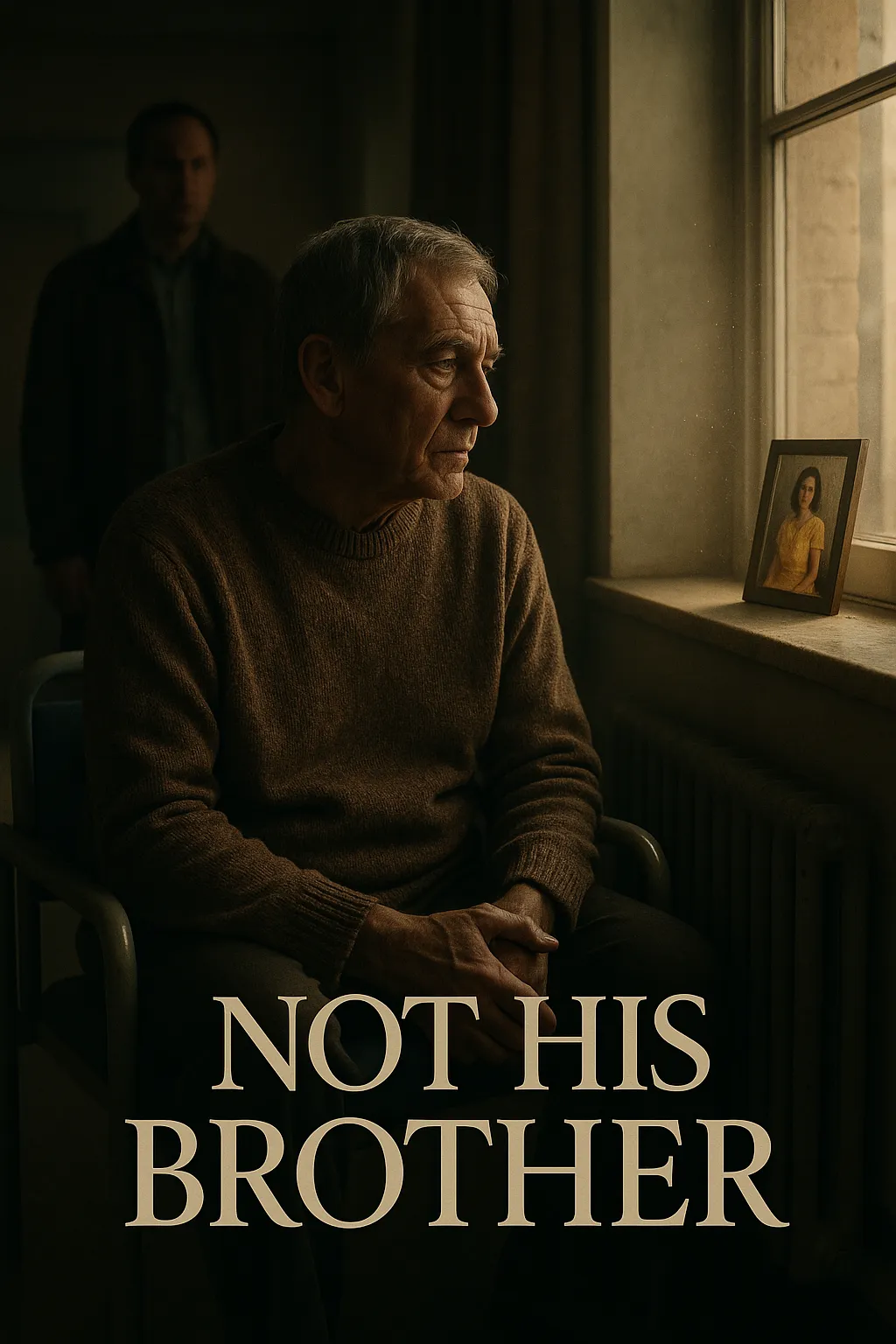
Not His Brother
The room smelled like talcum powder and reheated soup. A spider plant hung from a bracket by the window, its runners trailing down past a photograph of David's mother that had been turned slightly toward the bed — by Frank or by one of the staff, David couldn't say. The furniture was institutional except for one armchair, green corduroy worn pale at the arms, dragged here from the house when Frank moved in three years ago. His mother's chair. Frank wouldn't let them throw it out.
Frank sat in the other chair, the care home one, facing the door. He'd been watching television with the sound off. When David stepped into the doorway, his father's face did something David hadn't seen in months — it opened.
"Tommy. Jesus Christ, Tommy, get in here and let me look at you."
His father's whole body changed. Shoulders back, chin up, something lit behind his eyes. He gripped the armrests and pushed himself halfway to standing, then thought better of it and dropped back, but he was grinning — actually grinning — the way David remembered from before all this, from barbecues and birthday mornings and the one time England beat Germany in the qualifiers.
David stood in the doorway. Behind him, in the corridor, a care worker named Margaret slowed her step. He felt her presence before he heard her voice.
"He's been talking about Tommy all morning. His brother, from what I gather. He passed a long time ago."
"Sometimes it's easier if you just... go with it. But that's your call, love. It's always your call."
She touched David's arm once, briefly, and moved on down the corridor. The squeak of her shoes faded.
"Tom, what are you standing there for? You waiting for a bloody invitation? Sit down. Sit down, I'll put the kettle on — where's the... Margaret usually leaves the..."
Frank trailed off, his hand waving vaguely toward a counter that held a small electric kettle and two mugs. He looked at the counter as if it had rearranged itself when he wasn't watching. Then he looked back at David, and the confusion fell away, replaced by that same helpless delight.
"God, you look good. How do you always look the same? I'm falling apart over here and you haven't aged a day. Must be that sea air."
Something flickered across Frank's face — a shadow of a question, the faintest crease between his brows, as if a part of him understood that what he'd just said couldn't be right. It passed. Frank patted the arm of the green corduroy chair beside him.
"Come on, then. Your sister-in-law's chair. She won't mind. Dorothy always liked you better than me anyway."
Dorothy. David's mother. Dead four years now. Frank said her name the way you'd mention someone who'd just stepped out to the shops. David's throat tightened. He was still standing in the doorway, his coat still on, car keys cutting a line into his palm where he'd been gripping them.
David set his keys on the windowsill next to the spider plant and crossed to the counter. The kettle was there, and two mugs — one with a faded Blackpool Tower on it, one plain white with a chip on the rim. He filled the kettle at the small sink in the corner and clicked it on.
"Two sugars, Tom. Don't let me catch you skimping."
David opened the cupboard. Teabags in a jar with a rubber band around the lid. A box of sweeteners Margaret must have switched in months ago — Frank hadn't noticed, or didn't care. Sugar bowl beside it, actual sugar, nearly full. David spooned two into the Blackpool mug and one into the white.
He opened the fridge for milk. A sandwich in cling film sat on the middle shelf with a Post-it note reading TUESDAY LUNCH — FRANK in Margaret's careful handwriting. Today was Thursday.
David poured the milk. Behind him, he could hear his father breathing — slow and even, no restlessness in it, no agitation. Just waiting. The way you wait for someone you trust to come back across the room.
"When have I ever not had milk. Honestly, Tom, you'd think you'd never made me a bloody cup of tea."
David brought both mugs over. He handed his father the Blackpool one and watched Frank wrap both hands around it, thumbs hooked through the handle the way he'd always done, even when his hands were steady enough not to need to.
David sat in the green corduroy chair. Something shifted under the cushion — a fold, a give — and for half a second he caught it: lavender soap and wool. Dorothy. Gone before he could breathe in again.
"She'd kill me if she saw this room. Dust on the telly. Cups not put back. You know what she was like."
"Yeah. I know what she was like."
Frank blew on his tea and took a sip. His eyes stayed on David over the rim — not studying him, not searching for something wrong. Just looking, the way you look at someone you haven't seen in a long time and want to memorize again.
"I've been thinking about you, you know. More than usual. The things I want to forget stay put, and the things I want to keep..."
He trailed off. His thumb moved back and forth across the mug's surface, tracing the outline of the tower. Then he found his thread again — or a different one.
"You still down by the coast? Whitstable, was it? Or was that before."
David didn't know where Tommy had lived. He had almost nothing of his father's brother — a name, a war, a photograph somewhere in a box he'd never opened. He took a sip of tea that was still too hot and let it burn the roof of his mouth.
David set his mug down on the arm of the chair and looked at the photograph on the windowsill — his mother, younger than he'd ever known her, squinting into sunlight with her hair blowing sideways. Someone had angled it toward the bed so Frank could see it from the pillow.
"That photo of Dorothy. Who took that one?"
Frank turned his head toward the window. His face softened in a way that had nothing to do with confusion — just tenderness, plain and unguarded.
"Oh, that was the coast. That was — she'd worn that yellow dress and the wind kept getting at it and she was furious. Holding it down with both hands like she was wrestling the bloody thing. You were laughing so hard you could barely hold the camera."
David said nothing. He watched his father's eyes move across something that wasn't in the room — a beach, a dress, a woman holding her hem down in the wind. Tommy had taken that photograph. David had looked at it his whole life and never known.
"She looked beautiful that day. I mean she always — but that day. You said something to her, I can't remember what, and she laughed and forgot about the dress and that's when you took it. She was laughing."
Frank's voice had gone quiet. He took a sip of tea that must have been lukewarm by now and held the mug against his chest.
"She'd have wanted you here, Tom. She always asked after you. Even at the end, when she was — when things were bad. She'd say, has anyone told Tommy."
David's hand tightened around his own mug. His mother had died asking for her husband, for David, for the cat they'd had fifteen years ago. She had never mentioned Tommy. But Frank believed it, and the believing made his face so open and grateful that David couldn't touch it.
"She was something, wasn't she."
"She was the best of us. Better than me by a distance. Better than you too, and don't pretend otherwise."
Frank smiled — a real one, creased and lopsided. Then it faded, not all at once but in stages, like a light on a dimmer. His eyes stayed on the photograph but something behind them shifted. His thumb stopped moving on the mug.
"I should have come to the station. When you went."
The room changed. Not the light, not the sound — just the weight of it. Frank's voice had dropped into a register David didn't recognize. Lower. Steadier. As if this sentence had been rehearsed so many times it had worn smooth.
"I know you said it didn't matter. I know you said that. But I was your brother and I should have been there and I wasn't, and I have to say this to you because I don't know when I'll — before you —"
Frank's hand came up from the mug and pressed flat against his own sternum, fingers spread wide, as though trying to hold something inside his chest. His breath caught. Not a gasp — more like a door shutting on a word.
"Dad."
Frank blinked. The hand on his chest stayed where it was. He looked at David and for one terrible second his eyes were perfectly clear — not Tommy-clear, not memory-clear, but the flat confused clarity of a man who doesn't know where he is or who is sitting in his wife's chair.
Then Margaret was in the doorway with a small paper cup. She didn't knock. She read the room in half a breath and crossed to Frank's side, setting the cup on the table beside his tea.
"Medication time, Frank. Two tablets, then I'll leave you to your visitor."
Frank looked at the paper cup. Looked at Margaret. The hand came down from his chest and he took the tablets without argument, washing them back with his tea. Margaret collected the cup and turned to leave, but she paused beside David's chair. Her hand found the back of it and rested there — not on David's shoulder, just near it.
"He's had a good morning. Best in weeks."
She left. The corridor swallowed her footsteps. Frank was looking at the photograph again, and when he turned back to David his face had reassembled itself — the delight was there, but thinner now, like cloth held up to light.
"Sorry, Tom. Lost my thread. What was I — I was telling you something. Something I needed to say."
He frowned, reaching for it. His fingers opened and closed against his thigh — grasping at the shape of a thought that was already gone. Then he exhaled and shook his head.
"It'll come back. It always does. The things I want to forget stay put and the things I — well. You know."
David set his mug on the floor beside the chair. The tea had gone cold anyway. He leaned forward, elbows on his knees, and looked at his father — at the thin hands resting on the Blackpool mug, at the face still searching for whatever it had been about to say.
"Dad. I need to tell you something."
Frank's head tilted. The word again — Dad — landing in the room like a wrong note in a familiar song.
"What's that, Tom?"
"I'm not Tommy. I'm David. I'm your son."
Frank didn't grip the armrests. He didn't go still. What he did was worse — he laughed. A short, confused sound, the kind you make when someone tells a joke in a language you almost speak.
"Don't be daft. David's — David's not here today. He's busy, he's always busy, he works too much. You know what he's like."
"I'm right here, Dad. I've been here the whole time."
Frank looked at him. Really looked — not the warm sweep of recognition he'd been giving Tommy all afternoon, but a close, hard stare, the kind you'd give a stranger who'd said something unsettling on a bus. His fingers came up and touched his own mouth, pressing against his lower lip as if checking it was still there.
"No. No, you're — we were talking about Dorothy. You took that photograph, the one with the dress. You were there."
"That wasn't me. That was Tommy. Your brother. He died a long time ago, Dad."
Frank flinched. His whole upper body rocked back an inch, as if the chair had moved beneath him. Then his hand shot out and grabbed David's wrist — not gently, not the way you reach for someone. The way you catch yourself falling.
"Tommy's not dead. Tommy's sitting right — you're sitting right there, I can see you, I can —"
His voice broke apart. Not trailing off the way it had before, not losing the thread — cracking, like ice under weight. He held David's wrist and his eyes moved across David's face with a desperate, cataloguing attention. Forehead. Jaw. The set of the mouth. Looking for proof, or looking for the lie.
"You've got his eyes. You've got — why have you got his eyes?"
David couldn't speak. His father's grip on his wrist was stronger than it had any right to be — the tendons standing out on the back of Frank's hand, the skin paper-thin over the bones. Frank looked at the photograph of Dorothy, then back at David, triangulating between the living and the dead.
"David?"
"Yeah, Dad. It's me."
Frank's mouth opened. Closed. Opened again. He let go of David's wrist and brought both hands up to his own face, pressing his palms against his cheeks the way a child does when they're trying not to cry. He held them there, breathing through his fingers, and when he lowered them his face had changed — older, somehow, than it had been thirty seconds ago. As if the years Tommy's presence had been holding back had all arrived at once.
"Where's Tommy, then."
David opened his mouth. He could say Tommy's coming later. He could say Tommy sends his love. The lie was right there.
"He's gone, Dad. He's been gone a long time."
Frank nodded. Not the way you nod when you learn something — the way you nod when you're reminded of something you've been told before and will be told again and it will be new every time. He picked up his mug and took a drink of tea that must have been stone cold. Swallowed it anyway. Set the mug down with exaggerated care, lining it up with a ring stain on the side table.
"I didn't go to the station. When he shipped out. Did I ever tell you that?"
"You started to. Just now."
"I thought if I didn't see him get on the train, then he wasn't really going. That was my — that was the logic. Eighteen years old and I thought I could keep him safe by not watching him leave."
Frank blinked. His eyes were wet. He looked down at his hands in his lap as if they belonged to someone else — too old, too spotted, wrong.
"And then he didn't come back. And I'd wasted it. The last time I could have seen him and I spent it hiding in the kitchen like a bloody coward."
The room held it. The hum of the radiator. The spider plant turning imperceptibly toward the window. Somewhere down the corridor, a television played to no one.
"You look like him. Anyone ever tell you that?"
"No. No one ever told me that."
"Well. You do. Around the eyes. Same way of standing in a doorway like you're not sure you're allowed in."
David reached out and took his father's hand. Frank let him. The grip was loose now — nothing desperate in it, just an old man's hand in his son's, the bones close under the skin. Frank looked at their hands together and his thumb moved once across David's knuckle.
"David."
"Yeah, Dad."
"I'm glad you came. I don't always know — things get muddled. But I'm glad you came."
David didn't let go of his father's hand. The radiator ticked. Outside, someone was pushing a trolley down the corridor, the wheels catching on the linoleum every few feet.
"I want to tell you about me. About my life. Is that alright?"
Frank looked at him. His head was slightly forward, chin lifted, the posture of a man straining to hear music from another room.
"Go on, then."
"I'm a teacher. Year Tens. English. They're terrible, most of them. Wonderful and terrible. There's a girl called Priya who writes poems in the margins of her textbook when she thinks I'm not looking. She's better than half the poets on the syllabus and I can't tell her that because she'd stop doing it."
Frank's brow creased. Not confusion — concentration. He was listening.
"I was married. Sarah. We had eleven good years and then some bad ones and then we were honest about it, which was worse. She's in Bristol now. We're — we manage. We're kind to each other at parents' evenings."
"Sarah."
"You danced with her at our wedding. Mum had to come and get you because you wouldn't give her back."
Something moved behind Frank's eyes.
"I've got a daughter. Lily. She's nine. She does this thing where she reads out loud to the dog — sits him down on the sofa like he's enrolled in the bloody lesson and reads him chapter books. She does voices. The dog doesn't move. I think he's terrified of her."
Frank's mouth twitched. Not quite a smile. The beginning of one, held in reserve.
"Lily."
"She's got Mum's stubbornness. Exactly the same. Won't eat anything green, won't wear shoes in the house, won't go to bed without being told the same story three times. She'd drive you mad. You'd love her."
"Does she know me?"
David's chest locked. He breathed through it.
"She knows you. I bring her here sometimes. You call her 'the little general' because she rearranges your bookshelf every time she visits."
Frank laughed. One short breath through his nose, barely a sound, but his whole face changed around it — the lines deepened in the right direction.
"The little general. That sounds right. That sounds like something I'd say."
He went quiet. His free hand came up and touched David's face — fingertips against the cheekbone, light as paper. David felt the dry warmth of them, the faint tremor running through each one. He held still.
"You've got his hands. Tommy's. Big across the knuckles. Your mother used to say you'd got those hands from somewhere and it wasn't her side."
Frank's hand dropped to David's shoulder and rested there.
"Are you alright?"
It was the voice David had grown up with — the one that had asked him that same question when he'd stood in the hospital corridor after Dorothy died and couldn't make his legs work.
"Yeah, Dad. I'm alright."
David laughed. It came out ragged and he didn't try to fix it.
"I forget things. I know I forget things. People think I don't know that but I do. It's like — rooms. Doors shutting. I can hear what's behind them but I can't get back in."
His voice was steady. This was the clearest he'd been all afternoon — not the bright, borrowed clarity of Tommy's visit, but something harder-won. He was looking at David the way you look at something you're trying to press into wax before it cools.
"Tell me again. Your daughter. The one with the dog."
"Lily."
"Lily. And she reads to him."
"Chapter books. The whole thing. He just sits there."
Frank smiled. A real one — slow, arriving in stages, settling into his face like something that had been away and found its way home.
"Bring her next time. The little general. I want to see that."
The hand on David's shoulder tightened once, then let go. Frank reached for his mug, found it empty, and set it back down without complaint. He looked toward the window where Dorothy's photograph caught the last of the afternoon light — the yellow dress, the wind, the laugh Tommy had captured and Frank had carried here.
"David."
He said it carefully. Holding the word with both hands.
"Yeah, Dad."
"You'll come back."
Not a question. Frank's eyes were on his son's face, and whatever he saw there — whatever name he had for it, whatever room it lived in — he wasn't letting go of it yet.
"I'll come back. Every week. Same as always."
Frank nodded. He turned back to the window, and David sat in his mother's chair, and neither of them spoke, and the room held them both.
David eased his hand free and stood. His knees cracked — loud in the quiet room — and Frank looked up at the sound with mild alarm.
"Just making more tea, Dad. Sit tight."
Frank watched him cross to the counter the way you watch someone in an airport — already half-gone. David filled the kettle and clicked it on. The element ticked twice before catching.
He rinsed both mugs in the small sink. The Blackpool Tower had faded further than he remembered — the top of the tower dissolving into the ceramic, eaten away by years of washing. He dried it with the tea towel hanging from the cupboard handle and set it down.
Two sugars. Not the sweeteners. He didn't hesitate this time.
"You're quiet over there."
"Just making your tea."
"You sound like your mother. She used to go quiet when she was thinking too hard. I'd find her standing at the kitchen window with the tap still running."
David's hand stopped on the kettle. Frank had said your mother. Not Dorothy, not my wife. Your mother. The words sat in the room, ordinary and enormous.
He poured the water, stirred both mugs, brought them over. Frank took the Blackpool one and held it close to his face, breathing in the steam. His eyes half-closed.
"That's the stuff."
David sat. The green corduroy took his weight without ceremony. Outside, the light had shifted — the window threw a long rectangle of late afternoon across the floor, catching the leg of Frank's chair, the edge of the side table. Dorothy's photograph had fallen into shadow.
"What time is it? It feels late."
"About four."
"You'll have to get back. For the little one."
David looked at him. Frank was blowing on his tea, frowning at it with the concentration of a man defusing a bomb. But he'd said it — the little one. He was holding Lily somewhere behind a door he'd managed to push back open.
"She's at her mum's tonight. I've got time."
"Good. That's good. Don't go anywhere."
He said it lightly, the way you'd say it to someone getting up for a biscuit. But his free hand found the arm of his chair and stayed there, fingers resting on the fabric, not gripping. Just making sure it was solid.
"I had something I wanted to — no. Gone. Like a bird off a wire."
"It'll come back."
"Will it, though."
They drank their tea. Frank's eyes moved between the window and David — back and forth, slow, like a man reading a book he keeps losing his place in. The corridor was quiet. No trolley, no television. Just the two of them and the small sounds of drinking and breathing and being in a room together.
"Whatever your name is. You'll stay a bit."
David opened his mouth. Closed it. Took a sip of tea.
"I'll stay a bit, Dad."
Frank nodded once and turned to the window, and the light moved across them both, and the tea was good, and it was enough.
Frank finished his tea and held the mug out to David without looking — arm extended, waiting, the way you pass something to someone whose position in the room you know by heart. David took it and set it beside his own on the side table.
"She'll have my curtains down. The little general. She moved everything last time — I went looking for my reading glasses and they were in the bathroom cabinet. In the bathroom."
The reading glasses were on the windowsill, three inches from his hand. David didn't say so.
"That sounds like her."
"Bring her. Will you? Next time."
"I will, Dad. I promise."
Frank nodded. His hand found David's sleeve — not his hand, not his wrist, just the fabric above the cuff — and held it between finger and thumb, absently, the way you hold a thought you're not ready to let go of.
"You're a good lad, David."
He said it the way he'd say pass the milk. No weight behind it. No ceremony. Which is how David knew it had come from somewhere deeper than the afternoon — from a room that hadn't shut yet, or one that had opened just wide enough.
David crouched beside the chair. Frank's hand moved from his sleeve to the top of his head and rested there, palm flat, fingers curved against his skull. Holding his son's head the way he must have done when David was small enough to be held.
"I'll see you next week, Dad."
"Right. Good. And tell — tell her I've got biscuits. The good ones. Not those horrible pink wafers Margaret brings."
David laughed. It came out whole this time. He stood, and Frank's hand slid from his head to his shoulder and dropped away, and the loss of it was a physical thing — a warmth removed, a weight lifted that he hadn't wanted lifted.
He collected both mugs and washed them at the small sink. The Blackpool one he dried carefully and set back in its place by the kettle. The white one he left on the draining board. Behind him, Frank shifted in his chair — not settling in, but turning, angling himself toward the window where the last of the light came through.
"Dorothy."
He was looking at the photograph. Not the way he'd looked at it earlier — narrating it, living inside it, giving it back to Tommy. He was just looking at his wife. A man at the end of the day, turning toward the person he'd turned toward for fifty years.
David picked up his coat from the back of the chair. He put it on. He stood in the doorway — the way Frank had said he did, like he wasn't sure he was allowed in — and watched his father reach out and adjust the photograph's angle on the sill, tilting it a quarter-inch toward the bed. Getting it right for later. For the dark.