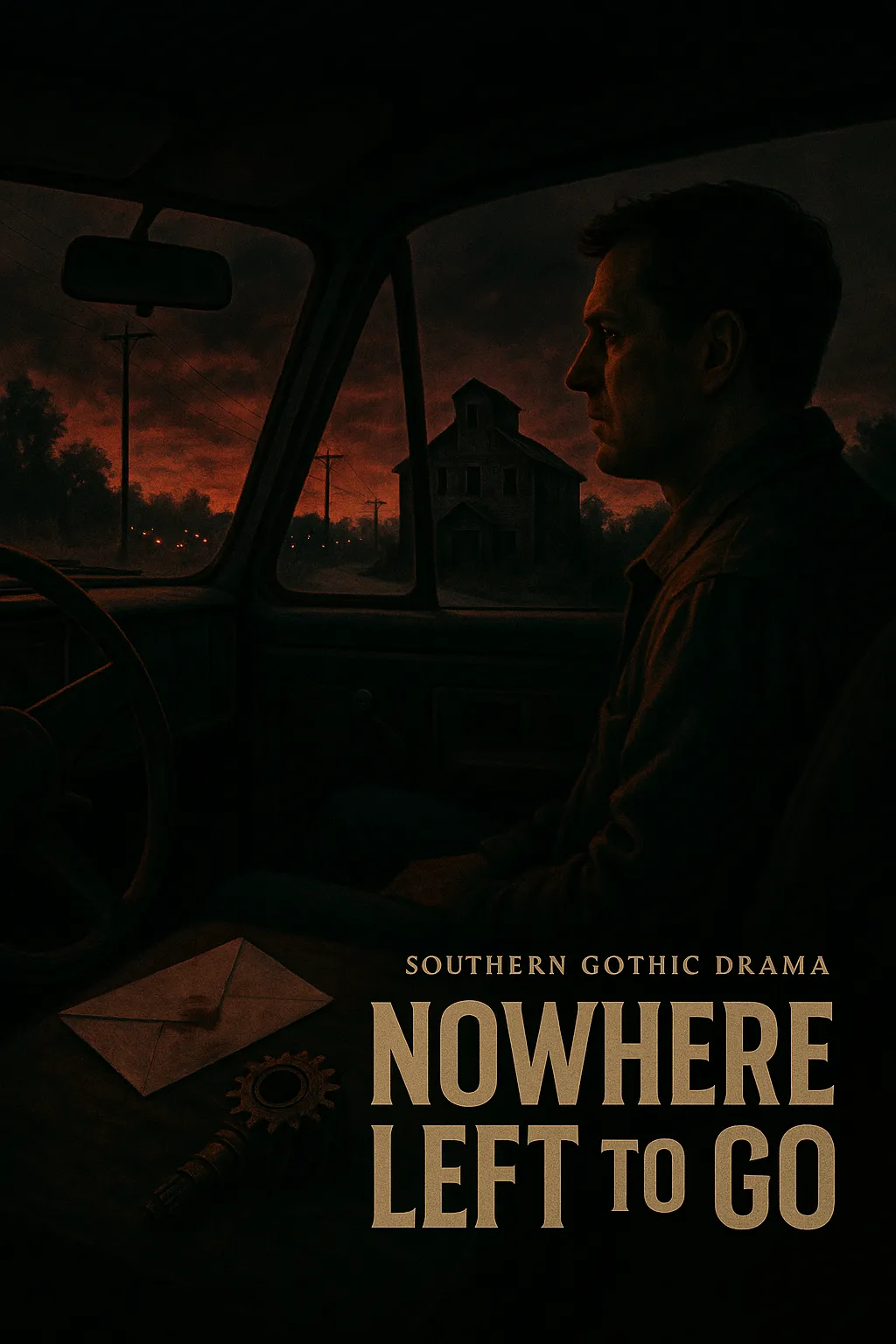
Nowhere Left to Go
The road ended where the mill used to be. Nothing left of it now but a concrete pad and some rebar reaching out of the ground like fingers that forgot what they were holding. Cade sat in his truck with the engine off and the windows down, letting the September heat settle over him like something that had nowhere else to go.
On the dash, a letter from a company in Baton Rouge. Six weeks old. He'd read it so many times the creases had gone soft. Dear Mr. — we regret to inform — position has been filled — wish you the best in your future endeavors. His future endeavors. He almost laughed every time he got to that part.
His phone buzzed against the bench seat. He looked at the screen long enough to see Eli's name, then picked up.
"You coming back or what? I got jalapeño chips and I'm not saving you any."
He said it the way he said most things lately — like the words had already been decided for him.
"Cool. Hey, I was thinking — you know that back lot behind the shop? The one with all the dead grass? What if we poured a pad out there, put up a lift. Could do alignments. Nobody in forty miles does alignments, Cade. That's money just sitting on the ground."
Through the phone, Cade could hear the compressor cycling in the shop. The fluorescent buzz. Sounds he'd grown up inside.
"Yeah. Maybe."
"I'm serious. I ran numbers. Well — I looked at some numbers. I'll show you when you get here. Just get here."
The line went dead. Eli never said goodbye on the phone, just stopped talking when he was done, the way a faucet shuts off. Cade set the phone down and didn't reach for the key.
Eli was twenty-two. He talked about the shop the way some people talk about a house they're building — like every rusted tool and cracked window was just potential waiting to be unlocked. He never questioned whether Cade would be there to unlock it. That was the thing Cade couldn't find a way to say out loud: his brother was drawing blueprints on the walls of a room Cade was trying to leave.
The letter on the dash. The phone on the seat beside him. A freight train sounded from somewhere east, the horn carrying for miles across flat land, and Cade sat still and listened until it faded and the dark filled back in around him.
He turned the key. The truck shuddered alive. He pulled a U-turn on the broken asphalt and drove back toward town, toward the lights — and the thing about this stretch of road was that you could see them all from here, every one, and you could name them. The shop. The gas station. The bar. The steeple. That was the whole of it. You could hold the entire town in your eyes and still not find a way out of it.
He didn't make it to the shop. Half a mile out, where County Road 4 widened into a gravel shoulder that nobody used anymore, Cade pulled over and let the truck idle. The headlights caught the ditch grass and a leaning fence post wrapped in old wire. Beyond that, the town — every lit window visible, the same ones as before, the same ones as always.
He shifted into park but left the engine running. The diesel knocked unevenly, a lifter tick he kept meaning to fix the way he kept meaning to do a lot of things. His hands stayed on the wheel. The vinyl was still warm from the day, holding heat the air had already given up.
From here he could see the shop. Eli had left the fluorescents on again — the bay door hung crooked on its track and light leaked through the gap at the bottom, a pale stripe across the gravel lot. Eli's Ranger was parked sideways near the dumpster, the way he always left it, like he'd arrived in a hurry and hadn't slowed down since.
His phone lit up on the seat. A text from Eli: 'DUDE I have IDEAS. Get here.' Cade looked at it the way you look at a clock when you're not ready for it to be the time it is.
A bat was working the sodium light on the power pole nearest the shop, cutting tight loops through the orange halo. Out to the edge of the light, back through the center, out again.
Cade watched it for a long time. The yellow light on Main blinked its empty rhythm. Nothing moved on the road in either direction. The whole town smelled like cut hay and the iron tang of the creek that ran behind the Dollar General, and it came through the open windows and settled in the cab like something that had always been there.
He thought about Baton Rouge. Not the job — he'd stopped thinking about the job — but the idea of it. An apartment he'd never seen. A commute. Strangers on a sidewalk who didn't know his father's name or what the shop used to be or that Cade had once been the kind of person who was going somewhere. The fantasy had worn smooth, like a river stone he kept turning in his pocket. It didn't cut anymore. He wasn't sure if that was better or worse.
A pair of headlights appeared on the state highway, east-bound, moving slow. Not a truck he recognized. The car passed the turnoff for town without stopping, taillights shrinking into the dark, and Cade felt something tighten in his chest that he couldn't name — not envy exactly, but adjacent to it. Someone going somewhere. The simplicity of that.
He picked up the phone. Typed 'On my way' and sent it before he could sit with it any longer. The diesel knocked. The bat was still circling.
Cade pulled back onto the road and drove the last half mile into town, past the gas station dark behind its padlocked pumps, and turned into the shop lot. The gravel popped under his tires. The crooked bay door. The light leaking out. Eli's Ranger. The dumpster. All of it exactly where he'd left it that morning, and the morning before that, and every morning since he'd come back.
He killed the headlights and sat in the dark of the cab. Inside the shop, he could hear Eli moving around — a wrench dropped on concrete, a radio playing something with fiddles. His brother was in there waiting for him with jalapeño chips and ideas and a future that fit this place like a hand in a glove. All Cade had to do was walk through the door and be the person Eli believed he was.
He got out of the truck. The door groaned on its hinges and he left it open behind him, the dome light casting a weak yellow circle on the gravel that shrank as he walked away from it.
The heat hit him first. The shop held the day longer than the air outside did — trapped it in the concrete slab and the steel walls and radiated it back through the night like a slow fever. Cade stepped through the side door and the smell wrapped around him: brake cleaner, diesel, the sweet rot of shop rags that needed washing a week ago.
Eli was at the workbench under the pegboard wall, hunched over something with a pencil. The radio on the shelf behind him played low — some country station out of Lafayette that came in scratchy this far north. A bag of jalapeño chips sat open beside his elbow, half-gone.
"Finally. Get over here. Look at this."
Cade crossed the shop floor. Eli had a piece of cardboard laid out flat — the side panel from a compressor box, flipped to the blank interior. On it, in careful pencil, he'd drawn a diagram of the back lot. Not to scale, but close enough to show he'd measured. The existing shop footprint was a neat rectangle. Behind it, a square labeled ALIGNMENT BAY with dimensions written along each edge. Lines indicating where the electrical would run. A note in the margin that said 'ask about permits???' with three question marks.
"Okay so — the pad is the big cost, right? But I called Danny Hebert and he said he'd do the pour at material cost if we let him store his boat trailer on the lot through winter. That's like two thousand we don't have to spend. And the lift — I found a used one in Opelousas, guy wants thirty-eight hundred but I bet he'd take three even. It's a Rotary, Cade. Those things last forever."
Eli's finger traced the lines on the cardboard as he talked, fitting each piece into its slot. He'd colored in the alignment bay with the side of the pencil lead, shading it darker than the rest, like it was already more real than the shop around them.
"It's a good drawing."
"It's a plan, not a drawing. There's — it's a plan. I ran the numbers, man. If we do even six alignments a week at seventy-five bucks a pop, that's — hold on —"
He flipped the cardboard over and pointed to a column of figures on the other side, written in the same careful pencil. Some had been erased and rewritten. The math was honest — Eli hadn't inflated anything, hadn't hidden costs. He'd even budgeted for insurance. Twenty-two years old and he'd thought about insurance.
"Where's the startup money come from?"
"That's what I wanted to talk about. I've got eighteen hundred saved. And I figured — the shop's paid off, right? Dad owned it outright. So we could take a small loan against it. Just a small one. Ten, maybe twelve thousand. Pay it back in a year, easy."
Cade looked at the numbers on the cardboard. The shop's paid off. He didn't know if that was true. He realized he didn't actually know. Their father had never talked about money except to say there wasn't enough of it, and after he died, Lorraine had handled the paperwork. Cade had let her. He'd been busy applying to jobs in cities he'd never visited, planning an exit he never got to make.
"I'd have to talk to Mama about the books."
"So talk to her. Cade — this could work. This is the thing that makes us not just some shop that does oil changes and brake jobs for people too broke to drive to Monroe. This is how we become something."
Eli looked at him with his whole face open, no guard on it. Like a door left unlocked. And Cade understood that the word 'we' in Eli's mouth was load-bearing — it held up the alignment bay and the five-year plan and every morning Eli would spend in this shop for the rest of his life, and it all depended on Cade standing next to him.
"Let me think on it."
"That means no. When you say 'let me think on it,' that's your way of —"
"It means let me think on it, Eli."
Eli held his gaze for a moment, then looked down at his diagram. He smoothed the edge of the cardboard with his thumb where it had started to curl. The radio played through the silence between them — a steel guitar line that went nowhere and came back.
Then a sound from outside. Not from the road — from the gravel lot. An engine running rough, a deep shudder in it like something grinding where it shouldn't. Headlights swept across the shop's side windows and stopped.
A car door opened and closed. Footsteps on gravel, then a knock on the metal frame of the side door — three sharp raps, the knock of someone used to asking strangers for help.
"Hey — sorry. Is this a shop? The sign out front's half dark. My transmission's been screaming at me since Natchitoches and I think it finally won."
She stood in the doorway with the dark lot behind her. Tall, brown hair pulled back with a bandana, grease already on her hands from where she'd checked under the hood herself before knocking. She looked at the two of them — Cade still standing over Eli's cardboard blueprint, Eli with chip dust on his fingers — and didn't seem embarrassed to have interrupted anything. She seemed like someone who'd driven a long way and was tired of pretending the car would make it.
"Yeah, we're — I mean, we're closed, but yeah, it's a shop. What kind of car?"
"Civic. 2009. Third gear's gone, maybe the torque converter. I can hear the difference but I can't fix the difference, if that makes sense."
Cade looked past her toward the lot. The Civic sat under the pole light with its hood up, steam or heat haze rising from the engine bay. The car that had passed through on the state highway without stopping — or one just like it. East-bound, he'd thought. Turns out it came back.
"Where you headed?"
"Houston. Eventually. If the car cooperates, which it has stopped doing."
Houston. The word hung in the shop air like smoke. A real city, a place with enough people that you could disappear into it and never be found. Eli was already moving toward the door, asking about the noise and when it started, filling the space with questions the way he always did. Margot answered him easily, matching his pace. Cade stayed where he was, next to the workbench, next to the cardboard diagram with its careful pencil lines and its three question marks about permits. He looked at it, then at the woman in the doorway talking about a city six hours south, and the shop felt like it had gotten smaller, or the world outside it had gotten bigger. One or the other. He couldn't tell.
Eli had the Civic up on the jack stands within twenty minutes. He moved around the car with the focus of a kid taking apart a clock — purposeful, reverent, sure that he could put it back together. Margot stood to the side with her arms crossed, watching him work without offering help she hadn't been asked for.
"Yeah, see — hear that? That's your torque converter. It's not third gear, it's the lockup clutch. Good news is you diagnosed it close. Bad news is it's still your transmission."
"How long to fix it?"
Eli slid out from under the Civic and sat up, wiping his hands on his jeans. He looked at Cade instead of answering her.
"We'd have to pull the whole transmission. Rebuild or replace. Two days minimum if we can source a converter, maybe three."
"Three days."
"She's not going anywhere tonight regardless. Right, Cade?"
"No. Not tonight."
Margot's gaze moved from one brother to the other. Then she nodded once, the way someone accepts weather.
"Is there anywhere to stay in this town?"
"There's the motel out on 84, but I think it closed. Cade, did the motel close?"
"March."
"March. Right. There's — I mean, Mama's got the spare room. She wouldn't mind. She'd probably love it, honestly, she's been —"
"Eli."
Eli stopped. Margot looked at Cade and he could see her deciding not to make this harder than it already was.
"I can sleep in the car. I've done it before. Just need to know where to park where nobody'll hassle me."
"Park in the lot here. Nobody'll bother you."
She held his gaze for a beat longer than was comfortable, then walked out through the crooked bay door toward the Civic. Cade watched her go. She moved like someone who'd learned not to argue with strangers about hospitality — take what's offered, leave the rest.
"See? That's exactly what I mean. She's proof. People come through here, Cade. They break down, they need help. If we had the alignment bay, we could catch them on the other end too — not just emergencies, but maintenance, real work. She wouldn't have to sleep in her car if this town had anywhere to put her."
"One stranded traveler isn't a business model."
"It's not one. It's the principle. You know I'm right."
Cade didn't answer. He pulled his phone from his back pocket and walked toward the side door, stepping out into the lot where the air had finally started to cool. The gravel was still warm through the soles of his boots. He could smell the creek — iron and mud and something green underneath it. Inside, Eli turned the radio up.
He called Lorraine. It rang four times, which meant she'd been sitting with the phone nearby but had to decide whether to pick it up. She always answered on the first ring or the fourth. Nothing in between.
"Baby. It's late."
"I know. I'm at the shop. Eli's here."
"I can hear. He's got that radio going. Tell him the Guidrys can hear it from across the street."
"Mama, I need to ask you something about the shop."
Silence. Not the silence of someone thinking — the silence of someone going still.
"What about it."
"Eli wants to take a loan against it. For the expansion. He says it's paid off — that Daddy owned it free and clear. Is that right?"
The silence this time lasted long enough that Cade pulled the phone away from his ear to check the call was still connected. It was. He could hear her television — the low murmur of a rerun, canned laughter from another decade.
"Come to the house tomorrow. We'll talk about it over coffee."
"It's a yes or no question, Mama."
"It's the answer I have at ten o'clock at night, Cade. Come tomorrow. Bring Eli or don't, but come."
He leaned against the wall of the shop. The metal was still giving up heat from the day, warm against his shoulder blades. He stared at the gravel between his boots.
"Is there something you're not telling me?"
"I'm telling you to come tomorrow. Goodnight, baby. Make sure Eli eats something that isn't chips."
The line went dead. Cade held the phone against his thigh and breathed. The canned laughter was gone. The creek smell had thickened. Across the lot, Margot had reclined the Civic's driver seat and turned off the dome light, and the car sat dark and quiet like something that had decided to stay whether it wanted to or not.
He went back inside. Eli was at the workbench again, pencil in hand, adding something to the edge of his diagram. He didn't look up.
"What'd she say?"
"She said come tomorrow."
"That's not an answer."
"No. It's not."
Eli's pencil stopped. He looked up, and for the first time all night, something behind the brightness in his face flickered — not doubt, but the awareness that doubt existed nearby and might be headed his direction. He set the pencil down carefully, the way you set down something you're afraid of breaking.
"Is there a problem?"
"I don't know yet. That's the truth."
Eli nodded. He picked the pencil back up, then put it down again. His hands didn't know what to do when they weren't building something.
"Okay. Tomorrow then."
They stood on either side of the workbench with the diagram between them. Outside, the lot was quiet. No engine sounds, no highway noise, just the dark pressing in against the building and the two of them inside it, not talking about the thing they were both thinking about. Eli reached into the chip bag and found it empty. He crumpled it slowly, the foil crackling in his fist, and tossed it toward the trash can in the corner. It missed. Neither of them moved to pick it up.
He drove the three blocks to Lorraine's house. Could have walked it, but he took the truck.
The porch light was on — she always left it on, had left it on every night since his father died, as if someone might still be coming home. Cade sat in the driveway for a moment with the engine running. The living room window glowed behind thin curtains. He could see the blue flicker of the television against the ceiling.
He killed the engine and went up the steps. The screen door was unlocked. He didn't knock.
Lorraine was in the recliner with a blanket across her lap even though it was still eighty degrees outside. The television was on but she wasn't watching it — she was looking at the hallway like she'd heard the truck and had been waiting for him to decide whether to come in. On the end table beside her, a glass of sweet tea with the ice mostly melted and a small stack of envelopes held together with a rubber band.
"I said tomorrow, Cade."
"I know what you said."
He stood in the doorway between the hall and the living room. The house smelled like Pine-Sol and the deep-settled ghost of cooking grease that lived in the walls themselves. He looked at the envelopes on the end table. Lorraine followed his gaze and her hands came together in her lap, fingers lacing tight.
"Is that them?"
She didn't ask what he meant. She picked up the stack and held it for a moment, then set it back down closer to his side of the table. An offering, or a surrender.
"Sit down."
He sat on the couch across from her. The cushions held the shape of years of the same bodies in the same positions. He pulled the rubber band off the envelopes and spread them on the coffee table. Six of them, all from the same bank in Monroe, addressed to his father. The oldest was dated fourteen months ago. The newest, three weeks.
He opened the newest one first. Read it standing still inside himself the way you stand still when the ground shifts. The numbers were clear. The shop had been mortgaged twice — once when Cade was in high school, again two years before his father died. The balance was sixty-three thousand dollars. Payments hadn't been made in eleven months. The letter used the word 'foreclosure' the way a doctor uses the word 'aggressive' — clinical, final, already past the point of softening.
"How much, Mama."
"You're holding it."
"I'm asking you to say it."
Lorraine's hands tightened in her lap until the knuckles went pale. Her eyes were dry. She looked at him the way she'd looked at him the morning after the funeral — like she was trying to memorize his face before something changed it.
"Sixty-three thousand and some change. Your father took it out to keep the shop running when the oil work dried up. Then he took more to cover the first loan. Then he stopped opening the letters, and then he died, and then I stopped opening them too for a while. And then I started opening them again and I didn't know what to do with what was inside."
The television played its canned laughter into the room. Lorraine reached over and turned it off. The silence that replaced it was worse.
"Eli wants to borrow twelve thousand against a shop that's sixty-three in the hole."
"I know what Eli wants."
"You let him plan. You let him draw diagrams and call Danny Hebert about pouring concrete and save eighteen hundred dollars toward something that doesn't exist. You watched him do all that."
"I watched both my boys do things I couldn't stop. You applied to jobs in Baton Rouge. He drew plans for a lift. Neither one of you asked me anything until tonight."
That landed somewhere Cade wasn't ready for it to land. He sat back against the couch and stared at the water stain on the ceiling above the recliner — the one that had been there since he was twelve, shaped like a state he could never decide on. Louisiana or Texas, depending on the angle.
"Does anyone else know?"
"No."
"Dale?"
"Dale knows your father was bad with money. He doesn't know how bad. Nobody does. I hid letters from a bank telling me I was about to lose the only thing your father left behind that still had his name on it. I'm not proud of that, Cade, but I'd do it again tomorrow morning if I thought it would help."
She said it without flinching. That was the thing about Lorraine — she could go still as standing water when the pressure built, but when she finally spoke, it came out clean and whole, like she'd been composing it in the dark for months.
"What were you going to do? Just let it happen?"
"I was hoping you'd help me figure out how."
There it was. Not a request. Not even an ask. Just the quiet transfer of something she'd been carrying alone, set down between them on a coffee table covered in bank letters, and now it was his. He felt it settle — not like a decision, but like the absence of a decision. The way a door doesn't close so much as the air changes when someone stands in the frame.
He stood up. Gathered the letters and stacked them neatly and put the rubber band back around them. Lorraine watched him without moving.
"I have to tell Eli."
"I know."
"Tonight."
"He's your brother. You'll know how."
Cade looked at her — this woman who had raised two boys in a house with a water stain she never fixed because fixing it meant admitting the roof was going, and fixing the roof meant money that was already gone. She looked small in the recliner. The blanket across her lap. The melted tea. He bent down and kissed the top of her head, and she reached up and held his wrist for a moment, her grip stronger than he expected.
He walked out through the hallway without looking at the photos on the walls. The screen door clapped shut behind him. He set the envelopes on the dash of the truck, next to the Baton Rouge letter that was still there, creased soft from six weeks of handling. Two different kinds of dead end, side by side on the same cracked vinyl.
He started the truck and backed out of the driveway. Three blocks to the shop. Eli was still in there — he could see the light through the crooked bay door from here, and if he listened hard enough past the diesel knock, he thought he could hear the radio. His brother was in there drawing futures on cardboard, and Cade was driving toward him with a stack of letters that would burn every line.
Cade didn't notice the shop when he walked in. Not the smell, not the heat, not the fluorescents. He was already past all of it, moving toward the workbench where Eli sat on an overturned five-gallon bucket with the radio on low and a pencil behind his ear, adding something to the margin of his diagram.
"Hey. That was fast. What'd she say?"
Cade set the stack of envelopes on the workbench next to the diagram. The rubber band held them in a neat block. Eli looked at them, then at Cade, and the pencil behind his ear stayed where it was.
"The shop's not paid off. Daddy mortgaged it twice. Once when I was in high school, again about two years before he died."
He said it the way he'd decided to say it on the drive over — straight, no preamble, no softening. Eli deserved that much.
"What do you mean, mortgaged it twice."
"I mean there's sixty-three thousand dollars owed on this building. Payments haven't been made in eleven months. The bank in Monroe has been sending letters. Mama's been hiding them."
Eli didn't move. He sat on the bucket with his hands on his knees, and Cade watched the information travel through his brother's body — the stillness first, unnatural on someone who was never still, and then a single breath that came out shaky.
"Hiding them."
"Fourteen months' worth. They're right there. You can read them."
Eli reached for the stack. Pulled the rubber band off and opened the top envelope — the newest one, the one with the word foreclosure in it. His eyes moved across the page. He read it once, then read it again, and his mouth opened slightly like he was going to speak, but nothing came.
Then it hit.
"I called Danny Hebert, Cade. I called him and talked about a concrete pad. I talked about storing his boat trailer. I had the whole conversation."
"I know."
"I found the lift in Opelousas. I drove down there on a Saturday and looked at it. I put my hands on it. I told the guy I'd be back with a deposit."
"Eli."
"Eighteen hundred dollars. I've got eighteen hundred dollars in a savings account at the credit union that I put in forty, sixty bucks at a time out of what this shop pays me, which is not a lot, Cade, and I saved it because I thought — because I thought we were building something —"
He stopped. Pressed his palm flat against the bank letter on the workbench like he was trying to hold it down, or hold himself up. The pencil fell from behind his ear and rolled across the concrete floor. Neither of them reached for it.
"She watched me draw that diagram. She was here last week. She stood right there and watched me measure the back lot with a tape measure and she didn't say a word."
"She didn't know how."
"That's not good enough."
"No. It's not."
Eli stood up from the bucket. He walked three steps toward the bay door, then stopped, then turned around and walked back. His hands opened and closed at his sides. The radio played between them — something slow and steel-stringed that had no business being in the room right now.
"Are we gonna lose it."
"I don't know. Maybe. The letters say foreclosure. That doesn't mean tomorrow, but it means soon."
"So what do we do."
Cade leaned against the workbench. His hand found the edge of the cardboard diagram where Eli had folded it in half and set it face-down, and he could feel the grooves where the pencil had pressed hard enough to leave marks on the other side. The alignment bay. The electrical lines. All of it scored into the cardboard like something carved.
"I don't know that either. Not tonight."
"You're gonna leave."
There it was. The thing under everything Eli had said for weeks, surfacing now because there was nothing left on top of it to keep it down.
"I'm not leaving tonight. I'm not leaving tomorrow. I told you that and I meant it. Past that, I can't promise you anything, because the last person in this family who made promises they couldn't keep is the reason we're standing here."
Eli flinched. Cade heard it land — harder than he'd meant, his father invoked like that, in this room that still smelled like his work. But he didn't take it back. He was past the part where taking things back helped.
Eli sat down on the concrete floor with his back against the wheel well of the Civic on the jack stands. He pulled his knees up and rested his forearms on them and looked at the far wall of the shop like he was trying to see through it to whatever was on the other side.
Something moved through his face that Cade recognized, because he'd felt it six weeks ago sitting in his truck at the end of Old Mill Road.
Cade crossed the shop and sat down next to him. The concrete was cool through his jeans — the only cool thing in the building, down here at floor level where the heat hadn't settled. Their shoulders were close but not touching. Above them, the underside of a stranger's car, and beyond the bay door, the dark lot where that stranger was sleeping in her front seat, pointed toward Houston.
Eli picked at a crack in the concrete between his boots.
"You found out from the letters? Or did she tell you."
"Both. She had them on the end table when I walked in. Like she'd been waiting for somebody to come ask the right question."
"And you just found out tonight. You didn't know before."
"I didn't know."
Eli nodded slowly. He was quiet for a long time — longer than Cade had ever heard him be quiet. The radio signal drifted, the station fading into static and back, and somewhere outside a dog barked twice and stopped, and the compressor kicked on in the corner and ran its cycle and shut off, and still Eli didn't speak.
"Sixty-three thousand dollars."
"And some change."
Eli let out a breath that was almost a laugh. Not funny — the sound a body makes when it has to do something with what's inside it. He dropped his head back against the Civic's quarter panel, and the car rocked slightly on the jack stands.
"I budgeted for insurance, Cade. On the expansion. I sat here and figured out what insurance would cost."
Cade didn't say anything. There was nothing to say to that — to the image of his brother at this workbench with a pencil and a calculator, planning for something that was already gone before he started. He just sat next to him on the floor and let the silence be silence.
After a while, Eli's shoulder settled against his. Not a lean, not a collapse. Just the weight of a body that had stopped holding itself apart. Cade didn't move away. They sat like that — two brothers on the floor of a shop that belonged to a bank in Monroe, breathing the same air, facing the same wall.
Cade woke up on the shop floor with his neck bent wrong against the Civic's quarter panel. Gray light came through the bay door — not sunrise yet, but the sky giving up on being dark. Eli was still beside him, slumped sideways, his cheek against his own shoulder and his mouth slightly open. He looked twelve years old. He looked like their father.
Cade stood slowly, his knees stiff from the concrete. The envelopes from Monroe were still on the workbench where Eli had left them, fanned out, the rubber band curled beside them like something shed. He didn't touch them. He walked to the bay door and pushed it open the rest of the way, the bad track grinding, and the morning came in — humid, already warm, smelling like cut grass and the creek.
Margot was sitting on the hood of her Civic with a foam cup of gas station coffee in each hand. She'd changed her shirt. Her hair was down. She held one cup out toward him without saying anything, and he took it.
"Rough night."
"Something like that."
She drank her coffee and looked at the road. He drank his and didn't. They stood in the early heat with the shop behind them, and she didn't ask what had happened, and he didn't offer it. After a while she turned the foam cup in her hands and spoke to the road instead of to him.
"I can call someone in Alexandria about the transmission. Have them tow it. You don't have to deal with my car on top of whatever that is in there."
"Your car's not the problem."
"I know it's not. That's why I'm offering to move it."
He looked at her. She looked back — not searching his face, not holding the moment. Just present, the way a person is present who has no stake in your answer except the practical one.
"We'll fix the car. That's what the shop does."
Something moved behind them. Eli stood in the bay door, blinking against the light, the crease of the Civic's body line pressed into his cheek like a scar. He looked at Cade, then at Margot, then at the coffee in Cade's hand.
"Is there a third one of those."
"Sorry. Just the two."
Eli nodded. He rubbed his face with both hands and stood there in the doorway with the morning behind Cade and Margot and the shop behind him. He looked smaller than he had last night, or maybe the door frame looked bigger. He put his hands in his pockets, took them out, crossed his arms. Then he dropped them to his sides and just stood.
"I'm gonna go get coffee. And then I'm gonna come back and we're gonna pull that transmission."
"Eli."
"I don't want to talk about it yet. I want to do something with my hands. Okay?"
Cade nodded. Eli walked past them toward his Ranger, parked sideways as always, and got in and pulled out of the lot without turning the radio on. The truck moved down the road toward town, brake lights flaring once at the stop sign, then gone.
Margot finished her coffee and crushed the cup.
"He going to be all right?"
"I don't know. Are any of us."
"Probably not. But that's a longer conversation than one cup of coffee."
She slid off the hood and walked back toward the shop, and he watched her go — this woman headed to Houston in a car that couldn't get there, moving through his life like weather, temporary and real. She stopped in the doorway and looked back.
"For what it's worth — the people who stay aren't always the ones who couldn't leave."
She went inside. He heard her pull a stool up to the workbench, out of the way, settling in to wait for the work to start.
Cade stood alone in the lot. The sun was coming up over the tree line east of town, and the light hit the shop's tin roof and turned it copper. From here he could see the gas station, the feed store, the steeple of the Baptist church, the water tower with the town name he'd been reading his whole life. All of it small enough to hold in one look. He'd spent years trying to see past it.
He pulled the Baton Rouge letter from the dash of his truck. Read it one more time — the regret, the budget constraints, the wish for future success. Then he folded it once, twice, and put it in his back pocket. Not on the dash anymore. Not in the trash. Just somewhere he could carry it without having to look at it.
Eli's Ranger appeared at the far end of the road, coming back. Cade could see the coffee cups on the dash, two of them, and his brother's face behind the windshield — serious, set, twenty-two years old and driving toward something that wasn't what he'd planned.
Cade walked into the shop. He hit the compressor switch. Pulled two jack stands from the wall rack and set them by the Civic, checked the lift points, laid out the socket set on the rolling tray. Eli's diagram was still face-down on the workbench. He left it where it was.
Outside, the Ranger pulled in. A door opened and closed. Footsteps on gravel — his brother's walk, that particular stride, unhurried now in a way it had never been before.
Eli set a coffee on the workbench beside the envelopes from Monroe.
"Thanks."
They looked at each other across the hood of Margot's car. Eli's jaw worked once, like he was going to say something — the old Eli would have, would have filled the air with plans and numbers and the sound of his own certainty. This Eli just picked up a socket wrench and walked around to the passenger side.
"Torque converter first?"
"Torque converter first."
Cade got down on the creeper and rolled under the Civic. Above him, the transmission housing, bolted and heavy and waiting to be taken apart by someone who knew how. He fitted the socket to the first bolt and pulled. It resisted, then gave. On the other side of the car, he heard Eli do the same — the ratchet sound, the breath, the work beginning. Margot's stool scraped once against the floor as she shifted to watch. Morning light stretched across the shop's concrete, slow and even, reaching the places the fluorescents couldn't.