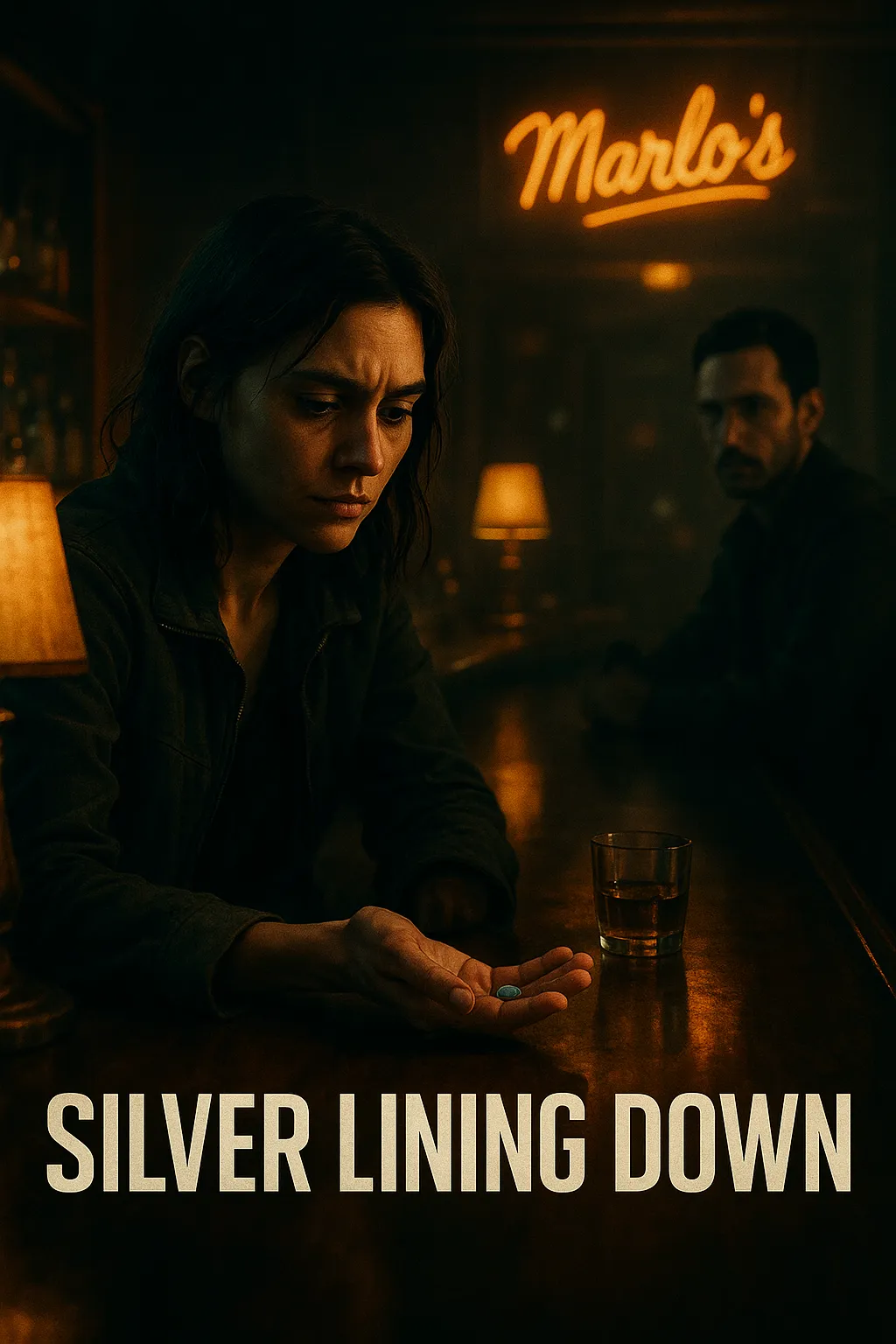
Silver Lining Down
The bar was called Marlo's, though nobody named Marlo had worked there in years. It sat on a block that couldn't decide if it was coming up or going under — a yoga studio on one side, a check-cashing place on the other. Inside, the light was the color of weak tea, and the music was low enough to ignore but too loud to think through, which was the point of places like this.
Sera sat at the far end of the bar with a vodka soda she'd been nursing for forty minutes. She'd ordered it to have something in her hands. The drink wasn't the thing. The thing was in her jacket pocket, a single pale blue pill she'd been carrying for three days — her last one, which made it either a floor or a ceiling, and she hadn't decided which.
She pressed her thumb against the bar's edge until the wood grain bit into the skin. A small test. Still here. The pill sat against her hip like a second pulse.
The man three stools down had been reading something on his phone, but he'd stopped. She noticed the way people notice weather shifting — not the thing itself but the change in pressure. He was just sitting with his hands around a glass of something amber, not drinking it, not performing relaxation or sadness or any of the usual solo-bar pantomimes. Just still.
She knew the difference between someone comfortable alone and someone who'd given up on company.
He looked up. Not at her — past her, at first, at the row of bottles behind the bar. Then his gaze caught on her and held, the way a sleeve catches on a nail. A half-second. A full second. Long enough to mean something. Sera felt it like stepping out of a warm building into January air — a sudden, vertiginous clarity that burned the lungs.
She felt it land in her chest like a stone dropped into still water. Rings spreading outward, disturbing everything.
He didn't smile. Didn't look away with that apologetic flinch people do when they've accidentally seen too much. He just let the moment exist, then returned to his drink with a quiet that felt like permission.
Sera's hand drifted to her pocket. She made it stop.
The bartender passed between them, wiping down the wood with a rag that had seen better centuries. When he moved on, the man was looking at her again. This time he didn't pretend it was an accident.
He spoke without leaning in, without raising his voice. Just loud enough to cross the distance.
It wasn't a question. Sera looked down at her vodka soda, the ice long melted, the glass sweating a ring onto the bar.
"I'm drinking it slowly."
Something shifted at the corner of his mouth. Not quite a smile.
Silence. But not the empty kind. The kind with weight, with texture — the kind two people build when they're deciding whether to let each other in. Sera caught herself in the mirror behind the bar: dark hair she hadn't washed, the angles of her face sharper than they used to be, bones pressing toward the surface like something trying to get out. Twenty-seven. She looked away.
She heard herself speak before she'd decided to.
"Only when they look like they're waiting for something better to come along."
That landed. She didn't show it, but her fingers tightened around the glass. He had dark eyes and a face that looked like it had been kind once and was trying to remember how. Paint under two of his fingernails — cadmium yellow, the kind that doesn't wash out. He held his glass the way she held her pill: like it was the last honest thing in the room.
Her phone buzzed in her other pocket. She didn't look at it. She knew who it was. There was only one person who still called, and that person needed her to come home, needed her to bring what she'd promised, needed her to stay exactly where she was. The phone buzzed again and went still.
The man — she didn't know his name yet, and that felt important, that he was still a stranger, still someone she hadn't ruined — picked up his drink and moved one stool closer. Not next to her. Just closer. Leaving the seat between them empty, like a question neither of them had asked.
"Elliot."
She could feel the pill against her hip. She could feel January still burning in her chest. Two kinds of pulse, two kinds of promise. One would make the other impossible.
She opened her mouth. Closed it. Opened it again.
"Excuse me."
She didn't wait for him to respond. She picked up her glass like she might take it with her, then set it back down — a small, aborted politeness — and walked to the hallway past the jukebox. She could feel Elliot not watching her go, which was worse than if he had.
The bathroom was small and hadn't been cleaned with any conviction. She shut the door. The lock was the sliding bolt kind, loose in its housing, and she had to press it twice before it caught.
She took it out of her pocket and held it in her palm. Just held it. The fluorescent light made her hand look bloodless.
Three days she'd been carrying it. Through the shaking mornings and the long afternoons that felt like crawling across a parking lot on her knees. Through the phone calls she didn't answer and the one she did, promising things she couldn't deliver. She'd kept it because having it meant she could still choose — and choosing meant she wasn't gone yet, not all the way, not like the people who had no choices left.
She looked at herself in the mirror. The glass was clouded at the edges with age, so her reflection existed inside a kind of vignette — just her face, floating, the rest dissolved. Her collarbones stood out like the ridgeline of something buried too shallow. She touched one, pressing down until it hurt. A different test than the thumb against the bar. Not am I still here but how much of me is left.
Her phone screen lit up against her thigh. She didn't reach for it. The name on the screen would be Denny's, and what Denny needed was the thing she'd said she'd bring back two days ago, the thing she'd taken instead, the thing sitting in her palm right now. She owed him. She owed him in a way that had teeth.
She ran the faucet cold and pressed her wrist under it. The shock traveled up through the tendons and settled somewhere behind her sternum. She held it there, counting without counting — just letting the cold accumulate until it crowded out everything else.
Out there, a man she'd given her name to was sitting with one empty stool between them, and he hadn't tried to close the gap. She kept circling back to that. Not the way he'd looked at her — she'd been looked at, she knew what that was — but the restraint. The willingness to let her be a whole person at a distance rather than a fraction of one up close.
She turned off the faucet. Dried her wrist on her jeans. The pill was still in her other hand, her fingers closed around it so tightly she could feel its edges softening from the heat of her grip.
She put it back in her pocket.
She unlocked the bolt, opened the door, and walked back into the bar. Elliot was where she'd left him, hands around his glass, not performing patience or concern or anything at all. He glanced up when she sat down. One stool closer than before. The empty seat was behind her now.
He looked at her wet wrist, then at her face. Didn't ask.
She wrapped her cold fingers around her watered-down drink.
She sat with the new proximity for a moment, feeling the difference one stool made. The jukebox had shifted to something with a slow bass line, and the bartender was cutting limes at the far end, the knife hitting the board in a rhythm that sounded almost domestic.
"I should probably go."
Elliot's hands stopped moving around his glass. Not a flinch — more like a record reaching the end of its groove. He went still in that way she'd already learned to recognize, the air around him tightening.
"Okay."
That was it. No argument. The word just sat between them, and it was worse than if he'd asked her to stay, because it meant the door was real and she'd have to walk through it herself.
Sera didn't move. The bartender's knife kept hitting the board. Somewhere outside, a car alarm started and stopped, started and stopped — someone fumbling with a key fob.
"I have somewhere I'm supposed to be."
"That's different from wanting to go."
She looked at him. He was watching the bartender's hands, giving her the space to leave or stay without his eyes making it a verdict. The cadmium yellow under his nails caught the bar light.
"You don't know what I want."
"No. But you didn't move when you said you should go. That's usually worth paying attention to."
Her chest did something she didn't try to name. She tightened her jacket around herself and felt both pockets press against her — one side heavy, the other empty.
She said it to the bar top, not to him.
It was the most honest thing she'd said to anyone in weeks. She hadn't planned it. The words came out the way water finds a crack in concrete — not because of force, but because the structure had already failed.
Elliot turned to face her for the first time since she'd sat back down. His eyes were dark and steady and didn't do the thing people's eyes do when they're recalculating you.
"Define safe."
The jukebox song ended. For three seconds the bar existed in silence — just the knife, the ice machine humming behind the wall, the faint bleed of traffic. Then the next track started, something with horns, and the room filled back in around them.
Elliot reached across the bar for a pen the bartender had left near the register. He wrote on a cocktail napkin — not quickly, not with any performance of urgency. His handwriting was small and slanted left, the kind that comes from years of working with the other hand.
He slid it across to her. A phone number. Ten digits on thin paper.
"You don't have to use it. But if you decide you don't want to go where you're supposed to be."
He left the sentence unfinished. Sera stared at the napkin. She could feel the bartender glancing over, the way bartenders do when they're reading a situation, deciding if someone needs a check or an intervention.
She picked up the napkin. Folded it once and put it in her jacket — the empty side. She didn't look at him when she did it, but she heard him exhale, and it was the quietest sound in the room.
"You don't know me."
"I know."
She said she needed to make a call. Elliot didn't nod or say okay or do any of the things people do to make leaving easier. He just moved his glass a quarter-inch to the left, a gesture so small it could have been nothing, and she stood before the silence could settle into something she'd have to answer.
The bathroom door stuck on the swollen frame and she had to shoulder it. Inside, the fluorescent tube was buzzing at a frequency that lived right behind the eyes. She set her drink on the sink ledge, braced both hands on the porcelain, and looked at the phone she'd been ignoring all night.
Eleven missed calls. She recognized the number the way you recognize a sound that wakes you — not by reading it but by what it did to her body. Her shoulders climbed toward her ears before her brain caught up.
She called back. It rang once.
"Where."
One word. No greeting, no question mark. Just a coordinate request — the voice of someone tracking a package.
"I'm coming. I just — I got held up."
"You got held up. That's interesting. Because I've been sitting here since eight, Sera, and it's almost eleven, and you said an hour."
The thing about Denny's voice was the spacing. He left room between his sentences the way someone leaves room between knife strokes on a cutting board — deliberate, even, nothing wasted. He never raised his volume. He'd told her once that yelling was for people who weren't sure they'd be listened to.
"I know. I know, Denny."
"Do you have it."
The pill in her pocket. She pressed her hip against the sink and felt it there, small and absolute.
"Not exactly."
Silence. Not the kind she'd shared with Elliot — that silence had texture, architecture. This one was empty. A held breath before a door slams.
"I gave you four hundred dollars' worth of product because you said you had a buyer. You said you'd bring me back three. That was Tuesday. It's Thursday."
"I have some of it. I can get the rest by —"
He cut her off. Not by speaking louder — by speaking slower.
She closed her eyes. The fluorescent buzz filled the space his voice left.
"I like you. I do. But I liked Tomás too, and look where that got us."
She didn't know what happened to Tomás. She didn't want to.
"I'll get your money. Give me till Sunday."
"Saturday. Noon. And Sera — don't make me come find you. I don't like how I am when I have to look for people."
The line went dead. She stood there holding the phone to her ear for a few seconds after, listening to nothing, because putting it down meant the conversation was over and what came next was real.
She turned the faucet on. Cold. Pressed her wrist under it and watched the tendons in her hand flex against the shock. In the mirror, her drink sat on the sink ledge behind her — untouched, the ice fully melted, a glass of slightly flavored water. She'd been carrying it around like a prop in a play she'd forgotten the lines to.
She turned off the water. Left the drink on the sink. Picked up her phone and opened the door without drying her wrist — the cold still traveling up her arm, a thread she wasn't ready to cut.
Elliot was standing in the hallway. Not close — six feet back, leaning against the opposite wall near the jukebox with his arms at his sides, palms flat against the wood paneling like he was holding the building up. He hadn't come to check on her. He'd come to be closer to the door she'd walk out of, and there was a difference she felt in her teeth.
"You're shaking."
She looked down at her hands. He was right. A fine tremor, visible in the hallway's bad light. She shoved them into her jacket pockets — and stopped. The left pocket had the napkin with his number. The right had the pill. Her hands were in both, and for a moment she just stood there, arms pinned to her sides like someone bracing for impact.
She pulled her hands out.
Elliot's fingers pressed harder against the wall behind him. She could see the tendons in his wrists shift, the cadmium yellow disappearing as his knuckles whitened. He didn't move toward her. Didn't offer money. Didn't say it would be okay.
"What happens if you don't have it."
"He mentioned someone named Tomás. In the past tense."
The jukebox cycled. A half-second of mechanical clicking, then a song she almost recognized — something with a piano, something that belonged in a room with better lighting. Elliot's jaw worked once, a small motion, the only break in his stillness.
"Do you want to sit back down."
"Why are you still here."
He considered this. Not for show — she could see him actually turning it over, the way he'd turned his glass in his hands all night, slow and deliberate.
It was the longest thing he'd said to her. She felt it land somewhere below language — not in her chest, not in her stomach, but in the place where her body decided, before she could, whether to stay or run.
"That's a terrible reason."
"Probably."
Her wrist was still wet. She could feel the cold fading, the warmth of the hallway reclaiming her skin inch by inch. Behind her, the bathroom door drifted shut on its pneumatic hinge. Ahead of her, the bar — the stools, the bad light, the bartender who'd stopped pretending not to notice.
She walked past him, close enough that her sleeve brushed his arm. She didn't look at him when she said it.
She heard him push off the wall and follow her back to the bar. He sat in the stool next to hers. No gap this time. His knee was three inches from hers, and she could smell turpentine and soap, and she didn't move away.
They sat without talking for a while. The bartender brought Elliot a fresh drink without being asked — the privilege of a regular or at least someone who tipped well — and Sera ordered water because it was the only honest thing on the menu. The piano song from the jukebox ended and nothing replaced it. The machine sat in its silence like it had made a point.
Sera pulled out her phone under the bar. The screen was cracked in one corner from a drop she didn't remember — a lot of things lived in that category now — and she opened the text thread with Denny. His last message, from two days ago, was just an address. No punctuation. Denny didn't use punctuation the way most people didn't use a gun: not because he couldn't, but because leaving it out made you fill the silence yourself.
She typed: I can get you 200 by Saturday. Rest by Monday. She stared at it. Changed Monday to Sunday. Changed 200 to 250. Her thumb hovered. Beside her, Elliot lifted his glass and actually drank from it — the first time she'd seen him do that all night — and the normalcy of the gesture made her press send before she could revise again.
She set the phone face-down on the bar. Elliot glanced at it, then at her, then at the row of bottles behind the bartender's head. His hands rested on the bar, and she noticed for the first time a pale scar across the base of his right thumb — old, the skin there thinner and slightly silvered.
"What are you painting?"
She hadn't meant to ask. The question came from the part of her that still knew how to be curious, and it startled her — a reflex she thought she'd sold off with everything else.
He turned the glass slowly between his palms.
Sera's throat closed. She reached for her water and drank half of it, and when she set it down her hand was steadier than it had been all night, which didn't make sense but there it was.
"Is it any good?"
"Not yet. The color's wrong. I keep mixing it warmer and it keeps needing to be colder."
Her phone buzzed against the wood. She flipped it over. Denny's reply sat on the screen: no. The single word with its period — that was new. Denny with punctuation meant Denny making an effort, and Denny making an effort was worse than Denny on autopilot.
She typed back: 250 sat noon and the other 50 by sunday I swear. Sent it. The phone sat there, dark. Ten seconds. Twenty. A minute. Denny was not a man who deliberated. When he took time, it meant he was choosing between options he'd already ranked, and the question was only how far down the list he'd go.
"Bad news?"
"Negotiating."
"Is that what you'd call it?"
She almost smiled. It didn't reach her mouth but something shifted behind her eyes.
The phone lit up. She read it with her body angled slightly away from Elliot — not hiding it, exactly, but not sharing it either. The message read: 250 sat noon. not sunday for the rest. sat noon all of it or dont bother showing up
Three hundred dollars by Saturday at noon. She had a hundred and thirty-eight in her checking account — she'd looked that morning, the way you look at a wound. She could maybe sell the pill for forty, fifty to the right person. That left a gap she could see the bottom of but couldn't reach across.
She typed ok and sent it. Then she put the phone in her jacket pocket — the left side, where the napkin was — and felt the folded paper crumple against the phone case.
"I need to use the bathroom."
She didn't take her drink this time. Didn't take anything. She walked down the hallway past the jukebox, which had come back to life with something she didn't recognize — a woman's voice, unhurried, singing in a language that might have been Portuguese. The bathroom door opened on the first try.
She sat on the closed toilet lid and pressed her palms flat against her thighs. The room was small enough that her knees nearly touched the opposite wall. Someone had written call me in silver marker on the back of the door, then someone else had crossed it out and written don't. She stared at that for a long time.
The math. She kept trying to do the math. A hundred and thirty-eight plus maybe fifty for the pill — if she could bring herself to sell it, which meant letting go of the last exit hatch, the last door she could pull shut between herself and the full weight of being awake. A hundred and eighty-eight. She needed three hundred. A hundred and twelve dollars she didn't have and no one to ask and two days to find it.
She could ask Elliot. The thought arrived fully formed and she hated it immediately — hated how fast her mind had turned him into a resource, how the machinery of need could strip a person down to what they were worth before you'd even learned their last name. This was what she did. This was what she'd become. Someone who met a man with kind hands and a scar on his thumb and within an hour was calculating what he might give her.
She stood up. Ran the faucet cold. But instead of her wrist, she cupped water in both hands and pressed it to her face — forehead, cheeks, the closed lids of her eyes. The cold was different here. Less clinical. More like rain.
When she opened her eyes the mirror showed her someone she almost recognized. Water dripping from her jaw, mascara starting to migrate, the architecture of her face too visible beneath the skin. But her eyes were clear. Not bright — not that — but present. The eyes of someone still making calculations, still trying to solve for a variable that might not exist.
She dried her face on her sleeve. Opened the door. Elliot was at the bar where she'd left him, but he'd moved her water glass to his side of the bar so the bartender wouldn't clear it. A small thing. The kind of thing that could break a person if they let it.
She sat down. He slid the glass back to her without comment. Their fingers didn't touch. She drank.
She set the glass down and looked at his hands. They were resting on the bar, loosely curled, the cadmium yellow visible only under the index and middle fingers of his left hand now — the rest had been worn away by the night, by glass and wood and the unconscious friction of living. The scar on his right thumb was a thin white line that curved from the base of the knuckle down to the webbing between thumb and forefinger. Slightly raised. The skin around it smoother than the rest, as if that small patch of him had healed into something softer than what surrounded it.
"What happened to your thumb?"
Elliot turned his right hand over on the bar, palm up, and looked at the scar. He rubbed it once with the pad of his left index finger — an absent gesture, automatic, something he'd done ten thousand times.
"Utility knife. I was stretching a canvas my first year out of school and the blade skipped. Needed nine stitches and I almost lost the tendon."
"Your right hand. You're left-handed, so —"
"So it could've been worse. Yeah. I was holding the frame with my right and cutting with my left, and the canvas was cheap, and the blade went through it and kept going."
He said it simply. No drama, no wince of retrospective pain. He was still rubbing the scar — slow circles, the kind of repetitive motion that belongs to someone who's made peace with a thing by touching it often enough.
"Did you finish the painting?"
He almost smiled. Not quite — the corner of his mouth lifted and held, and his eyes changed.
"Getting cut was the best thing?"
"Finishing something was. I'd started about forty canvases and abandoned every one. After I cut my hand I figured I'd already paid for that one in blood, so I might as well see it through."
Sera reached out and touched the scar. She didn't decide to. Her fingers found the raised line at the base of his thumb and traced it — three inches of healed damage, the skin warm and slightly waxy under her fingertip. Elliot's hand opened wider, not pulling away, not closing around hers. Just making room.
The bar door opened. Cold air reached them first — a draft that cut through the room's stale warmth and found the back of Sera's neck. Then the sound: boot heels on the wooden floor, measured and unhurried. She didn't turn around. She didn't have to. Her hand left Elliot's and went flat on the bar.
Denny crossed the room in no particular rush. He wore a dark jacket that fit like it had been tailored, which it probably had — Denny spent money on the things that made him look like someone who didn't need to threaten people. He didn't scan the room. He already knew where she was. He pulled out the stool two seats to Sera's right and sat without ordering, without acknowledging the bartender, without looking at Elliot.
"Sera."
Elliot picked up his drink with his left hand and took a slow sip. His right hand stayed on the bar where Sera had been touching it, fingers still open.
Sera's spine had gone rigid. She could feel the stool's vinyl edge cutting into the backs of her thighs.
He let the word sit. The bartender had stopped cutting limes.
"I was in the neighborhood. Thought I'd say hello."
He was looking at her now. Denny had a face that could pass for friendly in the right light — broad, clean-shaven, laugh lines that he'd earned in some earlier version of himself. But his eyes did something different from the rest of his face. They inventoried.
His gaze moved to Elliot. Unhurried. Taking in the paint, the scar, the drink, the proximity.
"He's nobody. I'm having a drink."
The word landed in two directions at once. She felt Elliot's hand close on the bar — not a fist, just the fingers drawing in, the open palm becoming something held. She didn't look at him.
Denny leaned back on his stool and rested one hand on the bar. His nails were clean. Everything about him was clean.
He paused. Looked at the ceiling as if searching for the right word.
"Impersonal."
"We understand each other."
Denny smiled. It reached exactly as far as his mouth.
He gestured vaguely at her. At all of her. The gesture encompassed everything she was and everything she'd lost and it was the most violent thing he'd done all night.
Elliot set his glass down and turned on his stool to face Denny. The movement was deliberate — not aggressive, but present, the rotation of someone choosing to be in a conversation rather than adjacent to one.
Denny looked at him for the first time. Really looked. The silence between them lasted four seconds, which in a bar at eleven p.m. is a geological age.
"I'm sorry. Who are you?"
"Nobody. She said."
Something moved across Denny's face — not anger, not yet, but the recalibration of a man who'd expected one variable and found two. He placed both hands flat on the bar, fingers spread. The gesture was symmetrical and controlled and it made Sera's stomach drop because she'd seen it before, the night he'd talked about Tomás, the same deliberate placement of hands like a man setting down tools he was deciding whether to pick back up.
"Sera. Walk me out."
"I'm fine here."
The pause between his sentences widened. The bartender had moved to the far end of the bar and was suddenly very interested in restocking glasses.
Sera stood. Her legs were unsteady and she put one hand on the bar to cover it. She could feel Elliot beside her — not reaching for her, but leaning forward slightly on his stool, his weight shifted toward her like a compass needle.
She said it without turning around.
She followed Denny toward the door. He held it open for her — always the manners, always the performance of civility that made everything underneath it worse. The January air hit her like a wall. The yoga studio next door was dark, its window full of silhouetted plants. The check-cashing place had a neon OPEN sign that buzzed and flickered, casting Denny's face in alternating red and shadow.
He stood close. Not touching her. He never touched.
"I'll have it. Three hundred, Saturday, noon. I said okay and I meant it."
"I believe you believe that."
He put his hands in his jacket pockets. Somewhere down the block, a bus hissed to a stop and released no one.
"The guy in there. The painter. He looks at you like you're something worth looking at. That's sweet. That's really sweet, Sera. But he doesn't know you. Not the you that called me crying at four in the morning because you'd gone through everything in two days. Not the you that — what was it — told your sister you needed rent money and spent it in an hour."
Each sentence landed with a pause after it. She stood very still on the sidewalk and let them hit.
"I'm not the bad guy here. I'm the guy you called. Remember that."
Her voice came out smaller than she wanted.
"Saturday. Don't make me be someone I don't want to be."
He walked away. Not toward a car — just down the sidewalk, hands in his pockets, the sound of his boots fading into the ambient noise of the block. He didn't look back. He never looked back. That was part of it — the certainty that the world would arrange itself in his wake.
Sera stood on the sidewalk until she couldn't hear him anymore. The neon sign buzzed. Her breath made small clouds that dissolved before they got anywhere. She put her hand in her right pocket and felt the pill — still there, still warm from her body, still the last unlocked door. Then her left pocket. The phone. The crumpled napkin with ten digits in left-slanted handwriting. She held both and stood between them on a gentrifying block in January and tried to remember who she'd been before this arithmetic became her whole life.
The bar door opened behind her. Elliot stepped out. He'd put on a jacket — canvas, paint-spotted at the cuffs — and he was holding her water glass. He crossed the sidewalk and held it out to her without a word. She took it. Drank. The water was lukewarm and tasted like nothing and she drank all of it.
She handed the empty glass back.
Elliot held the empty glass in his left hand. With his right, he reached out and wiped a drop of water from her jaw. The pad of his thumb, the scar she'd just been touching. It was the second time they'd made contact and it was so ordinary it wrecked her.
The street was quiet. The bus had gone. A light turned from green to yellow to red with no one waiting for it.
"I have a sister. Had. Have. She stopped answering my calls in October because I borrowed money for rent and spent it on — not rent. And before that I had a job, I think, at a framing shop, which is almost funny, and I got fired because I stopped showing up, and before that I was in school, and before that I was someone who read books and cooked dinner and called her mother back, and I don't know when I stopped being that person. I don't know which day it was. I keep trying to find the line and there isn't one. It just — "
She stopped. Not because she'd run out of words but because the next ones were too heavy to lift in the open air.
He said it simply, holding an empty glass on a sidewalk, his breath visible between them.
"What."
"You're still talking in present tense. You said have. Not had."
She looked at him. The neon sign caught the yellow paint under his nails and turned it briefly orange. He was shivering — his jacket was too thin for January — but he wasn't moving to go inside, wasn't shifting his weight or rubbing his arms. He was just there, cold and visible and choosing it.
She took the pill out of her right pocket. Held it in her open palm under the neon light. It looked almost white out here, drained of its pale blue, a small round nothing. Elliot looked at it. Looked at her.
"This is the last one. If I take it, I don't feel anything for about four hours. If I sell it, I'm forty dollars closer to not being Tomás. If I throw it away, I have to be here. All the way here. And I don't know if I can do that."
Elliot didn't tell her to throw it away. Didn't reach for it. He looked at the pill in her hand and then he looked at the street — the dark yoga studio, the buzzing neon, the empty crosswalk — as if he was seeing his painting, the light in a room after someone's just left it, and deciding again whether the color should be warm or cold.
"What do you want to do?"
"I want it to be someone else's decision."
"I know. But it isn't."
She closed her fingers around the pill. Stood there with it in her fist, feeling its edges, the warmth of it, the smallness. A car passed and its headlights swept across them both — two people on a sidewalk, one holding a glass, one holding something the size of a breath mint that had become the fulcrum of her entire remaining life.
She stood there long enough for another car to pass. Then another. The headlights moved across the storefronts and were gone, and the block returned to its particular brand of quiet — not silence, but the low hum of a neighborhood that had stopped expecting anything from the night.
Sera opened her hand. The pill sat in the center of her palm, slightly damp from her grip. She looked at it the way she imagined Elliot looked at a canvas he'd been fighting — not with desire or hatred but with the exhaustion of someone who'd been in the same argument for years.
There was a storm drain two feet from the curb. Iron grate, choked with a few wet leaves and a candy wrapper. She walked to it. Elliot stayed where he was. She could hear his breathing behind her — short, shallow, the cold doing that to him — and she was grateful he didn't follow.
She held her hand over the grate and turned it over. The pill dropped. A small sound — smaller than she'd expected, smaller than anything that had held that much power over her should have been allowed to make. Then nothing. Just the dark between the iron bars and the faint sound of water somewhere below the street.
Her hand stayed open. She looked at her palm — the lines there, the faint indent where the pill had pressed, the tremor still visible but different now, coming from somewhere deeper than withdrawal. She closed her hand and opened it again, just to feel the difference.
She turned around. Elliot was standing where she'd left him, shivering, the empty water glass still in his hand. The yellow paint under his nails was almost gone — worn down to faint traces by the hours, by glass and wood and the slow friction of the night. By morning it would be invisible. He'd have to earn it again.
"Tomorrow morning is going to be bad."
"Yeah."
"I don't have the money. I don't have a plan. I don't even have a phone call I'm not afraid to make."
He set the empty glass down on the sidewalk beside his foot. Straightened up.
"That's not an answer to what I said."
"I know it isn't."
She pulled her phone from her left pocket. The cracked screen lit up and she saw the lock screen — a photo from two years ago, her and Naia at someone's kitchen table, Sera's face half-turned toward the camera, Naia mid-laugh. A cropped arm at the edge she couldn't place anymore. She couldn't remember who'd taken it. She couldn't remember the kitchen. But Naia's laugh was still there in the pixels, preserved in a version of the world where Sera answered her phone and paid her rent and showed up.
She called Naia. It rang four times. Five. She expected voicemail — had already started composing the message in her body, the particular tension of talking to a recording of someone who used to talk back.
Voicemail picked up. Naia's voice, clipped and careful: Hi, you've reached Naia, leave a message.
The beep.
Sera pressed the phone hard against her ear. The cold had found its way through her jacket and she was shaking — not the fine tremor from before but the full-body kind, the kind that comes from standing still too long in January or from doing something irreversible.
She stopped. Breathed. A truck passed on the cross street, its engine filling the silence she couldn't.
"I'm going to call you again tomorrow. You don't have to pick up. But I'm going to call."
She hung up. Held the phone against her chest for a moment — the screen going dark against her jacket, the glass still warm from her face. Then she put it away.
Elliot was watching her. Not the way he'd watched her inside — not the held, unblinking stillness. He was rubbing his hands together against the cold, stamping one foot slightly, doing the small involuntary things a body does when it's been outside too long and choosing to stay.
"Four blocks?"
"Maybe five. I've never counted."
They started walking. East, away from Marlo's, away from the direction Denny had gone. The sidewalk was cracked and uneven — the old concrete buckling where tree roots had decided the surface was negotiable. Sera stepped over a raised slab and Elliot matched her pace without adjusting, as if they'd been walking together for longer than they had.
A bodega on the corner had a cat in the window, asleep on a stack of newspapers. A heating unit somewhere above them kicked on and exhaled warm air onto the sidewalk, a pocket of warmth they passed through and left behind. Sera's hands hung at her sides, empty.
She didn't know what the morning would look like. She had a hundred and thirty-eight dollars and a debt she couldn't pay and a sister who might never press the green button on her screen. She had a body that was going to start screaming at her in about six hours when it realized what she'd dropped through that grate. She had a phone number she hadn't memorized yet in a napkin she could still lose.
But she was walking. Her feet on the concrete, her breath visible in the air, the cold finding every gap in her clothing and announcing itself. Elliot beside her, close enough that their shoulders almost touched when the sidewalk narrowed. Ahead of them, half a block away, the diner light — yellow and ordinary, spilling out onto the pavement through a window that needed cleaning.
She walked toward it.