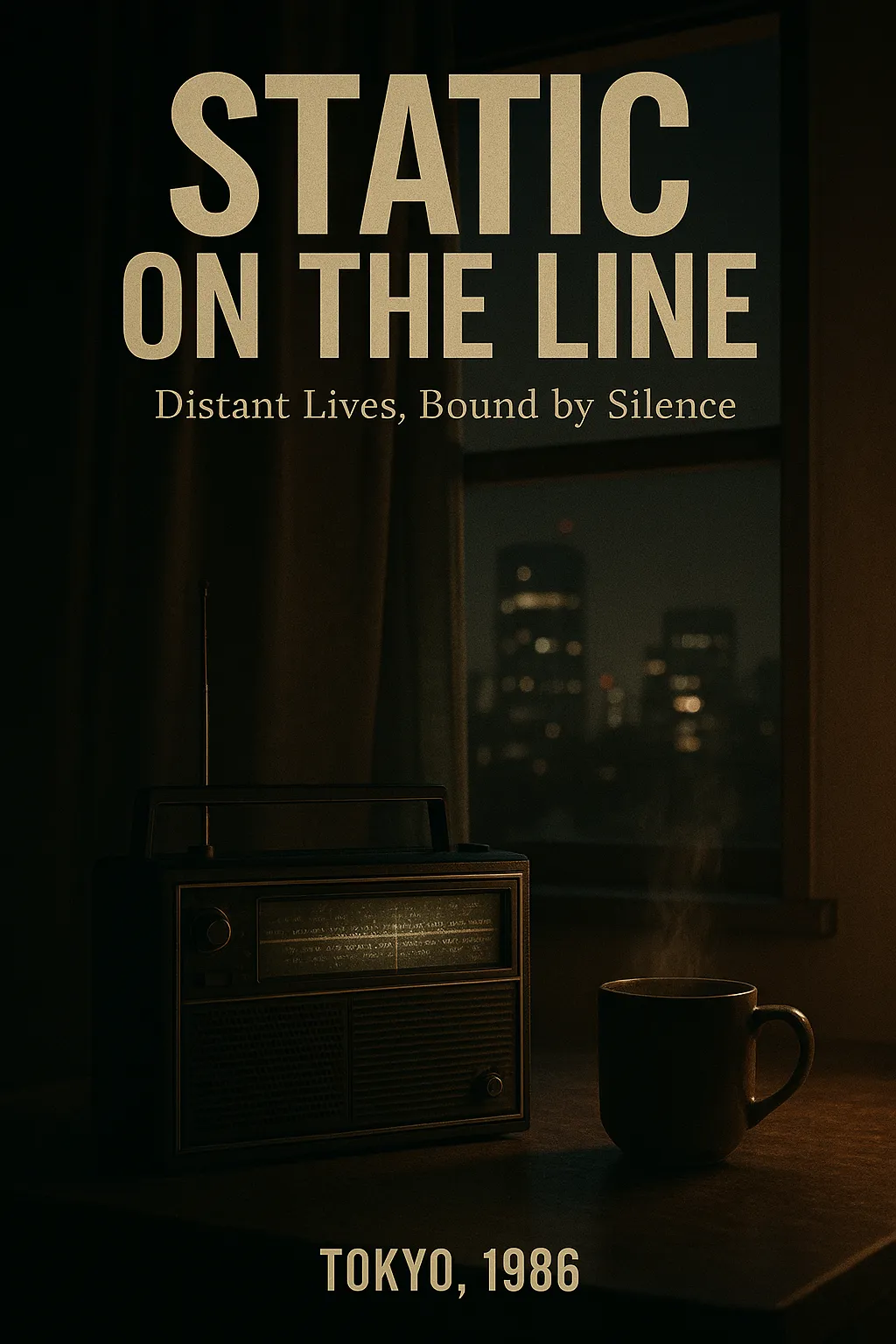
Static on the Line
The apartment was dark except for the kitchen. Hana stood at the counter in a wool cardigan she'd owned for longer than she could remember, waiting for water to boil. Outside, Tokyo at 1 a.m. was a scatter of lit windows and the occasional taxi pulling through the intersection below. January cold pressed against the glass.
The radio sat on the shelf above the rice cooker, tuned to FEN — Far East Network, the American military broadcast out of Yokota. She'd found the frequency two hours ago, lying in bed not sleeping, turning the dial through static until English surfaced. They were talking about the weather in Florida. A cold front. Ice on the launch tower. She'd left it on and gotten up.
The kettle clicked. She poured water over loose sencha in a clay pot she'd bought in Mashiko the autumn before — a good pot, the kind you use when the moment asks for it. The leaves uncurled slowly in the heat. She watched them.
On the kitchen table, next to a stack of ungraded student essays and a jar of pens, there was a photograph held down by a coffee mug. She didn't need to look at it. She'd been looking at it all week, ever since the launch date was confirmed after the delays. A man in a blue flight suit, squinting, one hand raised against the Florida sun. Behind him, a building she couldn't name. He had a crooked front tooth that the camera almost caught.
David. Not a name that fit him, she'd always thought. Too blunt for someone who drummed his fingers on every surface and talked about orbital mechanics the way other people talked about music.
He wasn't an astronaut — not really, not in the way people meant when they said the word. He was a materials scientist from Akron, Ohio, selected to run a crystal growth experiment in microgravity. A payload specialist. The last seat filled on the crew, and he'd called her in October to tell her, his voice cracking on the long-distance line like a teenager's. She'd laughed. He'd laughed. Eleven years of knowing each other and they could still do that.
She carried the tea to the low table in front of the window and sat on the floor, legs folded beneath her. The radiator ticked. The radio murmured from the kitchen — a man's voice reading launch status updates with the flat calm of someone who did this regularly.
She thought about the last time she'd seen him. A Denny's off I-95, the summer before she moved back to Tokyo. He'd ordered coffee and a short stack and talked about the application process — the physicals, the interviews, the centrifuge training that made him throw up twice. She'd held her own coffee with both hands and asked the right questions. Outside, the parking lot shimmered with heat.
What she'd said, when he asked why she was going back to Japan: "My mother needs me closer." Which was true. And then: "It's time." Which was also true, in the way that sentences can be true and still be the wrong ones.
He'd nodded. Poured more cream into his coffee. Said he understood. The waitress refilled their cups and called them hon and they'd split the check because that was what they did, had always done, as though any other arrangement would have named something neither of them was willing to name.
On the table beside the photograph was a letter she'd started six days ago. Two lines in her own handwriting, then nothing. She hadn't found the third line yet. She'd planned to finish it after the landing, when she could open with something easy — I watched you go up, or I listened, or I was awake — and let the rest follow from there.
The tea was good. She held the cup against her sternum and felt its heat through the wool. From the kitchen, the radio voice said they were T-minus nine minutes and counting. She closed her eyes.
He'd be strapped in by now. She tried to picture it — the helmet, the harness, the view from the window if there was a window where he sat. She couldn't. She'd never been inside anything like that. The closest she could get was the feeling of a plane at takeoff, that press into the seat, and even that was wrong by orders of magnitude.
A taxi turned through the intersection below, its roof light cutting briefly across the wet pavement. Hana opened her eyes and looked at the city, all its ordinary distance, and pressed her fingers around the cup.
She stayed where she was. The tea cooled against her sternum by slow degrees, and she let it.
The radio voice from the kitchen said something about the crew access arm retracting. She didn't know what that meant exactly — she imagined a bridge pulling away from the side of the shuttle, leaving it alone on the pad. The image was probably wrong. David would have corrected her, drumming his fingers on whatever was nearest, explaining the sequence with the patience he reserved for things he loved.
She should have put on socks. Her feet were bare on the tatami and the cold had settled into her toes without her noticing.
A memory surfaced — not the Denny's, not the phone call in October, but something older. A conference in Tsukuba, 1979. She'd been interpreting for a delegation of materials scientists, and David had been the youngest one in the room, twenty-six and unable to sit still. He'd asked her afterward where to find good ramen nearby, and she'd walked him to a place under the tracks where the owner served only one thing. David had eaten two bowls and burned the roof of his mouth and kept talking through it — about zeolite frameworks, about the way crystals form differently in the absence of gravity, about how his mother still thought he worked at a tire factory because that was easier to explain than what he actually did.
She'd watched him talk. That was the beginning of it, though she hadn't known.
The radio shifted. A different voice now — crisper, closer to the microphone — reading through what sounded like a checklist. She caught "go for launch" and "nominal" and the flat American cadence of people doing something extraordinary as though it were Tuesday.
Below the window, a couple walked past the closed pharmacy on the corner, leaning into each other against the cold. One of them laughed — the sound carried up faintly through the glass and was gone.
Hana glanced toward the kitchen table. The two lines of the letter were visible from here, her handwriting small and tilted on the airmail paper. Dear David, I've been trying to — She looked away.
At the ramen place under the tracks, she'd said something about how her English was better than his Japanese, and he'd said that wasn't a high bar, and she'd laughed with noodles in her mouth, which she'd been mortified about for exactly the length of time it took him to do the same thing deliberately.
That was how it went with David. He made the embarrassing thing the easy thing. And then they'd spent eleven years making the easy thing impossible.
The radio said T-minus four minutes. She set the cup down on the floor beside her knee. The tea had gone lukewarm.
She had his number at the motel in Cocoa Beach — he'd given it to her during the October call, reciting it twice because the connection was bad. She'd written it on the back of a receipt from the konbini downstairs. The receipt was in the kitchen drawer with the rubber bands and the spare batteries. After the landing, she'd call.
The radiator clicked twice, then settled. Somewhere in the building, a pipe groaned. Hana pulled her knees up and wrapped her arms around them, feet off the cold tatami, and listened.
She unfolded herself from the floor slowly, knees stiff from sitting too long in the cold. The cup stayed where she'd set it, lukewarm tea darkening a ring into the tatami she'd forget to wipe.
The kitchen was three steps away. The radio was mid-sentence — something about the oxygen tank pressurization, a phrase she filed without understanding. She opened the drawer beside the stove.
Rubber bands, a screwdriver she'd borrowed from the building manager, takeout menus. She pushed things aside. The receipt was near the back, folded once, tucked between a book of matches and a loose battery.
She held it under the light. The printed side was waxy and fading — ¥320, two onigiri and a bottle of Pocari Sweat. She turned it over. A phone number in her own handwriting, small and tilted left, written while the long-distance line crackled and David repeated the digits a second time. A 305 area code. Cocoa Beach.
She'd pressed the pen hard enough to dent the paper. She could feel the grooves with her thumb.
The radio voice said T-minus three minutes. She set the receipt on the counter next to the radio.
That was the whole plan. The launch, then the landing, then the number. She'd pick up the phone and dial and listen to it ring across the Pacific, across the date line, into a motel room where he'd be sitting on the bed with his shoes still on because he never took them off first thing.
She caught herself building the scene and stopped. Poured the cold tea from her cup into the sink. Rinsed it.
On the table, the letter. Dear David, I've been trying to — Two lines in six days. She'd written longer grocery lists. But grocery lists didn't require her to say why she'd actually left, and the third line did, and every version of it she'd composed in her head sounded either too large or too small.
She leaned against the counter. The fluorescent tube above the sink hummed at a frequency she usually stopped hearing after a few minutes. Tonight she heard it.
She thought about the last conference day in Tsukuba — not the ramen, which she'd replayed enough, but the morning after. David had found her in the hotel lobby with two canned coffees from the vending machine and asked if she wanted to see the research campus before his flight. They'd walked the grounds for an hour. He'd talked about crystal lattice structures and she'd watched his hands.
At the gate, he'd said he'd write. She'd said sure. He did write — a postcard from Akron with a drawing of a ramen bowl and the English words "mouth still healing" — and she'd kept it in a book for three years before moving it to a box, and then to another box when she moved back to Tokyo.
The radio shifted registers. A new voice, closer, reading the final sequence. She heard "T-minus two minutes" and something tightened below her ribs that she couldn't have named if asked.
The receipt sat on the counter, pale and small under the kitchen light. She looked at it the way you look at a door you've decided to walk through but haven't yet.
From somewhere below — the second floor, maybe the first — a television murmured through the pipes. Someone else awake at this hour. She wondered what they were watching. She wondered if anyone else in this building knew what was happening at Cape Canaveral right now, or if it was just her, standing barefoot on linoleum, listening to a man she hadn't touched in six months ride a column of fire into the sky.
She picked up the receipt between two fingers and carried it back to the window. The apartment was small enough that this took four steps — linoleum to tatami, kitchen light to the ambient glow of the city outside. She sat down cross-legged where she'd been before, the receipt in her lap, face-up.
The 305 looked back at her. She set the receipt on the tatami beside her knee.
Below, a delivery truck idled at the intersection, hazards blinking. A plume of steam rose from a grate near the pharmacy. The city doing what it did at 1 a.m. — running its machinery, indifferent to the hour, to her, to what was happening on a launchpad in Florida.
The radio said T-minus ninety seconds. She heard it the way you hear a clock in a room you've been sitting in too long — present, insistent, no longer separate from the silence around it.
She thought about the October phone call. The static on the line, and David saying he'd been assigned, and the pause before she said congratulations — a pause she'd meant to be shorter. He'd filled it by drumming on something. She'd heard the tapping through the receiver, rapid and arrhythmic, the way he did it when he wasn't sure a conversation was going the way he wanted.
She'd said the right thing after that. She'd said she was proud of him. And she was. That was the part that made all of it so difficult — the pride was real and it lived in the same place as everything else.
He'd given her the motel number at the end of the call. "For after," he'd said. Not for before. She hadn't called before.
She pressed her thumbnail into the pad of her index finger, a habit she didn't notice anymore. The truth about why she'd come back to Tokyo was simpler and worse than what she'd told him at the Denny's. Her mother had needed her for years. Hana had stayed in the States anyway. What changed was the mission — David getting the thing he wanted most, the thing that completed a sentence he'd been building since Tsukuba. She'd felt something close in her chest when he told her, and she'd known what it was, and she had not wanted to be standing that close to it.
She stopped herself there. She'd gotten that far before, turning it over late at night, and this was always where she put it down — at the edge of what it said about her. That she'd left not because he didn't need her but because he'd confirmed it.
The truck below pulled away from the intersection. Its taillights smeared red across the wet road and were gone.
From the kitchen, the radio voice shifted — tighter now, compressed, reading numbers she couldn't follow. T-minus sixty seconds. She heard the change in register more than the words. Something was beginning that couldn't be stopped.
She could be the person in the dark who knew his name.
The voice counted. Thirty seconds. Twenty. She pulled her knees up and held them. Fifteen. Ten. The voice said "we have main engine start" and then the sound changed — a low roar that the small radio speaker couldn't hold, breaking into distortion at the edges, and the voice rose over it, "four, three, two, one," and then a word she felt in her teeth: liftoff.
Hana exhaled. She hadn't known she'd been holding it.
The roar continued, tinny and vast at the same time, and the voice was saying something about the tower being cleared, and she sat at her window in Shibuya with the receipt beside her knee and her hand over her mouth, and David was going up.
She closed her eyes.
She tried to see him strapped in — the helmet, the harness, the seat tilted back against the force of what was carrying him. She couldn't get there. She tried the flight suit from the photograph, the Florida sun, the raised hand. That was closer but still flat, still a picture of a picture.
The David she knew sat across tables. He leaned forward when he talked. He picked up sugar packets and turned them end over end without looking at them. He had a way of going quiet before he said something that mattered — not a pause, exactly, but a gathering, as though the words needed a running start.
That was the face she found. Not the one in the flight suit. The one at the ramen counter in Tsukuba, steam between them, his sleeves pushed past his elbows because he ran hot even in October. A burn forming on his lower lip that he kept touching with his tongue and ignoring. Twenty-six years old and certain the universe owed him its secrets.
The radio was still going. She could hear the roar underneath the voice — a sound like weather, like distance made audible. The voice said something about altitude and downrange and she held on to the word "nominal" because it sounded like everything was fine.
She kept her eyes closed. She let herself have the lobby in Tsukuba — the morning after, David with two canned coffees, a burn on his lip from the night before, asking if she wanted to walk the campus. He'd held both cans against his chest because he didn't have pockets. She'd taken one and their fingers had touched around the cold aluminum and neither of them had said anything about it.
She'd thought about that touch for three days afterward. The specific temperature of it — his hand warm, the can cold, her fingers fitting into the space his made. She'd been twenty-three. She hadn't known yet that you could carry something that small for that long.
From the kitchen, the voice continued — throttle up, three engines — and then it stopped.
Not stopped. Changed. The sentence broke somewhere in the middle, swallowed by a wash of static that rose and flattened and didn't resolve. Hana opened her eyes. The city was still there — the intersection, the pharmacy, the lit windows. The radio hissed and crackled and then a different voice came through, not the one that had been counting, not the one she'd been holding on to.
The voice said it slowly, as though the words were being read for the first time.
Hana didn't move. Her knees were still drawn up. Her hands were still wrapped around them. The receipt was still beside her knee on the tatami. The sentence sat in the room like something fallen from a height.
She waited for the voice to correct itself. To say something else — a word, a number, a return to the cadence that meant people were doing their jobs and the doing was routine. The radio gave her static. Then fragments: "range safety" and "contingency" and a silence that was worse than any of it, a silence where the roar had been.
She was aware of the cold in her feet. She was aware of the fluorescent light still on in the kitchen, falling across the table where the letter sat with its two lines. She was aware that she was not breathing correctly — short pulls that stopped at the top of her chest.
The receipt was beside her knee. She looked down at it and could not understand what it was for.
She did not move. The receipt was beside her knee and the radio was talking and she sat at the window with her hands around her shins and waited for someone to say the right thing.
The voice on the radio was not the one from before. It spoke in fragments — recovery ships, coordinates, a patch of Atlantic she couldn't picture. Numbers that sounded like latitude. She understood the words the way you understand a sentence in a dream: each one clear, the meaning sliding off.
A sound reached her from somewhere new — a low vibration in the wall behind the shelf, something mechanical in the building's guts she had never heard before. It went on and on, a hum below the frequency of the radiator, below the pipes, as though the structure itself had shifted register.
The traffic light at the intersection cycled green to yellow to red for no one. The street was empty. The pharmacy sign was dark. Hana watched the light change and change and change.
A memory arrived that she hadn't called up — not Tsukuba, not the Denny's. A Tuesday in 1983, an apartment in College Park, Maryland. David asleep on her couch with a journal open on his chest, one sock on, the television showing snow. She'd come home from teaching and found him there. He had a key. He'd never asked for one; she'd had it copied at the hardware store and left it on his dashboard without saying anything, and he'd started using it without saying anything, and that had been the whole conversation.
She'd stood in the doorway of her own apartment and watched him breathe. The journal rose and fell on his chest. His mouth was slightly open. He looked like someone who trusted the room he was in, and she had thought, with a clarity that frightened her: I could say it now. I could sit on the edge of the couch and put my hand on his chest and say it and he would wake up and it would be true.
She'd made coffee instead. The grinder woke him. He'd sat up blinking, the journal sliding to the floor, and asked what time it was, and she'd told him, and that was the end of it.
The radio said nothing useful. More coordinates. The word "contingency" again, spoken as though it were a weather report. Hana's breathing was wrong — shallow, caught high in her throat. Her fingers had gone white around her shins.
From two floors below, a door opened and closed. Footsteps in the stairwell, then a woman's voice — Mrs. Tanaka from 2B, talking to someone, or maybe to herself. The voice rose through the building's thin walls, muffled and ordinary, and passed.
The pen was still in the jar on the kitchen table. The airmail paper was where she'd left it six days ago. From here she could see the edge of the page but not the words. Her hand, when she looked at it, was trembling against her shin — a fine vibration, like a wire struck and still ringing.
She thought about the key on his dashboard. How she'd placed it there between the parking brake and a gas station receipt, face-up, unmistakable. How she'd walked away from his car and into the hardware store where she'd had it copied and bought a thing of WD-40 she didn't need so it wouldn't look like she'd gone in just for the key. The ordinary machinery of almost saying something.
The radio shifted again. A third voice now — someone reading a statement, formal and measured, and she caught the word "terminated" and then the word "vehicle" and then she was standing, though she didn't remember deciding to stand. The receipt stayed on the tatami. Her knees ached. The city was still out there, its lights, its indifference.
In the kitchen, the fluorescent tube buzzed. Hana crossed to the table and sat down in front of the letter. The pen was cold when she pulled it from the jar. She held it over the paper — over the two lines, over the space where the third line was supposed to go — and her hand shook so badly that the tip touched the blue rule and left a small dot, perfectly round, like a period at the end of nothing.
She set the pen down. Pressed both palms flat against the table. Held them there until the wood took on the warmth of her skin, or her skin took on the cold of the wood — she couldn't tell which direction the temperature was moving.
The radio kept talking. It would keep talking. Outside, a delivery truck downshifted on the hill toward Dogenzaka, and for one second the sound was low and enormous and then it was gone, and the apartment was quiet except for the voice from Yokota saying words into the distance between here and a patch of ocean where the sky had come apart.
The radio kept talking. Hana stayed at the table with her palms pressed flat against the wood and listened to it talk.
After a while — she didn't know how long — she stood up. The chair scraped against the floor and the sound was too loud for the room. She stood still until the room absorbed it.
She crossed to the kitchen and filled the kettle. Set it on the burner. Turned the dial until the gas caught with its small blue sound. She watched the flame settle under the kettle and stayed there, both hands on the edge of the counter, while the metal began to tick with heat.
The water would boil. She would not pour it over anything. She knew this already.
On the radio, a man was reading coordinates she couldn't picture — numbers that described a piece of ocean, a search grid, the place where the sky had deposited what it couldn't hold. She reached up and turned the dial. The voice thinned, broke apart, became static, became silence. She left her hand on the knob.
The kitchen was very quiet. The kettle ticked. The fluorescent tube hummed. From somewhere far below, a motorcycle started and pulled away down the hill toward Dogenzaka, its engine note dropping as it went.
She thought about a phone call she hadn't made. Not the one after — the one before. October to January. Ninety-one days the receipt had sat in the drawer, and she had not picked up the phone, and he had not expected her to. "For after," he'd said. As though after were a place they'd both arrive at.
She looked at the ceiling. A water stain she'd never noticed spread above the stove in the shape of nothing — just a stain, brown at the edges, ordinary damage from ordinary pipes. She looked at it for a long time.
The kettle began to whisper. She turned off the burner. The whisper died. Steam curled from the spout once, twice, and stopped.
In the other room, the letter sat on the table with its two lines and its dot. She did not go back to it. There was nothing in her that could make a third line now, and she understood that there had never been a version of the third line that would have been enough, and that she had known this for six days, and that she had planned to write it anyway, after, because after was where she kept the things she couldn't do yet.
The window above the sink showed her reflection — dark hair, pale face, the collar of the cardigan she'd pulled on hours ago when the night still had a shape she recognized. Behind her reflection, the city. The first suggestion of gray at the eastern edge of the sky, so faint it might have been nothing.
She remembered his hands around two canned coffees in a hotel lobby. The way he'd held them against his chest. The cold of the aluminum and the warmth of his fingers when she took one, and how neither of them had said anything, and how that silence had been the truest thing between them for eleven years.
Hana turned off the kitchen light. She stood in the dark with her hands at her sides and the kettle cooling beside her and the radio silent on its shelf.