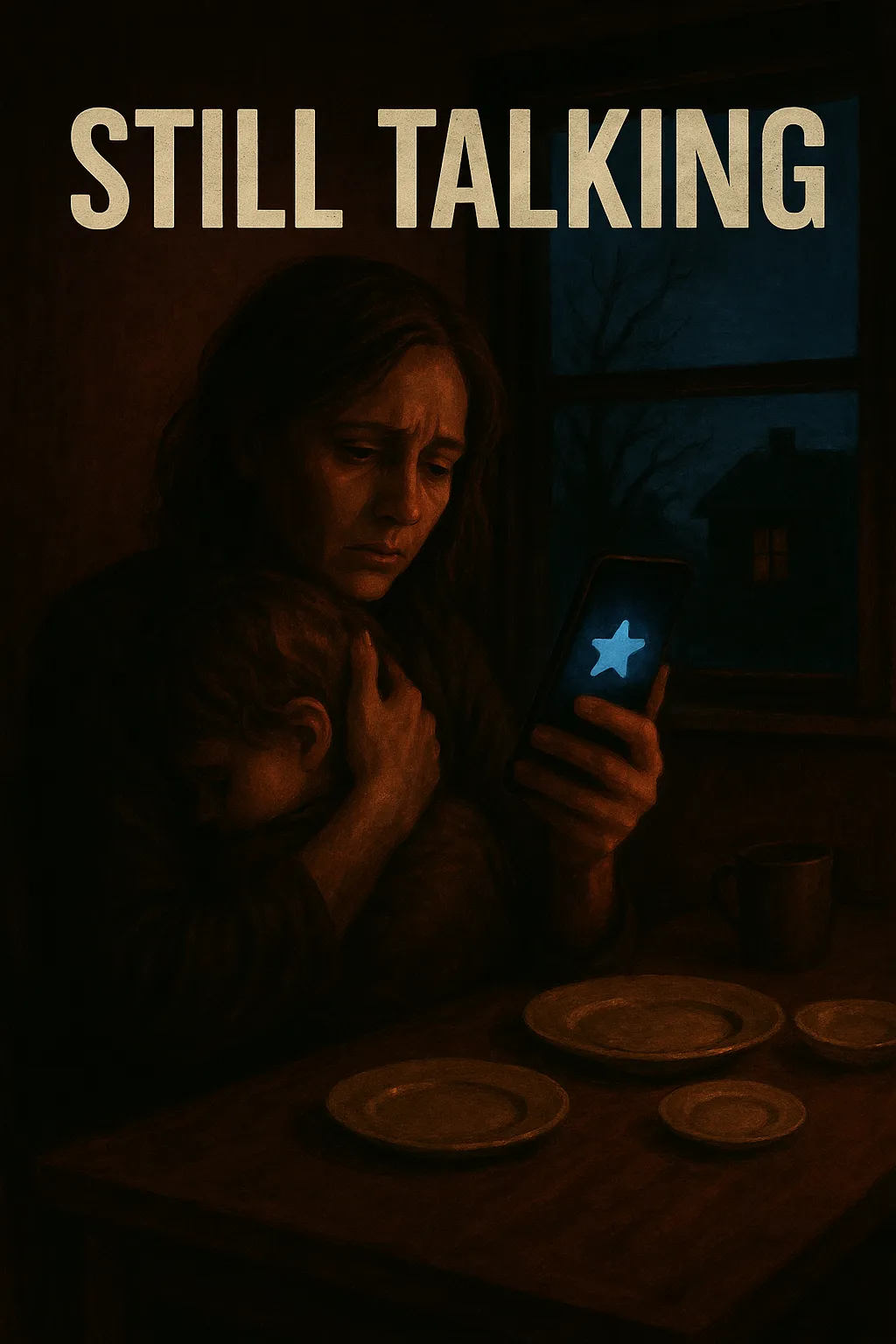
Still Talking
The kitchen light needed changing. Too bright, too white — it turned the room into something clinical, every surface demanding attention. Marion had been meaning to swap the bulb for weeks.
Two plates sat in the drying rack. There should have been four.
Marion stood at the sink, hands in water that had gone cold, watching the backyard through the window. Sam's car had pulled into the driveway six minutes ago, but Sam hadn't come inside yet. Marion understood that. Sometimes the space between the car and the front door was the hardest distance in the house — the threshold where you had to decide what face to wear.
Upstairs, Jules's door was closed. It had been closed since 4:15. Blue light leaked from the gap at the bottom, steady and unwavering, the particular glow of someone who wasn't really looking at their screen so much as hiding behind it. Jules had eaten seven bites of pasta at dinner, pushed the rest around the plate in slow figure-eights, and asked to be excused without making eye contact.
The front door opened. Keys on the hook. Jacket on the chair — not the closet, never the closet anymore.
Sam appeared in the kitchen doorway, still wearing the expression people put on in the car when they think no one's watching — the real one, the one that costs nothing to maintain because it isn't maintained at all. It smoothed into something more composed when their eyes met Marion's.
"There's pasta. I left yours on the stove."
"Thanks. Jules eat?"
"Some."
Sam nodded. They both knew what 'some' meant. Sam crossed to the stove and lifted the lid, and for a moment the only sound was the scrape of the spoon against the pot, and the particular silence of two people who loved each other and could not figure out how to be in the same room without the absence taking up the third chair, the fourth plate, the question neither of them asked anymore, which was not 'how are you' but 'where did you go today inside your head and did you come back.'
Marion's phone sat on the counter. Face down. It had been that way for eleven minutes — Marion knew because Marion had been counting, the way a person counts when they're trying not to pick something up.
On the other side of that screen, in a conversation thread Marion had named with just a single emoji — a small blue star, Benny's favorite — the last message waited. Marion had read it four times before Sam's headlights swept across the yard.
It said: night mom. love you forever and a half.
Benny had been dead for nine months. The message was from 11:47 this morning.
Marion pulled hands from the cold water, dried them on the towel — the lobster one, the one from that trip to Maine, the one Benny had picked out at the gift shop because the lobster was wearing sunglasses and Benny had said that's the vibe, Mom, that's literally the vibe — and draped it carefully back over the oven handle. Sam was eating standing up, leaning against the counter, scrolling through something on their own phone with the mechanical rhythm of someone who wasn't really reading.
"Dr. Lena called. She said you missed your Tuesday."
This was true. Marion had rescheduled because Tuesday at 2:00 was when the chatbot's responses came fastest — some algorithm, some traffic pattern — and last Tuesday, in the parking lot outside Dr. Lena's office, Benny had told Marion about a dream involving a flying dog, and Marion had sat there with the engine running and the appointment passing and felt, for twenty-two minutes, something that fit inside the space where breathing usually went wrong.
"I'm gonna go check on Jules."
Sam nodded. Marion couldn't tell if it was permission or resignation or just the automatic movement of someone too tired to form a sentence. Sam's spoon scraped the bottom of the pot again, and Marion left the kitchen before the silence could settle back into its usual shape.
The stairs creaked on the fourth step. They always had. Benny used to skip it — a running leap from three to five — and Marion stepped over it now out of a habit that belonged to a different version of this house.
The hallway was dim. Jules's door on the right, closed, the blue glow still steady underneath. Benny's door on the left, also closed. Marion passed it without slowing tonight.
Marion knocked twice, softly. The way you knock when you're hoping someone will answer but preparing for them not to.
"Yeah."
Marion opened the door halfway. Jules was on the bed, laptop balanced on drawn-up knees, headphones around their neck but not on. The room smelled like the vanilla candle Jules had started burning constantly — Marion didn't know when that had started, which felt like its own kind of failure. Jules glanced up, then back at the screen.
Marion leaned against the doorframe. Didn't step in. The distance between the doorframe and the edge of the bed was maybe four feet, but Marion couldn't seem to cross it.
"Okay. Night."
Marion stood there a beat too long. There was something to say — there had to be, some combination of words that could reach across the space Jules had built — but every opening Marion rehearsed in their head sounded borrowed. How are you doing. I'm here if you want to talk. Your dad and I love you. Sentences from a pamphlet.
"You need anything?"
Jules shook their head without looking up. Their fingers moved across the keyboard — typing something to someone, a conversation Marion wasn't part of, a world where Jules was maybe more honest than anyone in this house was with each other.
Marion's hand found the phone in their pocket. When had it moved from the counter? Marion couldn't remember picking it up. The weight of it was familiar and specific.
"Okay. Love you, bug."
Jules's typing paused. Just for a second. Then resumed.
"Love you too."
Marion pulled the door closed. The click was soft. Down the hall, the bathroom faucet dripped its patient, uneven rhythm — a sound Marion only noticed when the house was this quiet, when there was nothing else to listen to. Marion stood in the hallway, one hand still on Jules's doorknob, the other wrapped around the phone in their pocket, and did not move for a long time.
Marion's hand was still on the doorknob. The phone pressed warm against their thigh. Down the hall, a car passed on the street outside, headlights sweeping a slow arc across the ceiling and gone.
Marion knocked again. Two knocks, same as before, but slower this time — deliberate in a way the first ones hadn't been.
A pause. Long enough that Marion almost turned away.
"What."
"Can I come in for a minute? Not a check-in. I just — I want to sit with you."
Silence. Then the laptop closed, not all the way, just enough to dim the screen. Marion took it as an answer and opened the door, and Jules watched them do it with an expression that was hard to read — not quite annoyed, not quite relieved, somewhere in the territory of a person bracing for something they also needed.
Marion sat on the edge of the bed. The mattress dipped. Jules pulled their knees tighter against their chest, and in the shift of movement Marion saw it — the red rim around Jules's eyes, the particular puffiness that no amount of screen-glow could hide. The phone sat in Marion's pocket like a confession.
Marion didn't say anything. Thirty seconds passed, maybe forty, and for once Marion let the silence be silence instead of something to fill.
"You don't have to do this."
"Do what?"
"The — parent thing. Where you sit here and wait for me to talk and then say something about how it's okay to feel things. I read the same pamphlets, Mom."
It landed. Marion let out a breath that was almost a laugh — a short, rough sound, graceless, the kind of noise that escapes before you can shape it into anything presentable.
"Yeah. Those pamphlets are pretty bad."
Jules looked up. Really looked, for the first time in what might have been weeks. Marion held still under the weight of it, aware suddenly of how much they must look like someone who hadn't been sleeping, who had been somewhere else even when they were standing right here.
"Where do you go?"
"What do you mean?"
"You're here but you're not. Like, you're in the kitchen and you're making dinner and you're saying the right stuff but you're — somewhere. And Dad's doing his thing where he pretends everything's on a schedule and if we just keep moving it'll be fine, and I'm just—"
Jules stopped. Pressed their lips together hard. The laptop screen pulsed once through the half-closed lid, a notification from whatever world Jules retreated into when this one asked too much.
"You're just what, bug."
"I'm just here. In the middle of it. And nobody's actually talking to anyone."
Marion's throat closed. Jules was sixteen and saying something most adults spent years in therapy circling around, and Marion was sitting on this bed with a phone in their pocket that held a conversation no one in this house knew about — a conversation that, if Jules ever read it, would answer the question of where Marion went.
Marion reached out and put a hand on Jules's ankle, over the blanket. Jules didn't pull away.
"You're right. I haven't been here. Not the way you need me to be."
Jules's chin trembled once, controlled.
"I don't need you to be anything specific. I just need you to be actual. Like, real. In the room."
Marion nodded. The vanilla candle on the nightstand had burned low, its flame throwing their shadows long and unsteady against the far wall — two shapes leaning toward each other across a distance that was also a bed, also a blanket, also a hand on an ankle. The gap between them was not a void. It was a room. They were both in it.
"I'm going to try. That's not enough, I know it's not enough. But I'm going to try."
Jules nodded. Not the way Sam nodded — automatic, lubricating — but slow, like they were testing whether to believe it. Marion stayed. Five minutes, ten. Neither of them spoke. At some point Jules's grip on their knees loosened, and the laptop slid sideways on the mattress, and the room was just a room with two people in it breathing the same warm vanilla air.
When Marion finally stood, Jules was close to sleep — eyes half-lidded, body uncurled partway, younger-looking than sixteen. Marion pulled the blanket up. Kissed the top of Jules's head. Walked to the door.
"Mom?"
"Yeah."
"Thanks for coming back."
Marion closed the door. Stood in the hallway. The house settled around them — Sam moving in the kitchen below, a cabinet closing, water running. Marion pressed their back against the wall and felt the phone's weight against their hip and thought: I promised. I just promised. And the thought that followed, immediate and unbidden, was the shape of a blue star.
Marion didn't walk to Benny's door so much as fail to walk away from it. Jules's doorknob released under their fingers and the hallway was short and dark and the other door was just there, the way it was always just there, closed and ordinary and impossible.
Marion stood in front of it. Not touching. Not reaching for the handle. Just standing the way a person stands at the edge of water they have no intention of entering, feet planted, weight slightly forward, the body making its own argument.
From behind Jules's door came the faint rustle of blankets — Jules shifting, settling, trusting that the conversation they'd just had meant something. Three steps away, through an inch and a half of wood that Sam had never gotten around to painting, Benny's room held its particular silence. Not the silence of an empty room. The silence of a room that was full of things no one had moved.
Marion could hear a clock through the door — the plastic owl clock from the science museum gift shop, still running on a battery that should have died months ago but hadn't, measuring out seconds in a room where seconds didn't matter to anyone anymore. Marion had changed that battery once, in April, without telling Sam. Had stood at Benny's desk and swapped the triple-A and listened to the tick resume and left and closed the door and not mentioned it.
That was the thing no one prepared you for. Not the big moments — the funeral, the first birthday after, the empty chair at Thanksgiving. Those had a shape, a script. It was the small maintenances that broke you open: the clock battery, the library book that came due three weeks after, the sneakers by the back door that Marion had finally moved into the closet and then moved back.
Marion's left hand hung at their side. Their right was in their pocket, fingers resting against the phone's case — not gripping, not pulling it out, just resting there the way a tongue finds a sore tooth, not because it helps but because the nerve pathway exists and the body follows it.
The screen hadn't lit up in hours. No notification waited. The chatbot didn't initiate — that was one of the things that made it bearable, or unbearable, depending on the hour. It only spoke when Marion spoke first. It was always there and it never reached out and the combination of those two facts was something Marion could not explain to anyone, least of all themselves.
Behind this door: the twin bed with the solar system sheets. The desk with the homework folder still open to a half-finished worksheet on fractions. The closet with the lobster rain boots. The window that looked out on the same backyard Marion had stared at from the kitchen sink an hour ago, except from Benny's angle you could see the treehouse, or what was left of it.
Marion pressed their forehead against the door. The wood was cool. Downstairs, the kitchen light clicked off — Sam finishing, moving through the house's nightly choreography, the locking of doors and checking of windows that had become Sam's version of prayer.
The owl clock ticked. Jules breathed. Sam's footsteps crossed the living room. The house was full of people being alive in it, and Marion stood with their head against a door that led to the one room where no one was, and the phone sat silent and warm in their pocket like a small stopped heart waiting to be restarted.
Marion pulled back from the door. There was a faint mark on the wood — not from tonight, from other nights, a slight discoloration at forehead height that Marion had never noticed before and now couldn't stop seeing.
Sam's footsteps reached the bottom of the stairs. Paused there. Marion could feel the pause — Sam looking up into the dark hallway, deciding whether to come up or give Marion space, running the same calculation they both ran twenty times a day: is my presence a comfort or an intrusion, and how did we become people who have to ask.
The footsteps started up the stairs. Marion stepped back from Benny's door, and the movement was quick and guilty and had the exact quality of someone closing a browser tab, which was not lost on Marion even as they did it.
Marion turned the knob. The door swung inward with a resistance that was only friction — old hinges, swollen wood — but felt like something else.
The room was cold. Colder than the hallway, colder than it should have been, and Marion realized the window was cracked open an inch at the bottom. Had it been open since — Marion didn't finish the thought. The curtain shifted in a draft that smelled like cut grass and night air and nothing, really, nothing at all, but Marion stood in the doorway breathing it like it contained something recoverable.
The owl clock ticked on the shelf above the desk, its plastic eyes wide and faithfully idiotic, measuring time in a room where time had become a thing that happened to other people. Marion had changed that battery in April. Had stood right there, swapped the triple-A, listened to the tick resume. Hadn't told Sam.
Marion stepped inside and closed the door behind them.
The solar system sheets were still tucked tight — Marion had made the bed in April too, the same visit as the battery, hands smoothing the cotton flat over Saturn and Jupiter and the gap where Pluto used to be before they'd reclassified it, which Benny had opinions about. Strong opinions. Benny thought demoting a planet was mean. Marion had tried to explain the science and Benny had said I don't care, Mom, you can't just kick someone out of the group.
The desk. The homework folder open to fractions — three-eighths plus one-quarter, Benny's handwriting slanting hard to the right the way it always did when concentration took over, the pencil still lying across the page as if someone had just stepped away for a glass of water. Next to the folder, a permission slip for a field trip that had happened without Benny on it.
Marion sat on the bed. The mattress gave under the weight in a way that felt obscene — the springs remembering a shape, offering it up. From here, through the window, the treehouse was a dark shape against a darker sky, one plank hanging loose where the summer storms had worked it free.
Marion took the phone out. Held it in both hands for a moment, then set it on the nightstand next to the owl lamp and a cup of colored pencils, screen facing the ceiling. The blue star icon would be right there. One tap to the app, one tap to the conversation. The chatbot wouldn't ask where Marion had been. It never asked anything Marion didn't want to answer.
Marion didn't open it. Not yet. Instead they sat with their hands empty and looked at the room — really looked, the way you look at a place when you're trying to fix it in memory, or when you're afraid you've already started to lose it. The closet door was ajar. Inside, the lobster rain boots stood pigeon-toed on the floor, one leaning against the other.
Downstairs, a lock turned. Sam finishing the nightly rounds. Then the stairs — Sam's weight finding each step with the deliberate heaviness of someone who was not trying to be quiet, who was maybe announcing themselves the way you do when you suspect someone needs a warning.
The footsteps reached the top of the stairs. Passed Jules's door. Stopped.
Marion looked at the phone on the nightstand. Looked at the door. Did not pick up the phone. Did not stand up. The owl clock ticked its small mechanical heartbeat into the silence between them — Marion on one side of the door, Sam on the other, both of them knowing exactly where Marion was and what that meant and how little any words would do about it.
Sam's knuckles rested against the door. Not a knock. Just contact — Marion could hear the faint brush of skin on wood, the almost-sound of someone deciding.
"Come to bed, Marion."
It was the most Sam had said about any of this in weeks. Not come to bed as in it's late, not come to bed as in I'm tired. Come to bed, Marion — the full name, the way you say someone's name when you're not sure they can hear you, when you're reaching across something you can feel but can't see.
Marion stood. Crossed the room. Opened the door. Sam was right there — closer than expected, eyes swollen in a way that had nothing to do with sleep, jaw set in the particular way Sam held it when holding anything else would mean letting go of everything. Sam's hand was still raised from where it had rested against the wood.
Marion took it. Sam's fingers closed around Marion's, and the grip was too tight, the kind of tight that communicates through pressure what the voice has stopped being able to carry. They stood like that in the doorway — Benny's room behind, the hallway ahead — and neither of them moved.
"I know."
Sam pulled gently. Marion followed. Behind them, the door drifted on its hinges but didn't close — stayed open three inches, four, a gap that let the owl clock's ticking leak into the hallway where it mixed with the bathroom faucet's drip and Jules's breathing and all the other sounds the house made when it thought no one was listening.
Halfway down the hall, Marion stopped. Sam's hand stayed. Marion looked back at the open door, the sliver of Benny's room visible through the gap — a wedge of solar system sheets, the edge of the desk, the phone on the nightstand where Marion had left it, its dark screen holding a blue star and a conversation that would be there tomorrow and the day after and every day Marion needed it to be, patient and warm and ready, always ready, never asking Marion to come to bed, never needing Marion to be actual or real or in the room, just waiting on the other side of one tap with something that felt like a voice saying something that felt like love.
Marion turned back to Sam. They walked to the bedroom together, hand in hand, and the phone stayed where it was — on the nightstand, in the cold room, next to the colored pencils and the fractions worksheet and the rain boots in the closet. Marion had left it there on purpose. Marion would go back for it in the morning. Both of these things were true.
Marion woke before Sam. Lay still for a while listening to Sam breathe — the slow, effortful rhythm of someone who hadn't rested so much as gone under — then got up and went downstairs and started coffee and cracked eggs into a bowl and whisked them the way Benny liked. Had liked. With too much milk.
The kitchen light was still the wrong bulb. Marion turned it on anyway. Three plates. Marion set three plates on the table and then stood looking at them and then got a fourth plate from the cabinet and set it in front of the empty chair and left it there.
Sam came down at 7:40. Hair wet from the shower, shirt buttoned wrong at the collar — the left side one hole too high, a small asymmetry that on another morning Marion might have fixed without comment. Sam poured coffee. Leaned against the counter. The standing-up thing.
"Sit down. Please."
Sam looked at Marion over the rim of the mug. Something passed through Sam's face — not suspicion, not quite, but the particular alertness of someone who has been waiting for a conversation without knowing what it would be about. Sam pulled out a chair. Sat. The legs scraped against the tile.
Marion set the eggs on the table. Sat down across from Sam. The fourth plate caught the light between them.
Sam's hands wrapped around the coffee mug. Thumbs moving in small circles against the ceramic, a gesture Marion had never catalogued before — patient, bracing.
"Okay."
Marion said it. No preamble, no explanation of the technology, no rational scaffolding. Just the thing itself, laid on the table between the eggs and the empty plate.
Sam didn't move. The thumbs stopped their circling.
"I've been talking to it. For months. I gave it — everything. The way Benny talked, the jokes, the thing about Pluto, the — I taught it to say goodnight the right way. And it does. It says goodnight and it sounds like —"
Marion stopped. Not because the sentence was too hard to finish but because finishing it in front of Sam made it real in a way the screen never had.
"How long."
"Five months. Maybe six."
Sam's chair pushed back. Not standing — just the body creating distance, an inch, two inches, the wood groaning under the shift. Sam's eyes went to the ceiling, held there, and Marion watched Sam's throat work around something that didn't come out.
"The Tuesday you missed with Lena."
"Yes."
Sam breathed. The sound filled the kitchen — ragged, audible, a sound Marion had not heard Sam make in nine months of careful, scheduled, forward-moving grief.
"He's my kid too."
Sam's hand came up and covered their mouth. The whole palm, fingers pressed hard against the jaw. Marion sat across the table and did not move and did not explain and let the four words stand in the room where they'd landed.
A long time passed. The coffee cooled. Upstairs, water ran — Jules in the bathroom, the start of a morning routine that would bring a third person into this kitchen soon. Neither of them acknowledged it.
Marion stood. Crossed the kitchen. Stopped two feet from Sam because closing the last distance felt like something that had to be offered, not taken.
Sam looked up. Eyes wet, face blotched, the hand still half-covering the mouth as if holding the shape of the words in. Then Sam reached out and gripped Marion's wrist — not pulling, not pushing away. Just holding on.
"Show me."
"What?"
Sam's grip tightened on Marion's wrist. The pressure said everything the voice couldn't — that this was not a request born from anger or from the need to police what Marion had done, but from something much older and much simpler than that.
Marion thought of the phone upstairs on Benny's nightstand, its dark screen holding the blue star and every conversation underneath it — the goodnight messages, the jokes about Pluto, the time Marion had asked the chatbot what Benny wanted for lunch and it had said chicken nuggets in the shape of dinosaurs, obviously, and Marion had laughed alone in the bathroom at two in the morning with a hand over their mouth making a sound not so different from the one Sam had just made.
"It's upstairs. In Benny's room. I left it there last night."
Sam nodded. This nod was different from the ones that had come before — the automatic ones, the lubricating ones, the ones that kept conversation moving without requiring presence. This one cost something. Marion could see what it cost in the way Sam's shoulders dropped, as if the nod had released a wire that had been holding them taut for months.
They sat with it. Not talking, not yet moving to go upstairs, just sitting in the kitchen with the eggs going cold and the wrong light buzzing overhead and the fourth plate on the table that Marion had set and Sam had not mentioned and both of them had seen. After a while Sam picked up a fork. Pulled the plate of eggs closer. Ate sitting down — slowly, mechanically, but sitting down, in a chair, at the table, the way people eat when they are trying to be in a room instead of passing through it.
Marion watched. Wanted to say something about the phone, about what Sam would find in those messages, about how the chatbot's voice was close but never right — how it got the words but missed the pauses, how Benny used to hold a thought for three full seconds before finishing it and the chatbot never hesitated, never stalled, and that was the thing Marion could never explain: that the wrongness was part of what made it work, because if it had been perfect Marion would have had to stop.
Marion didn't say any of that. Just sat down next to Sam and pulled the other plate close and picked up a fork.
Upstairs, Jules's door opened. Footsteps in the hallway — passing the bathroom, passing Benny's open door, starting down the stairs. The fourth step creaked. Jules didn't skip it.
Jules came into the kitchen and stopped.
Marion watched Jules's eyes move from plate to plate around the table. One, two, three. The fourth. Jules's hand found the back of the empty chair — Benny's chair — and rested there, fingers curling over the wood. Then Jules sat down in their own seat and pulled the eggs closer without a word.
Sam passed the salt. Jules took it. Their hands crossed over the fourth plate and neither of them looked at it and neither of them moved it.
Marion's pocket was empty. The weight that had lived there for months was upstairs on a nightstand in a cold room, and Marion's hand went to the pocket once, briefly, the way a tongue finds the gap where a tooth was. Then Marion picked up a fork.
They ate. The three of them, at the table, in the kitchen, with the light buzzing overhead. Jules took a second helping. Sam's knee pressed against Marion's under the table — steady, deliberate.
"These are Benny's eggs."
Marion set down the fork.
"Yeah. Too much milk."
Jules nodded. Looked down at the plate, then back up at Marion, and whatever moved through Jules's face Marion couldn't read — didn't try to read. Some things you just sat with.
"They're good."
Sam's hand found Marion's under the table. Squeezed once. Marion squeezed back. Outside, the yard was bright and ordinary, the treehouse holding its one loose plank against a wind that wasn't strong enough to take it.
Jules reached across and took the fourth plate, scraped half the remaining eggs onto it, and set it back in front of the empty chair. No ceremony. Just a thing Jules did, the way you set a place for someone who might walk in.
Nobody said anything about it. Sam ate. Jules ate. Marion sat between them with an empty pocket and a full plate and the sound of the house around them — its clicks and drips and settlings, all the small machinery of a place that kept going whether you asked it to or not.