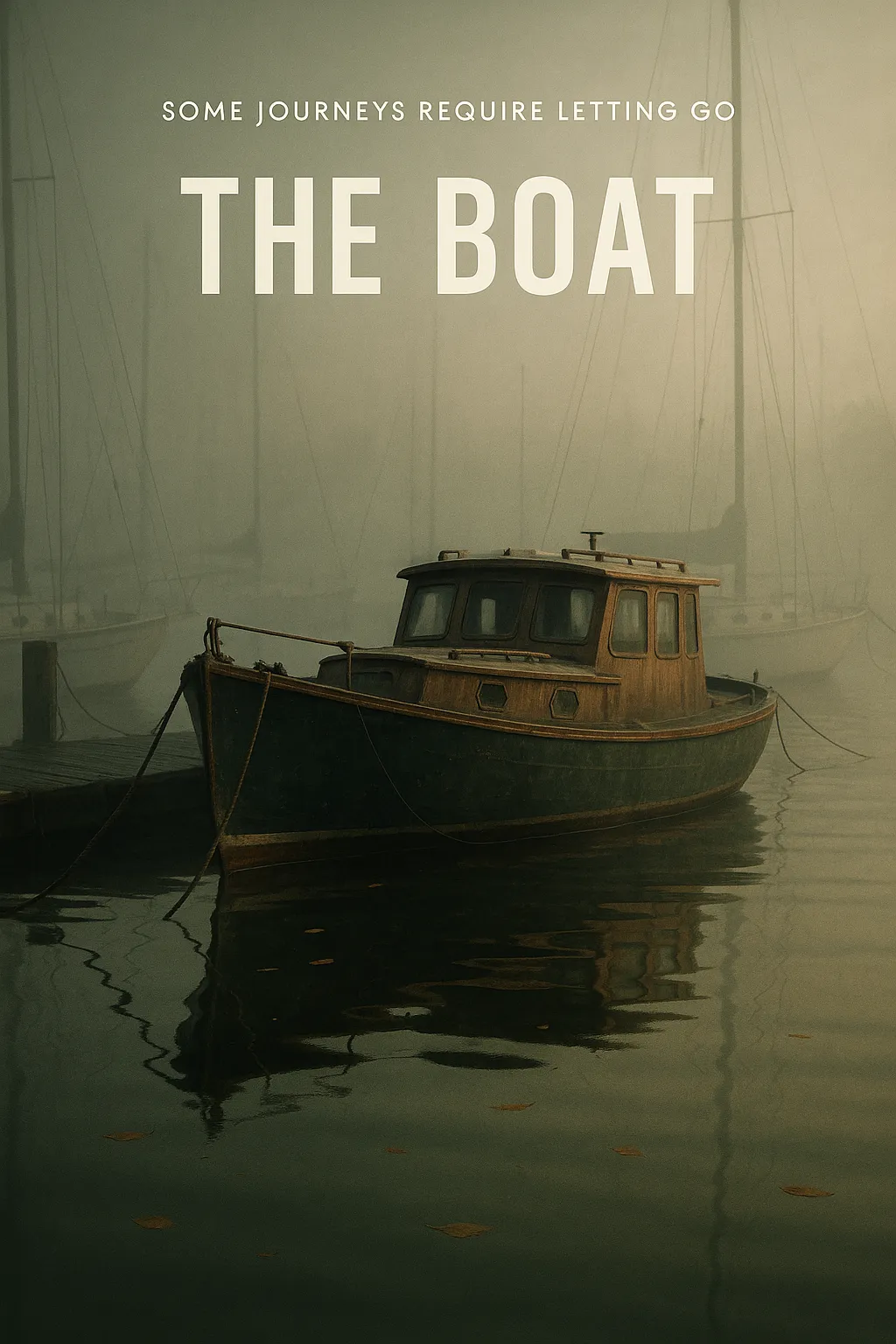
The Boat
Glen got there twenty minutes early and spent most of it standing in the parking lot with his coffee, not walking down to the slip.
The morning was flat and gray. October doing its thing. A few gulls worked the pilings near the fuel dock. Somebody's halyard was slapping against a mast three slips over, that hollow aluminum sound that used to drive Margot crazy.
He'd brought a folder. Title, registration, the survey from May, receipts for the engine rebuild. Everything in order. He'd even printed the listing photos, which was stupid — the guy had already seen the photos. That's why he was coming.
The boat sat where it always sat. A 1978 Pearson 323, teak trim, dark green hull. Margot had picked the green. He'd wanted blue and she'd said blue was for people who couldn't commit to a color.
His phone buzzed.
A text from Katie: How are you feeling about today? followed by a heart emoji. He typed Fine and then deleted it and typed Good and then deleted that too and put the phone back in his jacket.
He walked down the dock. The boards had that give to them, that slight bounce. He stopped at the slip and looked at the boat the way you look at something you're trying to see as a stranger would. Just a boat. Thirty-two feet. Good bones. Fair price.
He stepped aboard. The cockpit was clean — he'd come yesterday with a bucket and scrubbed it down, which had taken three hours because he kept stopping. The companionway hatch slid open smooth. She'd planed that track herself, cursing the whole time, and it hadn't stuck once since.
Below deck smelled like teak oil and mildew.
A truck pulled into the lot above. Glen heard the door shut, then footsteps on gravel, then the particular hesitation of someone scanning dock numbers.
He climbed back up into the cockpit and set the folder on the seat. Took a breath.
A man came down the dock. Mid-forties, work jacket, ball cap. He walked like someone comfortable around water — no wasted movement, eyes already on the hull before he reached the slip. He carried a small flashlight in one hand and nothing else.
The man stopped at the slip and looked at the boat for a long moment before he looked at Glen.
Yeah. Photos don't really get the color right.
The man put out his hand.
Glen shook it. Good grip. Calloused palm.
Glen held up a finger.
One sec. Gotta answer my kid.
Nate nodded and stayed on the dock, hands in his jacket pockets, looking up at the mast.
Glen pulled out his phone. Katie's text was still there. The heart emoji. He typed It's a nice morning for it and stared at it and added a period after it, which changed nothing. He sent it anyway.
He put the phone away and gestured Nate forward.
Step on the rail there, not the gelcoat.
Nate came aboard clean. His flashlight clicked on and off once in his hand — he didn't seem to know he was doing it.
Sixty-seven?
Seventy-eight.
Huh. She looks older. I mean that as a compliment. The woodwork.
Glen ran his hand along the coaming.
We replaced most of the teak. The original stuff was shot when we got her.
He looked at the companionway hatch.
Yeah. Thanks.
Nate crouched and ran his thumb along the edge of the cockpit seat.
Four years. Give or take.
Just you?
The halyard three slips over clanged against its mast. Glen reached down and adjusted the folder on the cockpit seat, squaring its edges with the cushion seam.
No. My wife and I.
Nate waited a beat, the way people do when they hear something in a voice.
Well, you two did beautiful work.
She did the beautiful parts. I did the engine.
Nate laughed. Glen almost did.
Glen slid the companionway hatch open. It didn't stick.
He stepped down into the cabin and moved aside to give Nate room.
Nate came down the ladder with one hand on the rail and his flashlight in the other. He stood in the main saloon and didn't say anything for a moment. Just turned slowly, taking it in — the settee cushions, the nav station, the way the teak caught what gray light came through the portlights.
This is all new.
Most of it. The handrails are original. Everything else we stripped and rebuilt.
Nate ran his hand along the edge of the galley counter where the fiddle rail met the bulkhead. His fingers found the scarf joint without looking for it.
Glen opened the seacock under the galley sink, checked it, closed it again. A thing to do with his hands.
Nate looked at him. Then at the galley counter again.
She do this professionally, or —
No. She was a nurse. She just — she had good hands.
The boat rocked gently on someone's wake. A coffee mug Glen had forgotten in the nav station holder shifted but didn't fall.
Nate crouched by the engine access and lifted the companionway steps himself before Glen could get there. The Yanmar sat underneath — clean, gray, bolted down.
Yeah. Full rebuild. New head gasket, injectors, raw water pump. Zincs are fresh. She runs.
Nate leaned in closer. He traced the fuel line with his finger, following it from the filter to the injection pump.
All new. Double-clamped below the waterline.
How many hours on the rebuild?
Glen picked up the coffee mug from the nav station and held it. It was a white mug with a chip on the rim.
Twelve.
Nate straightened up from the engine compartment.
Twelve hours total?
Glen set the mug back in the holder.
The wake passed. The boat settled.
Nate put his hand flat against the bulkhead beside him. He kept it there.
Glen took a breath.
He moved forward toward the head and pushed the door open.
Nate followed him forward, ducking under the grab rail.
Yeah.
Yeah, it is.
Nate looked into the head, then into the V-berth beyond it. The forward hatch let in a wedge of gray sky. Margot had picked the cushion fabric — a dark navy that she said wouldn't show wine stains, which turned out to be a promise she'd tested more than once.
Anything I should know about the rigging?
Glen leaned against the bulkhead opposite the head.
What'd the survey come back at?
It's in the folder up top. He was fair. Found some crazing on the deck but nothing structural.
Nate nodded slowly. He looked around the cabin one more time — a slow, careful look, the kind you give a place you're already imagining yourself inside.
Sure.
Twelve hours on a rebuilt engine, new hoses, new teak, four years of work. Why are you selling?
Glen looked at the navy cushions in the V-berth. At the grab rail Margot had sanded by hand because she said the factory radius was wrong. At the little brass hook on the head door that she'd found at a flea market in Mystic and carried around in her coat pocket for two weeks before she figured out where it should go.
Because it's finished.
Nate didn't click his flashlight. Didn't nod. He just stood there in the cabin of a boat that a woman he'd never met had built with her hands.
Glen's pocket buzzed twice in quick succession. Then a third time.
He pulled the phone out. Three texts from Katie.
The first: Did he show up?? The second: Don't let him lowball you. The third: 🤞
Glen typed He's here, good guy and sent it.
Nate had moved forward into the V-berth. His flashlight played along the hull-to-deck joint, and Glen could hear him tapping with a knuckle in a slow line, listening for delamination.
Nate backed out of the V-berth.
She's dry. Never had standing water in the bilge since we launched her back on the cradle.
Nate's flashlight clicked on and off. He was looking at the head door — at the brass hook.
That's not original hardware.
No. Margot found that somewhere.
The name came out before the title. Not my wife. Margot. He reached past Nate and tested the hook, swinging the head door open and shut. The latch caught clean every time.
Nate's flashlight clicked.
My wife picks up hardware at every antique shop we pass. I've got a garage full of doorknobs that don't fit anything we own.
Glen laughed. It came out of him like a cough.
She was like that. She'd find stuff and just carry it around until she knew.
She do all the finish hardware?
Everything you can touch. If it feels right in your hand, that was her.
Nate opened a locker above the settee. The latch was smooth, no play in it. He closed it and opened the next one. Same thing.
I've refitted two boats. Never got the locker latches right.
His phone buzzed again. He glanced at it. Katie: Don't forget to mention the survey 💪
He put the phone facedown on the nav station.
Nate was checking the seacocks now, crouched low with his flashlight aimed at the through-hulls.
All bronze. No dezincification. I check them every spring.
Nate stood up and wiped his hands on his jeans.
Glen nodded. A dock line groaned against a cleat somewhere outside.
You said the standing rigging needs doing. What else? Give me the real list.
Glen leaned against the bulkhead. There was a brown water stain on the overhead near the mast step where a deck fitting had wept one winter. He'd never gotten around to painting over it.
That's it?
That's it.
What about sails?
Main and a hundred-ten genoa. Both new. Well — new to us. They came off a boat in Essex that was being parted out.
He stopped. His thumb was on the bulkhead.
When did you lose her?
The question was simple and it landed simply. No preamble. No apology first.
Fourteen months.
Nate sat down on the settee. Not like a buyer inspecting the cushion. Like a man sitting down.
And the twelve hours on the engine. That's from the rebuild. Sea trials.
Yard ran her in the slip to break in the injectors. I was there for it. That's all twelve.
You never took her out.
It wasn't a question this time.
Glen pulled a dock line through a fairlead that didn't need adjusting.
He let the line go.
Anyway.
The bilge pump cycled once, a short mechanical gulp, then stopped.
My dad had a boat he never finished. A Catalina 27. It sat in his yard for eleven years under a tarp. After he died my brother and I tried to sell it and nobody wanted a half-built boat. We ended up paying someone to haul it.
That's worse.
I don't know. At least he never had to decide.
Glen looked at him. Nate was turning the flashlight over in his hands, not clicking it, just turning it end over end.
Katie — my daughter — she's the one who made me list it. She thinks selling it is the healthy thing.
Is it?
I'll let you know.
Glen stood up from the settee and his knee caught the edge of the nav station the way it always did.
Come on. I'll show you the rig.
They climbed up into the cockpit. The air had shifted while they were below — a west wind now, carrying diesel from the fuel dock. A flag on the harbormaster's office snapped twice and went taut.
Nate went to the mast and looked up. He put a hand on the lower shroud and gave it a shake, feeling the tension.
Swaged?
Swaged. Original Navtec fittings. The surveyor scoped them — no cracking. But they're forty-six years old, so.
I'd budget for rod.
That's what I'd do.
Nate moved forward along the side deck, one hand on the lifeline, testing stanchion bases with a boot as he went. He stopped at the bow pulpit and looked back at the mast from the foredeck.
Roller furling or hanks?
Glen almost smiled.
Only one?
Only one.
Nate came back along the port side. He crouched at the base of the mast and checked the step, then the gooseneck fitting. His flashlight clicked once.
Glen.
Glen was standing at the helm. His hand was on the wheel, which Margot had wrapped in leather because she said the stainless got too hot in July and too cold in November.
I want to buy your boat.
Glen nodded. He turned the wheel a quarter-turn to port. The rudder responded below them, a faint drag through the water.
Okay.
He sat down on the cockpit coaming. The nonskid under his boots was still good.
I'm not going to negotiate with you. Your price is fair and you know it.
Yeah. No. I appreciate that.
A gust came through and a loose dock cart rolled three feet across the pier and stopped against a piling.
I've got a question and you can tell me to go to hell.
Glen looked at him.
Before we do the paperwork. Do you want to take her out?
Glen's hand stopped on the wheel.
Just out past the breakwater and back. An hour. I can crew or I can stay on the dock. Either way.
Glen looked at the green hull, at the water moving against it. At the dock lines he'd tied himself, the ones that had held the boat in this slip for fourteen months while he drove here on weekends and sat in the cockpit and didn't go anywhere.
His phone buzzed in his pocket. He didn't reach for it.
She'd be pretty pissed if I sold it without sailing it.
He said it to the water. Then he looked at Nate.
Yeah. Okay. Yeah.
Nate put the flashlight in his jacket pocket.
You know how to handle jib sheets?
I grew up on a Catalina 27.
Glen stepped to the bow cleat and started working the dock line free. His hands knew the knot. They'd tied it a hundred times.
Glen pulled his phone out and leaned against the coaming. The screen was bright in the overcast light. Two missed texts from Katie — a thumbs-up emoji and then, forty seconds later: Well??
He called her. She picked up before the first ring finished.
Did he lowball you? He lowballed you.
He offered asking.
A beat.
Wait, seriously? Full price?
Full price. He's good, Katie. He knows boats.
Dad, that's great. That's — I'm really glad. Are you okay?
Nate had moved to the foredeck and was checking the anchor roller, giving Glen the length of the boat.
We're going to take her out.
Nothing on the line for a moment.
Out like — out on the water?
Just past the breakwater. An hour.
Dad.
He offered. The buyer. He said I should take her out before we sign anything.
She was doing the thing she'd done since she was nine, holding the phone away from her face so he wouldn't hear.
No.
The flag on the harbormaster's office popped in a gust. Glen watched it.
Mom would be so mad at you.
Yeah. I know.
Go. Call me after. I mean it — call me after.
I will.
He hung up and set the phone on the chart table below. When he came back up, Nate was already at the bow cleat, one hand on the dock line, waiting.
You good?
Yeah.
Glen turned the key. The engine caught on the first try.
Cast off the bow.
Nate freed the line and tossed it aboard in a clean coil. Glen reached back and pulled the stern line himself, felt the rope come through the chock, felt the boat shift under him — a different kind of floating now, untethered, the hull answering the current for the first time.
He put the throttle in forward. The Pearson eased out of Slip 14, her green hull cutting a crease in the flat water of the fairway.
The breakwater was a quarter mile ahead. Nate sat on the cabintop with his legs hanging into the cockpit, not saying anything, his face into the wind. Glen held the course. The boat moved beneath him and the engine was running and that was what was happening.
He didn't think about Margot. He didn't not think about her either. The wheel was in his hands and the water was ahead and that was enough.
The breakwater passed to starboard, close enough to see the barnacle line. Then open water.
The hull rose and settled into the waves. Glen widened his stance and let his knees take it. The wheel pulled gently to weather, a habit of the rudder he was learning for the first time.
You want to put the genoa out?
Your call.
Glen killed the engine. Nate uncleated the furling line and the genoa unrolled in a white arc against the gray sky. It luffed once, found the wind, and filled.
The boat leaned. Glen felt it in his ribs, a tilt that was nothing like sitting at the dock. The depth sounder read nine feet, which meant ten.
They sailed for twenty minutes without talking. Nate trimmed the sheet when the wind shifted. Glen held the course. A cormorant sat on a channel marker and watched them pass. There was a plastic bag caught on a lobster pot buoy about fifty yards to port.
When they came about, Glen eased the mainsheet and the boom swung across and Nate ducked under it like he'd done it a thousand times. The Pearson settled onto the new tack and the wake curled behind them.
The marina grew on the horizon — the masts first, then the fuel dock, then the slips. Glen started the engine and Nate furled the genoa without being asked. They motored in through the fairway at idle, the wake barely a ripple.
Glen brought the Pearson into Slip 14. Nate stepped off the bow with the dock line and made it fast. Glen cut the engine.
The boat settled against the pilings. Water lapped at the hull. Glen stood at the helm with both hands on the leather wrap and didn't move for a while.
Nate was standing on the dock, hands in his jacket pockets.
Give me a minute.
Nate walked up the dock toward the parking lot. Glen sat down in the cockpit and called Katie.
She picked up on the first ring.
Glen cleared his throat. Ran his thumb along the coaming where the gelcoat was smooth.
It was good, sweetheart.
Katie was quiet for a second. Then she said, Good.
You going to sign?
Yeah. I'm going to sign.
Okay, Dad.
He hung up. Stood. Stepped off the boat onto the dock and felt the solid wood under his feet. Up the pier, Nate was leaning against his truck, reading something on his phone. The survey folder was on the hood. Glen walked toward him.