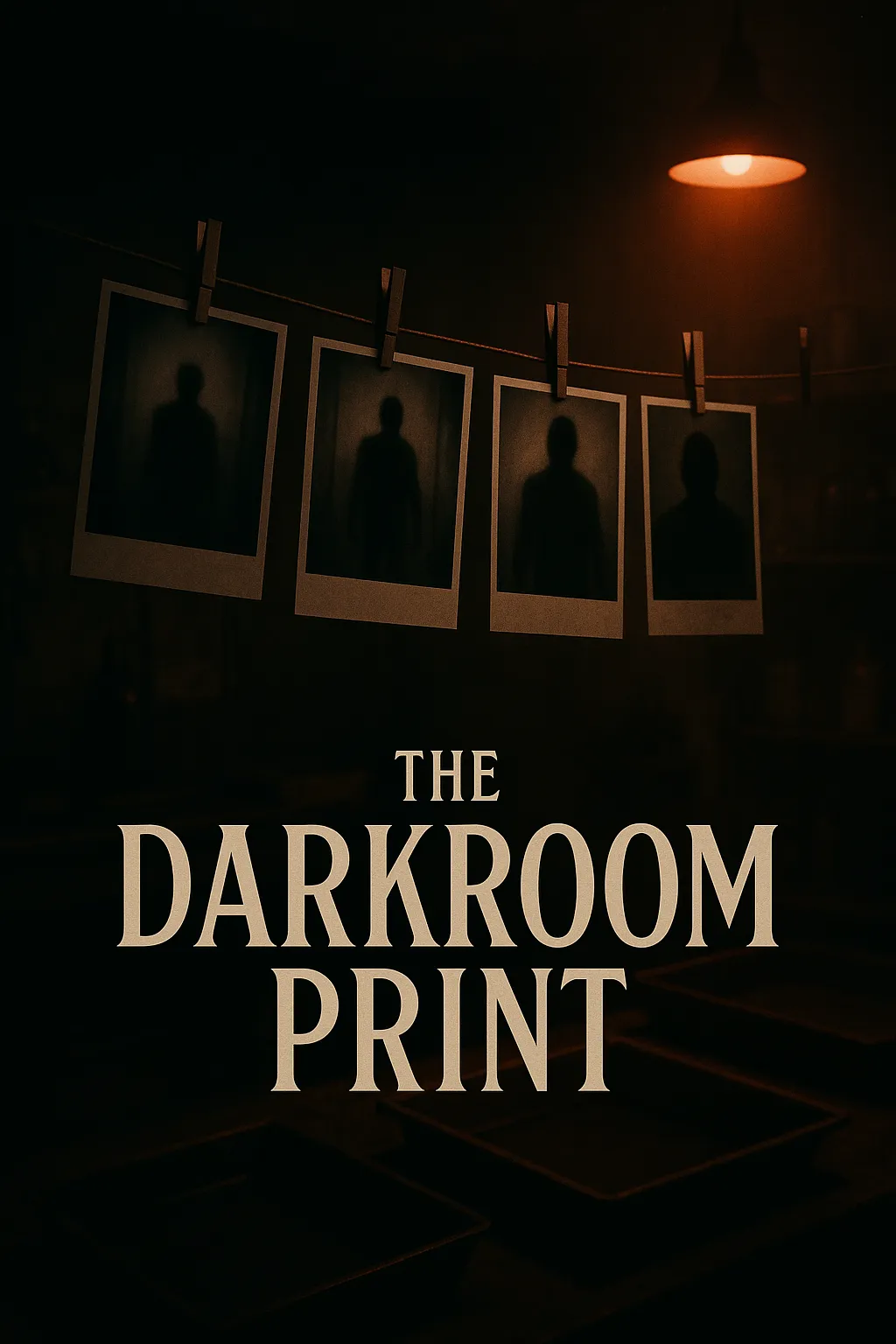
The Darkroom Print
The darkroom smelled the way it always did — fixer and dust and the faint chemical sweetness that Margot had long stopped noticing except on nights like this, when she'd been down here long enough for her nose to reset. Nine p.m. The safelight turned everything the color of old brick. Somewhere above her, the building settled, and the ventilation fan that never quite worked right pushed warm air through the ceiling vent in stuttering breaths.
She'd shot a roll of Tri-X that afternoon. Portraits of a woman outside the Laundromat on Division Street — good light, good face, the kind of stranger who said yes without Margot having to explain why she was asking. Twelve frames. Nothing remarkable. The kind of work she did to keep her hands busy when no one was paying her to point a camera at anything.
Her phone sat on the shelf by the door, screen down. Two missed calls. One from a number she didn't recognize. One from Callum. She hadn't listened to either voicemail. Callum's would be gentle and careful and would use her name too many times, the way he did when he was trying not to sound worried.
She pulled the film from the tank, hung it to dry, and waited. This was the part she loved — the patience of it, the enforced stillness that digital had killed. You couldn't rush chemistry. You stood in red light and you breathed and you let the world narrow to a strip of acetate and whatever it had caught.
When the negatives were dry, she cut them into strips and chose a frame — the seventh, the woman half-turning, mouth slightly open as if about to speak. Margot slid it into the enlarger, adjusted the focus, and exposed a sheet of paper. Eight seconds. She moved the print to the developer tray and watched the image rise out of nothing, the way it always did, like a memory surfacing.
The woman's face came first. Then the Laundromat window behind her, the reversed letters of the sign, the hard diagonal of afternoon shadow on the sidewalk. And then, at the left edge of the frame, something else.
A figure. Standing in the mouth of the alley that ran alongside the building. Dark, slightly blurred, the way a person looks when they're just outside the plane of focus. Tall. Arms at their sides. Facing the camera.
Margot pulled the print from the developer and moved it to the stop bath, then the fixer, her hands going through the motions while her eyes stayed on that left edge. She hadn't seen anyone in the alley. She was certain of it — not the vague certainty of a bad memory, but the specific, professional certainty of someone who checked her backgrounds before she pressed the shutter. The alley had been empty.
She went back to the enlarger and checked the negative under the loupe. The figure was on the negative too.
Not a processing artifact. Not a light leak. Something that had been standing in that alley and printed onto silver halide crystals at one-hundred-and-twenty-fifth of a second, and she had not seen it.
Margot printed another frame. The fifth — the woman looking directly into the lens, full face, no ambiguity in the background. She exposed it, developed it, fixed it. The figure was there. Further back this time, half-hidden by a dumpster, but unmistakable once you knew where to look. Same posture. Same angle of attention.
She printed four more. The figure was in every one. In the earliest frames it stood at the far end of the alley, barely distinguishable from shadow. By the twelfth, it had moved to the mouth of the alley. Closer to her. Closer to wherever she'd been standing when she took each shot.
The fan pushed its stuttering air. The safelight hummed. Six wet prints hung from the line above the trays, dripping fixer onto the concrete floor, and in every one of them something stood where nothing had been.
Margot reached for her phone, turned it over, and looked at Callum's name on the screen for a long time. Then she set it back down, screen-side up this time, and pinned the seventh print — the closest figure, the sharpest — to the corkboard above her workstation. She leaned in until her nose nearly touched the paper. Studied it the way she studied any portrait. Trying to find the face.
Margot stood in front of the corkboard for another full minute, maybe two. The seventh print was still pinned there, still wet at the edges, and the figure in the alley mouth hadn't moved. She didn't know why she'd expected it to.
She turned away. Her camera bag sat on the stool by the door where she'd left it when she came in — the Nikon inside, lens cap on, strap wound twice around the body. She didn't open it. Didn't need to. Whatever was on the negatives was on the negatives, and holding the camera wasn't going to change that.
She drained the trays, rinsed them, hung them to dry on the hooks above the sink. Wiped down the enlarger. Capped the bottles. The routine steadied her hands the way it was supposed to. When the darkroom was clean she pulled the light chain and stood for a moment in full dark — no safelight, no nothing — and listened to the fan push its broken rhythm through the vent.
She grabbed the camera bag, slung it over her shoulder, and locked the darkroom door behind her.
The basement hallway was narrow and smelled like concrete dust. Edith's door — her office, or sitting room, or whatever it was she kept on the ground floor — was closed as Margot passed it on the first landing. A thin line of yellow light showed underneath. Ten p.m. and Edith was still up. Margot kept climbing.
Her apartment was the second floor. One bedroom, a kitchen that was also the living room, a bathroom with a window that didn't close all the way. She let herself in and set the camera bag on the chair by the door. The overhead light in the kitchen had burned out two weeks ago and she'd been using the lamp on the counter instead, which threw long shadows and left the corners dark. Dishes in the sink. Library books on the table she kept meaning to return. A sweater hung over the back of a chair where she'd left it three days ago.
She checked her phone. Callum's voicemail was still there, a small red number she could feel without looking at. The other missed call — the unknown number — had left a message too. She played that one first.
The voice was clipped, assured, the kind of person who talked fast because they assumed you were keeping up.
Margot played it again. Real money. Three weeks. She tried to remember Ren from the Aperture opening — a woman in a green jacket, maybe, sharp earrings, had asked to see Margot's portfolio on her phone and then actually looked at every image. That was enough to stand out.
She set the phone on the counter, screen up, both voicemails waiting. Then she brushed her teeth. She changed. She got into bed and pulled the quilt up and stared at the ceiling.
She thought about the prints drying downstairs. Six of them, pinned to the line in a locked room in a dark basement, each one holding a shape that shouldn't exist. She thought about the sequence — far, closer, closer, closer — and tried to make it mean something mechanical. A smudge on the lens that shifted as she moved. A reflection she hadn't clocked. Anything with a name.
Sleep came in pieces. At some point she dreamed she was back on Division Street, standing where she'd stood that afternoon, but the light was wrong — flat and directionless, the way light gets in photographs when you push the contrast too far. The Laundromat was there but the sign above it said something she couldn't read, the letters rearranging every time she focused on them. The woman was gone. The street was empty. And at the far end of the alley, something stood the way a telephone pole stands — vertical, patient, indifferent to whether anyone was looking.
In the dream, Margot raised her camera. She knew she shouldn't. She could feel the knowledge like a hand on her wrist, but her hands were already moving — thumbing the advance lever, finding the focus ring, pressing the shutter. The click echoed wrong, too loud, bouncing off buildings that were closer than they should have been. And when she lowered the camera, the far end of the alley was empty.
She woke at 4 a.m. with the quilt twisted around her legs and the apartment silent except for the bathroom window rattling in its frame. She lay there and watched the dark and didn't look at the chair by the door where the camera bag sat, though she knew exactly where it was.
She got up at four-twelve. The bathroom window was still rattling. She stood in the dark hallway in her underwear and a t-shirt and listened to the apartment settle around her — the refrigerator cycling, a pipe ticking somewhere in the wall, the ordinary machinery of a building at night. The counter lamp was still on in the kitchen, throwing its yellow wedge across the dishes and the library books, and everything was exactly where she'd left it.
The camera bag was on the chair by the door. She unzipped it and took out the Nikon. Her fingers were cold — four a.m. cold, the kind that lives in the knuckles — and she fumbled the film door latch twice before it opened. She had a fresh roll of Tri-X in the side pocket. She threaded the leader onto the take-up spool by feel, the way she'd done ten thousand times, but this time she held her breath while she did it, as though the camera might hear her.
She closed the film door and advanced to the first frame. Then she stood in the bedroom doorway and shot the empty kitchen. Advanced. Shot the hallway to the bathroom. Advanced. Turned to the window with its rattling frame — and stopped. Held the camera at her chest. The window looked out onto the street, and the street was dark, and she didn't want to look through the viewfinder at something she might not be able to see with her eyes.
She took the shot anyway. Three frames. Then she lowered the camera and stood there, arms at her sides, and felt the apartment waiting with her.
Four exposures left the other thirty-two frames blank. She rewound the roll — the small mechanical whir filling the apartment — and when the tension released and the leader pulled free of the take-up spool, she felt a dull pang, like tearing out the first three pages of a notebook and throwing the rest away. Thirty-two frames she'd never get back. But she needed to know now, not after thirty-two more chances for whatever this was to get closer.
She pulled on jeans and shoes, put the rewound canister in her pocket, and grabbed her keys. The counter lamp stayed on behind her.
The stairwell was cold. On the first-floor landing, Edith's door was dark this time — no light underneath, no sound. Margot went down to the basement, unlocked the darkroom, and pulled the door shut behind her. She didn't turn on the overhead. Reached for the safelight by muscle memory and heard the click before the amber glow came up, warming the concrete walls, the trays, the line where last night's prints still hung.
She loaded the tank in the changing bag, working by touch. Mixed chemistry. The developer was cold — she'd forgotten to check the temperature, which she never forgot, and she lost three minutes standing at the sink with the graduated cylinder in a water bath, watching the thermometer climb to sixty-eight degrees. The waiting was different this time. Not the enforced stillness she loved. Just stillness.
Develop. Stop. Fix. She opened the tank and pulled the reel out and unspooled the film, holding it up to the safelight. Three small exposures in a sea of clear acetate — the unexposed frames catching the amber light and throwing it back like empty windows. She found the first frame. Kitchen. She could see the counter, the lamp, the shapes of dishes. Nothing else. The second — hallway, bathroom door. Clean. The third —
She brought the strip closer. The third frame was the window. She could see the glass, the frame, the suggestion of the street beyond. And on the left side, standing on the sidewalk outside, something that resolved under the loupe into a shape she already knew. It was closer than the twelfth frame from Division Street. It was standing directly below her window.
Margot set the negative down on the light table. Her hand flinched back from it — a small, involuntary jerk, the kind the body makes before the mind has decided to be afraid. She printed it anyway. Slid the negative into the enlarger, exposed the paper, carried the sheet to the developer tray. The image rose slowly, the window materializing first, then the street, then the figure. It developed at a different speed than the rest of the image — later, darker, as though the light had further to travel to reach it. The shape sharpened. Tall. Dark. Its head was tilted slightly to the right. That was new.
She was staring at the print in the fixer tray when her phone buzzed in her back pocket. Five-oh-seven a.m. A text, then another.
Margot pulled the phone out. Two messages from an unsaved number — Ren's, she realized, matching it to the voicemail.
Margot looked up at the ceiling. Her apartment was two floors above her. The counter lamp was on — she'd left it on. Ren could have seen it from the street. That was the explanation. That was the explanation, and it was five in the morning, and Ren Okafor was standing outside her building.
She pulled the print from the fixer and hung it on the line next to last night's six. Seven prints now. The figure in the newest one stood on the sidewalk below a second-floor window, its head canted slightly right, and Margot thought about Ren outside on that same sidewalk and felt something cold move through her chest that she couldn't name. She turned the safelight off, locked the darkroom, and went upstairs to let Ren in.
Margot stopped on the first-floor landing, keys in one hand, phone in the other. Through the front door's wire-glass panel she could see a shape on the sidewalk — a woman, coat collar up, breath visible. Ren. Standing roughly where the figure had stood in the print she'd just hung downstairs.
She didn't open the door. She stepped back from the glass and typed.
There's a place on Milwaukee, three blocks south. Grounds. Meet me there in ten.
Three dots appeared almost immediately.
"It's 5 am Margot. I'm literally at your door."
Margot looked through the glass again. Ren had her phone up, the screen lighting her face from below. Behind her, the street was empty. Margot checked — really checked, the way she checked backgrounds before pressing the shutter — and there was nothing on that sidewalk except Ren and the parked cars and the bare trees catching streetlight.
They open at 5. I'm buying. 10 minutes.
She watched the dots appear, disappear, appear again.
"Fine. Oat milk latte. Large."
Margot went back upstairs. She pulled on a jacket and grabbed the contact sheets from the kitchen table — last night's six prints and the one she'd just made, still slightly damp, pressed between two sheets of wax paper. She rolled them into a loose tube and held them in her fist. The Nikon was on the table where she'd set it after unloading the test roll. She looked at it. Left it.
She took the back stairs down and out through the service entrance, avoiding the front door entirely. The October air hit her throat and she zipped the jacket to her chin. Milwaukee Avenue was quiet. She walked fast, the rolled prints in her hand, and didn't look back at the building.
Grounds was a narrow room with exposed brick and a counter staffed by a kid who looked like he'd been awake for either one hour or twenty. Margot ordered two lattes and sat at the table farthest from the window. She unrolled the prints and spread them flat, weighting the corners with a sugar dispenser and a salt shaker. Seven prints. The sequence.
Ren came through the door at five-nineteen. She was shorter than Margot remembered — compact, precise, wearing a camel coat over what looked like actual pajama pants. She spotted Margot, checked her watch, and crossed the room without ordering.
She sat down and looked at the prints spread across the table before she looked at Margot.
"Because I need you to look at something and I need you to not be standing in it when you do."
Ren's eyebrows went up. She pulled the nearest print toward her — the seventh, the Division Street portrait, the woman half-turning — and studied it the way Margot had seen gallery people study work, which was nothing like the way photographers studied it. Ren was looking at composition. Feeling. Whether it belonged on a wall.
"This is good. This is exactly what I—"
"Left edge."
Ren looked. Her fingers, which had been sliding the print closer, stopped. She tilted the print toward the overhead light. Margot watched her face and saw the exact moment she found it — a small contraction around the eyes, the kind of flinch that happens below conscious thought.
Ren checked her watch. Looked back at the print.
"I don't know. Look at the next one."
Margot laid them out in order. Six from Division Street, then the apartment window shot. Ren went through them one at a time, and Margot could see her tracking the figure's position — far, closer, closer — the way you track a pattern in data before you've decided what it means. When she reached the seventh print, the window shot, she held it up and her thumb pressed into the margin hard enough to dent the paper.
"This one's different. This isn't Division Street."
"That's my window. I shot that two hours ago from inside my apartment. That's the sidewalk outside my building. The sidewalk you were just standing on."
Ren set the print down. She picked up her latte, took a long sip, and set it back with the kind of deliberate care that meant she was deciding what to say next. When she spoke, her voice had shifted — the late-night energy was gone, replaced by something more calibrated.
"Okay. So either someone is following you, or someone is fucking with your negatives, or you're fucking with me. Those are the options I can work with."
"It's on the negatives. I checked under a loupe. It's in the emulsion."
Ren checked her watch again — twice in two minutes now.
"In the darkroom."
"Your darkroom. In the building you didn't want me inside."
Margot said nothing. She wrapped both hands around her cup and felt the heat seep into her knuckles. Ren was watching her the way Margot watched a subject — looking for the thing the face was trying not to show.
Ren leaned forward. Her voice dropped, not for secrecy but for precision.
"And if it shows up in every frame I shoot for you?"
Ren picked up the seventh print again — the window shot, the figure on the sidewalk, the tilted head. She held it at arm's length and looked at it for a long time. When she spoke, something had changed in her voice. Not softer. Hungrier.
"Then we title the series and double the price."
Margot stared at her. Outside, Milwaukee Avenue was waking up — a bus hissing past, someone unlocking a storefront. The prints lay between them on the table, seven images in a row, and in the last one the figure stood beneath Margot's window with its head tilted toward something only it could see.
Margot stood from the table, zipped her jacket, and rolled the seven prints back into their tube. Ren was still holding her latte with both hands, watching Margot the way a buyer watches an auction lot walk itself out of the room.
"Where are you going? We're not done."
"I need to talk to my landlord."
"It's six in the morning."
"She's up. She's always up."
She left Ren at the table. The walk back was short — three blocks north on Milwaukee, the cold doing its work on the parts of her face the jacket didn't cover. She kept the tube of prints in her right hand and didn't look at them.
Inside the building, the stairwell was warm and close. Margot stopped on the first-floor landing and stood in front of Edith's door. Light showed underneath — a warm, steady glow. She knocked three times, then once more when the silence held.
The door opened. Edith stood in the gap in a quilted housecoat, her white hair pinned back, reading glasses pushed up onto her forehead. The room behind her was tidy in a way that suggested permanence rather than effort — books spine-out on the shelves, a single lamp burning on a side table, a chair by the window with a blanket folded over its arm. Her hand rested on the doorframe, thumb moving along the wood grain once, slowly.
"Margot. You're up early."
"I need to ask you about the person who rented the darkroom before me."
Edith didn't ask what she was talking about. That was the thing Margot noticed first — the absence of confusion, the way Edith's face held perfectly still, as if the expression had been set there in advance. She stepped back from the door and gestured Margot inside.
Margot sat in the chair by the window. Edith lowered herself into the one opposite, next to the side table with the lamp. Between them, on a low shelf built into the wall, a framed photograph lay face-down. Margot had noticed it the first time she'd been in this room, months ago, and Edith had changed the subject when she'd asked about it. She didn't ask again now.
"His name was Soren. He rented the darkroom for about two years. Good photographer. Quiet. Kept to himself — not unfriendly, just private. He shot medium format, mostly. Landscapes, some portraits."
"What happened to him."
Edith's hands were in her lap. She looked down at them for a moment, then back up at Margot with an expression that had rearranged itself into something more deliberate — not evasive, but curated, each word arriving as if she'd already decided which ones to allow.
"He started seeing something in his prints. A shape. He came up here one night — very calm, very precise — laid them out on this table and asked me if I could see it. I could. It was there."
"How many prints."
"Seven. Maybe eight. I don't remember exactly. But it was in every one of them, and he said it was getting closer. He was — he was very specific about that. He'd measured the distances in the negatives with a loupe and a ruler. He had numbers."
Margot unrolled the tube of prints onto the table between them. Seven photographs, laid out in sequence. Edith looked at them for a long time without touching them. Her breathing changed — not faster, but shallower, as if she were rationing the air in the room.
"It's the same thing. Isn't it."
"Yes."
"What happened to Soren, Edith."
Edith reached for the nearest print — the window shot, the figure on the sidewalk — and held it under the lamp. Her thumb pressed into the margin. When she set it down, the dent stayed.
"He tried to stop shooting. That was his first instinct — the rational thing. Put the cameras down, don't feed it, wait it out. He lasted eleven days. I'd hear him pacing upstairs at night. He couldn't sleep. He said the not-knowing was worse than the seeing. He needed to check — needed to point the camera somewhere and find out if it was still there. Like picking at a wound."
"And when he started shooting again."
"It was closer. Whatever distance he'd gained by stopping — it hadn't gained any. But it hadn't lost any either. It just waited. And when he picked the camera back up, it was exactly where it had been. Like it knew he'd come back."
The lamp hummed. Somewhere above them, a pipe ticked in the wall.
"You said he had cameras. Plural."
"He tried different ones. Different lenses, different film stocks. He thought maybe it was the equipment — something about the specific camera, the specific chemistry. He borrowed cameras. Bought a disposable from the drugstore. Shot Polaroids. It didn't matter. It was in everything."
"Where is he now."
Edith stood. She crossed to the shelf and picked up the face-down photograph, held it for a moment with her back to Margot, then set it down again without turning it over. Her thumb found the doorframe as she stood there, and this time the press whitened the nail.
"He left. One night in February — no notice, no forwarding address. Left everything. His clothes, his books. Every camera he owned. I found them lined up on the darkroom counter like he'd arranged them before he went. I boxed them up. They're in the storage closet down the hall."
"But you kept renting the darkroom."
The silence that followed was the longest of the conversation. Edith stood at the doorframe, not quite in the room and not quite out of it, and Margot watched her face work through something that looked like a decision being unmade and remade in real time.
"I put a new ad up in March. You answered it in April."
She said it simply, without defense, and that was worse than any justification would have been. Margot gathered the prints. She rolled them back into their tube and stood, and Edith stepped aside to let her through the doorway. Their eyes met as Margot passed, and what Margot saw there was not guilt and not apology — it was the steady, complicated gaze of someone who had made a choice and was watching it arrive at its consequences.
"Did you ever turn the photograph over? The one on the shelf."
"No."
"Why not."
"Because Soren told me not to. And he was the most rational person I've ever known, right up until the night he wasn't."
Edith closed her door. The light underneath held steady. Margot climbed the stairs to the second floor, let herself into her apartment, and set the tube of prints on the kitchen table next to the Nikon. The counter lamp was still on. Through the window, the sky had gone from black to the flat gray of early October morning, and the sidewalk below was empty — visibly, verifiably empty — and she stood at the glass and looked at it until her eyes ached from not blinking.
Her phone buzzed. Two messages. One from Ren: Contract terms by noon. Don't ghost me. And one from Callum — not a text but another voicemail, left at 5:44 a.m., which meant he'd been awake too, or hadn't slept, or had seen something on his phone that told him she was up. She held her thumb over his name for a long time. Then she set the phone on the table, screen down, and picked up the Nikon. She turned it over in her hands. Checked the film door. Empty. No roll loaded. Just a machine — glass and metal and the faint smell of old lubricant — and she held it to her eye and pointed it at the window and saw nothing through the viewfinder except the street and the trees and the ordinary morning. She pressed the shutter. It clicked on an empty chamber. Nothing happened. Nothing was captured. The relief was so sharp it felt like grief.
Margot stood in the stairwell for a long time after leaving her apartment. The tube of prints was on the kitchen table. The Nikon was on the kitchen table. She'd brought neither. She went down the stairs with only her keys and the specific, bone-level certainty that she was about to do something Soren had told Edith not to do, and that Edith — curated, careful Edith — had obeyed for years.
She knocked on Edith's door. No answer. She knocked again, harder, and heard movement inside — the creak of a chair, the soft impact of slippered feet on wood. The door opened. Edith looked older than she had two hours ago. Not tired — diminished, as though the conversation had cost her something structural.
"I need to see the photograph."
Edith didn't ask which one. She stood in the doorway and her hand found the frame, but this time the gesture was different — not the slow thumb-trace Margot had seen before. A grip. Knuckles locked against the wood as though the frame were the only solid thing in the building.
"He asked me not to."
"He's not here. And whatever he was trying to keep you from seeing, I'm already seeing it. Every frame. Every roll. You knew that when you rented me the darkroom."
Edith's grip on the doorframe released. She stepped back into the room and stood beside the low shelf, one hand resting on the back of her reading chair, and watched Margot cross to where the photograph lay face-down next to a stack of books and a ceramic dish holding two buttons and a key to nothing.
"Soren took that the last week he was here. He gave it to me and said don't look at it and don't throw it away. I asked him why and he said because it's the last one. I didn't know what that meant."
Margot picked up the frame. It was heavier than it looked — solid wood, no glass, the print mounted directly to a backing board. She turned it over.
It was a self-portrait. Soren had shot it in a mirror — she could see the camera raised to his face, a Hasselblad, the square format filling the frame with the cramped geometry of what looked like the darkroom. He was thin. Dark hair, sharp jaw, eyes visible above the camera body. Behind him, reflected in the mirror with him, the figure stood close enough that its shape overlapped with his left shoulder. Its head was tilted to the right — more than in Margot's window shot, a cant that looked almost like listening. And where the face should have been, the emulsion had done something she'd never seen in thirty years of looking at photographs: it had resolved into geometry that almost cohered. Not a face. The architecture where a face was assembling itself. Cheekbones without skin. The suggestion of a mouth.
Margot's hands were steady. She registered this the way she'd register an unexpected exposure reading — noted, filed, examined later. She studied the print the way she studied any print. The figure developed at a different density than Soren, the same way it developed at a different speed in her own work — it existed in the image but not quite of it, like a signal bleeding in from an adjacent frequency.
"When did he give you this."
"February seventh. He was gone by the morning of the eighth."
"And you put the ad up in March."
Edith sat down in her reading chair. She folded her hands in her lap and looked at them — at the veins, the age spots, the evidence of years — and when she spoke, she didn't look up.
"The darkroom needs someone in it. That's what I told myself. A space like that — the chemicals go bad, the equipment degrades. It needs use."
"That's what you told yourself."
"Yes."
The lamp hummed between them. Margot looked at the photograph again — Soren's eyes above the Hasselblad, steady and precise, a man who measured distances with a loupe and a ruler documenting the thing that had moved beyond measurement. She set the frame face-up on the shelf. Soren stared at the ceiling.
"You said he didn't have anyone. What did you mean by that."
Edith's gaze moved to the window, to the gray morning light pressing against the glass.
"The woman upstairs — Ren. She saw the prints this morning. She believed me."
"And what did she want to do about it?"
Margot didn't answer. She thought about Ren's face in the coffee shop — the flinch, then the recovery, then the hunger. Title the series and double the price. She thought about Callum's voicemail sitting unplayed on her phone, his voice she could already hear without pressing play, her name threaded through every sentence like a rope he was trying to throw her.
Edith leaned forward in her chair. Her voice dropped — not to a whisper but to the register people use when they're saying something they've carried too long.
Margot left the photograph face-up on the shelf. She walked to the door. Edith didn't follow her — she stayed in the chair with her hands folded, the lamp burning beside her, Soren's last print watching the ceiling from the shelf where it had been hidden for two years.
Upstairs, Margot's apartment was exactly as she'd left it. Counter lamp on. Dishes in the sink. The Nikon on the kitchen table next to the rolled prints. Her phone, screen-down, holding two voicemails and a contract offer and the accumulated weight of every person who wanted something from her — her work, her attention, her proximity. She picked up the phone and turned it over. Callum's voicemail. Ren's text. The morning pushing gray light through the window where, twelve hours ago, something had stood on the sidewalk and tilted its head toward her.
She looked at the Nikon. Empty chamber. No film loaded. Just a machine. But her hands wanted it — the weight of it, the viewfinder's small rectangle that made the world manageable, the click that proved she'd been somewhere and seen something. The click that, right now, would also prove whether the sidewalk below her window was as empty as it looked.
She opened the side pocket of her camera bag. One roll of Tri-X left.
Margot stood at the kitchen table and looked at what was on it. The Nikon. The rolled prints. Her phone. The roll of Tri-X in the open side pocket of her camera bag, its leader curling out of the canister.
She picked up the film. Held it in her palm. It weighed almost nothing — an ounce, maybe two — and it was the last roll she had.
She thought about Soren. A man she'd never met, whose cameras sat boxed in a storage closet, who had measured the distance between himself and something that didn't exist and then walked into whatever came after measurement failed. He'd been alone.
She set the film canister down. Opened the junk drawer — dead batteries, a rubber band ball, takeout menus from places that had closed — and put the roll inside. Closed it.
Then she picked up the phone and called Callum.
It rang three times. She heard the click of him answering and the half-second of breath before speech — the sound of someone who'd been waiting for this call and was now afraid of it.
"Margot."
Just the one. Just her name, once, and then silence. She closed her eyes.
"I need you to come over. I need to show you something and I need you to not tell me what to do about it. Can you do that."
She could hear him not saying her name again. The effort of it. The space where it would have gone.
"Yeah. I can do that. Twenty minutes."
"Twenty minutes."
She hung up. Set the phone on the table. The apartment was quiet — no rattle from the bathroom window, no refrigerator cycling, just the particular silence of a room where someone has made a decision and is sitting inside it.
Through the window, the October morning was gray and ordinary. The sidewalk was empty. She didn't check it twice.
Twenty minutes. She could wait twenty minutes.