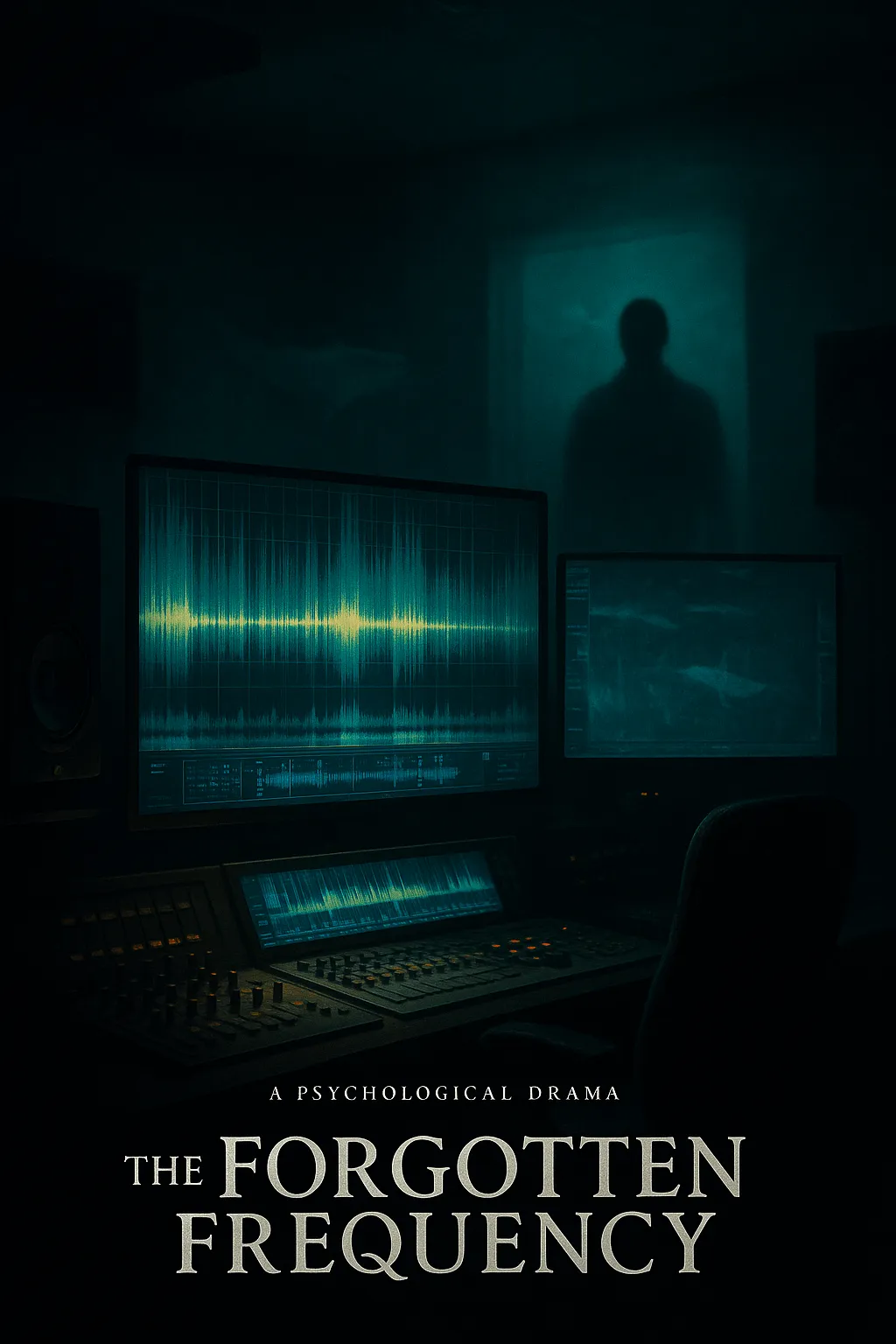
The Forgotten Frequency
The whale was singing in D-flat minor. Maren had the waveform up on both monitors, the spectrogram scrolling left to right in waterfall mode, and for the last forty minutes nothing existed except the low-frequency pulse of a humpback somewhere off the Azores. Good work. Clean work. The kind of edit where the world outside the headphones simply stopped mattering.
The anomaly showed up at timecode 01:47:33. A shape in the spectrogram that didn't belong to the whale or the ocean or any artifact Maren had seen in eleven years of audio post. It sat in a narrow band between 14 and 18 hertz — below the threshold of human hearing, technically, except the spectrogram said it was there, dense and structured, and when Maren isolated the band and pitch-shifted it up into audible range, the studio monitors gave back a sound like a single sustained chord played on something that hadn't been built yet.
Maren pulled the headphones down around their neck and let it play through the room.
That was Tuesday. Four people in the studio. Maren at the desk, Callum leaning against the doorframe with a coffee, Leigh on the couch going through licensing paperwork, and Suki cross-legged on the floor with her laptop, logging timecodes for the rough cut. The chord filled the room for eleven seconds before Maren muted it. Eleven seconds. Maren had checked the session log twice.
Now it was Thursday. Maren sat alone at the desk, staring at the spectrogram frozen on the left monitor. The shape in the 14-to-18-hertz band looked grown. Not constructed, not random. Grown — like coral, like vasculature, like something organic that had found its niche in the noise floor.
The right monitor showed Maren's email. Two from Callum, sent at 3 a.m. The first canceled his interview with the Marine Conservation Society. The second asked Maren to send him the raw, unprocessed whale audio — all of it, not just the Azores sessions. No explanation. No sign-off.
Leigh had come in that morning, set her bag down, and stood in the middle of the room for a long time without taking her coat off. When Maren asked if she was alright, she said she'd had a dream about her mother's house, except it wasn't a dream, it was a memory she hadn't thought about in twenty years, and it had come back whole. Every detail. The wallpaper pattern. The temperature of the kitchen floor on her bare feet. She said it like she was reporting a crime.
She'd looked at Maren and her mouth was tight at the corners.
Maren hadn't answered. Leigh had nodded anyway and gone to her office.
Suki had been out sick Wednesday. Today she'd come in late, headphones already on, and settled at her station without a word. But twice Maren had caught her looking over — not at Maren, at the left monitor, at the frozen spectrogram. She'd look, look away. Then back.
The third time, she pulled one earcup off.
Weird how?
Suki shrugged, but she didn't put the headphone back on.
Maren looked at the session history on the editing software. Someone had opened the whale audio project at 1:14 a.m. and closed it at 3:47. The playback log showed the same eleven-second segment looped forty-one times.
Maren closed the session log. Minimized the spectrogram. The desktop wallpaper underneath — the default one, the blue hills. There was a ring stain on the desk from a mug Callum had left there weeks ago, a pale brown circle that nobody had wiped away.
A kitchen was surfacing in Maren, too. Since Tuesday. Late afternoon light. Someone standing at the window with their back turned. The memory had no sound, which for Maren was like a photograph with no image.
Maren's phone buzzed. Leigh, from down the hall: Can you come to my office. Not a question.
Maren didn't go to Leigh's office. They sat with the phone face-down on the desk and looked at Suki, who was pretending to scroll through timecodes on her laptop.
Tuesday. After you left.
Suki's hands stopped on the keyboard.
I found something in the whale audio. A structure in the low frequencies — fourteen to eighteen hertz. Below what you'd normally hear. I pitch-shifted it up and played it through the monitors.
Suki closed the laptop halfway.
I can't describe it. Eleven seconds. Callum and Leigh were both in here.
Maren reached for the volume knob on the near-field monitor, turned it a quarter-inch down, turned it back. Old habit. Checking levels on a silent room.
Leigh came in this morning and told me she'd remembered something from twenty years ago. Not like a dream. Like it was happening. She said it was the sound.
Suki waited.
Callum came back here at one in the morning and looped that same eleven seconds forty-one times. He canceled his MCS interview. He wants all the raw recordings now, not just the Azores sessions. Everything.
Suki opened the laptop again, then closed it all the way. Put both palms flat on the lid.
The studio's climate system clicked through a cycle. Maren could hear the compressor frequency — a low C, give or take.
Yeah. Me too.
Can I hear it?
No.
Suki looked at the left monitor — the blue hills wallpaper, the taskbar at the bottom, the minimized project file. She looked away. Then she stood up, tucked the laptop under her arm, and walked to the studio door.
She stopped in the doorway without turning around.
She left. The door stayed open. Down the hall, Maren could hear Leigh's office chair creak, then nothing.
Maren waited until the hallway went quiet, then opened the project file.
Headphones on. Volume at reference level. The cursor sat at timecode 01:47:33, right where it had been left Tuesday.
Maren pressed play.
The pitch-shifted chord came through the drivers and filled the space between Maren's ears, which was a different thing than filling a room. In the room on Tuesday it had been ambient, atmospheric — something that happened to everyone at once. In headphones it was directed. Personal. Eleven seconds of a sound that seemed to know where it was going.
Maren stopped playback at eleven seconds. Did not loop it.
Nothing came. No kitchen. No window. No figure. Just the afterimage of the chord fading in Maren's inner ear and the climate system humming. Maren sat with their hands flat on the desk and waited for the memory to arrive, and it didn't, and that was worse.
Maren pulled the headphones down and became aware of Leigh standing in the doorway. Coat on. Arms folded. No way to know how long she'd been there.
You didn't come.
No.
Leigh looked at the headphones around Maren's neck, then at the monitor. The waveform was still up. The cursor blinking at 01:47:44.
You just played it again.
Once.
Leigh came into the room and sat down on the couch. First time she'd sat in this studio since Tuesday.
Maren turned the desk chair to face her.
You called a researcher.
I called someone who studies whale vocalizations for a living, yes.
Did you tell her what it does.
I told her we found an anomalous structure in the low-frequency band and it warranted analysis. I didn't tell her it made me remember the exact color of my mother's bathroom tiles.
Her jaw tightened. She looked at the floor.
She'll want to hear it.
I know she will.
And I think she should.
From somewhere down the corridor, a workstation chimed — the startup sound of editing software loading a project. Suki's station. Maren's hands went still on the armrests.
What.
Suki's looking for it.
Looking for what?
The recording. I told her what happened Tuesday. She asked to hear it and I said no, and she told me she'd find it herself.
Leigh stood up.
The project files are on the shared drive.
Yeah.
She has access to the shared drive.
Yeah.
Leigh was already moving toward the door. Maren got up and followed. The corridor was narrow, lit by the same fluorescent tubes that had been dying since March, and Suki's edit suite was the last room on the left. The door was open.
Suki sat at her workstation with the whale project loaded. She had the spectrogram up and was scrolling slowly through the timeline, headphones on, laptop closed and pushed aside. Her finger hovered over the trackpad. She hadn't pressed play yet.
Suki looked up and saw them both in the doorway. She didn't take the headphones off.
Suki.
Suki's cursor was parked at 01:47:30. Three seconds before the anomaly.
Good. Don't.
Why not.
The question sat in the room. Leigh looked at Maren. Maren looked at the cursor on Suki's screen, three seconds from the edge of it.
Everyone keeps telling me what it did. Nobody will let me hear it. You told a stranger at UCL before you told me, and I work here.
Leigh's hand went to her zipper and stopped.
Then what is it about.
Nobody answered. Down the hall, the studio's hard drives hummed in their rack. The fluorescent above Suki's desk ticked at sixty hertz.
Suki looked at Maren. Not the monitor. Not Leigh. Just Maren.
Maren stepped past Leigh into the edit suite. The room was small enough that three people made it feel like an argument. Suki at her workstation, Leigh behind Maren in the doorway, and nowhere for anyone to look that wasn't someone else's face.
Maren didn't look at Suki's screen.
Leigh's hand dropped from her coat zipper.
I told her we found a structured anomaly in the infrasonic band of a humpback recording. I sent her a screenshot of the spectrogram. That's it.
That's it.
I didn't send her the audio. I didn't mention Tuesday. I told her the structure was unusual enough to warrant a second opinion.
But she's coming here. Friday. To this studio.
Yes.
And when she gets here, she'll want to hear it.
Leigh said nothing. Suki pulled her headphones down around her neck and waited. The room had no window. The only light was the monitor and the fluorescent overhead.
Will you tell her what it does before she listens. Or after.
Leigh looked at the wall behind Suki's head for a long time.
So you'll let her hear it cold.
I think it has to be heard to be understood.
Suki said, "That's easy to say when you've already heard it."
Leigh opened her mouth, then closed it. Her weight shifted toward the corridor. Maren watched her calculate — producer math, risk and exposure and who could be held responsible for what.
Nadia is a professional. She has context for this kind of—
I sat in that room Tuesday. Same room. Same air. I left five minutes before you played it and now I'm the one person who needs protecting. That's not a decision you get to make for me.
Leigh turned to Maren.
The question Maren had been avoiding since Tuesday, handed to them like a clipboard to sign.
Maren looked at Suki. At the monitor behind her, the waveform still loaded, the cursor blinking.
Leigh's jaw went tight. She didn't confirm it. She didn't need to.
Was it a bad memory.
Leigh went still. Feet planted, hands at her sides. Then she said something Maren didn't expect.
No. It was a Saturday. I was seven. My mum was making toast and singing something and I was sitting on the kitchen floor because the tiles were cold and I liked how they felt. That's all it was. A Saturday.
The fluorescent ticked overhead.
Then why are you so frightened of it.
Leigh's voice came out flat, stripped of the producer cadence.
Because I'd forgotten it completely. I didn't even know it was missing. And now I can't stop — I keep feeling those tiles. Under my feet. While I'm driving. In bed. I can feel the grout lines.
Maren's chest went tight. A kitchen. Someone at the window. Their own memory pressed up behind their sternum — not the image this time, just the weight of it.
Suki stood up from her chair.
Suki.
You can be in the room. You can have your hand on the mute button. I'm asking you. Not finding it on the drive. Asking.
Maren looked at Leigh. Leigh was staring at the floor, one hand pressed flat against the doorframe.
I can't be the one who says yes to this.
She walked out. Not toward her office — toward the front of the building. Maren heard the street door open and not close, and then traffic, and then Suki reaching over and shutting the edit suite door with a quiet click.
They were alone. Suki stood with her hand still on the door handle. Maren sat on the edge of the desk, the monitor's glow catching the side of their face.
Will you play it for me.
The edit suite was quiet except for the fluorescent and the fan in Suki's workstation. Maren hadn't moved from the edge of the desk. Suki hadn't moved from the door.
What do you think you forgot.
Suki's hand came off the door handle. She stood there with both arms at her sides, and for a moment she looked younger than she was.
I don't know. That's what forgot means.
You must have some idea. Something you've been circling.
No.
She crossed the small room and sat in her desk chair. Pulled her knees up, feet on the seat edge, arms around her shins. The waveform glowed behind her.
My dad died when I was eleven. And there's about two years around that where I just — it's like looking at a wall. I know things happened. I went to school. We moved house. My mum cut her hair. I know these things because people told me. But I can't see any of it.
Maren said nothing.
Maybe it's nothing to do with that. Maybe I forgot where I left my keys in 2019. I don't get to pick, right. That's not how it works.
No. You don't get to pick.
Then I'll know.
Maren looked at the waveform on Suki's monitor. The cursor still parked three seconds before the anomaly.
Monitors or headphones.
Monitors.
Why.
If it's going to happen I want it in the room. Not just in my head.
Maren reached past her and turned the near-field monitors on. The soft pop of the drivers waking up. Suki uncurled from the chair and sat properly, feet on the floor, hands in her lap. Maren moved the cursor back to the start of the anomaly and hovered over the spacebar.
I'm going to mute it after eleven seconds. Don't ask me to play it again.
Okay.
Maren pressed the spacebar.
The chord came through the monitors and filled the small room. Different from the main studio — closer walls, lower ceiling, the sound had nowhere to go but through them. Suki's shoulders dropped first. Then her breathing changed, lengthening, like someone settling into sleep. Her eyes were open but they'd gone somewhere else.
Maren counted in their head. At eleven, they hit mute.
The room came back in pieces. The fan. The fluorescent. Traffic from the street two floors down. Suki sat perfectly still, her hands flat on her thighs, staring at the dark strip between the monitors where the wall showed through.
Maren's hands had gone cold. Both of them, from the wrists down, as if they'd been holding something frozen. They pressed their palms against their jeans and waited.
A long time passed. Maybe a minute. Maybe three.
Suki said, "Oh." Just that. Flat and careful, like she was reading a number off a form.
Maren didn't ask.
Suki stood up. Walked to the door. Opened it, went through it, turned left toward the bathroom. The lock clicked shut. Then nothing.
Maren sat alone in Suki's chair. The monitors were still on, the drivers humming at idle, the waveform frozen on screen. The coldness hadn't left their hands. It had moved up — forearms now, a spreading numbness.
From the bathroom down the hall, no sound at all.
Maren sat in Suki's chair for seven minutes. They knew because the session timer was still running on screen, counting nothing.
The bathroom lock clicked. Footsteps. Water running — not briefly, not a quick rinse. Suki ran the tap for a long time. Then it stopped and the hallway was quiet again, and then Suki was standing in the doorway with her sleeves dark to the elbows.
She didn't sit down. She stood with one hand on the doorframe and looked at her own workstation like she wasn't sure what room she was in.
What did you remember.
Suki's jaw moved. She looked at the monitor, looked away.
A swimming lesson. I was maybe nine. My dad was watching from the gallery and I did a whole length without stopping and when I got out he had this towel. Blue, with dolphins on it. He wrapped it around me and I could feel his hands shaking because he was so — I don't know. He was just shaking.
She stopped. Pressed her lips together hard.
I haven't thought about that towel in fifteen years. I didn't know I'd lost it.
Suki wiped her face with her wet sleeve. Quick, efficient.
I don't know.
Nadia's coming tomorrow. Callum's out there doing whatever he's doing with the raw files. And you're sitting in my chair not knowing.
Maren's hands were still cold. They pressed them flat against the desk and felt nothing — not the surface, not the temperature, just absence where sensation should have been.
What Callum did that night — going back alone, looping it — that's what happens when someone decides the frequency is theirs to use. Leigh wants to hand it to a researcher. You wanted to hear it and now you're standing there with wet sleeves. None of us are making good decisions about this.
I'm glad I heard it.
Maren looked at her.
I know that's not what you want me to say. But I am.
The street door opened downstairs. Footsteps on the stairs — Leigh's pace, deliberate, each step placed like she was deciding whether to take the next one. She appeared in the corridor and stopped when she saw Suki in the doorway.
Leigh's coat was still on. She looked at Suki's wet sleeves, at Maren in Suki's chair, at the monitors still powered on with the waveform frozen mid-screen. She closed her eyes.
You played it.
Yes.
Leigh leaned against the corridor wall. She didn't come in.
And.
Suki turned to face her. The overhead light caught the dampness on her forearms.
Leigh's hand found the zipper of her coat and held it without pulling.
Nadia will be here at ten.
I know.
I'm not going to tell her what it does. I'm going to let her listen and draw her own conclusions. That's the only way this holds up.
And if she remembers something that isn't good.
Leigh looked at the floor. Then at Maren.
That's why I need you in the room.
Maren stood up from Suki's chair. The cold in their hands had reached their elbows now — not pain, not numbness exactly, more like the feeling before pins and needles.
I'll be in the room. But I'm not playing it. You play it, you own what happens after.
Fine.
And Callum. Has anyone heard from him.
Leigh and Suki looked at each other.
He requested the raw Azores recordings from the archive this afternoon. All of them. Not just our sessions.
Maren walked past them both into the corridor. The hook by the studio door was empty — Callum's jacket, gone since morning, still gone.
Behind them, Suki powered down her monitors. The hum died. The waveform disappeared. Maren stood in the corridor with their arms crossed against the cold in them, and Leigh was checking something on her phone, scrolling past what looked like a parking notification, and then the three of them went their separate ways without saying goodnight.
Maren arrived before anyone else on Friday morning and sat in the main studio with the lights off. The monitors were cold. The desk was clean. They'd deleted the session files from the shared drive at two in the morning — the project, the spectrogram, the isolated segment. Gone from local backup. Gone from the recycling partition. The kind of deletion that required three confirmations and a password.
They sat in the dark and listened to the building wake up. Pipes first. Then the climate system cycling on, one floor at a time. A delivery van reversing in the alley below. Someone in the next building was playing music, tinny and distant, and Maren couldn't identify it and didn't try.
Suki came in at half eight. She didn't turn the lights on either. She set her bag on the floor by the door and sat in the producer's chair three meters away and didn't ask why Maren was sitting in the dark.
They sat like that for a while. Suki picked at something on her thumbnail. Maren watched the shape of the mixing desk emerge as the light outside grew.
I keep smelling chlorine.
Maren nodded.
Nadia's coming at ten.
I deleted it.
Suki's hands went still on her thumbnail.
The segment.
All of it. Session files, spectrogram, the isolation. It's gone from every machine in this building.
Suki looked at the blank monitors. Looked at Maren.
Callum has the raw files.
I can't reach those.
Suki sat back in the producer's chair and exhaled through her nose — long, controlled. She picked at her thumbnail again.
Okay.
At quarter to ten, voices on the stairs. Leigh's measured pace, and with it a second voice — faster, mid-sentence, something about spectral density and sample rates. Leigh pushed the studio door open and found the lights still off and Maren and Suki sitting in the grey morning.
Leigh stopped. Her coat was over her arm. Not on. Not being negotiated with. Just carried.
There's nothing to hear.
Leigh's hand tightened on the coat.
What do you mean.
I deleted it. Last night. The segment, the project file, all of it.
Nadia looked from Maren to Leigh. She shifted her laptop bag higher on her shoulder.
You deleted the anomaly.
Yes.
The room held. Nadia's gaze moved between them.
Give us a minute, Nadia. Please.
Nadia backed out. Her laugh — short, uncomfortable — bounced up the stairwell as she retreated toward reception. The studio door swung shut behind her.
Leigh set her coat on the mixing desk. Slowly.
Then what was the point.
Maren didn't answer.
I brought her across London. I vouched for this. I told her it was significant.
It is significant. That's why I deleted it.
Leigh stared at Maren for a long time. Suki hadn't moved from the producer's chair. She was watching Leigh's face carefully.
I could fire you for this.
Yes.
Leigh picked up her coat. Held it against her chest. Then she walked out of the studio and turned left toward her office, and the door clicked shut.
Suki stood up. She crossed to Maren's desk and sat on the edge of it, close enough that Maren could see the faint dark circles under her eyes and a small scab on her jawline, maybe from a scratch or a razor.
You know it's not gone. Not really.
Maren knew. Callum had the raw archive recordings. Somewhere in the Azores data, in hours of unprocessed whale song, the structure sat in its infrasonic band. You could find it again if you knew where to look. You could find it again if you listened long enough.
I know.
The sun cleared the building opposite and came through the studio window. It fell across the mixing desk, the dead monitors, Maren's hands resting on their knees. The hands were warm. Maren noticed that.
Somewhere in the back of Maren's skull, behind the silence of the studio, they heard humming. Faint. Tuneless. The sound a person makes in a kitchen when they think no one is listening. It had always been silent before — the memory at the window, the figure with their back turned, the afternoon light. No sound. Now there was sound.
Suki said, "What are you going to tell Callum?"
Maren didn't have an answer for that yet.