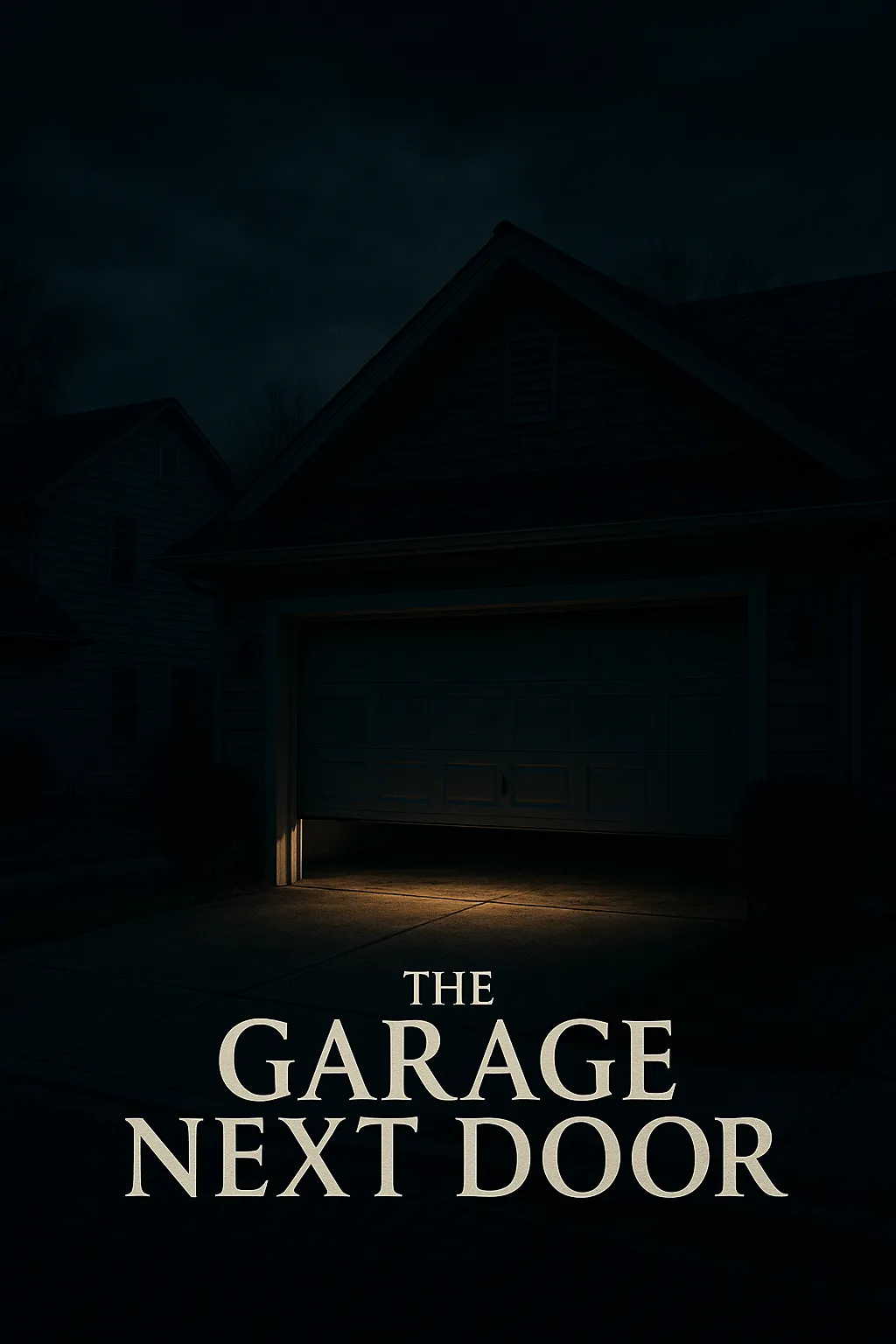
The Garage Next Door
The hum came through the floor first. Not loud — Paul had never been able to say it was loud, which was part of the problem. It was a vibration more than a sound, something he felt in the bones of his feet when he stood barefoot on the kitchen tile. It had started in March, or maybe earlier. Maybe he'd just started admitting he could feel it in March.
He was eating leftover pasta cold, fork halfway to his mouth, when it stopped.
Not the hum. Everything.
The fridge shuddered and went silent. The light over the sink died. The little green dot on the microwave display vanished, and the house around Paul became a thing he had to navigate by memory — the counter edge here, the doorframe there, the floor plan of a place he'd lived in for nine years reduced to guesswork and shuffling feet.
He found his phone on the counter. The screen threw a pale rectangle across the ceiling when he lit it. 11:47 PM. He went to the front window.
The street was gone. Not dark the way it got at night, when the sodium lamps painted everything that flat sick orange and you could still see the outlines of bins and hedges and parked cars. This was dark like someone had put a lid on it. Meg's porch light — the one she left on every night since her divorce, the one Paul used as a landmark when he came home late — was out. The Hendersons' security floods, out. The streetlamp on the corner that buzzed loud enough to hear from Paul's bedroom, out. Every light on Garner Crescent, all nineteen houses, swallowed at once.
Except it wasn't quite silence. From somewhere to his left — Dennis's side of the shared fence — came a single metallic clang, then nothing.
Dennis. Paul pressed his forehead against the cool glass and looked toward the house next door. No movement. No torch beam. Dennis's garage sat at the end of his driveway, roller door sealed the way it had been since March, when Dennis had backed his ute up to it on a Saturday morning and spent three hours unloading things Paul couldn't identify from forty feet away. Paul had been mowing his lawn. He'd waved. Dennis had not waved back, and Paul had decided that meant Dennis was busy, because that was easier than deciding it meant anything else.
Since then: the hum. The smell — ozone and something sharper, chemical, drifting over the fence on warm nights. The sound of power tools at hours that didn't make sense. And Dennis, who used to lean on the fence with a beer and talk about the Broncos for twenty minutes at a stretch, had become a man who checked his mailbox quickly and went back inside.
Paul had noticed all of it. He'd laughed about the tools with Craig from number fourteen. He'd cracked a beer on the back deck and listened to the hum and told himself it was Dennis's business, whatever it was. A boat, Dennis had said once. A generator, he'd told Meg. Home repairs, he'd said to Craig. Three different answers to three different neighbours, and Paul had never once asked him directly, because asking directly would mean standing in the gap between what Dennis said and what Paul suspected, and Paul did not want to stand there.
He stood there now. In his dark kitchen, phone light casting his shadow huge against the back wall, listening to the silence where the hum used to be.
His phone buzzed. A text from Meg: You awake? Power's out the whole street. Something's wrong at Dennis's.
Paul stared at the message. His thumb hovered over the keyboard. Through the wall between his house and Dennis's, nothing. Through the window, the garage — shut, still, giving away nothing it hadn't been guarding all summer.
Paul texted back three dots, deleted them, typed 'Yeah I'm up,' and sent it before he could think of anything better. Then he pocketed the phone and went to the front door.
Outside, the dark had depth. Inside it had been walls and furniture — known edges. Out here the street was open and formless, and Paul's phone screen lit a small circle at his feet that made everything beyond it worse.
He walked past Dennis's frontage without looking at the garage. He didn't need to look. The chemical smell was there — faint, acrid, something between pool chlorine and burnt wiring — and it told him everything the dark wouldn't. He kept walking.
Craig's place was three doors down. Paul could see the shape of it only because the rendered brick caught the faintest ambient glow from somewhere — the moon behind cloud, maybe, or the next suburb's lights bleeding over the ridge. He knocked twice, then a third time harder.
A torch beam swept across the frosted glass panel beside the door. Then the deadbolt turned.
Craig stood in the doorway in a Broncos jersey and boxers, torch aimed at Paul's chest like he wasn't sure yet whether to be annoyed or relieved. His free hand came up and crossed over his chest, gripping his own bicep — holding himself in place.
"Mate. It's midnight."
"Power's out the whole street."
Craig tilted the torch toward the dead streetlamp on the corner, as if confirming it for himself.
"You hear anything from Dennis's place? Right when it went out — a bang, like metal."
Craig's expression shifted. Not much. A tightening around the jaw, the arm crossing a fraction higher.
"Dennis. Right. This is about the garage again."
"He told you he was doing home repairs. He told me a boat. He told Meg a generator."
Craig let out a laugh that bounced off the quiet street and came back sounding wrong.
The word 'bomb' hung between them. Craig had meant it as absurdity — the most ridiculous thing he could reach for — but it landed in the silence and neither of them laughed.
"I'm not saying that. I'm saying the power's out, there was a noise, and he's been — you can smell it, Craig. From his place. You must be able to smell it from here."
Craig scratched the back of his neck, then folded his arms again.
"And say what to the cops? My neighbour's garage smells funny?"
Craig aimed the torch back at Paul's face for a moment, then lowered it. When he spoke, the dismissiveness had thinned out, and underneath it Paul could hear something that sounded a lot like a man trying very hard not to be afraid.
Craig stepped back. The door closed. The deadbolt turned, and Paul was alone on the porch with the torch-afterimage fading from his vision.
He stood there a moment longer than he needed to. Three doors back toward his own house, past Dennis's driveway, past the sealed garage. Or he could cross the street to Meg's — her house was the one with the dark porch where a light used to be. His phone buzzed again in his pocket. He didn't check it yet.
Paul stepped off Craig's porch and crossed the street. He didn't use his phone light. The asphalt was uneven under his shoes and he couldn't see the gutter until his foot found it, but the dark felt less hostile when he wasn't advertising himself in it. Dennis's garage was behind him now, across the road and to the right, and he kept it there — a presence he tracked by the smell, which was stronger out here in the open air than it had been from Craig's doorstep.
Meg's front door opened before he knocked. She'd been watching from the window — of course she had. Her house faced Dennis's directly, which meant she'd spent six months looking at that sealed roller door every time she stepped outside.
She held a camping lantern low at her hip, its white glow filling the entryway behind her. She was dressed, he noticed. Jeans, cardigan, shoes. Not someone who'd been woken up.
"I saw you go to Craig's."
"Yeah."
"And he told you to call the cops or go back to bed."
"More or less."
She stepped back to let him in. Her fingers found the cuff of her cardigan sleeve and pulled — a small, habitual thing, like checking a bandage was still there.
She set the lantern on the hallway table and turned to face him.
"The hum."
"I could hear it from my bedroom if I opened the window. Not loud. Just — constant. Like something running that shouldn't be running all night. And then tonight it stopped, and then everything stopped, and there was that bang —"
"You heard that too."
She nodded. The cuff again — tighter.
He didn't know. That was the thing he couldn't say to her. He'd been next door since March and he knew less than she did, because she'd been paying attention and he'd been deciding not to.
"Have you tried his door?"
The question came out before he heard it properly — before he registered that he'd walked past Dennis's house twice tonight and hadn't knocked either. Meg looked at him, and he saw her clock it at the same time he did.
"I'm not going over there alone at midnight, Paul."
He nodded. He deserved that.
Meg moved to the front window and pushed the curtain aside. From here, Dennis's property was a silhouette — the house, the driveway, and the garage hunched at the end of it like something with its back turned.
"Checking for what?"
"That's what I'd like to know. That's what I've been wanting someone else on this street to care about for months."
The lantern hummed faintly on the hallway table — a tiny electrical whine nothing like the sound from Dennis's wall, but Paul's shoulders tightened at it anyway. Meg was watching him the way Craig had, but reversed. Craig had wanted him to go home and stop thinking. Meg wanted him to go next door and start acting. And Paul was standing in her hallway doing neither, which was what he'd been doing since March.
"Something's wrong over there. You know it. I know it. Craig knows it and he's pretending he doesn't because that's easier. But the power didn't go out on its own, and Dennis hasn't come outside to check like every other normal person would, and that smell — you can smell it right now, can't you? Standing in my house with the door closed, you can still smell it."
He could. Faint, but there. The ozone sharpness threading through the night air like it had soaked into the street itself.
"If I go over there and knock, and he opens the door, what am I supposed to say? Hey Dennis, the power's out, just checking — and then what? Ask to see his garage?"
"Yes. That's exactly what you say. The power's out, you heard a noise, you're checking on your neighbour. That's a normal thing to do. That's what neighbours do."
She was right about that. It was a normal thing to do. The fact that it didn't feel normal — that the idea of walking up Dennis's driveway in the dark made something in Paul's chest go tight and cold — was the part he couldn't explain to her, or to Craig, or to himself. It was just a garage. Dennis was just a bloke. And Paul was just a neighbour who'd left it too long.
Paul turned from Meg and looked out through the open front door. The crescent curved away in both directions, and from her porch he could count the houses he knew — the Lins at number seven, the Hendersons at twelve, old June Alcott at the far end who kept cats and complained about bins.
"What about the rest of the street? Anyone else awake?"
Meg moved to the doorframe beside him. Her eyes had already done this inventory.
"So nobody."
"Craig's locked his door. The Hendersons wouldn't notice if Dennis launched a rocket from his driveway. And everyone else on this street is doing exactly what you did for six months — not looking."
Paul stepped onto the porch. Meg followed him to the threshold.
"I'm not stalling. I just — if something's actually wrong, I want to know someone else on this street gives a shit before I walk over there."
Meg's hand went to her cuff. Tighter.
Across the road, Dennis's house sat in the same blackout as every other, but the stillness coming off it was different. The other houses were asleep. Dennis's house was holding its breath. No torch beam moving behind windows. No front door opening to check the fuse box. Nothing a normal person would do when the power died at midnight.
"What if I knock and he doesn't answer?"
"Then we know something, don't we."
"And if he does answer?"
"Then you look at his face and you tell me what you see."
She didn't say she'd come with him. He noticed that. She'd go to the window — her post — and she'd watch, the way she'd been watching since the garage sealed shut and the lies started. But the driveway was his to walk.
Paul looked at Dennis's front path. Forty feet of concrete he'd walked a hundred times. Borrowed a socket wrench. Returned a parcel left at the wrong door. Stood in that driveway drinking beer from a stubby while Dennis talked about nothing.
"If he doesn't answer, I'm coming straight back. And then we call the cops. Both of us. Not just me."
Meg nodded once.
Paul crossed back across the street without his phone light, retracing the gutter by feel. He didn't look at Dennis's frontage as he passed it. He went up his own driveway, through the side gate — the latch stiff, loud in the silence — and into his backyard.
He texted Meg from the back step: Going around the side. Checking the fence first. Then he pocketed the phone and stood still, letting his eyes adjust.
The fence between his property and Dennis's was colourbond, six feet, the kind of barrier that said privacy without saying hostility. Paul had helped Dennis replace two palings three years ago when a storm buckled them. They'd done it on a Sunday with the radio going and a six-pack sweating on the concrete. One of the replacement palings had never sat flush — it bowed outward at the base, leaving a finger-width gap at knee height. Paul had meant to fix it. He'd meant to do a lot of things.
He moved along the fence line, one hand trailing the metal. The grass was damp and cold through his shoes. Somewhere behind him a fruit bat shrieked once from the fig tree on the corner and then the quiet reassembled itself, thicker than before.
Halfway along, he found the warped paling. He crouched and put his eye to the gap.
He couldn't see anything. Dennis's yard was the same depthless black as everything else — the garage a shape he knew was there only because it blocked the slightly less dark sky above the roofline. He held his breath and listened.
A ticking. Irregular, metallic — something contracting unevenly, the sound of heat leaving a surface that had been running far too hot for far too long. It was coming from the garage. Not the house. The garage.
And then, beneath the ticking, air moving. A thin, steady draw — the kind of pull you felt near an open window on a still night. Something on Dennis's side of the fence was open. The side door, the one Meg said Dennis used at 2 AM. Paul couldn't see it, but he could feel the garage breathing out through it, exhaling warmth and a smell that was different now. Sharper. Underneath the chemical bite, something organic and close, like scorched insulation or melted plastic that had cooled into something new.
Paul's hand was shaking against the fence. He noticed it the way you notice a tap dripping — after it had been happening for a while.
He pulled out his phone. Typed a message to Meg, deleted it. Typed again: Side door might be open. Can feel air coming out. Something's hot in there. Sent it before the careful part of him could sand the words down into something less alarming.
Meg's reply came in four seconds: Come back. Now. We call.
Paul stood up from the fence. His knees ached. He took one step back toward the house and then stopped, because from Dennis's side of the fence — close, ten feet at most — came the sound of a door closing. Softly. Deliberately. The latch catching with a click that meant someone's hand was on it, controlling the sound.
Then footsteps on concrete. Slow. Moving toward the driveway.
Paul didn't move. He stood in his own backyard with his phone screen dying against his thigh and listened to his neighbour walk out into the dark, and he understood with a clarity that felt like nausea that Dennis had been in the garage the whole time. Since the power went out. Since the clang. For the last forty minutes, while Paul walked to Craig's and crossed to Meg's and stood in hallways talking about whether to knock — Dennis had been in there, in the dark, with whatever it was, and now he was coming out.
The footsteps stopped. Paul could picture it without seeing it — Dennis standing in his driveway, scanning the street the way Meg had described. Checking.
Paul opened his mouth and the words came out before the smart part of him could stop them.
"Dennis."
The footsteps on the driveway stopped. The silence that followed had weight to it — not the absence of sound but the presence of someone choosing not to make any.
"It's Paul. From next door. You alright?"
Three seconds. Five. Paul's jaw ached and he realized he'd been clenching it since he stood up from the fence.
When Dennis spoke, his voice was close — he'd moved to the fence line without Paul hearing him.
It was the Sunday-afternoon voice. The one from before March. It fit the moment the way a suit fits a corpse.
"Power's out the whole crescent. Heard a bang from your side when it went. Just checking you're okay."
"Yeah, no, I'm fine. Just the hot water system tripped when the power cut. Made a hell of a racket. You know how those old Rheem units are."
Paul did know. He had the same model. It didn't clang like that.
"Your garage is putting out a lot of heat, Dennis."
A pause. When Dennis answered, the warmth was still there but something underneath it had shifted — a gear engaging.
"Had a space heater running in there. Working on the boat — you know, fibreglass sets better when it's warm. Must've been running too hard before the power cut. Thing's like an oven now."
"You told Meg it was a generator."
He heard himself say it and his breath caught — not from courage but because the sentence had simply fallen out, the way a glass falls off a counter. You don't decide to drop it. Your hand just isn't where it needs to be.
Dennis didn't answer immediately. The fence was between them — six feet of colourbond, the warped paling at knee height, three years of a Sunday repair job that had never been finished. Paul couldn't see Dennis's face. He could hear him breathing.
"Meg's got a lot of time on her hands since the divorce. You know that. She hears generator, she hears boat — people mix things up. It's a boat, mate. Come have a look in the morning and I'll show you. We'll have a coffee."
Paul could see it. The morning. The two of them in Dennis's kitchen, mugs on the bench, Dennis opening the garage roller door to reveal a half-built hull and fibreglass dust, and Paul laughing at himself, and the smell having an explanation, and everything sliding back into the ordinary shape of neighbours being neighbours.
"What project, Dennis?"
The silence stretched. On the other side of the fence, Dennis's breathing had changed — slower, more deliberate, the rhythm of someone managing themselves.
When Dennis spoke again, the warmth was gone. Not replaced by anger. A flat, clean register, like a man reading terms and conditions.
"I can't do that."
It surprised him. He'd meant to say something else — goodnight, probably, or fair enough, or any of the dozen phrases that would let them both retreat to their houses and pretend this conversation was normal. But his mouth had found the truth before his brain could dress it up, and now it was out there, hanging in the warm air between the fence palings.
"What do you mean you can't?"
"I mean I've been listening to that hum through my wall since March. I've been smelling whatever's coming out of your garage every warm night for six months. You blacked out the window in April. You come out at two in the morning and stand in your driveway looking up and down the street. You've told three different people three different things about what's in there. And tonight the power goes out across nineteen houses and you're in your garage in the dark for forty minutes and you come out checking if anyone's watching."
Paul's hands were shaking. He pressed them flat against the fence and felt the metal still holding warmth from Dennis's side.
"So I can't go inside and have a coffee in the morning and pretend I don't know what I know. I can't do that, Dennis. I'm not built for it."
For a long time, nothing. A dog barked somewhere — not on the crescent, further out, another street, another world. Paul stood with his palms on the fence and waited.
When Dennis spoke, his voice was closer. Right against the fence. Paul could have reached over and touched him.
It wasn't a threat. That was what made Paul's stomach drop — the absence of menace, the way Dennis said it like he was genuinely sorry, like Paul had just made a mistake that couldn't be walked back and Dennis wished he hadn't.
"Come around the front. I'll show you."
Paul heard Dennis's footsteps move away from the fence, back toward the driveway. Slow. Unhurried. The footsteps of a man who had stopped pretending but hadn't decided what came next. Paul's phone buzzed against his thigh — Meg, watching from her window, seeing Dennis move. He didn't check it. He stood in his backyard with his hands still pressed to the warm metal and understood that in about thirty seconds he was going to walk around that fence and into Dennis's driveway and see whatever was in the garage, and that the person who walked back would not be the person who'd spent six months mowing his lawn and deciding not to look.
He took his hands off the fence. He walked to the side gate.
The side gate opened onto the front yard and Paul walked through it. Dennis's driveway was right there — the concrete path he'd taken to return a parcel, to borrow a drill bit, to stand around on a nothing afternoon while Dennis talked about the Broncos. He'd never once thought about his feet on this concrete. Now each step registered.
Dennis was standing at the open roller door. He'd pulled it up sometime in the last thirty seconds, and the garage exhaled into the night — a wall of trapped heat that Paul felt from ten feet away, dry and close, carrying something underneath it that wasn't chemical and wasn't electrical but sat in the back of his throat like a warning.
Paul stopped at the foot of the driveway. Dennis turned to face him, and for the first time since March, Paul saw him clearly. The camping torch Dennis held was angled down, but enough light spilled upward to catch his face. He was smiling. Just the mouth. The eyes were flat and patient, and beneath that, something Paul couldn't read — exhaustion so deep it had become structural, load-bearing, part of the man.
"Well. You're here."
Paul walked up the driveway. He didn't look across the street at Meg's window. He didn't check his phone. He stopped at the threshold of the garage and looked inside.
It filled most of the space. That was the first thing — the scale of it, how it dwarfed the workbench and the pegboard tools and the old mower shoved into the corner. Metal framing rose from a base of copper coils so dense they looked grown rather than wound, and panels of something translucent and faintly amber were set into the frame at angles Paul's eyes couldn't resolve into a shape that made sense. Thick cables ran from its base to a junction box wired directly into the mains with the confidence of someone who knew exactly what he was doing and didn't care what it cost.
Paul's legs wanted to step back. He stepped forward. The air inside was ten degrees warmer than the driveway. The structure gave off a residual warmth of its own — not electrical heat, not combustion, something else. He put his hand out and stopped short of touching it. The amber panels were warm on his palm from six inches away.
Paul's mouth was dry. He swallowed twice before the words came.
Dennis set the torch on the workbench. He didn't look at the structure. He looked at Paul.
"It started as the generator. That part was true — Meg got that one. I was trying to build something that pulled energy from — it doesn't matter from where. It matters that it worked. About six weeks in, it started doing something I didn't design it to do."
Dennis's jaw worked. He stared at the structure the way you stare at a fire that's jumped its pit — respect and dread in equal measure, and no certainty it's finished moving.
"The hum. You heard it through the wall. That was it finding its own frequency. I didn't make it do that. I woke up one morning and it was just — going. Drawing power. More every week. I tried to throttle it back and it pulled harder. Tonight it took the whole street."
Paul heard himself ask the question from somewhere outside his own body.
Dennis didn't answer. The silence lasted long enough for Paul to understand that the silence was the answer.
Dennis sat down on the concrete floor, his back against the workbench. He looked smaller down there. Older. He rubbed his face with both hands and when they dropped, the smile was gone. What was left was just a man who hadn't slept properly in months.
Across the street, Meg's curtain moved. Paul saw it in his peripheral vision — a pale shift in the dark, there and gone. She was watching. She'd been watching for months. And now there was something to see, and Paul was the only one close enough to describe it.