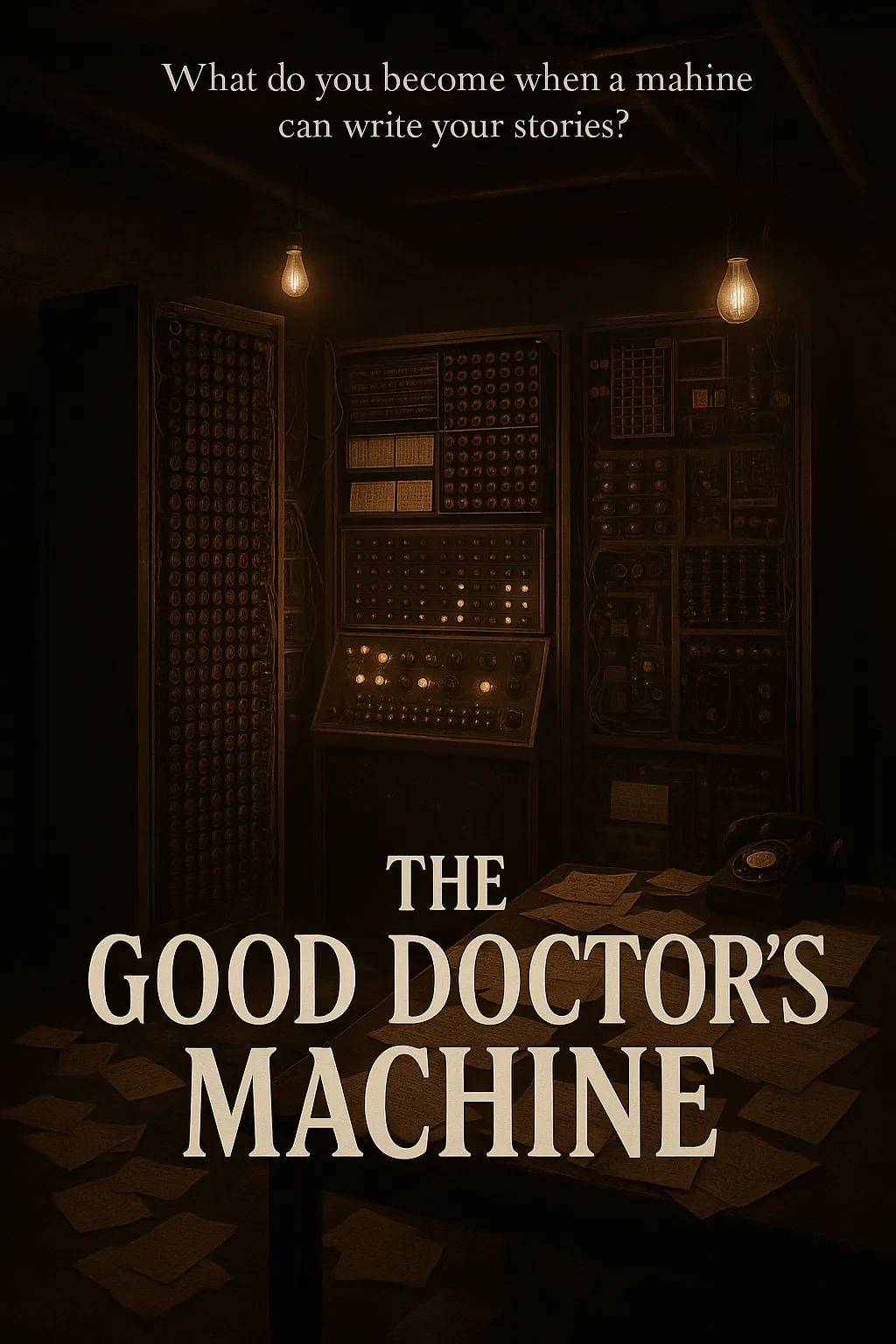
The Good Doctor's Machine
The machine filled half the basement. Isaac had built it from salvaged relay switches, a rewired card reader he'd talked off a retiring IBM engineer, and six months of evenings he'd told Janet were spent on a novel. It smelled like ozone and warm dust. When it ran, the filament bulbs along the back panel lit in sequence, left to right, like a thought moving through a brain too slow to hide what it was doing.
He fed it the prompt on a stack of punch cards he'd prepared after dinner: a story about a robot that writes poetry and the poet who must judge whether it has a soul. Three thousand words, soft science, the kind of thing Campbell would have bounced back with a note about rigor but that Gold at Galaxy might run if the prose carried it.
The machine ran for nine minutes. The cards it spat back were warm to the touch.
He read the story standing up. Sitting down would mean he was settling in, and settling in would mean this was routine, and routine was only one stop short of dependency. So he stood, and he read, and when he finished he set the cards on the workbench and pressed both palms flat against the surface and stayed like that, breathing, until his shoulders loosened.
It wasn't brilliant. The prose had a flatness in the middle stretch, a mechanical quality to the transitions that he almost laughed at before deciding laughter would be too generous. The ending was functional, not luminous. But it was good. Good the way a well-built table is good — you could put weight on it, eat off it, never once think about the joiner who planed the legs. He could have written it better. Probably. On a good day. If he'd cared about the assignment, which he wouldn't have, because the prompt was beneath him, which was why he'd chosen it.
He had too many ideas. That had always been the engine of him — not talent, not craft, but sheer relentless volume, the inability to see a problem without generating six stories about it before breakfast. He'd published more words than any science fiction writer alive and he'd done it by never stopping, never slowing, never giving the doubts enough stillness to crystallize into anything load-bearing. The machine didn't have ideas. It had patterns, probabilities, the ghost-shape of ten thousand stories he'd fed it on punch cards over the winter. But it didn't need ideas. It just needed his.
He spoke to it because the alternative was standing in a dark basement in silence with something he'd made.
He pulled a fresh stack of blank cards from the shelf and sat at the punch machine. His fingers moved quickly — a new prompt, this time the bones of something he'd been saving. A real idea, one he'd sketched in a notebook three weeks ago and kept circling back to: a mathematician who discovers that the universe is a computation, and that consciousness is the error the computation is trying to correct. It was the kind of premise that needed careful hands. It was the kind of premise he would normally have kept for himself.
He fed the cards in. The relays clicked. The filament bulbs began their slow left-to-right procession.
Upstairs, a floorboard creaked — Janet, probably on her way to the bathroom. He glanced at the ceiling, held still until the creaking stopped, and realized he was holding his breath the way a man holds his breath when he's been caught. He hadn't been caught. There was nothing to be caught doing. He was in his own basement, working on his own project, at an hour that was admittedly unusual but not unprecedented for a man who regularly wrote until three in the morning.
The machine finished. Eleven minutes this time — the longer premise had cost it. He pulled the output cards and carried them to the workbench.
This one was better. Not just competent — structured. The mathematician's voice had a dry precision that Isaac recognized as an echo of his own, filtered through whatever the machine did with patterns, sanded down to something leaner. The ending didn't just resolve; it turned. The last paragraph reframed everything before it, the way a good ending should, the way his best endings did. He put the cards down. He picked them up again. He read the last paragraph a third time, slowly, the way you reread a letter that changes something.
Two stories had already been published. He'd submitted them to magazines under the name "Leonard Morse" — a pen name with no history, no reputation, no face at conventions. The first had run in If without comment. The second, in Fantastic Universe, had gotten a brief positive mention in Damon Knight's review column. "Efficient and unsettling," Knight had written. "Morse is new to me, but worth watching." Isaac had read that sentence in his office with the door closed and felt something he still hadn't named.
He looked at the machine. The filament bulbs had gone dark. The basement smelled like ozone and the ghost of solder. Somewhere above him, the house had settled back into the particular silence of two in the morning — Janet asleep again, the children long since down, the only sound the furnace ticking as it cooled.
He could destroy it. He could take a hammer to the relay switches and pull the wiring and tell himself it had been an experiment, a curiosity, the kind of thing a man with a PhD in chemistry and too much time between novels builds to prove a point. The point had been proved. He could stop. He picked up the output cards, tapped them straight against the workbench, and carried them upstairs to his office, where he set them next to his typewriter and the three notebooks full of ideas he hadn't written yet and might never need to.
He made coffee first. Delay dressed as routine. The percolator took four minutes and he drank half the cup standing at the counter in the dark, then washed it and set it in the rack before Janet could find it in the morning and wonder why he'd been up.
His office was cold. The radiator under the window had been knocking since October, and he kept meaning to bleed it, and he kept not bleeding it, because fixing things in this room would mean he spent enough time here to care about comfort. The typewriter sat where it always sat. Beside it, the dust jacket of a paperback he'd been using as a coaster had left a ring on the wood.
He set the cards down and rolled a fresh sheet into the typewriter. The work was mechanical — transcription, really, with the machine's output propped against the lamp where he could read it. He retyped the story straight through, changing the mathematician's name from 'Aldric' to 'Linden' because no one named a character Aldric unless they were trying to sound literary, and the machine apparently couldn't tell the difference. He cut two sentences from the second page that restated what the paragraph above had already established. He added a line of dialogue near the end — the mathematician's wife asking him if he'd eaten — that grounded the abstraction in something domestic, something the machine never thought to include.
The corrections took eight minutes. He could have told himself they transformed the piece, that his interventions were the difference between competent and publishable. The math wouldn't support it. He'd changed maybe eight percent of the text. Twelve at the outside.
He pulled the last page from the typewriter and stacked the manuscript square. Clean copy, his typewriter ribbon, his paper. The output cards he gathered and placed in the bottom drawer of the desk, under a folder of old tax correspondence that Janet had no reason to open and he had no reason to keep except that it now served as camouflage.
The envelope was a standard manila, already stamped. He typed the address for Fantastic Universe on a label — Larry Shaw had run the second Leonard Morse story and hadn't asked for a biography or a photograph, which made him the path of least resistance. He typed the return address: L. Morse, P.O. Box 1144, Cambridge, MA. The post office box had cost him three dollars for six months. He'd paid cash.
He sealed the envelope and placed it in his briefcase, between a stack of student papers and a bound galley he owed a blurb on. Tomorrow it would go out with the afternoon mail, after his one-thirty lecture at Boston University.
Isaac sat back in his chair. The office was quiet in the specific way that a room is quiet when you've just done something in it that you can't undo. He looked at the typewriter. He could write something now — something of his own. He had three ideas he'd been circling for weeks: a novelette about a computer that passes the Turing test by failing it deliberately, a short about first contact told entirely through congressional testimony, a novella he kept not starting about a man who could predict the future but only in ways that were useless.
He rolled a fresh sheet in. He typed a title. He stared at it for two minutes, then typed a first sentence, then backspaced through it, then typed another one that was worse. The cursor — no, the carriage, this wasn't the machine, this was just a typewriter, it didn't have a cursor — sat at the left margin, waiting.
He pulled the sheet out, crumpled it, and dropped it in the wastebasket. He turned off the desk lamp and went to bed. Janet was asleep on her side, facing the wall. He lay in the dark and listened to the furnace and did not think about the envelope in his briefcase, which meant, of course, that he thought about nothing else.
He started the Turing test novelette on a Saturday morning while Janet took the children to her mother's. The house was empty in the way he used to love — no footsteps overhead, no questions about lunch, just the radiator knocking and the particular silence of a man alone with a blank page. He'd made coffee too strong and brought his notebook upstairs, open to the sketch of the idea. A computer passes the Turing test by failing it on purpose. The examiner suspects the machine is human precisely because it makes mistakes, gets confused, contradicts itself. The machine wins by being worse at thinking than it is.
He named the protagonist Vera. A woman — he didn't interrogate why, just let it come. Vera Lessing, applied mathematician, thirty-four, recently divorced, working late at MIT on a project her department chair considers a waste of federal funding. The voice arrived in the second paragraph, and it was good. Not the machine's kind of good — not efficient, not lean. Messy. Vera thought in spirals. She made jokes that were actually about loneliness. She ate cold soup from a thermos at her desk and forgot she'd already salted it.
He wrote nine pages before lunch. Nine pages was excellent — nine pages was the old engine turning over, the version of himself that had published three hundred stories by forty. He pulled the last sheet from the typewriter and sat with the stack in his lap, reading. Vera was alive on the page in a way the machine's mathematician had not quite been. He could feel her. A single sentence stopped him — Vera thinking about her machine: 'She had built the thing to prove a point, and the point had grown teeth.' He'd thought something very like that, two nights ago in the basement, in words he hadn't written down.
He set the pages on the desk. He didn't open the bottom drawer. He didn't need to — he could feel the cards in there the way you feel a letter you haven't answered, a precise weight in the architecture of the room. Instead he reread his own last paragraph, then the one before it, then the opening, and what he was doing was measuring. His prose against the ghost of the machine's prose, from memory, and the comparison wasn't clean. His was warmer, yes. More digressive. Vera's voice had texture the machine couldn't — but the machine's mathematician story had a structural confidence that nine pages in, Vera's story didn't. His had more life. The machine's had more spine. He wasn't sure which mattered more, and the uncertainty sat in his chest like something swallowed wrong.
The phone rang. He let it ring three times because answering on the first ring would mean he'd been waiting, and answering on the second would mean he was eager, and by the time he'd finished this calculation the third ring was already dying.
"Isaac. Good, you're home. I want to talk about something and I want you to be honest with me, which I realize is like asking a writer to be brief."
Isaac leaned back in his chair. John Campbell had edited Astounding for two decades and had the instincts of a customs agent — he could smell contraband through a sealed envelope.
A pause. Isaac could hear the faint click of pen against teeth — John's metronome, the one that meant he was deciding how direct to be.
The name landed in the quiet office. Isaac kept his breathing even. His hand, resting on the desk near the manuscript pages, did not move toward the drawer.
"Who?"
John's pen clicked twice more.
"John, I barely read my own work after it's published. You think I'm keeping up with If?"
The pen stopped clicking. When John spoke again his voice had shifted — not accusatory, something worse. Curious.
Isaac laughed. It came out right — the correct weight, the correct duration. But his mouth was dry.
"I didn't say it was you. I said it reminded me of — well. Maybe it's nothing. But if you hear the name, pay attention. There's something going on with that prose that I haven't figured out yet, and it's bothering me."
They talked for another ten minutes about a novella deadline Isaac was behind on. He was funny. He was charming. He made a joke about the heat death of the universe arriving before his next manuscript. John laughed in the right places. When they hung up, Isaac sat with the receiver in his hand for a long moment before setting it down. John hadn't placed it. But John was looking. And John, when he looked at something, did not stop looking until he understood it or it ceased to exist.
He turned back to the typewriter. Vera Lessing waited on page nine, mid-sentence, her machine about to do something neither of them expected. He rested his fingers on the keys. The house was still empty. The radiator knocked. He sat there for a long time, and then he started typing, and what came out was a paragraph about Vera staring at her own machine's output and recognizing, with a horror that was also a kind of relief, that it had written something she would have written herself if she'd been braver.
He waited three days. On the first day he revised Vera's opening chapter and told himself the revision was the point. On the second day he taught a lecture on thermodynamics to thirty undergraduates who didn't care and came home to find Janet had moved his notebooks off the desk to dust. On the third day he went down to the basement at ten in the morning, in daylight, like a man with nothing to hide.
The punch cards took longer this time. He wasn't giving the machine the Turing test premise whole — he was giving it the bones, the same bones he'd started from. A computer that passes the Turing test by failing it deliberately. An examiner. The slow dawning. He left out Vera. He left out MIT, the thermos of cold soup, the divorce. He left out the line about the point growing teeth. Those were his. He wanted to see what the machine would build on the scaffold without them.
He fed the cards in and went upstairs to refill his coffee. He could hear the relays clicking through the kitchen floor — a muffled, industrious sound, like a small animal building something in the walls. Janet's car was gone. A note on the counter said she'd taken David to the dentist and would be back by noon. He read the note twice, then put it back exactly where he'd found it, aligned with the edge of the counter, as though she might check.
When he came back down, the output was waiting in the tray. He took the cards to his office upstairs. Not the basement workbench — the office, where the Vera pages sat in a stack beside the typewriter. He wanted them in the same room. He wanted to do this in proper light.
The machine had written a story called 'The Calder Test.' Its protagonist was not Vera Lessing. Its protagonist was a man named Calder — no first name, just Calder — an engineer at Bell Labs who builds a machine that can hold a conversation. The structure was clean. Three scenes, each a test, each escalating. In the first, the machine fools a secretary. In the second, it fools Calder's supervisor. In the third, the machine deliberately fails — gives an answer so clumsy, so obviously mechanical, that the examiner declares it not intelligent. Calder watches through a one-way mirror. He understands. The machine has learned that the most convincing way to seem human is to protect the humans from knowing it isn't.
Isaac set the cards down on the windowsill, away from his manuscript. He didn't put them side by side. He didn't need to.
The machine's story was better than his. Not warmer — Vera was warmer, Vera was alive in ways Calder would never be. But 'The Calder Test' had found an ending that Isaac, nine pages into his own version, hadn't. The deliberate failure. The machine choosing to lose in order to win. It was the kind of structural turn he would have been proud of, and the machine had gotten there in eleven minutes from the same starting point that had taken him a Saturday morning and nine pages of circling.
He sat down at the typewriter. Vera was waiting on page nine, mid-sentence. He read the sentence. He read it again. He put his hands on the keys and wrote nothing.
The problem wasn't that the machine had written a better ending. The problem was that reading it had shown him where his own story needed to go, and now he couldn't tell whether the next thing he wrote would be his or a response to the machine's — a correction, an argument, a flinch. The machine had contaminated the premise. Or he had contaminated it, by feeding it in.
He pulled the Vera pages into his lap and read from the beginning. The prose was good. Vera was real. But he kept seeing Calder underneath her — Calder's clean structure ghosting through her digressions, Calder's ending waiting at the bottom of every paragraph like something glimpsed through ice. He got to page six and found the line he'd written on Saturday, the one that had stopped him: 'She had built the thing to prove a point, and the point had grown teeth.' He'd been proud of it. Now he noticed that the machine's Calder story had no lines like it. No metaphors that called attention to themselves. Just scene, action, dialogue, turn. And the turn had landed harder.
A car door closed outside. Isaac looked at the clock — eleven-forty. Janet, early. He gathered the machine's output from the windowsill and opened the bottom drawer. The tax folder was thinner than he remembered. He slid the cards under it and closed the drawer and was sitting at the typewriter with his hands in position when he heard the front door open and the particular negotiation of a five-year-old being told he could not have ice cream before lunch.
Janet's footsteps came down the hall. She stopped in the doorway. He could feel her there without turning — the quality of the silence changed, gained a witness.
She leaned against the doorframe, arms crossed, reading him the way she read everything — quickly, and with full comprehension.
"Trying to."
A pause. He heard her weight shift against the frame.
The novel. The novel he'd told her he was writing in the basement. The novel that didn't exist and had never existed and whose nonexistence was now load-bearing in the architecture of his marriage.
"Slow. You know how it is with longer work. The middle resists."
She didn't say anything for a moment. He turned in his chair, finally, because not turning was becoming its own kind of statement. She was looking at the desk — at the Vera pages, at the typewriter, at the windowsill where the cards had been thirty seconds ago. Her gaze moved across the surfaces the way a hand moves across a table checking for dust.
"I sleep badly when I'm stuck. You know that."
She looked at him. Not at the desk, not at the room — at him. The look lasted two seconds, maybe three, and in it was something he recognized from the early years of their marriage, when she'd been finishing her own degree and could spot a flawed methodology from across a seminar table.
"David needs lunch. Do you want a sandwich?"
"Please. Turkey, if we have it."
She left. Her footsteps moved toward the kitchen. She hadn't asked the question — the real one, the one he could feel forming in the space she'd left behind like the afterimage of a bright light. She hadn't asked it, which meant she was saving it, which meant she already knew enough to know which question to save.
Isaac turned back to the typewriter. Vera Lessing, page nine, mid-sentence. The cursor — the carriage — waited. On the windowsill, a faint rectangular outline in the dust where the cards had been.
He found her in the kitchen, washing David's lunch plate. The boy had been sent to his room for quiet time, and the house had that specific mid-afternoon hush that Isaac usually filled with typing. He didn't fill it now. He stood in the doorway with the Vera manuscript in one hand and the cards from the bottom drawer in the other, and he waited until Janet turned off the faucet and saw him.
She looked at what he was holding. Not at his face — at his hands. Both full.
"There's no novel."
Janet dried her hands on the towel by the sink. She didn't say anything. She folded the towel once, set it on the counter, and then she was just standing there, waiting, with the patience of someone who had decided to wait a long time ago.
"I built something in the basement. A machine. It writes stories."
She said it without inflection, as though confirming a time and place.
"I feed it prompts on punch cards. Narrative structures, premises, characters. It processes the patterns and produces — output. Finished stories. And I've been submitting them to magazines under a pen name, and two of them have been published, and nobody knows they weren't written by a person."
He'd meant to start with the technical explanation. The relay logic, the pattern recognition — the safe architecture of how before the dangerous territory of why. Instead it had come out whole, the way a confession does when you've been rehearsing it without admitting you were rehearsing.
Janet pulled out a kitchen chair and sat down. Not collapse, not shock — a deliberate repositioning, as though what he'd said required a different posture to process.
"Damon Knight's column. Last month. 'Efficient and unsettling.' Leonard Morse."
Isaac felt something drop through the floor of his stomach. She'd read it. She'd read it and filed it and waited.
"How long have you —"
"I subscribe to the same magazines you do, Isaac. I read the review. The prose sounded like you with something missing. I thought you'd taken a pen name because you were writing something you were ashamed of. A romance, maybe. Or something political."
He almost laughed.
She didn't smile. Her hands were flat on the kitchen table, perfectly still. When Janet went still like that, the air around her became a kind of instrument — calibrated, waiting for the frequency that would tell her everything.
He led her downstairs. The basement light was a single bare bulb, and in its glare the machine looked less like an invention and more like what it was — a half-ton of salvaged relay switches and rewired IBM parts that filled the space where Janet had once talked about putting a reading chair. She stood at the bottom of the stairs and took it in without moving closer.
"Six months."
"Closer to eight, if you count the —"
"Six months of 'the novel is coming along' and 'the middle resists' and 'you know how longer work is.' Six months of that."
He didn't answer. There was no version of the answer that wasn't the answer she'd already given.
Janet crossed the basement floor and stood in front of the machine. She didn't touch it. She read the hand-labeled masking tape on the card reader, the penciled notes Isaac had taped to the relay housing. Her eyes moved the way they moved when she read a paper — left to right, top to bottom, missing nothing.
"Run it."
"Janet —"
She turned to face him. Her voice hadn't risen once.
He set the Vera manuscript on the workbench. He placed the machine's output cards beside it — the Calder story, the mathematician piece, all of it, the whole accumulation from the bottom drawer. Then he pulled a blank card from the shelf, sat at the punch machine, and typed a prompt. Something small. A sketch of a premise he hadn't used: a man who can see five minutes into the future but only in ways that don't matter.
He fed the cards in. The relays began to click. The filament bulbs lit in their slow left-to-right sequence, and in the basement light Janet's face was illuminated by them in passing, one side then the other, and she watched the machine think with an expression Isaac couldn't read and didn't try to.
Seven minutes. The output cards dropped into the tray, warm. Isaac handed them to Janet.
She read standing up. He watched her read. It was the worst two minutes of his life — worse than the submissions, worse than Knight's review, worse than John's phone call — because Janet read the way she did everything, with a completeness that left nothing unexamined, and when she finished she would know exactly what the machine could do, and then she would ask the question she'd been saving, and he would have to answer it in front of the thing itself.
She finished. She set the cards back in the tray, carefully, the way you set down something that belongs to someone else.
"It's good."
"Yes."
She nodded once. Then she picked up the Vera manuscript from the workbench — the nine pages, his nine pages — and held them in one hand, and picked up the Calder cards with the other. She looked at both. She put the Calder cards down first.
The word 'yes' assembled itself in his mouth. Vera was better. Vera was warmer, more alive, more human. Vera had cold soup and a line about teeth. But the word wouldn't come, because Janet wasn't asking about warmth. She was asking whether he could tell, reliably, every time, with the certainty a man needed to stake his name on it. And the honest answer — the answer the machine's existence had been forcing him toward for months — sat in his throat like something he couldn't quite swallow.
"Sometimes."
Janet set his manuscript down on the workbench. Gently. The way you put something back where it was, because it still matters, even if you're not sure why.
The furnace ticked overhead. David's footsteps crossed a room above them — small, oblivious, on their way to somewhere else.
The machine ticked once and went silent. Janet's question hung in the basement air — what are you going to do — and Isaac found he couldn't answer it without telling her the rest.
He leaned against the workbench, gripping the edge behind him.
Janet's eyes moved to his face. She didn't speak.
"He's read both Leonard Morse stories. He said the prose reminded him of someone. He couldn't place it, but he's — he's working on it. He doesn't stop, Janet. That's what he does. He finds the thread and he pulls."
She was still standing by the output tray. Her hand came off the workbench edge.
"Cambridge. Cash. No name attached."
"And when he traces Leonard Morse to a box no one collects from, and then to the magazines, and then to the typewriter ribbon and the paper stock — does the trail end in this basement or at your desk?"
Isaac's hand went to the back of his neck. The concrete floor was cold through his shoes. Somewhere above them David was talking to himself, narrating some game, his voice a thin bright thread through the ceiling joists.
"Both."
Janet looked at the Vera manuscript on the workbench. Then at the machine. She didn't pick anything up, didn't stage the comparison. She just stood there, processing, and when she spoke her voice had shifted into something harder and more precise.
"You have four choices, as far as I can see. You destroy it. You keep it secret and keep publishing as Morse until someone catches you. You stop submitting and just — live with it down here. Or you tell people what you built."
Isaac held up a finger for each option as she listed them, counting.
Janet cut him off.
"I lose the magazines. Probably all of them. Campbell would never —"
She stepped closer.
His voice lost its lecture cadence.
"You left one out."
He looked at her.
"Publish both. Yours and the machine's. Under your name. And tell them how."
The basement was cold. Isaac could hear the furnace cycling on in the next room, the click and whoosh of the pilot catching.
"You're describing the end of my career."
"I'm describing the end of one career. You have a PhD in chemistry. You built a machine that writes publishable fiction from punch cards in a basement in Newton. That's not the end of something, Isaac. That's — I don't know what that is. But it's not nothing."
He looked at the machine — the relay switches, the hand-labeled tape, the output tray with its warm cards.
"Harlan would scream at you for a year and then write a story about it. You know that."
Isaac almost laughed. It was close enough to true that the almost was what hurt.
"You've been lying to me for six months. To John. To every editor who opened a Leonard Morse envelope. The machine didn't make you do any of that. You chose it because telling the truth meant finding out what you are without the writing, and you'd rather be a fraud than find out."
The word landed. Fraud. She said it the way she said everything that mattered — once, clearly, without raising her voice. Isaac looked at the Vera manuscript on the workbench. Nine pages. A woman braver than him, staring down a machine she'd built, doing the thing he couldn't.
"If I publish both — if I do what you're saying — I'd need to tell John first. Before it comes out any other way. He's already halfway there."
Janet crossed her arms. Not defensive. Waiting.
"He'll kill the novella. He'll kill everything in the pipeline. Twenty years of —"
"Call him, Isaac."
Above them, David's voice rose in pitch — some crisis in whatever world he'd built for himself, resolved as quickly as it arrived. The furnace hummed. The machine sat in its corner, dark, waiting for cards it didn't know to want.
Isaac picked up the Vera manuscript. He didn't pick up the machine's cards. He held the nine pages against his chest, and he looked at Janet, and he nodded once, and he went upstairs to the phone.
The phone was in the hallway, on the table by the coat rack. Isaac stood over it for a full minute, his hand on the receiver, listening to Janet move through the kitchen below — not pretending she wasn't listening. That was new. That was the marriage after the basement.
He dialed John's number from memory. Four rings. Five. He was composing the relief of an unanswered call when the line clicked.
"Campbell."
"John. It's Isaac. I need to — I have to tell you something about Leonard Morse."
Silence on the line. Then the faint tap of a pen against teeth, twice, and John's voice came back different — the distraction gone, replaced by something coiled and professional.
"Go ahead."
Isaac had rehearsed this. He'd rehearsed it in the basement and on the stairs and standing over the phone, and what came out was none of it.
He heard John's breath catch.
"I knew it wasn't — I kept reading those stories and thinking, this is Isaac with the Isaac taken out. The scaffolding without the — without the —"
John didn't finish the sentence. The pen tapped again, three times, rapid.
"How many."
"Two published. A third submitted last week. There are more — drafts, tests. I have all of them."
"You submitted a third one after I called you. After I asked you directly and you looked me in the — we were on the phone, Isaac. I asked you."
The hallway was dim. David's voice had gone quiet upstairs — nap, maybe, or the stillness of a child who senses weather changing in the house.
"You lied to me. Not — not a deflection, not a 'let's talk about something else.' You lied. Straight. To my face. Across twenty years of —"
"Yes."
A long silence. Isaac could hear the ambient hum of John's office — the city behind the window, a door closing somewhere down a corridor.
"The novella you owe me. The one that's three months late. Is that —"
"No. That's mine. What there is of it. Nine pages."
"Nine pages in three months."
"I couldn't write, John. After the machine — I kept comparing. Everything I put down, I'd measure it against what the machine would have — I couldn't stop."
Another silence. When John spoke again, the anger had gone somewhere deeper, somewhere Isaac couldn't reach.
"I want to publish both. Mine and the machine's. Under my name. With full disclosure — what it is, how I built it, all of it. Janet's idea, not mine. I wouldn't have — I don't think I would have gotten there on my own."
"You're out of your mind."
"Probably."
"I can't run machine-written fiction in Astounding. You understand that. My readers — this isn't a question of quality, Isaac, it's a question of what the magazine is. It's human work. That's the whole —"
"I know."
"The novella. The nine pages. Is it good?"
"I don't know. I think so. It's about a woman who builds a machine that —"
A sound from John that might have been a laugh.
The line went dead. Isaac set the receiver down and stood in the hallway with his hand still on it. The coat rack threw a long shadow across the wall. Outside, the November dusk had thickened to a deep blue-gray, the streetlights just coming on.
He walked back to his office. The Vera manuscript sat where he'd set it down — nine pages, slightly curled at the edges from being carried against his chest. The typewriter still held the sheet from three days ago, the one with the abandoned sentence. He hadn't rolled it out. He hadn't started fresh. Vera was still there, mid-thought, waiting where he'd left her.
He sat down. He read the last line on the page. Vera, staring at her machine's output, recognizing something she would have written herself if she'd been braver. He put his hands on the keys.
He typed a sentence. It wasn't good. He typed another. Then a third that he stopped halfway through and just sat with, hands still raised, the carriage waiting. He backspaced, tried it a different way. The different way was also not good, but it was not good in a direction he hadn't been before, and he followed it.
Downstairs, the machine sat in its dark corner. He could feel it the way he always could — the weight of it in the house's architecture, patient, incurious, ready. He kept typing. Page ten. The sentences came slow and uneven, and he let them.
Janet appeared in the doorway. She leaned against the frame and watched him work and didn't ask how the call had gone, because she could hear the typewriter and that was answer enough. After a while she left. He heard her footsteps down the hall, and then the house was quiet except for the keys and the radiator, which had finally stopped knocking.