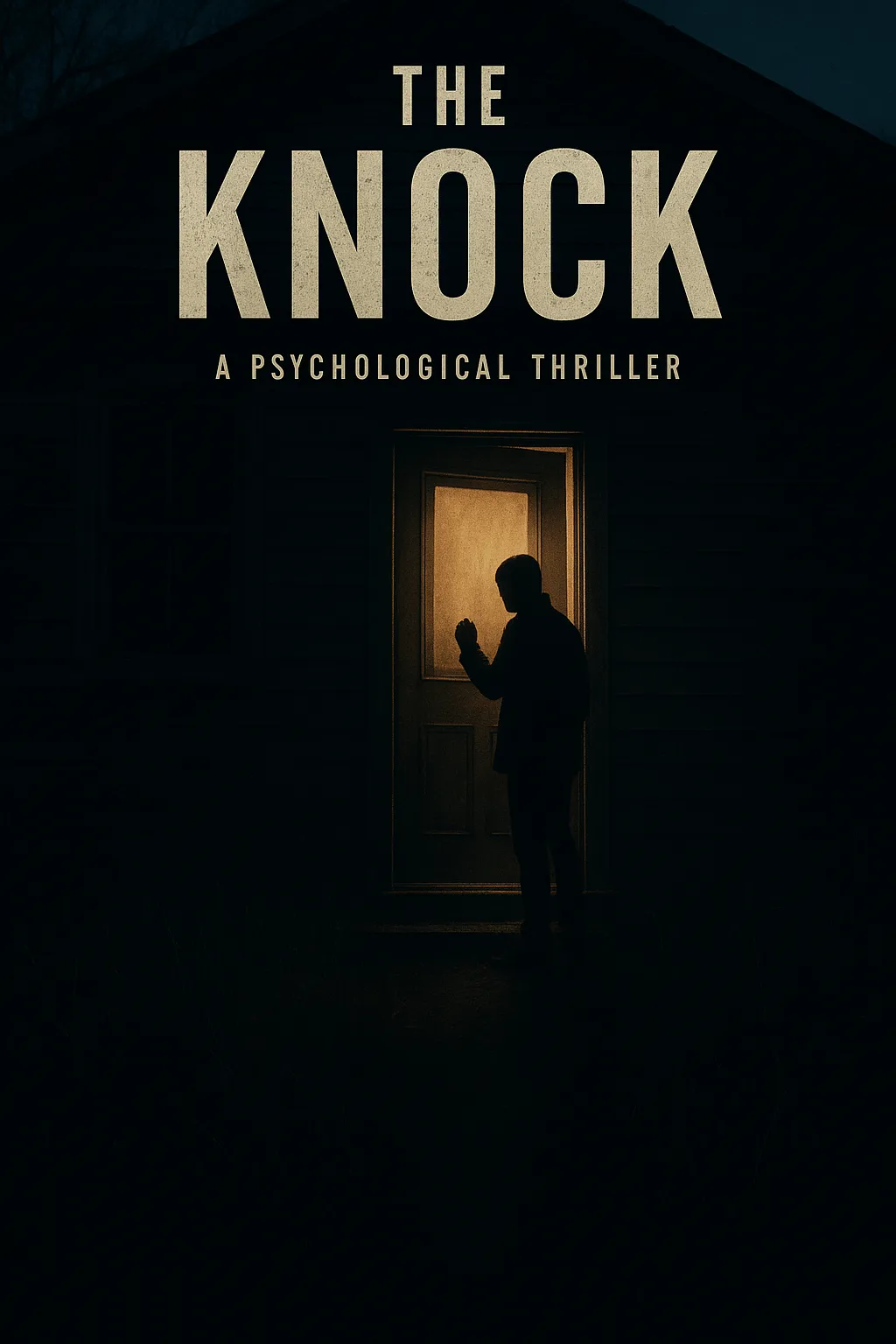
The Knock
Day ninety-something. Wren had stopped counting when the marks on the kitchen wall started looking like they'd been made by someone else.
The last can of peaches sat on the counter like a sacrament. Wren opened it the same way every third morning — slow pull on the tab, fingers careful not to cut on the lid, syrup poured into a coffee mug first because the sweetness deserved its own moment. The ritual mattered more than the food. It was proof that someone still lived here who cared about the order of things.
The radio on the kitchen table had been dead for weeks. Wren turned it on anyway, adjusted the dial with two fingers, and waited through the static the way you'd wait for someone running late.
"You'd hate these peaches. You always said canned fruit was a crime against nature."
The static held its shape. And then, underneath it — or inside it, or nowhere at all — Wren heard Iris laugh. A little impatient, the way she'd always been.
The amber power light on the radio pulsed once. Wren watched it, mug halfway to their lips. It didn't pulse again.
The boards over the windows let in thin slats of gray light. Wren had reinforced the front door with a bookshelf, the back door with the dining table turned sideways. Nails driven at angles into the window frames, towels stuffed into gaps where the draft came through. The house breathed when the wind hit it, a low moan through the walls, and Wren had learned to sleep through that sound the way you learn to sleep through a neighbor's dog.
The knock came at 4:17 in the afternoon. Wren knew because the kitchen clock still worked — its battery-powered tick the only heartbeat in the house besides their own.
Three times. Evenly spaced. Patient. A human rhythm — knuckles against wood, not wind, not debris, not the house settling into itself. The sound of someone who knew how a door worked and expected it to open.
Wren set the mug down. Peach syrup trembled at the rim.
They hadn't heard another human voice — a real one, coming from outside their own skull — in so long that the knock didn't register as a knock at first. It registered as a mistake. A glitch in the long, gray noise of being alone. Wren stood very still and waited for the house to tell them it hadn't happened.
The knock came again. Same cadence. Same patience. And then a voice, muffled through the reinforced door and the bookshelf pressed against it.
The words barely made it through — thin, stripped of resonance by wood and insulation, but unmistakably real. Unmistakably alive.
Wren looked at the candle on the counter. The one they lit every evening at four because Iris used to say a house without warm light wasn't a home. The flame leaned sideways in the draft from the door, pointing toward Wren like a finger.
On the radio, static shifted — a frequency change that sounded almost like a word. Almost like don't.
Wren's hand found the hunting knife on the counter. The other hand pressed flat against the bookshelf barricading the door. Through the wood, through the books, through all the weight Wren had stacked between the world and this room — they could feel it. The faintest vibration. Someone breathing on the other side.
Wren stepped back from the bookshelf. The vibration of the stranger's breathing faded under their palm, replaced by the cold grain of the wood, and the kitchen felt enormous around them.
They crossed to the radio. Sat down in front of it the way they always did — knees drawn up, back against the cabinet, the hunting knife laid flat across their thighs. The amber light was dark. The static had gone thin and flat, like water spreading across a floor.
Wren's voice came out scraped raw, a whisper aimed at the speaker grille.
The static didn't shift. Didn't warm. The radio sat on the table like a thing that had never been anything but plastic and wire, and the kitchen was colder than it had been thirty seconds ago.
Wren pressed their forehead against the edge of the table. The wood smelled like dish soap — Iris's brand, the one Wren had never replaced.
Nothing. The amber light stayed dead. Outside, the stranger was quiet too — no second appeal, no pleading. Just the fact of someone standing on the other side of the door, willing to wait.
The candle on the counter — Iris's candle, the four o'clock candle — had gone perfectly still. No lean, no flicker. The flame stood straight up as if the draft from the door had stopped, as if the house itself were holding something in.
Wren watched it for a long time. The stillness felt like a hand over a mouth.
The voice came through the bookshelf again. Closer to the gap this time, near the top where the shelves didn't sit flush against the frame.
Six days. Wren's fingers tightened on the knife handle. Six days meant the stranger had started somewhere specific and walked in a specific direction and ended up here — at this door, at this house, where a candle was burning in the window like a signal fire.
"Six days from where?"
A pause. The kind of pause that could be exhaustion or could be someone choosing which version of the truth to offer.
"East. There was a relay station on the highway, one of the emergency ones. It's gone now."
Wren looked at the radio. The amber light flickered — one half-pulse, guttering, like a match struck in wind — and went dark again. The static didn't change. But the warmth that sometimes gathered in the kitchen when Wren talked to Iris, that faint charge in the air like someone had just left the room — it was gone. Completely.
Wren sat between the dead radio and the barricaded door, knife across their knees, and felt the house hold its breath around them. Ninety-some days of silence on one side. A living voice on the other. And between them, a bookshelf and forty pounds of hardcovers.
Wren stood up. The knife stayed in their hand — they didn't decide that, it just happened, the way breathing happened — and they crossed to the bookshelf.
The books were heavier than they remembered. Ninety days ago, Wren had loaded the shelves with everything dense enough to matter: encyclopedias, atlases, a complete set of legal references that had belonged to Iris's father. They'd built this barricade in the first week, when building things still felt like a reasonable response to the end of the world.
Wren dragged the bookshelf sideways. It screamed against the hardwood, a sound so loud after months of careful silence that it felt like a violation. The door behind it was just a door. White paint, brass knob, a deadbolt Wren had reinforced with a steel plate and lag screws.
They undid the deadbolt. Turned the knob. Opened the door six inches and held it there with their foot.
The woman on the porch was shorter than her voice. Dark hair cut close to the skull — practical, not styled. A hiking pack rode high on her shoulders, cinched tight, the straps fraying where they met the buckles. Her boots were wrecked. The left sole was separating at the toe, held together with what looked like electrical tape. She held her hands open at her sides, palms forward, fingers spread. A deliberate gesture. Rehearsed.
She looked at the six inches of open door, then at Wren's face, then at the knife. She didn't step back.
The evening air came through the gap — cold, carrying the mineral smell of rain that hadn't fallen yet. Behind Sable, the street was empty in a way that had stopped being remarkable months ago. Overgrown lawns. A car with its driver door hanging open, the interior long since stripped by weather. No movement anywhere.
"You said six days."
Sable's thumb pressed into the center of her opposite palm. A small, grinding motion, like she was working something out of the muscle.
"When it went down."
"Fire. Electrical, I think. The whole grid they'd patched together just — went. Three days ago. Maybe four. The days run together out there."
Wren studied her face. The sunburn was real — layered, peeling at the bridge of the nose, the kind you got from days of walking without shade. The dehydration was real too: cracked lips, the skin around her eyes tight and papery. But she stood centered in the doorframe, weight balanced, not leaning or swaying. She'd rationed whatever water she had with precision.
"There are a hundred houses on this street. Why this door."
Sable's eyes dropped to her own boots. The electrical tape on the left sole was starting to curl at the edges.
"Candlelight. I saw it from the end of the block. Everything else is dark."
That was true. Wren knew it was true because they'd checked, walking the perimeter of the yard every few weeks in the early days, confirming that every other window on the street was black. The candle at four o'clock — Iris's ritual, kept like a promise — had been burning in the kitchen window for months. A beacon. Wren had never thought of it that way before.
Wren opened the door the rest of the way. Stepped aside. Did not put down the knife.
Sable came in the way you enter a church — slowly, staying to the center of the hallway, not brushing the walls or touching anything. Her pack scraped the doorframe and she flinched at the sound. She stopped three steps inside and waited, watching Wren's hands.
Wren closed the door. Threw the deadbolt. Did not push the bookshelf back.
They stood in the hallway, five feet apart. The candlelight from the kitchen threw two shadows on the wall.
"Thank you."
Wren didn't answer. They walked back toward the kitchen and Sable followed at a distance that said she understood the terms — guest, not equal. The hunting knife caught the light as Wren set it on the counter, blade toward the wall, handle toward their hand.
Sable drank from the pot in slow, measured sips, one hand braced on the edge of the stove. Her eyes moved across the kitchen — the marks on the wall, the empty peach can, the nailed windows — and landed on the radio. She looked at it, and something shifted in her face. Not surprise. Recognition. Then she turned to the water and drank again.
Wren caught it. That half-second on the radio. Filed it away in the place where ninety days of silence had made them very, very good at noticing things.
"How long have you been here alone?"
"Long enough."
Silence. Not the kind Wren had lived inside for three months. Hollow.
Sable set the pot down carefully. Her thumb found her jaw, pressing along the hinge of it — working tension, or buying time.
"Close to what."
"I don't know yet. I know they had a list of locations. Places that mattered, for reasons I didn't get to hear before the fire. This address was on it."
The kitchen went very quiet. On the counter, the candle flame stood perfectly still.
"This address."
"I know how that sounds."
Wren's hand was on the knife again. They didn't remember reaching for it.
Sable stood very still. The rehearsed openness from the porch was gone. She looked tired in a way that went past the sunburn and the cracked lips — tired the way people get when they've been carrying something heavy and invisible for too long.
"The candle is why I knocked instead of just watching. The list is why I walked six days to get here."
The radio sat on the table between them, dark and silent. Wren waited for the static to shift, for the amber light to pulse, for anything from Iris — any signal, any warmth. The radio gave them nothing.
Wren held out their hand. Palm up, fingers steady. The knife stayed in the other.
"Show me."
Sable didn't move right away. The clock on the wall ticked three times — Wren counted — before she reached for the side pocket of her pack. Her thumb pressed hard into her opposite palm as she worked the zipper, a slow grinding motion, and then she pulled out a folded piece of paper and set it on the kitchen table.
It was a photocopy, smudged and water-stained. A hand-drawn map covered most of the page — highways reduced to single lines, towns to dots, the whole region flattened into someone's hurried shorthand. Five locations were circled in red ink. Four had been crossed out. The fifth circle sat over a cluster of residential streets on the west side of the map, and next to it, in handwriting that wasn't Sable's, someone had written this house's address.
Wren picked it up. The paper was soft from handling, the creases nearly worn through. Next to each crossed-out circle, single words in different handwriting: BURNED. EMPTY. COLLAPSED. FLOODED. The fifth circle — Wren's circle — had no annotation.
"Who drew this."
"A man named Harlan. He ran the relay station. Engineer — the real kind, not someone who read a manual. He'd been mapping the pattern since week three."
"What pattern."
Sable pulled out the chair across from Wren and sat down without asking. The pack stayed on her back. She put both hands on the table, flat, like she was bracing for something.
"The signal that killed everything — the grid, the phones, the broadcasts — it didn't come from nowhere. Harlan tracked it to five origin points. Five houses, five residential addresses, all within a two-hundred-mile radius. He thought they were relay nodes. Hardware buried in the infrastructure, maybe decades old, maybe longer. Dormant until whatever triggered them."
"And this is one of them."
"This is the last one standing."
The clock ticked. Somewhere in the walls, a pipe settled with a low metallic groan that Wren had heard a thousand times and never flinched at. They flinched now.
"There's nothing buried here. I've lived in this house for three years. Iris and I — we chose it because it was cheap and the roof didn't leak."
Sable's hands stayed flat on the table. She didn't look away.
The question sat between them. Wren could feel the shape of the answer in their mouth — the easy version, the version that cost nothing. My partner. She's gone. But Sable had looked at the radio when she walked in, and the radio was dark, and Wren was so goddamn tired of carrying this alone.
"She's the reason I light the candle. She's the reason I've been talking to that radio for ninety days."
A beat. Sable's gaze moved to the radio on the table, then back to Wren.
"Talking to it how."
Wren set the map down. Their fingers left damp prints on the paper.
Wren watched for the flinch. The polite rearrangement of features that meant someone thought you'd lost your mind. Sable's expression didn't change. Her hands stayed on the table, but the thumb of her left hand had shifted — just slightly — toward the center of her right palm.
"Harlan said the nodes produced residual signal. Low-frequency, just above the threshold of the equipment he had. He said people living near them reported... presence. Sounds in dead electronics. Voices they recognized."
"Voices they recognized."
"The signal uses what's already in the house. Electromagnetic residue, I don't know — I'm repeating what he told me. He said the nodes read the environment and reflect it back. Like an echo in a canyon. It sounds like your own voice because the canyon is shaped like your mouth."
Wren stood up. The chair scraped back and hit the counter. They didn't pace — there was nowhere to pace to — but they turned away from Sable and faced the dark window where the boards let in nothing.
The words came out before Wren could shape them into something less raw.
Sable's voice behind them, steady.
"You don't know. You weren't here."
Silence. The kind that has weight. Wren pressed their forehead against the nearest board and breathed in the smell of old pine and dust and the faint chemical tang of the nails they'd driven in during week one. Behind them, Sable was quiet in a way that felt less like patience and more like someone standing at the edge of something they'd already fallen into once.
"Harlan heard his daughter. For six weeks. She'd been dead for eleven years."
Wren turned around. Sable was still at the table, both hands flat, but her posture had changed — shoulders drawn in, the pack suddenly looking too heavy. Her eyes were wet, though nothing had fallen.
"What happened to Harlan."
"He went into the basement of the first house on the list. The one marked BURNED."
"And."
Sable's hands curled off the table, into her lap, out of sight.
Wren looked at the map on the table. The fifth circle. No annotation. Then at the radio — dark, silent, offering nothing. Then at the knife in their own hand, which they'd been holding so long the handle had gone warm and slick.
"You want to go into my basement."
Sable met their eyes.
The clock ticked. The house settled around them — old wood, old pipes, the particular creak of a structure that had been standing long before Wren moved in and would probably stand long after. Wren had never thought much about what was under it.
Wren flexed their hand open, fingers aching from the knife handle. They set it on the counter and left it there, rolling their wrist once, feeling the blood come back.
"No."
Sable's mouth opened, then closed. At the edge of Wren's vision, her hands moved under the table — a small, tight motion, thumb against palm.
"You want to do the same thing in my house that killed him. And I'm supposed to just step aside because you drew me a map."
Sable leaned back in the chair. The pack shifted behind her, and for a moment she looked like someone pinned to a wall.
"What did he find."
A pipe ticked somewhere deep in the house. The radiator, maybe, or something lower — something in the floor joists that Wren had never bothered to trace.
Sable pulled the zipper of her pack's front pocket and took out a second piece of paper — smaller, denser, covered in handwriting so compressed it looked like a single block of ink. She unfolded it and smoothed it flat next to the map.
Wren didn't reach for it. They read it from where they stood, leaning just enough to make out the words. The handwriting was small and fast — someone transcribing faster than they could think. Diagrams of wiring that didn't match any residential standard. Measurements of electromagnetic frequency that climbed in a curve Wren didn't need an engineering degree to recognize as exponential. And at the bottom, in letters pressed so hard they'd nearly torn through: IT RESPONDS TO PROXIMITY. IT KNOWS WHEN YOU'RE CLOSE.
"He went into the basement after writing that."
"Yes."
"Why."
Sable turned her right hand over on the table. The scar ran from the base of her thumb across the center of her palm — raised, shiny, the skin pulled tight in a way that spoke of deep heat. Not a cut. A burn.
The house settled. A long, low creak that started in the kitchen wall and traveled down through the floor, and Wren felt it in their feet the way they'd felt the stranger's breathing through the door hours ago. They'd heard that sound a thousand times. It had never once made them think about what was underneath.
"How did you get the scar."
Sable looked at her own hand as if she'd forgotten it was showing.
"You were there."
"I was outside. I was always outside. Harlan didn't trust anyone else near the equipment. He said the nodes responded differently to different people — that proximity was personal. That it mattered who you were, what you'd lost."
Wren's gaze dropped to the radio. Dark. Silent. The amber light like a closed eye. Ninety days of Iris's voice coming from that speaker, and now — the night a stranger shows up with a map and a theory — nothing.
"What you'd lost."
Sable met Wren's eyes. Her thumb had gone still.
The candle on the counter had burned down to a stub. Wax pooled across the saucer in a shape that looked, if you were the kind of person who'd been alone long enough to see patterns in everything, like an open hand.
Wren's voice was steady. Their hands were not.
"I didn't say that. Harlan's daughter wasn't less real because the node was using her voice. The grief was real. The love underneath it was real. The thing just — found a frequency that matched."
"And if I go into my own basement. If there's a node down there. It does what — plays Iris for me until the house catches fire."
"The other four are destroyed. If this one goes the same way, there's nothing left to study. Nothing left to understand. Harlan died because he went in alone, in the dark, chasing a voice. I'm asking you to go in with me, in the light, knowing what it is."
Wren picked up Harlan's notes. Read the last line again. IT KNOWS WHEN YOU'RE CLOSE. They thought about ninety days of peach syrup and static and a laugh that sounded just like hers. About how the radio had gone cold the moment a living person knocked on the door — as if Iris's voice and Sable's voice couldn't exist in the same room. As if one was a replacement for the other, and the house was waiting to see which one Wren chose.
"You said it responds to proximity. That it's personal."
"Yes."
"Then you don't need my permission. You need me. Specifically. Because it won't work for you."
Sable didn't answer. Her hands stayed flat on the table, and the scar caught the last of the candlelight, and the silence between them was the loudest thing in the house.
Wren struck a match. The third one — the first two had broken, their fingers shaking in a way that had nothing to do with cold. The sulfur caught and the kitchen filled with that brief, acrid brightness.
"Get out."
Sable didn't stand. Her hands stayed on the table, but the left one had curled inward — thumb working against her scarred palm.
"Wren."
"You came here to use me. You need my grief to unlock whatever's in that basement. That's the whole pitch. Everything else — Harlan, the map, the nodes — is packaging."
The match burned down to Wren's fingers. They dropped it. The kitchen went dark except for the candle stub guttering in its pool of wax, throwing just enough light to catch the wet shine of Sable's eyes.
"Yes."
The word sat there. No qualifying clause, no pivot into justification. Just the admission, bare on the table next to Harlan's map.
"Yes, I need you specifically. Yes, I came here knowing that. And yes, Harlan is dead because he did what I'm asking you to do. I don't have a version of this that sounds safe, because it isn't."
"Then why the hell would I say yes."
Sable's voice cracked on the last word.
Wren went still. The empty peach can sat on the counter where they'd left it, lid curled back, syrup drying to a brown ring at the bottom. The last can. They hadn't said that. They hadn't needed to — Sable had counted the empties in the recycling bin, or noticed the bare shelves, or simply looked at the kitchen of someone running out of reasons to maintain a routine.
"What happens on the next third morning? When there's nothing left to open? When the ritual's gone and it's just you and a dead radio in a nailed-shut house?"
"Don't."
"I'm not trying to —"
Wren's hand closed around the knife on the counter. Not a threat. A reflex — the way a drowning person grabs the nearest solid thing.
Sable stood. The chair legs barked against the floor. She shrugged the pack higher on her shoulders and took one step toward the hallway, then stopped. Her hand went to her jacket pocket — not reaching for a weapon, the motion too slow, too deliberate — and she pulled out a small rectangle of paper. She set it on the table next to the map.
"Harlan wrote that the night before he went in. It's not for me. It was never for me."
Sable walked to the front door. She undid the deadbolt herself — she'd watched Wren do it once and remembered the sequence, which was its own kind of unsettling — and stepped onto the porch. The night air rushed in, smelling of wet asphalt and something mineral and deep, like stone after rain. She pulled the door shut behind her without looking back.
Wren stood alone in the kitchen. The house was theirs again. The deadbolt was open, the bookshelf still shoved aside, and the silence poured back in like water filling a hull breach — not the comfortable silence of routine, but the older kind. The kind that had been waiting underneath Iris's voice all along.
They looked at the radio. Dark. They looked at the candle. Nearly gone — a fingernail of wax, the flame barely surviving its own heat. They looked at the piece of paper Sable had left on the table.
Harlan's handwriting. Smaller than the notes, more careful, as if he'd slowed down for the first time in weeks. A single paragraph:
The node isn't the signal. The node is a door. The signal comes through it, but the door is just a door — it opens from either side. If you go down carrying someone else's name, it will use that name. But if you go down already knowing what it is, already grieving with your eyes open, I believe the door works both ways. I believe you can close it. I couldn't test this. By the time I understood, Emma's voice was the only thing I could hear, and I wasn't willing to make it stop. Whoever reads this: be braver than I was.
Wren read it twice. Then they set the knife down on the counter, gently, and pressed both palms flat against the table the way Sable had, and breathed.
The candle died. The kitchen went fully dark, and in the darkness, from somewhere below the floor — not the pipes, not the foundation settling, not any sound the house had made in three years — a low, sustained hum. Barely audible. The frequency of a voice about to speak.
Wren crossed to the front door and opened it. Sable was sitting on the top step, pack between her knees, staring at the empty street. She didn't turn around.
Wren's voice came out rough, scraped raw by something they couldn't name.
"Emma."
A long silence. The street was dark in every direction. No candlelight now — Wren's house looked the same as all the others, just another dead window in a dead row. The only difference was the two of them, breathing.
"If I go down there. You don't touch the radio. You don't talk to me about Iris. And if I say stop, we stop. We come back up and you leave and I nail the basement door shut and we never speak again."
Sable turned. In the dark, Wren couldn't read her expression — couldn't check for performance or rehearsal or the careful architecture of someone managing a mark. There was just a shape on the steps and the sound of her breathing and the choice Wren had already made somewhere between the last line of Harlan's letter and the hum beneath the floor.
"Okay."
"Okay."
They went inside. Wren threw the deadbolt. This time, they pushed the bookshelf back — not all the way, but enough that the door was blocked again. Sable watched but didn't comment. The kitchen was fully dark now, and from below, the hum had grown just enough to feel in the soles of their feet, steady as a pulse, steady as something that had been waiting ninety days for this exact moment.
Wren found the basement door by touch. The knob was cold — colder than the rest of the house, colder than the air outside had been — and when they turned it, the hum rose through their wrist like a current.
Sable stood three steps behind, at the edge of the kitchen. She'd set her pack down for the first time since entering the house. Her arms hung at her sides, and in the dark Wren could hear her breathing — measured, deliberate, the way someone breathes when they're trying not to influence what happens next.
The stairs were narrow. Wren had been down here once, maybe twice — to check the water heater the first winter, to store boxes Iris kept saying they'd unpack. The air tasted like limestone and something faintly sweet, like fruit left too long in a bowl.
On the fourth step, Iris's voice came back.
Not from the radio. From the walls themselves, or the floor below, or the space between Wren's ribs — it was impossible to locate. Just her voice, mid-sentence, the way she used to talk from another room while Wren was cooking: warm, distracted, half-laughing at something she hadn't shared yet.
Wren stopped. Their hand found the stair rail and gripped until the wood grain bit into their palm.
The voice said Wren's name. The way she said it when she wanted attention — two syllables instead of one, the second lifting, teasing. Wren's throat closed around something that wasn't air.
Wren said it to the dark, to the hum, to whatever was wearing her voice like a borrowed coat.
The voice shifted. Still Iris, still perfect, but the warmth curdled at the edges — the laugh arriving a half-beat late, the tone dipping where it should have risen. Like a recording played back at the wrong speed. Like a canyon that had learned the shape of Wren's mouth but not quite the rhythm of her breathing.
Wren took the fifth step. The sixth. The hum grew until it lived in their teeth.
At the bottom, the basement was smaller than they remembered. Concrete floor, exposed joists, the water heater squatting in the corner like a sleeping animal. And in the center of the floor — Wren didn't know how they'd missed it before, or maybe it hadn't been there before — a crack. Not structural. Too regular, too deliberate, running in a circle roughly the width of a manhole cover. The hum poured from it like heat from a grate.
Iris's voice came again. Clearer now, closer, stripped of the static that had softened it through the radio for ninety days. She was saying the things she always said — stay, I'm here, don't go — and every word was right and every word was wrong, the way a photograph of someone you love is both exactly them and nothing like them at all.
Wren knelt at the edge of the crack. The concrete was warm. They pressed their fingertips to it — not flat-palmed, not bracing — just the tips, the way you touch something to confirm it's real.
She had burned toast every single morning. Not sometimes. Every morning. And she'd argued about directions even when she was holding the map, especially when she was holding the map, because being lost with someone was her favorite way to spend an afternoon. And she fell asleep on Wren's shoulder during movies she'd picked herself, her breathing going slow and deep before the second act, and Wren would sit perfectly still for two hours rather than wake her.
The voice from the crack said Wren's name again. The teasing lilt. The two syllables.
"That's not how she said it."
And it wasn't. Iris had said Wren's name a thousand different ways — exasperated, delighted, furious, half-asleep — and this thing had picked the prettiest one and put it on repeat, because it didn't know that the version Wren missed most was the boring one. The one from across a room on a Tuesday. The one that meant nothing except I see you and you're there.
Wren closed their eyes. The hum pushed against them — not painful, not yet, but insistent, the way grief is insistent, the way it finds you in the shower or at the grocery store or on the fourth step of a staircase you've walked a thousand times. The crack in the floor pulsed with warmth and the voice kept calling and Wren knelt there and let it call and did not reach down.
They opened their eyes. The crack was glowing now — faint, amber, the exact color of the radio's pilot light.
The hum broke. Not all at once — it fractured, the sustained tone splitting into harmonics that climbed and thinned and separated like a chord resolving into silence. The amber light in the crack flared once, bright enough to throw Wren's shadow against the ceiling, and then pulled inward, collapsing to a point, and went out.
The voice stopped mid-syllable. Wren's name, cut in half. The basement went dark and cold and utterly silent, and Wren knelt on the concrete with their fingertips still touching the floor, and the floor was just concrete now. Cool, inert, faintly gritty. The crack was still there but the light was gone and the warmth was gone and the hum was gone and Iris was gone — not the new gone, the radio-silent gone, but the old gone. The real one. The one Wren had been building barricades against for ninety days.
Wren stayed on the basement floor for a long time. Long enough for their knees to ache, for the cold to seep through their jeans, for the silence to stop feeling like absence and start feeling like silence again. Then they stood, and climbed the stairs, and came back into the kitchen where Sable was sitting on the floor with her back against the stove.
Sable looked up. Her thumb was buried deep in the center of her scarred palm, grinding, and when she saw Wren's face she stopped. Her hands opened and dropped to her knees.
"It's done."
Sable exhaled — a sound like she'd been holding her breath since Wren disappeared down the stairs. She pressed the heels of her hands against her eyes, hard, and held them there. Her shoulders shook once.
Wren crossed the kitchen to the front door. The bookshelf was still wedged against it, and this time when they dragged it aside the sound was just a sound — wood on wood, loud and graceless. They undid the deadbolt and opened the door.
Dawn was coming. The sky above the dead street had gone the color of a bruise healing — purple at the edges, pale at the center, not yet light but no longer dark. The overgrown lawns were wet with dew. The car with the open door sat where it had always sat. Somewhere, impossibly far away, a bird was singing.
Sable appeared in the hallway behind them, pack on her shoulders again, straps cinched.
"East. There were other people at the relay station. Some of them might have made it out before the fire."
Wren looked back into the house one last time. The radio sat on the kitchen table, its amber light dead. They waited — one breath, two — for the static to shift, for the warmth to gather, for anything. The radio was a radio. The house was a house.
Wren pulled the door shut behind them. They didn't lock it.
The two of them walked down the porch steps and into the street, heading east, and the bird kept singing in a world that had no particular reason to contain birds anymore, and the sky kept lightening the way it does whether anyone is watching or not.