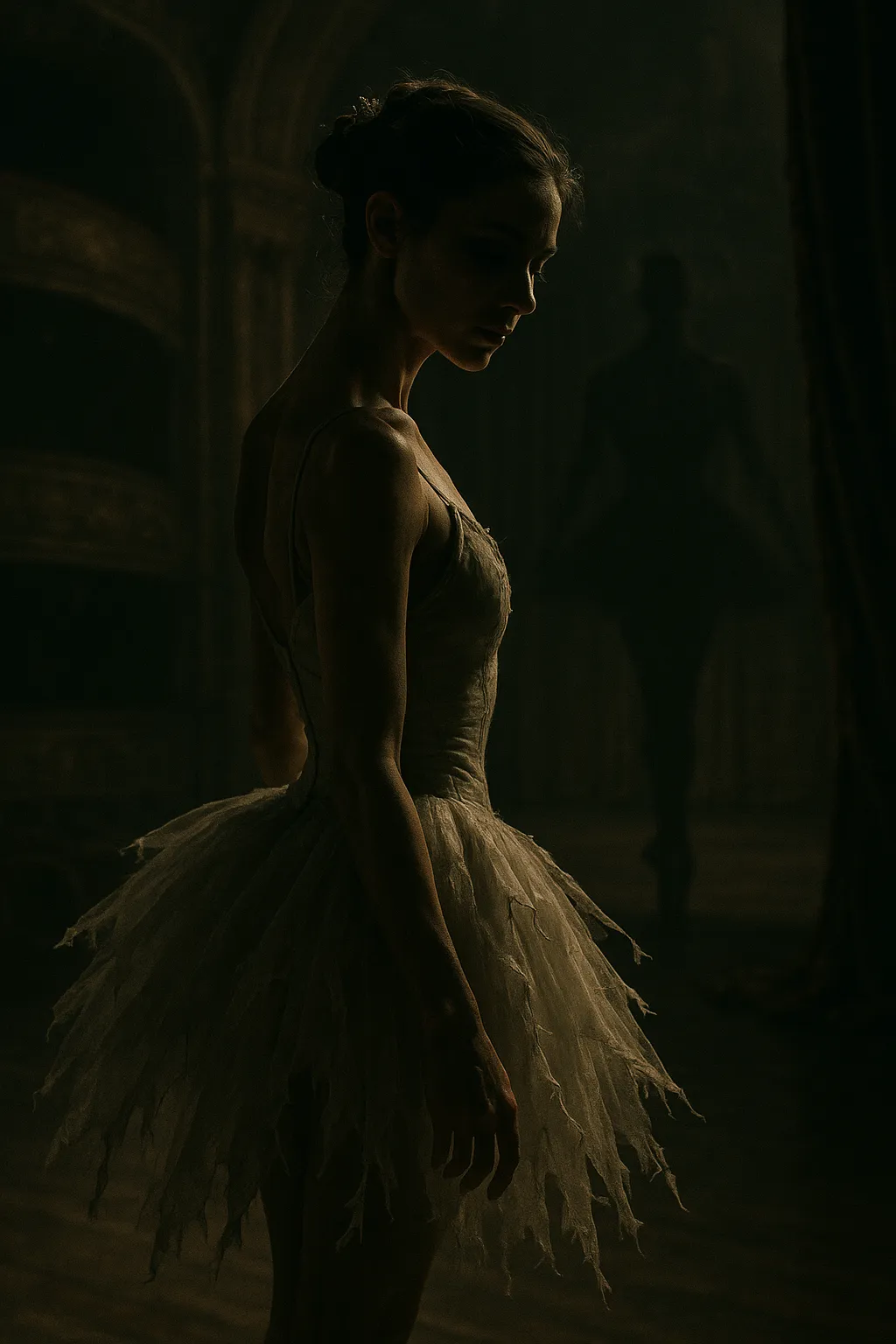
The Last Curtain Call
The dressing room smelled of rosin and something chemical underneath the powder and the lilies some admirer had sent. Elara sat at the vanity in her dressing gown, bare feet flat on the cold floor, and began.
White base first. She spread it with two fingers, working from the center of her forehead outward. Then the contour — hollows under the cheekbones, the bridge of the nose narrowed to a blade. Dark lines around the eyes, extended past the temples. Exaggerated, geometric. A creature meant to be seen from the back of a two-thousand-seat house.
She flexed her right foot under the dressing gown. Flexed it again to be sure.
The brown bottle sat on the vanity between the lip color and the spirit gum. No label. She uncorked it and the fumes bit at her nostrils. She soaked a cloth, wrung it once, pressed it flat against her right calf. Held it there. Through the wall, an oboe tested its reed — a thin, complaining sound, almost human.
She moved the cloth down to the ankle, then the arch. The skin had a yellowish tinge where she'd been applying it longest, just above the tendon. She watched the tendon shifting under skin that didn't report back.
A knock. Elara dropped the cloth into the vanity drawer and corked the bottle in the same motion.
Yes.
Katya came in sideways, the way she always did, as if the door were narrower than it was. She carried the costume across both arms — white tulle and beading, the bodice stiff with boning. She was maybe twenty-two, with a broad face and quick hands that knew every hook and eye in the company's wardrobe.
They've called fifteen minutes. The house is full. Someone said there are grand dukes in the second box.
There are always grand dukes in the second box.
Katya laid the costume on the chaise and began checking the ribbons on the pointe shoes. Her fingers stopped. She brought one shoe closer to her face, then set it down and smoothed the front of her skirt.
The left ribbon's fraying. I can restitch it, there's time.
Do it.
Katya sat on the low stool with the shoe in her lap and a needle between her teeth. Elara stood and let the dressing gown fall. Underneath, the practice leotard, the wrap skirt. Her legs bare from the knee down. She didn't look at Katya and Katya didn't look at her legs.
Elara stepped into the costume. Katya set down the shoe, crossed to her, and began fastening the hooks up the back. Her hands were steady and close. The bodice tightened.
Katya's voice was quiet, directed at the hooks.
Like always.
Katya fastened the last hook and stepped back. Through the wall, the orchestra began tuning in earnest — a wash of strings finding each other, then losing each other, then finding each other again.
Elara sat to put on the shoes. She laced the left one, the restitch tight and clean. Then the right. She pulled the ribbons firm around an ankle she couldn't feel and tied them with the same knot she'd tied ten thousand times. She stood on pointe, testing. Her face in the mirror gave back nothing.
Outside, the company depended on what she did next. Forty-six dancers, eighteen stagehands, the seamstresses, the old piano tuner who'd been with the company since before Elara was born. Their families. The villages some of them sent money home to.
Katya held the door open.
Elara walked past her into the corridor. She walked the way she always walked to the wings — upright, unhurried, each step placed. The floorboards were cold through the satin. She couldn't tell.
The corridor behind the fly gallery smelled of hemp and dust and the particular staleness of air that never moved. Ropes hung in ordered rows along the left wall, disappearing up into the dark above the grid. A bucket of sand sat near the base of the first fly line, half full. Elara walked through it without seeing any of it.
He was standing near the rosin box, a young man in a suit that still had the fold marks from the shop. Notebook open. Pencil already moving, though she hadn't said a word.
Elara stopped.
Madame — forgive me. Lev Morozov, from the Gazette. I have permission from the company office. Just a few questions before —
No.
She turned to face him fully and he backed up half a step. The pencil stopped.
The director said — Valentin Andreyevich himself said I could —
Valentin says many things.
She watched him recalculate. His hand steadied against the notebook. He was perhaps twenty-five. Clean-shaven.
It's for the farewell series. The readers — they want to know what this tour has been like. From the inside.
Elara glanced past him toward the wings. Twelve minutes, maybe less.
Yes.
It's loud. And then it's quiet. And then you're done. Print that.
She moved past him. He didn't follow — then he did, matching her stride, which put him too close. She felt the air shift when his sleeve brushed the hanging ropes.
I've heard the tour's been extended. Four new cities. Is that true?
Elara's right foot landed and she felt nothing and then she felt the floor through the left one and that was how she measured distance now — one leg at a time, alternating between the world and its absence.
You should ask Valentin about scheduling.
He wrote something. His hand was trembling slightly.
She stopped again. Looked at him properly for the first time. He had the decency to hold still under it.
Katya.
Katya appeared from fifteen feet back. She'd been following.
Madame.
This gentleman needs to find his seat. Would you show him to the front of house?
Katya's hand found the journalist's elbow. Not pulling. Just there.
Lev closed the notebook. Opened it again.
The concertmaster drew an open fifth from the pit. One by one, the other strings found the note — second violins, then violas, then the cellos underneath.
Katya led him away. His shoes squeaked on the boards. He looked back once.
Elara stood at the edge of the wings. Through the gap in the curtain she could see the first three rows — fur stoles, program fans, the particular forward lean of people who had paid to watch someone be extraordinary. Her right foot was numb. Her left foot was cold on the boards. The gap between the curtain panels was four inches wide.
The performance was over. Applause, curtain calls, flowers she couldn't bend to pick up so Sasha collected them and Elara pretended that was generosity. Then the corridor. Then the stairs down, past the wardrobe rooms, past the carpenter's shop with its sawdust smell, to the administrative wing where the gas lamps were already turned low.
Valentin's office door was unlocked. It was always unlocked — he kept nothing of value here, he said, which Elara had never believed. The room was small and brown. Leather chair, oak desk, a cabinet with glass doors showing the spines of ledgers going back twenty years. A water stain on the ceiling above the window had been there for years, brown and vaguely kidney-shaped. Pipe tobacco had soaked into the plaster and the curtains and the rug until the room smelled like the inside of a humidor.
She closed the door behind her. Her right leg had begun to ache — the solvent wearing thin, the nerve endings waking like a limb coming back from sleep, that prickling wrongness. She sat in Valentin's chair and opened the center drawer.
Letters. A tobacco pouch. A photograph of Valentin with someone she didn't recognize, both men squinting in summer light. She closed it and tried the left side. Financial correspondence — creditors, mostly, the letterheads of banks she recognized and two she didn't. She didn't read them. She was looking for the contracts.
The bottom drawer stuck. She pulled harder and it came free with a sound that carried in the quiet building. Inside: a leather folio, the company seal stamped on its cover.
She opened it on the desk. The original tour agreement was on top — ten cities, her signature at the bottom, dated March. Underneath, an addendum. Four additional cities: Warsaw, Budapest, Munich, Milan. Her signature again, at the bottom of the addendum. The same looping E, the same trailing flourish on the final a. Except she had never signed it.
She held the addendum under the lamp. The hand was good. Someone had practiced.
She folded the addendum once and tucked it into her left pointe shoe, which she carried in her other hand. Then she pushed the bottom drawer shut with her knee. It caught on something and wouldn't sit flush. She pushed again. It closed.
Footsteps in the corridor. Elara stayed in the chair.
The door opened. Katya stood in the frame with Elara's dressing gown over her arm.
I thought you'd gone home.
I'm going.
Katya looked at the desk. At the open folio. At Elara sitting in a chair that wasn't hers. She stepped inside and closed the door.
What are you looking for?
The tour schedule. Have you seen it? The full list.
Valentin posted it on the call board last week. Fourteen cities.
Elara closed the folio.
Last week.
Everyone knows. I thought you —
She stopped.
Elara stood. The ache in her right leg had sharpened — a hot wire running from the ankle to just below the knee.
Katya waited.
Never mind. Help me out of this.
Katya crossed to her and began unfastening the hooks down the back of the bodice. Her fingers worked the same way they always did — quick, precise, starting from the top. The costume loosened. Elara breathed.
Katya's hands paused at the middle of Elara's back.
Through the floor, the building's pipes knocked twice — the boiler settling for the night.
It's a liniment. For the muscles.
Katya unfastened the last hook. She lifted the costume off Elara's shoulders and draped it over the chair. Then she held out the dressing gown and Elara stepped into it. Katya's eyes passed over Elara's right calf — the yellow skin above the tendon, the faint chemical sheen — and kept moving.
I'll have the costume pressed for Vienna.
She picked up the costume and the folio and left the office. Her footsteps receded down the corridor.
Elara stood in Valentin's office in her dressing gown with the house keys in her pocket.
The dressing room was cold. Someone had left the window cracked and the October air had gotten into everything — the tulle hanging on the rack, the towels, the jar of cold cream with its lid off. Elara shut the window and sat at the vanity.
She worked the cream across her forehead with two fingers. The stage makeup came away in streaks — white base, contour, the dark geometric lines around her eyes. She wiped the cloth and went again. Underneath, the skin was pale.
She unlaced her left pointe shoe. The addendum was folded inside, pressed against the shank. She flattened it on the vanity. Her signature at the bottom. The looping E, the trailing flourish.
She struck a match from the box by the spirit lamp. Held the flame to the corner of the page. The edge caught. The ink turned brown, then black. She held it until the heat reached her fingers and dropped the last curl of it into the washbasin. It hissed once against the wet porcelain.
The door opened without a knock. Katya came in carrying Elara's street shoes in her right hand, the costume folded over her left arm.
She stopped in the doorway. The smell of burned paper hung in the room alongside the chemical one, fainter now but still there.
A letter.
Katya looked at the washbasin. The black residue. She set the shoes on the shelf by the door and crossed to hang the costume on the rack.
The folio's gone from his office. I put it back but the addendum was missing. He'll notice.
There was no addendum.
Katya stood at the costume rack with her back to Elara. Her left hand hung at her side. She opened and closed it once.
Elara.
There was no addendum. I never signed one. And now there isn't one. So.
Katya turned around.
Elara set down the cloth. In the mirror she could see them both — herself bare-faced at the vanity, Katya standing behind her with her arms at her sides.
My word has filled every seat in this building for eleven years.
And his word pays the company. Forty-six dancers who've already told their families about Vienna and Warsaw and—
Don't.
Katya smoothed the front of her skirt.
You could have shown that paper to anyone. A lawyer. The board. You burned it instead. Why?
Through the floor, the orchestra was packing up — cases latching, chairs scraping, the muffled argument between the second oboist and someone about a missing mute.
Elara looked at her own hands. Traces of white makeup still in the creases of her knuckles.
The word sat in the room. Katya didn't move.
You want to stop.
Elara said nothing. She picked up the cold cream cloth and wiped the last of the contour from under her left eye.
Katya's voice was different now. Careful.
Which answer do you need?
I don't — the true one.
Elara met her eyes in the mirror.
Katya's left hand closed into a fist at her side. The fingers got most of the way there.
Since Moscow.
I need someone to know. I've needed someone to know for a long time. And I need you to not do anything about it.
You're asking me to watch.
I'm asking you to help me finish. Ten cities. Not fourteen. And then it's done.
Katya crossed to the vanity. She picked up the brown bottle, held it at arm's length. Uncorked it. The fumes filled the space between them. She looked at the yellow skin above Elara's right tendon, visible below the hem of the dressing gown. She looked for a long time.
She corked the bottle and set it back on the vanity. Then she pulled the stool from the door to the center of the room and sat down.
Vienna is in nine days.
I know.
Valentin will come looking for that paper tomorrow.
I know.
Katya looked at the black residue in the washbasin.
She didn't leave. The stool was in the center of the room and she was on it and the door was closed behind her. Elara looked at her in the mirror. Katya looked back.
Elara sat at the vanity in street clothes — wool skirt, high-collared blouse, her hair still pinned from the night before. She was writing a letter on company stationery. Her handwriting was small and tilted left. Below, her signature.
The letter was addressed to no one. She was practicing the shape of the words: I am writing to inform you that the farewell tour will conclude after ten performances, as originally contracted. She wrote it twice, then folded both copies and set them aside.
Katya came in with tea. Two glasses, both in metal holders. She set one on the vanity and kept the other. She was wearing the cotton gloves.
Valentin is in the building. He went straight to his office.
Elara picked up the tea glass and held it against her right kneecap. The heat didn't register. She set it down.
Good. Let him look.
What are those?
Drafts. For when he comes.
Katya read the top one over Elara's shoulder. She set her tea down beside it.
You're going to tell him ten cities. To his face.
I'm going to tell him I never signed an addendum. Because I didn't. And if he has one, I'd love to see it.
Katya pulled off the right glove and flexed her fingers. The skin underneath was dry and cracked at the knuckles.
He'll add the cities anyway. He'll say it was verbal. He'll say you agreed in front of witnesses.
Then I'll need a reason he can't argue with.
She looked at Katya in the mirror. Katya looked back.
Is Sasha here?
She's been warming up in Studio B since seven.
Tell her she's rehearsing the lead today. Full run. With the pianist.
Katya didn't move.
If Valentin sees Sasha rehearsing the lead —
Yes.
He'll think you're leaving.
I am leaving. In ten cities. He should start planning for that.
Katya pulled the glove back on. She picked up her tea and drank from it standing, which she never did.
She's not ready.
No one's ever ready. Go get her.
Katya left. The door stayed open behind her — then Elara heard her stop, come back, and close it.
Elara stood. Her right leg took her weight the way a wooden leg would — it was there, it held, it told her nothing. She walked to the corridor and down to Studio B. The sprung maple floor was visible through the open door. Sasha was inside, alone, working through relevés at the barre. Her warm-up sweater had a coffee stain on the hem that had been there for weeks. Street shoes on the edge of the studio.
Katya hadn't reached her yet. Elara got there first.
Sasha saw her in the mirror and came off the barre. She cracked her right pinky knuckle against her thumb.
I didn't know anyone was — the studio was empty, I thought —
You're rehearsing the lead today.
Sasha's hands went still.
The — which lead?
Mine.
Sasha stood in fifth position because that was where her body went when she didn't know what to do with it.
Is this for understudy? Katya said something about Vienna, but I assumed —
It's not for understudy.
Sasha opened her mouth. Closed it.
I don't — okay.
Start from the adagio. I'll watch.
Elara leaned against the doorframe. She didn't enter the studio. Sasha looked at her for a long moment, then walked to center and settled into the opening position — arms in first, chin lifted, weight on her left foot.
The pianist will be here in ten minutes. Until then, count it yourself.
Sasha began. The adagio was slow, sustained, built on balances that demanded a conversation between the standing leg and the working leg — a conversation Elara's body could no longer hold. Sasha's shoulders rode slightly ahead of her hips, hungry for the next position before she'd finished the current one. She attacked the turns with her whole body.
At the développé in the second phrase, Sasha changed the angle. Opened the hip a quarter-turn wider than the choreography called for. It wasn't a mistake.
Katya appeared at the far end of the corridor, breathing slightly hard. She saw Elara at the doorframe and stopped.
Don't hold the arabesque.
Sasha's arabesque was quick.
Again. From the top.
Sasha went back to center. This time her face was different — not performing, not nervous. Working. The kind of focus that doesn't know it's being watched.
Footsteps on the stairs behind them. Heavy. Deliberate. Valentin's gait.
Elara didn't turn around. In the studio, Sasha was halfway through the adagio, and her balance on the promenade was almost clean.
Elara touched Katya's wrist. One touch, two seconds. Katya looked at the hand, then at the stairwell where Valentin's footsteps were still climbing.
The costume trunks for Vienna. Ask him about the shipping weight — he loves that.
Katya went up the stairs. Elara went down. She took the narrow service corridor past the carpenter's shop, through the door that stuck, and out into the loading dock. The October air hit her face.
The dock was concrete and iron. A painted garden flat leaned against the far wall, its hedgerows ending in raw canvas where the scene painter had stopped caring. Elara sat on a shipping crate and pressed both palms flat against her right thigh. Nothing. She pressed harder. The muscle was there — she could see it working under the wool — but the leg had gone quiet.
A match struck somewhere behind the stacked flats. Then the smell of tobacco — not Valentin's pipe blend. Cheaper. Papirosa.
He stepped out from behind the scenery flat. No notebook. He held the cigarette between his thumb and forefinger like a soldier.
You live here now?
Valentin gave me a backstage pass. I go where the pass goes.
He sat on the crate opposite hers. The distance between them was ten feet. He didn't close it.
There's a girl upstairs dancing your role.
Elara looked at him. He let her.
Her name is Sasha.
I know her name. I just — I wasn't expecting that.
He took a drag. The cherry flared and dimmed. Above them, through the building's bones, Katya's voice carried — bright, wrong-register, asking about dimensions. Valentin's lower reply, indistinct.
I think you didn't agree to fourteen cities.
Elara said nothing. Her right hand was still on her thigh.
That's all I've got. The rest is — I notice things. Doesn't mean I understand them.
And if I told you the tour ends at ten cities. As contracted. Would you print that.
Is it true?
It's what I signed.
Lev looked at the cigarette in his hand. He dropped it and ground it under his heel. Then he reached into his coat — and stopped. His hand hovered over the breast pocket where the notebook lived.
Off the record or on.
I haven't decided yet.
His hand came back empty. He rested it on his knee.
You should watch Sasha rehearse. The développé in the second phrase — she changed it. Her own interpretation.
She stopped. Above them, the piano started. The sound came down through the building muffled, thinned by distance, but the tempo was right. Sasha had started the adagio again.
She's what.
Elara stood. Her right leg bore her weight and told her nothing about it. She smoothed her skirt.
Go watch. Write what you see. Don't put my name anywhere near it.
You're giving me a story about someone else.
Elara was already at the door. She turned back.
Yes. That's what I'm giving you.
She went inside. The corridor was dark. She made it four steps before her right knee buckled — not fully, not a fall, just a quarter-second where the joint forgot what it was for. She caught the wall with her palm. Plaster, cool and gritty. She stood there until the knee remembered. The piano kept going above her, steady and indifferent.
The dressing room was warm. Someone had closed the window and the radiator had done its work — the air was thick with rosin dust and the ghost of spirit gum. Elara's vanity was laid out the way Katya always left it: brushes parallel, pins in the porcelain dish, the brown bottle at the far edge.
Elara sat down. She was still in street clothes. Her right leg had carried her up the stairs from the loading dock, through the service corridor, past the carpenter's shop. It did the job.
The sealed letter was on the shelf by the door, where Katya must have moved it. Elara's name on the front. She'd written it that morning, finalizing the language from the drafts, folding it into an envelope Katya produced from the stationery cupboard. Ten cities. As contracted.
She picked up the brown bottle. Uncorked it. The fumes rose and she held it there, an inch from the yellow skin above her right tendon.
She corked it. Set it down. Picked up the letter instead.
The door opened. Katya came in with the costume for Vienna on her arm, pressed and covered in muslin. She hung it on the rack and turned around. She saw the bottle, then the letter in Elara's hand.
He's still upstairs. I gave him twenty minutes on shipping crates. He wants to talk to you about the schedule.
Let him come.
Katya looked at the bottle on the vanity.
Did you use it?
No.
Katya crossed to the vanity and picked up the bottle. She held it at arm's length, away from her body. She looked at Elara.
Leave it.
For what.
Elara didn't answer. Katya set the bottle back down.
Who gets this letter.
The board. Valentin.
Good. Both copies. Before he comes down.
Katya took the envelope. She held it with both hands, carefully, from the edges.
Sasha's still in the studio. She ran the whole adagio three times. The pianist stayed.
Elara nodded. Above them, through the ceiling, the piano had stopped. The building was quieting — stagehands finishing, the house emptying, someone's boots on the iron stairs.
How was she.
She held the arabesque.
I told her not to hold it.
I know.
Katya almost smiled. Then didn't.
What do I tell Valentin when he asks why.
Tell him to read the letter.
He'll come down here.
I know he'll come down here.
Katya stopped smoothing her skirt mid-gesture and looked at her hands — the cotton gloves, the cracked skin visible at the wrist where the glove ended.
What happens after ten.
I don't know.
Katya stood there. Elara sat at the vanity with her hands in her lap. In the fly gallery, a stagehand whistled twice — the all-clear.
We should pack for Vienna.
She went to the costume rack and began folding. Elara watched her work — the quick hands, the cotton gloves, the muslin rustling. Nine days to Vienna. Then eight more cities. Then whatever came after.
Elara reached under the vanity and ran her thumb along the grooves scratched into the underside. Seven cities done. She found the blank space after the last mark and left it.