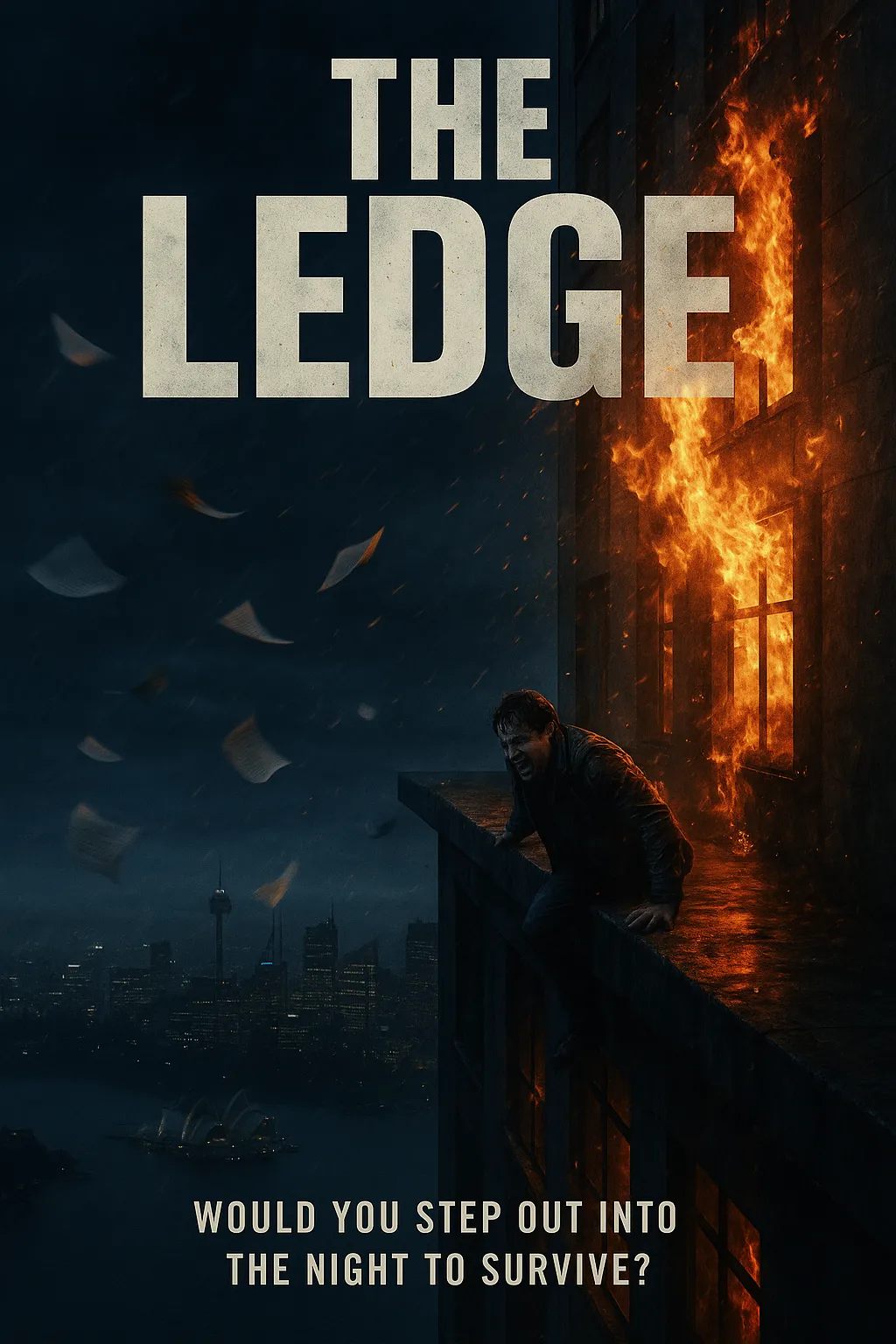
The Ledge
The door to the stairwell was hot. Not warm. Matt pulled his hand back and stood there in the dark corridor and listened to the sound behind it, which was not a sound any building should make.
His phone buzzed in his pocket. He'd already called triple zero. He'd already been told crews were six minutes out, which had been four minutes ago, which meant two minutes, which meant nothing because the stairwell was gone and the lifts were dead and the corridor behind him was filling with smoke that moved along the ceiling like a living thing.
He answered the phone.
Matt. Matt, I can see it. I can see the building from the apartment. Which floor are you on?
Thirty-four.
Silence. He heard her breathing change.
Okay. Okay okay okay. Are you — can you get to the stairs?
No.
The other stairs? The ones near the—
Jess. No.
He moved down the corridor toward the west side of the building. The smoke was thinner here but the emergency lights were out and he navigated by the glow of his phone screen, one hand trailing the wall. The plaster was cool. Then it wasn't. Then he stopped touching it.
The corner office had a window that looked west over Darling Harbour. Matt tried the handle. Locked. He kicked it twice below the lock and the latch gave and the door swung open and the air inside hit him clean and cold because someone had left the window cracked.
Wind. Real wind, thirty-four floors of it, pressing through a gap of maybe ten centimetres. The curtain was horizontal.
What was that? Matt, what are you doing?
There's a ledge. On the outside.
He crossed to the window and forced it wider. The frame resisted, then gave with a shudder, and Sydney opened up beneath him. He didn't look at the view. He looked at the building next door — the Meridian, six metres away, its fire escape a vertical line of steel grating bolted to the eastern wall. Between here and there, running along the face of Harrington Tower, was a concrete ledge. Barely wider than his foot.
A hundred metres of it, give or take, to where the two buildings nearly touched at the northwest corner. Then a step across to the fire escape. Then down.
Matt, no. No no no. What ledge? How wide is it?
He leaned out. The wind tried to take his tie and he grabbed it and stuffed it in his shirt pocket.
Nothing from her end. He could hear traffic. A siren, maybe hers, maybe his.
No.
Yeah.
Matt, no. No. Wait for them. They said six minutes, you said—
That was four minutes ago and the corridor's gone, Jess. I can't go back the way I came.
Behind him, the smoke found the corner office. It came low under the door, grey curling into grey, catching the glow from the harbour below.
How wide?
Wide enough.
Matt. How wide.
He looked at the ledge again. His foot was a size eleven. The ledge was his foot with maybe two centimetres to spare on either side.
Doesn't matter. It's the only thing there is.
A deep sound from somewhere in the building. Not close. Not far enough. The floor hummed under his shoes and then stopped.
She was crying. He could hear it in the way she wasn't crying.
I need you to stay on.
He hadn't meant to say that.
I'm here. I'm not going anywhere. I'm right here.
Matt put one leg over the windowsill. The wind hit his calf and kept going, straight through the fabric, straight through the skin, into the bone. He gripped the frame with both hands. His phone was wedged between his ear and his shoulder. Below him — he didn't look below him. He looked at the wall. Grey concrete, pocked and stained, close enough to press his face against. He put his foot on the ledge.
It held.
He swung the other leg out. For a moment he was sitting on the windowsill with his feet dangling over nothing, and his hands were the only thing that mattered in the world. Then his right foot found the ledge and he shifted his weight and stood.
He was on the ledge with his back to the harbour and his chest against the wall. The concrete was cool against his cheek.
Her voice was tinny and half-lost in the wind.
Yeah.
Okay. Okay okay okay. Don't look down.
Wasn't planning on it.
The wind came in sets, like waves. A lull where the air just sat there, dead and cold, and then a shove from the south that flattened his shirt against his ribs and tried to peel him off the wall. He waited through it with his fingers in a crack in the concrete. The phone bit into his jaw where he clamped it.
Right foot. Weight. Left foot, close. He did it again. The soles of his shoes were wider than the ledge and the outer edges hung over nothing. He could feel the void under his arches like a hum.
Somewhere below, a horn. Long and flat.
Talk to me. Tell me what you see.
Wall.
What else?
More wall.
Another shuffle. His left knee locked and he had to wait for it, standing perfectly still with his fingers splayed against the concrete, breathing through his nose until the muscle released. The wind picked up during those seconds and he felt it funnel between Harrington Tower and the Meridian — not a gust but a corridor of moving air, a sustained pressure against his left side that didn't let up.
The phone slipped. He caught it with his shoulder, jamming his head sideways so hard his neck popped. The silicone case pressed against his teeth.
What was that? What is it?
Still here. Moving.
He counted steps because his brain needed a job. Ten. Fifteen. Each one maybe ten centimetres. A hundred metres to the corner. A thousand steps. He stopped counting at fifteen.
Behind him, through the wall, the fire sounded almost mechanical — like an engine running hot in a closed room. The concrete under his fingers was warm here. Two metres back it hadn't been. He moved faster.
A window to his right — dark, intact, reflecting him back as a smear of white shirt and black nothing. He shuffled past it. Then another window. This one glowed orange from inside. He felt the heat through the glass on the backs of his hands and didn't stop.
Jess's voice had gone flat.
I know.
The wind died. Just stopped. He could hear the fire clearly now — not through the wall but from behind, from the open window he'd climbed out of, carrying across the gap. And in that quiet, between one shuffle and the next, he heard something else.
A cough. Not his. Not from Jess's end. From inside the building, close — the other side of the wall his face was pressed against.
Matt stopped moving.
Matt? Why'd you stop? Matt?
He said it quietly, like volume might cost him his balance.
He held still. The wind stayed dead and the fire sound dropped to a low chewing behind the wall and in the gap he heard it again — a cough, wet and deep, maybe three metres ahead and to the right. Behind the next window.
Matt? Matt, talk to me—
Quiet.
She went quiet. He listened. The cough came again, then a sound like something heavy dragging across carpet. Then a thump against the window — not a fist. A body, falling against it.
He shuffled forward. Three steps. Four. The window came into view on his right and the glass was dark but not empty. A shape behind it, low, crumpled against the base of the window. A person sitting on the floor with their back against the glass. He could see the top of a head. Dark hair. The shape moved and a face turned up toward him and a hand came up and hit the glass once, weakly.
There's someone. A woman. She's on the floor.
What?
The woman's mouth moved behind the glass. He couldn't hear her. The smoke behind her was amber, lit from somewhere deeper in the floor. She hit the glass again and this time she kept her hand there, fingers spread. Her other arm hung wrong — tucked against her chest at an angle that didn't belong to a working joint.
She's hurt.
Matt, you can't. You can't go back in.
He didn't answer. The woman's eyes found his through the glass. She wasn't panicking. That was the thing. She looked at him and then looked at the ledge under his feet and then looked back at him.
He looked at the glass. Office glass. Tempered, probably. His right elbow was the only hard thing he had. He raised it, testing the range — and the motion shifted his weight a centimetre left and his stomach lurched before his foot caught the edge. Thirty centimetres. He kept forgetting.
What are you doing.
The wind came back. Not from the south this time — from below, a thermal updraft from the fire floors underneath, warm air that rose along the face of the building and hit him like a breath. His shirt ballooned and the phone shifted against his jaw and he let it go.
He let it go. The phone dropped from his shoulder and he watched his hand open away from the wall and close around it six inches from his hip. His fingers knew what they were doing. The rest of him caught up a second later, standing on thirty centimetres of concrete with one hand free, the harbour wind pushing warm air up his back. He brought the phone down to his chest and held it there.
Matt? I heard — what happened?
I'm here.
But the phone couldn't go back to his ear. Not with one hand on the wall and the other holding it against his sternum. He could hear Jess's voice, small and tinny against his chest, saying his name.
The woman hit the glass again. Behind her the amber went orange.
Matt thumbed the phone to speaker. Jess's breathing filled the air between him and the building, mixing with the wind.
I have to break this window.
No.
The woman wasn't hitting the glass anymore. She'd lowered her good hand to her lap. She looked at the ledge. At the width of it. At the drop behind him. She closed her eyes and shook her head.
She was telling him to go.
Matt, please. Please keep moving. You said a hundred metres, how far have you gone?
He tried to think. Fifteen steps before he stopped. Maybe six more. Two metres. Maybe two and a half.
Not far enough.
The orange light behind the woman brightened. A desk or a partition caught and shadows jumped across the ceiling. She flinched but didn't move from the glass. Couldn't, maybe. Her legs were drawn up under her and he could see now that it wasn't just the arm. The way she held herself. Ribs, maybe. Everything on her left side was wrong.
He put the phone in his breast pocket, speaker up. Jess's breathing, his breathing, the fire. He pressed both palms flat against the wall above the window frame and looked down at the glass. One sharp strike at the corner. That's where tempered glass broke — he knew that from somewhere, some video, some life that wasn't this one.
The woman opened her eyes. She looked at him and shook her head again, harder. Her mouth moved. He still couldn't hear her but he could read it. Go.
Jess's voice came from his pocket, small and far away.
Matt looked at the woman. The woman looked at Matt. The orange light grew behind her.
He moved. That was the decision and it happened in his legs before his head caught up — right foot sliding along concrete, then left foot closing the gap, then again, and the woman's face in the glass slid out of his peripheral vision and was gone.
Behind him the window blew out. Not from his elbow. From the heat. The glass let go in one clean sheet and the sound was a pop and then a waterfall of something tinkling down the face of the building, taking a long time to reach anything. The fire breathed out through the gap — he felt it on the back of his neck, a pulse of air so hot it dried his eyes from two metres away.
Jess's voice jumped from his pocket, stripped thin by the speaker.
Window went.
Are you —
Moving.
He didn't look back. Wind came through the blown window carrying smoke and a sound like fabric tearing, and then a voice — the woman's voice, finally audible, one word he caught before the wind took it. She was saying please. He didn't know what she was asking for.
He kept going. His ankles ached, a deep lateral strain from holding his feet straight on a surface that wanted them to roll. His calves had started to shake. Not the dramatic kind. A fine vibration, constant now.
The phone buzzed against his chest. Call waiting. He ignored it. It buzzed again.
Someone's calling you.
I know.
It might be — it could be the fire people, Matt. Answer it.
He hooked his right thumb into a vertical seam where two concrete panels met. Held. He freed his left hand, fished the phone from his pocket, and tapped the screen without looking at it. The wind almost had it. He got it back into the pocket with the heel of his palm.
A man's voice, mid-sentence, replacing Jess.
Yeah.
Matt, we've got you on the exterior. Aerial's got a visual. You're on the ledge on the west face, is that right?
That's right.
Okay. Crews are in the building. We're working floors twenty-eight through thirty-one but the stairwell above thirty-two is compromised. The plan is to reach you from the Meridian side. You're heading to the northwest corner, correct?
Yeah.
Good. That's the right call. I need to give you some information. Wind forecast has a southerly change due in the next ten to fifteen minutes. Gusts up to sixty kilometres. That's going to make things harder on an exposed face.
Sixty. He tried to think what sixty felt like. He'd driven sixty with his hand out the window of the ute. He stopped thinking about it.
The structural assessment on Harrington is ongoing. The concrete's rated but we're seeing significant thermal loading on the west side. What I'm telling you is keep moving and stay on the wall. The ledge is sound for now.
For now.
You're doing well, Matt. Estimated time to get a team onto the Meridian fire escape is twelve minutes.
Twelve minutes. He'd covered maybe three metres in ten.
There's a woman. Behind me. Window just blew on her room.
A pause. He could hear Rook talking to someone else, muffled.
We're aware of a possible second occupant on thirty-four. Can she reach you?
No.
Understood. Keep moving, Matt. That's the best thing you can do for both of you right now.
The call ended. Jess wasn't there either — the phone had swapped, not merged. He was alone on the wall with the wind and the fire eating the room he'd just left the woman in. He tapped the screen blindly until Jess's name appeared and hit it and waited through two rings that lasted the rest of his life.
Matt?
Still here.
He slid the phone back into his pocket and put both hands on the wall. The concrete under his right palm had changed. Not warm. The heat lived deeper in it now, banked in like coals, radiating through the surface into the meat of his hand. He moved his grip higher, found cooler stone, kept going.
He counted panels. The seams came every few shuffles — vertical lines in the concrete where his fingers could hook and hold. One panel. Another. He stopped counting at four because the number wasn't helping. His left calf cramped and he stood still, breathing, until it released. The harbour was down there. He knew it was down there because he could smell salt under the smoke, and because light moved on the underside of the Meridian's lower floors — water light, reflected.
From his pocket, barely audible over the wind:
He didn't answer. Knowing she could see him made it worse. He was a shape on a wall to her. A speck.
The wind shifted. It came from below again — that thermal updraft — but this time it brought sound with it. A deep groan from somewhere in the building's guts, structural, the kind of sound that doesn't repeat because the thing that made it only happens once. The ledge didn't move. He waited for it to move. It didn't.
What was that?
Don't know.
Matt. How far.
He looked to his left for the first time. The corner of the building was out there, somewhere in the dark, where the west face met the north face and the Meridian's fire escape waited. He couldn't see it. He could see the ledge running away from him, lit orange from the windows below, and then nothing. He looked back at the wall.
Far.
Behind him — distant now, or maybe not distant, maybe just quieter — the woman coughed twice. Then nothing. The fire filled the silence where the third cough should have been.
He stopped. Not because his legs gave out or the wind pushed or his hand found something wrong with the wall. He stopped because Jess was breathing on the speaker and the woman behind him had stopped coughing and he needed to say something or he was going to come apart.
The words didn't make sense even to him until they were out.
Wind filled the pause. Not the thermal — the real wind, the southerly Rook had promised, arriving early as a scout gust that pressed his shirt flat and died.
What?
The kitchen light. You leave it on when I'm late. Can you see it from where you are.
Silence. He heard her move — a chair, maybe, or a step toward a window.
Yeah. Yeah, I can see it.
Don't turn it off tonight.
He shouldn't have said it. He knew that as soon as it left him because his right foot shifted half a centimetre on the ledge and his stomach went and for one full second he was not a person, just a set of reflexes clamping onto concrete. His fingers found the seam. Held. The second passed.
She didn't say anything. She just breathed.
Rook's voice cut through from the merged line, clipped.
Matt. Southerly's early. First gusts hitting the north face now. Need you moving.
He moved. Not the careful shuffle — something faster, uglier, his burnt right palm dragging along the wall leaving skin on the concrete. His left hand led, fingers finding each seam and releasing it before his weight fully committed. The ledge narrowed where a downpipe bolted to the wall and he had to turn his feet sideways to pass it, toes pointing left, heels over nothing, and for three shuffled steps he was a man walking a tightrope in dress shoes.
The wall curved. He felt it before he saw it — the angle of his palms shifting, the concrete pulling away from his chest by degrees. The corner. The west face becoming the north face. The wind hit him from a new direction and his body didn't know this wind, hadn't calibrated for it, and he pressed his forehead into the concrete and waited.
Jess said his name from his pocket, half-eaten by the wind.
He didn't answer. The wind was coming in hard from the south, hitting the north face dead-on instead of sliding past. It didn't gust. It leaned. A constant lateral pressure against his left shoulder that wanted to peel him off the building one degree at a time.
You're on the north face. Meridian escape is fifteen metres ahead. Visual on you from the street.
Fifteen metres. He could see it now — a dark lattice of steel against the Meridian's pale concrete, close enough to have shape but not detail. The ledge between here and there was lit from below by the fire's glow on the lower floors, a strip of orange concrete running into darkness and then into the steel.
The next gust came and it wasn't a gust. It was the southerly. Sixty kilometres an hour hitting the flat north face of Harrington Tower with nothing between it and Antarctica. Matt's left foot slid. His knee hit the wall. His fingers went white in the seam and he hung there with his cheek grinding against concrete and his eyes shut and the wind screaming past his ears like a train through a tunnel.
From his pocket, barely audible:
He opened his eyes. The fire escape was there. Twelve metres. Ten. The wind had pauses — Rook was wrong about the gusts, or right in a way that didn't help, because the wind came in walls and between the walls were windows of two, three seconds where the air just stopped and he could move.
He moved in the windows. Three steps in a lull. Stop. Hold. Two steps. Stop. The fire escape grew until he could see the bolts, the rust, the diamond pattern of the grating. Eight metres. Five.
Team's on the Meridian roof. Coming down to you. Three minutes.
He didn't have three minutes and Rook knew it. The wall behind his hands was hot now — not warm, not banked heat, but hot, the kind of hot that shortened the time his palms could stay in contact to a count of two before he had to lift and replace them. He was slapping the wall instead of gripping it, each touch a flinch, moving by flinches.
The wind hit again and this time a crack from inside the building, deep and structural, and a section of window three metres behind him blew out in a sheet of orange glass that spun into the dark. The thermal updraft caught the shards and for a moment they hung in the air below him, turning, catching firelight.
Two metres. The fire escape railing was right there — black steel, bolted to the Meridian's wall, close enough that he could see the reflective tape wrapped around the top rail. Between the ledge and the platform was a gap of maybe half a metre where the two buildings didn't quite meet. He'd have to step across it. He'd have to let go of Harrington Tower and reach for the Meridian and trust that his foot would land on steel grating instead of air.
He waited for the wind to stop. It didn't stop. He waited longer. It didn't stop.
Jess.
I'm here. I'm here, I'm here.
He stepped. His left hand caught the railing and his right foot hit the grating and the steel rang under his shoe and he pulled himself over the rail and fell onto the platform on his hands and knees. The grating pressed diamond patterns into his palms. He could feel every single one.
He knelt there. The wind hit the fire escape and the whole structure hummed but it was bolted to the Meridian and the Meridian was not on fire and the grating was wide enough to lie down on. He put his forehead against the steel.
From his pocket, Jess was saying something. He pulled the phone out. The screen was cracked from corner to corner but the call was live. He held it to his ear with a hand that wouldn't close properly.
I'm off.
She made a sound that wasn't a word. He sat against the Meridian's wall with his legs stretched out on the grating and looked back at Harrington Tower. The west face was bright now — four, five floors of fire, windows blown, flames curling out and up into the dark. Somewhere on the thirty-fourth floor, behind a window that wasn't there anymore, was a room he'd stood outside of. He looked at it until he couldn't anymore, and then he looked at the grating between his knees.
Boots on steel above him. Voices. A torch beam found his face and he raised his burnt hand against it.
A firefighter in breathing apparatus dropped onto the platform beside him and grabbed his shoulder. Matt could see his own reflection in the visor — filthy, white-eyed, alive.
Matt held the phone against his chest. The cracked screen glowed with the call timer, still counting.
The grating hummed under him with the wind and the boots coming down the stairs above. His back was against the wall. His legs were out straight. His burnt palm throbbed — he could feel the diamond pattern of the grating pressed into the backs of his thighs, each small diamond a separate point of cold, and cold was so good he almost laughed.
Jess was breathing on the speaker. Uneven. Shaky on the inhale, held too long, released in a way that meant she was crying and trying not to let him hear it.
He listened to it. He didn't say anything and she didn't say anything and the call timer counted seconds neither of them needed.
Rook crouched beside him. The shift in the wind pattern, a body blocking the gust, the creak of turnout gear. A gloved hand settled on his shoulder and stayed there.
Ambos are two minutes out. Just stay put.
Matt nodded without opening his eyes. Rook's hand lifted. The boots moved off — radio chatter, someone else's crisis, the night continuing.
The wind gusted and the fire escape sang a low metal note and from across the gap Harrington Tower gave back a sound like a door slamming. He didn't open his eyes for that either.
Jess's voice came through the cracked speaker, small and rough.
Yeah.
A breath. Two.
Okay.
Matt pressed the phone flat against his chest with his burnt hand. It hurt. He kept it there.
The paramedic's hands were cold. That was the first thing — cold latex fingers on his wrist, finding the pulse, and Matt almost pulled away because cold was wrong after everything. But it wasn't wrong. It was just cold.
They'd wrapped his right hand in something wet. He sat on the grating and let them do it, watching the gauze go around his palm in slow loops. The paramedic was young. She had a smudge of ash on her cheek and she worked without talking. There was a mole on her wrist, just above the glove line, and he stared at it because it was a thing that had nothing to do with anything.
Rook's voice came from above, on the radio, already somewhere else in the building.
Matt stood. His legs held. He was surprised by that — he'd expected them to refuse, but they held. The paramedic put a hand under his elbow and he let her.
The phone was still in his pocket. He could hear Jess breathing through the speaker, a sound so small it disappeared under the wind and reappeared in the stairwell when the door closed behind him.
Yeah.
The stairwell was fluorescent and beige and smelled like nothing. Not smoke, not salt, not concrete dust. Nothing. His sinuses opened, his chest loosened, his breath came in without cost for the first time since the thirty-fourth floor. He stopped on the landing and breathed.
The paramedic waited. She didn't tell him to keep moving. She checked her own phone — scrolled something, put it away. Somewhere above, a door opened and boots echoed and the stairwell carried the sound down past them and away.
They went down. The flights blurred — beige walls, grey steps, numbered doors he didn't read. His dress shoes sounded wrong on the treads, too sharp, too normal. The paramedic's boots kept a steady count beside him. On one landing there was a fire extinguisher with a dent in the side and a paper coffee cup on the floor next to it, and he looked at both of these things and kept walking.
Halfway down, or what felt like halfway, Jess's voice came from his pocket.
I'm coming. I'm in the car.
Don't speed.
He heard her laugh. One short breath through her nose, not really a laugh. Then the sound of a car door and an engine and she was driving across the city to wherever they'd let her get to, and he was walking down stairs, and those two things were happening at the same time in the same world.
The ground floor was a lobby. Glass doors, marble tile, a security desk with a half-eaten sandwich on it and a pen lying across a sudoku book. The paramedic pushed the door open and the street came in — red and blue light pulsing across every surface, radio chatter, diesel engines running, a sound like a crowd at a distance. The air was cool. Not cold. October cool. He stood in the doorway.
They walked him to the ambulance. He sat on the back step with his feet on the street and his wrapped hand in his lap. The paramedic cut his shirt cuff away from the burn and he watched the scissors work. His brain had gone somewhere quiet and empty.
Rook appeared from the street, walking fast with his helmet off and his radio in his hand. He looked shorter than his voice. He stopped in front of Matt.
Still got it.
Rook nodded. He looked like he was going to say something else. Then he said, "Your hand — they'll sort that out," which wasn't what he'd been going to say. He put his helmet back on and walked toward the red trucks and the shouting.
Matt took the phone out of his pocket. The screen was spidered with cracks but the call timer was still running. Forty-three minutes.
Don't look at it.
Yeah.
He heard her indicator ticking. A car horn, distant on her end.
He leaned back against the ambulance wall and closed his eyes. The paramedic was doing something to his hand that should have hurt more than it did. A blanket appeared across his shoulders — he didn't see who put it there. The wool was coarse and it smelled like plastic packaging.
Jess's indicator kept ticking on the speaker. Left turn. Right turn. Getting closer in increments he couldn't see but could hear.