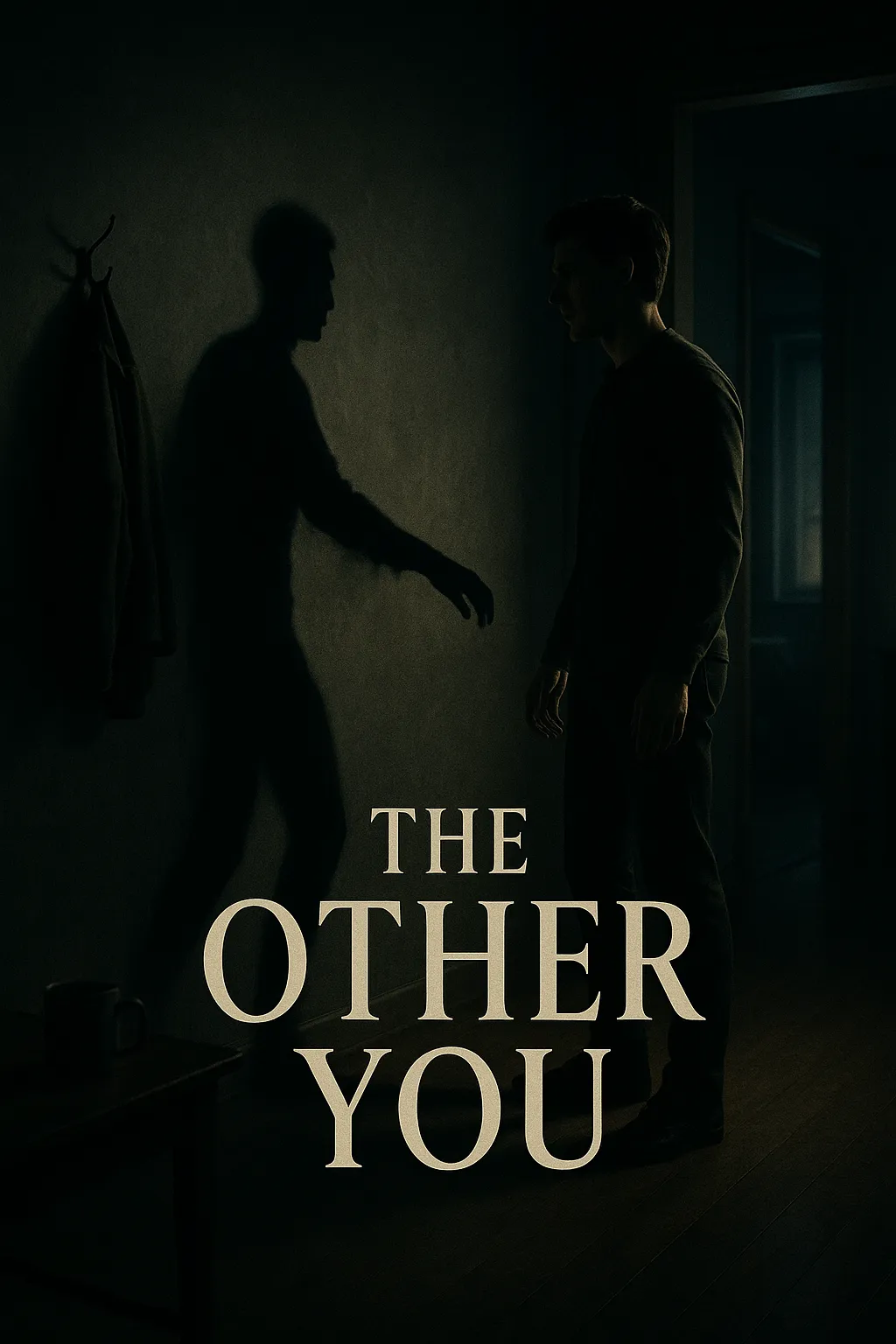
The Other You
The coffee grinder woke Ellis up. Which was wrong, because Ellis hadn't set the coffee grinder. Ellis hadn't bought coffee in two weeks. The bag of Sumatra dark roast had been sitting on the counter since before the couch became the only room that mattered, and the grinder had a crack in the lid that Ellis kept meaning to tape.
Ellis tried to stand. Got halfway — Loss of interest, said the knees — and settled for propping up against the armrest. From there: the kitchen. Visible past the half-wall. Someone was in it.
It had Ellis's shape. The exact shape — the slightly rounded shoulders, the way the left hand curled when it wasn't holding anything. It moved through the kitchen the way water moves through a pipe it's traveled a thousand times. Cabinet, filter, mug. The blue mug with the chipped handle that Ellis's mother had sent in a care package three apartments ago.
It was flat. Not flat like paper — flat like the absence of depth. Like someone had cut Ellis's silhouette out of the air and filled it with something that knew where the mugs were.
The grinder stopped. The shape poured water into the machine and pressed the button, and the kitchen filled with the small domestic sounds Ellis hadn't made in weeks. It opened the fridge. Found the eggs behind the leftover Thai that Ellis had ordered — Thursday? Wednesday. The eggs were cracked into a pan, one-handed, no shell. Ellis always got shell in the pan.
It ate standing up at the counter. The fork moved precisely. When it finished, the pan went into the sink and the water ran immediately — not placed on the stove to soak for three days, not forgotten until the egg cemented itself into an archaeological layer. Just washed. Dried. Put away.
Ellis's phone buzzed on the floor next to a library book eight days overdue and a plate with something orange dried on it. The shadow crossed the room. Picked up the phone. Ellis watched its flat black thumb move across the screen.
The reply it typed to Margot's text was four words: Absolutely. Looking forward to it. Ellis didn't use exclamation points. Ellis didn't use the word absolutely. Ellis would have left the message on read for two days and then sent 'sorry just saw this' like a liar.
The shadow set the phone on the counter — not the floor, the counter — and moved to the closet. It picked out the green jacket. The good one, the one Ellis hadn't worn since last October, the one that still fit right. It hung the jacket on the hook by the door. Not draped over a chair. The hook. The hook that Ellis had installed eleven months ago and used exactly twice.
Then it left. The front door opened and closed and the apartment was just an apartment again, full of morning light and the smell of coffee Ellis hadn't made. The blue mug sat on the drying rack, upside down.
Ellis looked down. Just the light. The shape where a shadow should have been.
The couch was warm. The indent fit perfectly. Ellis pulled the blanket up and looked at the hook by the door, where the green jacket hung.
Ellis did nothing. This was not a decision so much as a continuation of existing policy.
The coffee smell faded by ten. By eleven the light from the kitchen window had crossed the half-wall and reached the arm of the couch, and Ellis watched it move across the blanket. Outside, someone was leaf-blowing. The neighbor two doors down had a dog that barked at the mailman every day at 11:15 and today was no different. Ellis knew the mailman's schedule better than the mailman did. The leaf-blower stopped and started again. There was a flyer wedged under the front door that must have been there for days — Ellis could see the corner of it from the couch, bright yellow, probably for a pizza place or a church.
At some point Ellis reached for the phone on the counter. Got up, crossed the room, came back. The couch accepted this brief betrayal without comment.
Margot's text thread was open. The shadow had written: Absolutely. Looking forward to it. Margot had replied with a string of exclamation points and a time — Saturday, 2pm, the place on Hewitt with the good soup. Ellis scrolled up. Three weeks of unanswered messages from Margot, then the shadow's four words, and Margot responding within a minute.
Ellis put the phone face-down on the cushion.
The phone died at 1:40. Ellis knew because the microwave clock was visible from the right angle if you pressed your cheek into the armrest, which Ellis had been doing long enough to have a permanent sense of the kitchen's geometry from a horizontal position.
The front door opened at 3:17. The shadow came in carrying a paper grocery bag. It moved past the couch without adjusting its path — not avoiding Ellis, not acknowledging Ellis, just moving through the apartment on a route that happened not to include the couch, the way you'd walk around a coffee table.
It unpacked the bag onto the counter. Milk. Cheese. Bananas. A box of those crackers Ellis liked but never bought because seven dollars was too much for crackers. Ellis's hand closed around the edge of the blanket.
The shadow put everything away. It knew where things went — the cheese drawer, the spot on the counter where bananas didn't bruise against the wall. Then it washed the pan from this morning that was already clean and dry, and Ellis realized it wasn't washing. It was checking. Running a flat black thumb along the rim to confirm its own earlier work.
Ellis held one hand up against the light from the window. The fingers were all there. Solid enough. But the light came through the edges in a way it shouldn't have — a faint amber glow along the knuckles, like holding a hand over a flashlight as a kid to see the blood underneath. Except this wasn't blood-glow. This was the carpet showing through.
Ellis put the hand down.
The shadow opened Ellis's laptop at the kitchen table. The keys didn't make sound under its fingers — or maybe they did, just not the same sound. A muted version. It typed for eleven minutes. Ellis counted because there was nothing else to count. When it finished, it closed the laptop and the screen-light that had been casting its shape against the wall disappeared, and for a half-second the shadow looked less like a shape and more like a person. The way it paused with its hand still on the laptop lid.
Then it moved to the closet again. Took out a clean shirt — the gray henley, the one Dean had said made Ellis look like a person who had their shit together, back when Dean still said things like that — and hung it on the hook next to the green jacket. Two items on a hook that had held nothing for ten months.
The shadow stood by the door. It was looking at something. Ellis followed its gaze to the shelf by the entrance — the small ceramic dish where keys went, and next to it, a candle. Half-burned. The wick black and curled. Ellis hadn't lit it in — a long time. Hadn't looked at it. The shadow reached toward it, and Ellis sat up.
Just sat up. That was all. But the shadow's hand stopped. It stayed there, hovering over the candle, and for the first time since the coffee grinder, everything in the apartment held still. The leaf-blower outside had stopped. The dog wasn't barking. Ellis could hear the fridge humming and nothing else.
The shadow withdrew its hand. It left the candle where it was. It left the apartment again without the jacket or the shirt, the door clicking shut behind it. The candle sat on the shelf. Half-burned. Ellis stared at it from across the room and could almost smell the smoke from the last time it was lit, could almost see the table set for two, the food going cold, the phone not ringing.
Ellis lay back down. Pulled the blanket up.
Ellis stood up. The blanket slid off and pooled on the floor and Ellis didn't pick it up. The kitchen was nine steps from the couch. Ellis knew this because the linoleum was cold through the hole in the left sock, and each step announced itself.
The cracker box was on the second shelf, between the peanut butter and a jar of something pickled that predated the couch era. Rosemary and sea salt. The shadow had placed it label-out, like a store display.
Ellis picked it up. It was heavier than expected — still full, still sealed. The cellophane crinkled under Ellis's thumb. Ellis held it over the trash can and let go.
The box hit the bottom with a flat cardboard sound. The lid swung back and forth twice and stopped.
Ellis stood there. The fridge hummed. Outside, a car alarm started and stopped, started and stopped.
The rest of the shadow's groceries were still in the fridge. Ellis opened it. The milk was the right milk — the one with the green cap, two percent, the brand Ellis's mother used to buy. Ellis had been buying whatever was cheapest for years. The shadow had not bought whatever was cheapest.
Ellis closed the fridge and leaned against it. The magnets pressed into the back of one shoulder — a pizza place, a dentist appointment reminder from April. The apartment was very quiet. Ellis's hand, resting on the counter, caught the afternoon light, and the knuckles looked like wax. Not translucent yet. Just thin. Like the hand of someone who'd been sick a long time.
The laptop was on the kitchen table where the shadow had left it. Ellis opened it. The screen woke to an email draft folder — three sent responses, all from this morning, all in Ellis's name. The first was to Ellis's landlord about the dripping faucet Ellis had reported in January and then never followed up on. The second was to a coworker named Priya about a project Ellis had stopped answering questions about two weeks ago. The third was to Ellis's mother.
The email to Ellis's mother said: Things are good here. Been keeping busy. Made eggs this morning. The tone was warm and plain and completely wrong — not wrong like a stranger wrote it, wrong like someone had remembered how Ellis used to write before the couch. The sign-off said: doing better.
Ellis read it again. Then again. Ellis's jaw was tight, and there was a pressure behind the sternum that wasn't quite anger and wasn't quite grief, and the words on the screen blurred for a second before Ellis blinked them clear. Doing better. Ellis closed the laptop hard enough that the hinge protested.
The candle was still on the shelf by the door. Half-burned, wick curled black. The shadow had reached for it and stopped. Ellis walked to it now. Picked it up. It was lighter than it looked — most of the wax had melted down one side, pooled and hardened into a shape like a fist. The label was gone. There had been a label once, something about cedar and bergamot, but that was from the store, from the day Ellis had bought it for the dinner. The dinner where the table was set for two and the food went cold and the phone didn't ring, and Ellis had lit the candle anyway and let it burn while eating alone because blowing it out felt like admitting something.
Ellis put the candle back. Didn't move it, didn't turn it. Put it back in exactly the same spot, in the dust-ring it had made on the shelf.
The green jacket and the gray henley hung on the hook. Ellis touched the henley's sleeve. The fabric was soft and familiar and Ellis's fingers went partly through it — not through the fabric, through Ellis's own fingers, the tips losing their edges against the gray cotton like a photograph left in the sun. Ellis pulled the hand back and held it against the chest, tucked it there.
From below, the building's front door opened. Footsteps on the stairs. Ellis looked at the trash can — the cracker box visible through the gap where the lid didn't close all the way. Rosemary and sea salt, seven dollars, bought by something that thought Ellis deserved them. The footsteps climbed. Ellis didn't move from the door.
The door opened and the cold came in first. Not weather — something else. The temperature in the hallway was fine. Ellis had stood in that hallway a hundred times. But the air that moved ahead of the shadow carried the particular chill of a room where the heat's been off too long, where nothing living has been breathing.
The shadow stopped. Three feet from Ellis. It had never been this close while Ellis was standing. On the couch, sure — it moved past the couch the way you'd move past furniture. But Ellis was vertical now, in the doorway, blocking the path to the hook and the jacket and the henley, and the shadow stood there holding a paper bag from the pharmacy and did nothing.
Ellis could smell cedar. Not the candle — the candle hadn't been lit in months — but the ghost of it, the way a smell lives in wax long after the flame's gone.
Ellis's voice came out wrong. Too quiet, like the apartment had forgotten how to carry sound.
The shadow set the pharmacy bag on the floor. Slowly, the way you put something down when you don't want to spook what's in front of you.
The dinner. The candle. I set the table for two and somebody didn't come, and you — you knew not to touch it. You reached for it and you stopped.
The shadow was still. Not the stillness of a person thinking — the stillness of a shape that doesn't need to breathe. The radiator ticked against the far wall, metal expanding, contracting. It sounded like someone tapping a fingernail on a pipe, patient and regular.
Ellis took a step closer. The cold got worse.
The shadow moved. Not away — it turned, slightly, toward the shelf. Toward the candle. Its hand hovered the same way it had two days ago, flat black fingers above the pooled wax, and then it did something it hadn't done before. It touched the shelf beside the candle. Not the candle itself. The dust-ring. One finger tracing the circle where the candle had sat undisturbed for months, and when it pulled back, there was a clean arc in the dust, bright wood underneath.
Ellis's throat was tight.
Ellis stopped. The quip was right there, the self-deprecating turn, the part where you make it smaller by making it funny. It didn't come.
He said he'd come. He said seven-thirty.
The radiator ticked. The faucet in the kitchen dripped once.
Ellis's right hand was shaking. Not from the cold.
Is that why I stopped? Is that — all it was?
The shadow reached into the pharmacy bag on the floor. It pulled out a box of bandages, a bottle of ibuprofen, and a receipt. It set them on the shelf next to the candle. Then it picked up the receipt and held it out toward Ellis.
Ellis took it. The paper was warm — or Ellis's fingers were cold enough that anything felt warm. The receipt was from the pharmacy on Hewitt. At the bottom, below the items, the shadow had written in neat blocky handwriting that looked nothing like Ellis's: BEFORE.
Before what.
The shadow pointed at the candle. Then it moved its hand — not to Ellis, not to itself — to the space between them. The three feet of cold air in the doorway of an apartment where two shapes stood and neither of them cast a shadow on the floor.
Ellis looked at the receipt. The word sat there, blocky and plain.
The shadow was already moving. It stepped around Ellis — close enough that Ellis felt the cold slide across the skin of both arms, a full-body flinch — and crossed to the kitchen. It filled a glass of water from the tap and set it on the counter. Not for itself. It didn't drink. The glass sat there catching light, sweating slightly, next to the laptop and the dentist reminder magnet that had fallen off the fridge at some point and nobody had picked up.
Ellis looked down at the hand holding the receipt. The thumb was gray at the tip, the nail bed the color of old newspaper, and the receipt showed through it — not like transparency, like the thumb was becoming an idea of a thumb, a suggestion the light was starting to ignore. Ellis closed the hand into a fist. The receipt crumpled. The thumb held.
The shadow stood in the kitchen with its back to Ellis, one hand resting on the counter near the glass of water. Waiting. Not for Ellis to drink it. Not for Ellis to speak. Just waiting, with the patience of something that had nowhere else to be because it lived here now, in the gap between what Ellis remembered and what Ellis wouldn't.
Ellis walked to the kitchen. Sat on the floor with the back against the cabinet, the grout line pressing into one heel. Uncrumpled the receipt. Read the word again. BEFORE. The glass of water was above, on the counter. Ellis reached up for it and the fingers wrapped around the glass and held, all five of them, gray tips and all.
Ellis stood up from the kitchen floor. The receipt went into the back pocket. The glass of water stayed on the counter, untouched, sweating a ring onto the laminate.
The desk was first. The shallow drawer stuck on its track the way it always did — you had to lift and pull at the same time, a two-handed trick Ellis's body remembered before Ellis did. Inside: takeout menus, a phone charger with a frayed cord, a screwdriver, loose change. Nothing. The deep drawer had hanging files, most of them empty. One labeled LEASE. One labeled TAX. One labeled nothing, just a blank plastic tab, and inside that one a single bank statement from March and a coupon for an oil change.
Ellis closed the drawer. The bedroom closet was six steps from the desk. The closet had a shelf above the hanging rod where two boxes sat — one for shoes Ellis never wore, one unlabeled. Ellis pulled down the unlabeled one. It scraped against the shelf's edge, heavier than expected, and Ellis had to brace it against the chest to keep from dropping it.
Inside, under a tangle of old phone cables: a journal. Black cover, the elastic band still tight. Ellis had bought it three years ago from a bookstore that wasn't there anymore. The pages were blank. All of them — Ellis fanned through — except that something fell out from between the last pages and landed on the carpet face-down.
A letter. Folded into thirds, the creases soft from being opened and refolded more than once. The handwriting on the front said ELLIS in block capitals, no address, no stamp. Hand-delivered. Slid under a door.
Ellis sat on the edge of the bed. The mattress had a brown water stain near the foot that had been there when Ellis moved in, an ugly ring on ugly beige fabric. The right hand was steady now — the specific hand that had been shaking ten minutes ago in the doorway. That was the strange part. The steadiness. Like the body had decided something the rest of Ellis hadn't caught up to yet.
The letter was four paragraphs. Dated thirteen months ago. Dean's handwriting — small, left-leaning, the kind that looks like it's apologizing for taking up space on the page.
The first paragraph said he'd been thinking about this for a while and didn't trust himself to say it in person because the last time he'd tried, at the bar on Caldwell, Ellis had changed the subject to the game on the TV above the bartender's head and Dean had let him. The second paragraph said he'd started driving to Ellis's apartment three separate nights and turned around each time, and the last time he sat in the parking lot for twenty minutes watching the blue light of the television under Ellis's door. The third paragraph said he wasn't asking Ellis to be fixed or okay or anything other than what Ellis was, but he was asking Ellis to meet him halfway. Anywhere. A coffee. A walk. Just not the silence. The fourth paragraph said he'd be there whenever Ellis was ready, and he meant it, and he was sorry for writing it down instead of saying it but he'd been practicing the words for so long that paper was the only way to make them hold still.
Ellis read it again. Not the words this time. Just the dent in the paper where Dean's pen had pressed too hard on the word halfway.
Thirteen months ago. The dinner was eleven months ago. Ellis held the letter in one hand and the math was just — there. The space between them. Two months. Dean wrote the letter, and two months later Ellis finally set the table, bought the chicken, lit the candle. And by then.
Ellis's jaw ached. Not from clenching — from the effort of keeping it loose, of not letting the face do the thing it was trying to do. The letter sat in both hands. The right thumb, the gray one, pressed against the crease where Dean had folded it, and the thumb held. Barely. The paper dimpled under pressure that was almost not there.
From the kitchen, the sound of the tap running. The shadow was filling the glass Ellis hadn't touched. Or emptying it. Ellis couldn't see from the bedroom. Just the sound of water, then the sound of water stopping.
Ellis folded the letter back into thirds. Carefully, along the existing creases. Put it in the back pocket with the receipt. Stood up. Walked to the doorway of the bedroom and stopped there, one hand on the frame, looking down the short hallway toward the kitchen where the shadow stood with its back to Ellis, one flat hand resting on the counter beside the empty glass.
The coat hook was visible from here. The green jacket. The gray henley. Two items hung by something that lived in Ellis's apartment and used Ellis's name and bought Ellis's milk and had been right — about the emails, about the faucet — and Ellis hated that it was right and hated more that the hate felt like energy, like the first thing in weeks that moved in a direction.
Ellis said it to the hallway, to the shadow's back, to the letter folded in the back pocket.
I need you to leave.
The shadow turned. Not quickly — the way a door swings when the air pressure changes. It faced Ellis from across the apartment, and the distance between them was the hallway and the half-wall and everything else.
I mean it. Out. The door, the wall, wherever you go. I need you to not be here.
The shadow didn't move toward the door. It moved toward the shelf. Toward the candle. Its hand hovered — not over the wax this time, but beside it, near the clean arc it had traced in the dust two days ago. Then it pointed at Ellis. Then at itself. Then at the space between.
Yeah. I know.
Ellis crossed the hallway. Nine steps to the kitchen, but Ellis stopped at five, at the edge of the linoleum where it met the carpet. Close enough to feel the cold rolling off the shadow's outline. The hair on both forearms stood up.
Ellis's voice cracked on the first word and kept going anyway.
But it's mine. The shitty version where I don't get up and the faucet drips and the emails go unanswered — that's mine. You don't get to — you can't just do it better and that fixes it.
Ellis reached for the gray henley on the coat hook. The right hand — the one with the gray thumb, the fading edges — closed around the fabric. For a moment the fingers sank into the cotton like pressing into fog. Then they caught. Held. Ellis pulled the henley off the hook and the hanger swung empty.
The shadow took a step back. Just one. It was the first time it had ever moved away from something in this apartment instead of toward it.
Go.
The shadow reached into Ellis's back pocket. Ellis flinched but didn't pull away. The cold went through the hip and into the bone. The shadow pulled the crumpled receipt free and smoothed it against the wall beside the door. BEFORE. Then it wrote underneath, pressing hard enough that the pen — Ellis's pen, from the kitchen drawer — dented the drywall through the paper: BEFORE YOU STOPPED WANTING TO.
It let the receipt fall. It didn't look back at Ellis. It walked to the wall beside the door — not through the door, the wall — and pressed itself flat. The shape narrowed. Shoulders first, then the arms, then the legs, until it was just the outline of a person on paint and plaster, and then it was less than that, and then it was the shadow of someone standing in a doorway, and then it was just the light in the room shifting as a cloud moved outside.
Ellis looked down. A shadow stretched across the linoleum from both feet. Faint. Thin. But there.
The faucet dripped once. Ellis picked up the receipt from the floor and read the full message. The handwriting was blocky and deliberate and nothing like Ellis's, and the drywall dust on the back of it was fine as talc.
Ellis put on the henley. It smelled like the closet — cedar blocks and dust.
The phone was dead on the couch cushion. Ellis plugged it into the frayed charger at the kitchen counter and waited. The screen took forty seconds to wake. The lock screen was a photo Ellis didn't remember setting — a window, morning light, the coffee mug. The shadow must have taken it.
Ellis opened contacts. Scrolled past Margot, past Mom, past the pizza place. Dean's name sat between a defunct dentist and an old coworker Ellis couldn't place. The last call was fourteen months ago. Outgoing. Three minutes.
Ellis pressed the number. Held the phone to the ear with the hand that had gone through the counter yesterday, the hand that had sunk into the henley two minutes ago. All five fingers held the phone now. The gray thumb pressed the speaker grille against the cheekbone and stayed solid.
It rang four times. Ellis watched the shadow on the kitchen floor — thin, barely there, but moving when Ellis shifted weight from one foot to the other.
The line clicked. A breath on the other end.
Ellis?
The line was open. Ellis could hear Dean breathing and behind it a television or a radio turned low.
Hey.
Dean didn't say anything for a while. Ellis could hear him waiting.
It's been a while.
Fourteen months.
Yeah.
The faucet dripped. Ellis pressed the phone harder against the cheekbone. The gray thumb whitened at the knuckle from the pressure, and the color held — actual color, blood under skin, not the newspaper-ash it had been an hour ago.
I found your letter.
Dean went quiet. The television sound got louder because everything else stopped.
When.
Today. It was in a box. In a journal I never wrote in.
You kept it.
I didn't — I mean, I didn't throw it out. I don't know if that's the same thing.
A creak on Dean's end, like weight moving in a chair.
I sat in your parking lot the night of the dinner. Drove over, sat there, drove home. I could see the candle through your window.
Ellis closed both eyes. The kitchen floor was cold through the socks.
I made chicken.
I know.
That was — I was trying to. That was me trying.
Dean didn't say anything. Ellis let it go. The shadow on the kitchen floor shifted as Ellis leaned against the counter.
I wrote you that letter two months before.
I know.
And you didn't call. You made chicken.
Yeah.
Ellis opened the eyes. The lock screen photo caught the edge of vision — the mug, the morning light. Ellis set the phone on the counter and pressed speaker.
So what's different now.
Ellis looked at the receipt on the counter. BEFORE YOU STOPPED WANTING TO. The blocky handwriting. The drywall dust.
I don't know. I got up.
Dean breathed out. Long and slow.
Nothing. Saturday.
Saturday.
There's a place on Hewitt. Soup.
I know the one.
The line went dead. Not a hang-up — more like two people reaching for the button at the same time.
Ellis stood in the kitchen holding nothing. The henley hung loose at the wrists. The receipt went into the back pocket with Dean's letter, and Ellis's hand came back with all five fingers solid and accounted for.
The shower handle was stiff. The water ran cold for a long time before it didn't. Ellis stood under it with the henley in a pile on the tile and the bathroom filling with steam, and when the mirror fogged over the glass was blank and Ellis was no one. Then a hand wiped the condensation away.