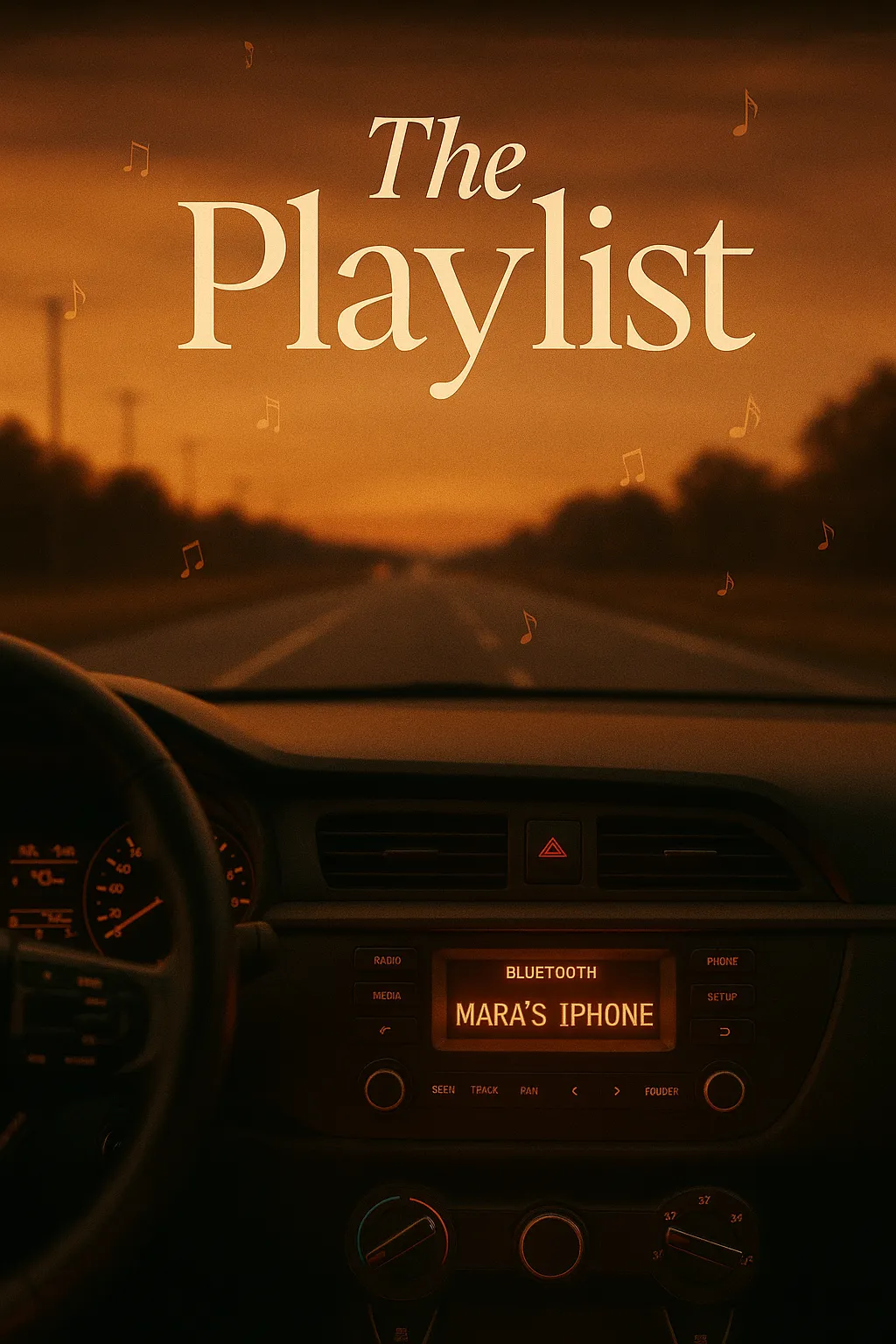
The Playlist
The passenger seat held the shape of her. Some trick of the leather, the way it remembered weight — Glen sat there with the engine running and didn't touch it.
Her lanyard was on the floor mat. Purple, fraying at the clip, with a keychain from that aquarium in Monterey they'd driven to the summer she turned twelve. She'd left it or she hadn't taken it. He picked it up and put it in the cup holder where it looked worse, so he moved it to the glovebox where he wouldn't have to decide what it meant.
Move-in had taken forty minutes. He'd carried the last box up four flights because the elevator was packed with families who all seemed to know what they were doing — fathers in clean polos shaking hands with roommates' fathers, performing some ritual Glen had missed the manual for. Mara's roommate had a mother and a father and a golden retriever in a bandana that said CLASS OF 2028, and Glen had stood in the doorway holding a desk lamp with no bulb and thought: I should have brought a bulb.
The goodbye was nothing. That was the thing. He'd made a joke about communal bathrooms — something about flip-flops being the difference between civilization and chaos — and she'd laughed the way she laughed at his jokes now, which was mostly with her eyes, a little impatient, already looking past him toward the version of her life that started when he left. She'd hugged him. He'd said love you the way you close a browser tab, already clicking away. She'd said it back.
Then an elevator door closed and eighteen years fit inside it.
He sat in the parking lot for what might have been two minutes or ten. The car was still connected to her Bluetooth — MARA'S IPHONE glowing on the dash display like a name on a mailbox after someone moves out. Her playlist picked up where she'd left it, mid-song, some artist he didn't recognize. A woman's voice, low and echoey, singing about something he couldn't follow. He didn't skip it.
His phone buzzed. Danielle.
The first text:
Then, four seconds later:
I mean how is she. How's the room.
Glen looked at the texts. The cursor blinked in the reply field. He typed She's good and then erased it and typed Fine, room's small but she likes it and then erased that too because fine was a word that had done a lot of heavy lifting in his family and he was tired of asking it to carry more. He put the phone face-down on the passenger seat, on the indent that was already gone.
He put the car in reverse. The parking lot was emptying out — other parents in other cars, some of them probably crying, some of them probably fine, the actual kind. A woman in a Subaru next to him was openly sobbing into a Jamba Juice and her husband was rubbing her back and Glen looked away from that because it was too specific to watch.
He followed the signs toward the highway. Left on Elm, right on University, merge onto I-80 West. The directions were simple enough that his hands did them without him, and the song ended, and another one started — something with a beat, young and confident — and the highway opened up into that long flat nothing of central valley afternoon, the kind of road that doesn't ask you to pay attention, that just holds you at seventy and lets you think.
The playlist kept going. MARA'S IPHONE. Four hours of her music and his silence.
He made it eleven miles. The song changed to something with horns and a girl rapping in Spanish and Glen put on his blinker like the shoulder of I-80 was a lane change that required signaling, and he pulled over and stopped.
The car shuddered once as a produce truck blew past.
He didn't turn the engine off. Didn't unbuckle. Just sat there with his hands at ten and two like a kid in driver's ed, the seatbelt cutting a diagonal across his chest, the Spanish horns still going. The girl was really into whatever she was saying. He had no idea what any of it meant but she meant it.
A CHP cruiser drifted past in the slow lane. Slowed. Considered him. Kept going.
His phone buzzed on the passenger seat. He picked it up.
Danielle again. Just three dots, pulsing. They appeared, held for a few seconds, vanished. He watched the space where they'd been. Then he set the phone on the dash, screen up this time, and pressed his thumbs into his eye sockets until he saw colors.
The song ended. The next one was acoustic — some guy with a soft voice and a guitar, the kind of song that shows up on playlists between the loud ones, the filler track you skip or don't. Glen didn't skip it. The guy sang about a house with a blue door and Glen thought about the day they'd painted Mara's bedroom, the summer before seventh grade, when she'd picked a purple so dark Danielle called it "bruise" and Glen had spent two coats defending it and a third admitting Danielle was right.
Mara had loved it anyway. Slept in that bruise-colored room for six years. Taped things to the walls — postcards, ticket stubs, a photo strip from some boardwalk booth where she and Glen were making the same face without trying. He wondered if she'd taken the photo strip to college or if it was still up there, adhesive pulling paint, in a room in a house he was not driving back to.
He hadn't told her that part. Hadn't told anyone. The lease was up in October and he'd let it just — sit there, that fact, like a piece of furniture he kept walking around. Mara thought he was going home. Danielle thought he was going home. He was on the shoulder of I-80 with no plan for dinner or the rest of his life.
Another truck. The car rocked and settled.
He thought about the goodbye. The flip-flop joke. Her laugh — a real one, surprised out of her, the kind where her shoulders came up and she looked twelve again for half a second before the eighteen-year-old climbed back into her face. He'd had her right there. Could have said something. Could have said: I don't know how to do this part. Could have said: I'm proud of you in a way that doesn't fit in the word proud.
He'd said the thing about flip-flops.
The acoustic song ended. Something loud and wrong for the moment came on — bass-heavy, a beat drop that rattled the rearview mirror — and Glen almost laughed. He was forty-six years old crying on the side of a highway and his daughter's playlist had just prescribed him a club banger. He turned it up. Not because he wanted to hear it but because the alternative was hearing himself.
He checked the mirror. Wiped his face with the heel of his hand. Put on his blinker again — signaling to nobody — and pulled back onto I-80.
He drove. The valley opened flat and yellow on both sides, fields of something — alfalfa, maybe, or grass seed, he'd never learned the difference — running out to a brown line of hills that never got closer. The sun was behind him and dropping.
The playlist played. He didn't touch it.
A song about a body. A song about a different body. Something with a flute sample that looped for three minutes and forty seconds — he watched the timer on the dash display because watching it was easier than listening. Then a Joni Mitchell track came on, 'A Case of You,' and Glen's hands tightened on the wheel before the first line was finished.
Danielle used to sing this one. Badly. Standing at the kitchen sink in the old house, the one on Terrace, barefoot on the tile, while Mara sat in her high chair gumming a cracker. Danielle always got the words wrong — 'I could drink a case of you, darling, and I'd still be on my feet' — she'd sing 'still' instead of the way Joni actually sang it, and Glen had corrected her once and she'd thrown a dish towel at his head and said she liked her version better because it was about surviving someone, not being ruined by them.
He let it play. Joni sang. The window that stuck in the kitchen on Terrace — he could hear it, the specific rattle when trucks passed. Mara banging the tray of the high chair with a plastic spoon. Danielle's voice underneath all of it, half a key off, completely sure of herself.
The song ended. Something with cheerful synth keys bounced in after it and Glen let out a breath.
His phone buzzed. He glanced at the screen propped on the dash.
Mara's name. One line.
Glen looked at the glovebox. Looked back at the road. A white pickup drifted into his lane and he corrected without thinking, the way you steer around something in a dream.
He waited for the second text. The one that would add context or soften it or crack the door an inch. A minute passed. Two. Just the lanyard.
He picked up the phone at a straight stretch and typed with his thumb.
Yeah. Glovebox. I can mail it.
Three dots appeared. Held. Vanished. Then:
Ok
He set the phone down. Ahead of him, three wind turbines turned on a ridge, slow and white against the haze. He watched them until they were behind him and then there were just more fields and more road and the synth song had ended and something else was playing.
The mile markers ticked past. He passed a sign for a rest stop in twelve miles and his bladder registered the information before his brain did. The coffee from Davis was working through him. He'd bought it at the campus café while Mara was in the bathroom, a large drip in a paper cup, and the barista had said 'move-in day?' and Glen had said 'that obvious?' and the kid had pointed at his face and said 'you all have the same look' and Glen hadn't asked what look that was.
The playlist shuffled to something he almost recognized. Piano, then a woman's voice that sounded like it was coming from inside a closet. He'd heard Mara play this one through her bedroom door last spring — one of those nights he'd stood in the hallway with a glass of water he didn't need, listening, trying to decode what his daughter felt from what she chose to listen to at midnight. He'd never knocked.
The rest stop sign said two miles. Glen put on his blinker.
The rest stop exit came and went. Glen watched it slide past in his peripheral — the blue sign, the arrow, the little pictogram of a person and a table — and kept his hands on the wheel and his foot steady. His bladder could wait. Everything could wait.
The playlist gave him three songs he didn't know. He let them wash through the car — a man singing falsetto over a drum machine, something with a banjo that didn't go anywhere, a track that was mostly silence and breathing with a piano underneath. Mara's taste was wider than he'd thought. He'd stood outside her door all those nights and only ever caught fragments, bass through drywall, and he'd assumed it was all the same. It wasn't.
The valley kept going. Irrigation pipes threw long shadows across dirt that looked like it hadn't rained since spring. A crop duster banked low over a field to the south, trailing something white that dissolved before it reached the road. Glen watched it make its turn and come back for another pass, methodical, the way you mow a lawn.
His phone lit up on the dash. Danielle.
She called me. She sounds good, Glen.
He read it once. Read it again. Mara had called her mother. He looked at his own phone — the last exchange sitting there, lanyard, glovebox, Ok — and set it back on the dash without answering.
A Fleetwood Mac song came on. 'Landslide.' The opening guitar, those first few notes that exist in some protected category of sound where your body responds before your brain gets a vote. Glen's jaw tightened. His eighteen-year-old daughter who listened to women rapping in Spanish and club songs that rattled mirrors had also, at some point, added 'Landslide' to a playlist, and Stevie Nicks was now singing about getting older in a car that smelled like vanilla air freshener and he was not ready for this.
He reached for the skip button. His finger hovered.
He pulled it back.
Stevie sang about a landslide bringing you down and Glen drove at exactly seventy miles an hour through the flattest landscape in California and thought about the hallway. Not the goodbye hallway at the dorm — the one at home, the rental, the beige carpet he'd never replaced. Standing outside Mara's door at midnight with a glass of water he didn't need, listening to whatever she was playing, trying to decode her from the other side of two inches of hollow-core door. He could have knocked. Any of those nights. Could have said, what are you listening to. Could have sat on the edge of her bed the way he used to when she was small and let her show him something. He'd stood there instead, holding water, and then walked back to the kitchen and poured it out.
The song ended. He exhaled. Something with a beat came on and he was so grateful for it that his eyes burned.
He picked up the phone. Typed a reply to Danielle.
Good. That's good.
He almost set it down. Then added:
She said anything about the room?
What he meant was: did she say anything about me. He sent it before he could rephrase it into something that didn't have a trapdoor in the middle.
The reply came fast. No hesitation, no dots.
Glen's hand went to his mouth. He pressed his knuckles against his lips and held them there. His one stupid joke. She'd carried it to her mother.
The mile markers passed. 158. 159. The light was changing — the sun dropping low enough to turn the dust gold, and the shadows of fence posts stretched across the road. A semi pulled alongside him and paced him for a full mile, close enough that he could see the driver's arm resting on the window frame, sunburned, a tattoo he couldn't make out. Then it pulled ahead and Glen was alone again.
He needed to stop. His back ached from the dorm stairs and the coffee was making itself known in a way that was becoming less suggestion and more ultimatum. A green sign said gas and food in four miles — one of those highway exits that deposits you into a town that's really just a gas station and a taqueria and a stoplight nobody obeys.
He took the exit. Slowed to forty-five on the off-ramp, then thirty-five past a feed store with a hand-painted sign. The gas station was an ARCO with two pumps and a mini-mart that had a handwritten note taped to the door: BATHROOM IS FOR CUSTOMERS. CUSTOMERS BUY THINGS.
He parked next to the air pump and killed the engine. The playlist cut out mid-song — something with a xylophone — and it was quiet.
The ARCO lot was mostly empty. A mud-caked F-250 at the far pump. A woman in scrubs eating something from a wrapper on the hood of a Civic. The light had gone full gold now, that last hour before the valley turned blue, and it hit the mini-mart windows in a way that made you notice them.
Glen picked up his phone. Danielle's last text sat there — She said you were funny about the flip-flops — and below it his own reply about the room, hanging unanswered. He scrolled up. Her first two messages from the parking lot, the ones he'd never replied to. The single text about Mara calling. All of it stacked up like a conversation he'd been having with a two-minute delay for three years.
He pressed call.
It rang. Second ring. Third. He watched a sparrow land on the air pump hose and peck at something. Fourth ring.
Glen?
Hey.
A pause. He could hear something on her end — a faucet, or a TV turned low.
Are you okay?
Yeah. I'm at a gas station. Somewhere past Vacaville, I think. One of those towns that's just a gas station.
You stopped.
She said it like it meant something. He didn't follow up.
You carried everything up, didn't you.
Elevator was full.
It's always full. I read that. They tell you to go early but everyone goes early so it's the same.
Glen leaned his head back against the headrest. The sparrow was still working on whatever it had found. A plastic bag drifted across the lot and caught on the F-250's bumper.
She called you, he said.
She did.
Good.
She told me about the flip-flops like it was, I don't know. Like she was reporting something.
Glen pressed his knuckles against the bridge of his nose. The gold light was on his dashboard, on the dark screen where MARA'S IPHONE had been.
That was the whole goodbye, Danielle. That was it. A joke about shower shoes.
The faucet or whatever it was had stopped on her end.
That's what you two do, she said.
What.
You make each other laugh and then you leave before it gets heavy. You've been doing it since she was fourteen. It's — she knows, Glen.
Glen opened his mouth. Closed it. Outside, the woman in scrubs crumpled her wrapper and got back in the Civic.
You think she does.
I know she does. She called me twenty minutes after you left and the first thing she said was the flip-flop thing. Not the room, not the roommate. Your joke.
The sparrow flew off.
Remember the almonds? he said.
What almonds.
We drove this same road when we looked at that place in Sacramento. Before Mara. And we stopped at one of those farm stands and bought a bag of almonds and we didn't talk for like an hour. Just ate almonds and drove.
A long pause.
The ones with the chili powder.
Yeah.
Why are you thinking about that.
He looked at the mini-mart. The handwritten sign about buying things. A rack of wiper fluid in the window. A stack of cardboard boxes by the dumpster, broken down and tied with twine.
I don't know. I just am.
Another pause. Then:
Eat something. Not almonds. Something real. You forget to eat when you drive.
I know.
She's going to be fine. She's tougher than both of us.
I know that too.
He could feel the shape of what he wasn't saying — October, the lease, the empty rooms — pressing against his teeth.
Drive safe. Text me when you're home.
Yeah. I will.
He hung up. Set the phone on the dash. Sat there.
The engine was off and the playlist was off and the car was just a car — metal and glass and a vanilla air freshener swinging gently from the mirror because he'd hit the brakes too hard pulling in. He reached up and stilled it with two fingers.
He turned the key. The engine caught and the dash lit up and there it was — MARA'S IPHONE — like she'd never left.
The playlist picked up where it had cut out. The xylophone song, right at the bridge. Glen put the car in reverse, backed away from the air pump, and pulled out of the ARCO lot onto the two-lane road that led back to the highway. He passed the feed store. He didn't look at it.
The on-ramp fed him back onto I-80 and the valley swallowed him again. The xylophone ended. Something slow came on — a man's voice over a single guitar chord, repeating, patient.
Mile 165. 170. The light was going. Not the dramatic way — just the slow drain of a valley evening, the sky turning the color of dishwater above the coast range. His headlights clicked on automatically and he let them.
He hadn't eaten. His stomach knew it and had stopped asking.
Around mile 190 the playlist looped back to a song he'd already heard — the woman with the echoey voice from the parking lot at Davis, the one that had been playing when he still had the shape of his daughter in the seat next to him. He recognized it the way you recognize a room you've rearranged.
His phone lit up on the dash. Danielle. One line, no follow-up, no correction.
She's going to call you tomorrow. She told me.
Glen read it at seventy miles an hour and his hands stayed on the wheel and his eyes stayed on the road.
The highway thinned to two lanes for construction somewhere past Fairfield. Orange cones in the headlights. A flagger in a vest waved him through with a slow arm. He slowed to forty-five and the songs changed twice during the detour — something electronic, then something country, an actual country song on his daughter's playlist — and when the cones ended and the lanes opened back up he was doing seventy again without remembering the acceleration.
He thought about October. Not the lease, not the boxes he hadn't bought, not what came after. Just the cereal. The box of Cheerios on the counter that he ate standing up at eleven p.m. because dinner was a thing that happened to people who had someone to eat it with. The kitchen faucet that dripped if you didn't tighten the handle all the way. He thought about the tape marks on Mara's wall where the postcards had been.
The photo strip was in his shirt pocket. He'd found it on the visor an hour ago — the two of them in a boardwalk booth, four frames, making the same face without trying. He could feel it there, against his chest, the stiff paper edge catching when he breathed.
His phone buzzed. He glanced down expecting Danielle.
My roommates dog has a graduation cap. Like a tiny graduation cap. For a dog.
Glen stared at the screen. Then a second text.
It has a tassel
He laughed. It came out of him like a cough — sudden, graceless, real. He picked up the phone at the next straight stretch and typed with one thumb.
Does the dog know what it achieved
It has a BANDANA that says CLASS OF 2028
That dog worked hard for this
😂😂😂
He set the phone down. The highway was dark now, fully dark, and his headlights carved a tunnel through it and the fields on either side had disappeared into something he could only know was there because the stars stopped at the horizon line.
The playlist gave him three songs he didn't know and one he did — an old Counting Crows track, 'Round Here,' that he'd listened to in college when he was the age Mara was now and the world was a problem he was excited to have. He let it play. It sounded different from this side.
Mile 220. The Altamont Pass. Windmills on the ridge, visible only by their red blinking lights, a field of slow-pulsing dots against the dark. He crested the hill and the Bay Area opened below him — a scatter of light, distant and orange.
He pulled off at a Chevron at the bottom of the pass. Not for gas. Not for the bathroom. He just stopped.
The playlist kept going — something quiet, a piano — and he sat there with the engine running and the city lights ahead of him and his phone in his hand. He opened Mara's thread. Scrolled up past the dog, past the lanyard, past Ok, to the blank space above her first text where a different kind of goodbye would have gone if either of them had known how to write it.
He typed: I'm proud of you.
He looked at it. Erased it.
He typed: Your room at home is still your room.
He looked at that one longer. The cursor blinked after the period. He erased it.
He typed: The lanyard's in the glovebox. I'll mail it Monday. The aquarium keychain still works. Love you.
He sent it before he could take it apart.
Then he opened Danielle's thread and sat there with the cursor blinking and the piano playing. He typed four words.
My lease is up October.
He sent it. Set the phone face-down on the passenger seat. The leather was cool and smooth and held no shape at all.
The piano song ended. The next one started — something he didn't recognize, something that belonged entirely to his daughter. He let it play.
He put the car in drive. The highway was right there. An hour to wherever he was going, which was not the house, which was not home, which was just the next place, and he'd figure it out or he wouldn't but he was moving and the music was playing and his daughter had texted him about a dog in a graduation cap and that was enough. He merged onto I-80. MARA'S IPHONE glowed on the dash. He drove.
He'd meant to keep driving. Past the exit, past the familiar off-ramp, past the street with the jasmine that bloomed too late every year. He'd told himself that at the Chevron — not the house, not home, just the next place — and he'd believed it the way you believe things at gas stations, with the engine running and the night still open.
But the exit came and his hands turned the wheel.
No decision. Just muscle memory, the car finding the groove it had worn into this route over three years of weekday commutes and weekend nothing. Past the taqueria, the laundromat. Past the elementary school where the marquee still said HAVE A GREAT SUMMER in letters so old some had blown crooked and no one had fixed them because no one was looking.
He turned onto his street. The porch light was off. He'd left it on that morning — he remembered the click, standing in the doorway with Mara's duffel over one shoulder, hitting the switch out of habit before remembering they'd be back after dark. That was four hours ago. The bulb must have finally gone. He'd been meaning to replace it since June.
He pulled into the driveway and put it in park and sat there with the engine running. On the dash, the playlist had stopped. The screen said NO DEVICE.
He looked at it for a long time.
His phone buzzed. He turned it over on the passenger seat.
I know. We'll figure it out.
Five words. Glen read them twice and then pressed the phone against his thigh and stared through the windshield at the dark house where his daughter's bedroom was still painted the color of a bruise and the Cheerios were still on the counter and the faucet still dripped.
His phone buzzed again.
Ok well mail that too
He didn't know what she meant. He scrolled up — the aquarium keychain, the lanyard, the glovebox. She wanted both. She was assuming he'd go to a post office, buy a mailer, stand in line. She was assuming next week.
He killed the engine. The dash went dark. He sat in the quiet for a while — the tick of the engine cooling and a dog somewhere and the jasmine by the fence, sweet through the cracked window.
He got out. Left the phone on the seat. Walked up the dark path with his keys in his hand and the porch light dead above him and six weeks of lease he hadn't planned for and a post office errand he had.
He went inside.