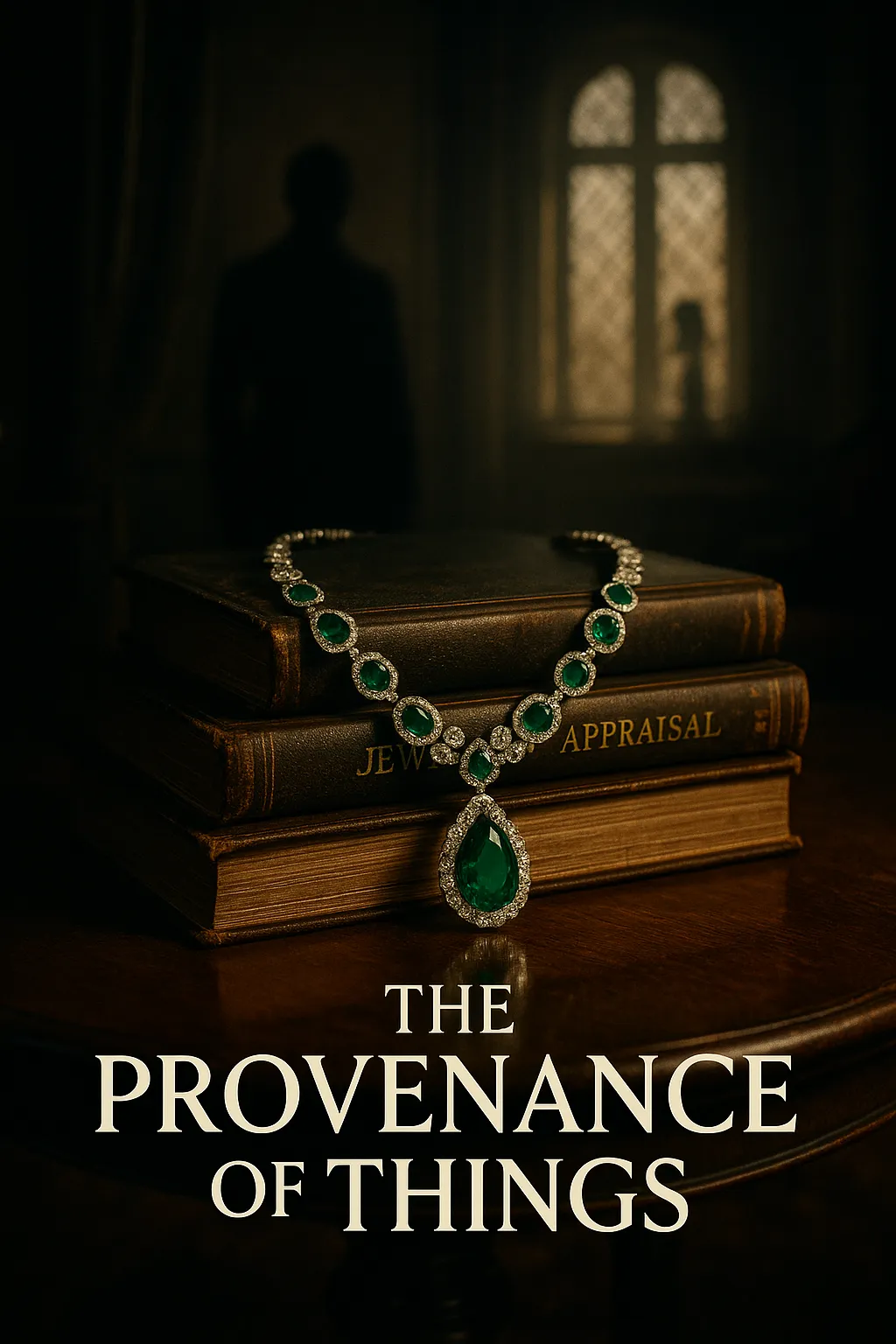
The Provenance of Things
The house was set back from the road by a quarter mile of gravel that popped under her tires. Old money architecture — fieldstone, copper gutters gone green, the kind of place that didn't need to announce itself. Margot parked behind a silver Volvo wagon and sat for a moment with the engine off, her appraisal kit on the passenger seat.
She checked her face in the rearview. Lipstick fine. Hair pulled back clean. The woman in the mirror was forty-three, credentialed, sought-after. She'd been this woman for fifteen years and it still sometimes felt like a costume that fit too well.
Claire Alderman opened the front door before Margot reached the steps. Younger than she'd expected — early thirties, dark hair cut blunt at the jaw, wearing a black linen shirt untucked over jeans. No jewelry except a man's watch loose on her left wrist.
Claire's handshake was firm and held a beat too long.
Of course. I'm sorry about your father.
Claire nodded the way people do when they've heard it forty times and it still doesn't help.
The foyer opened onto a central hall — wide staircase straight ahead, living room to the left through a broad archway, and to the right, a study with its doors standing open. Margot could see built-in shelves, a leather sofa, a desk buried under file boxes. Deeper into the house, past the staircase, a dining room was visible through a second doorway, and that's where the gray cloth was. She could see it from here — a long table draped and waiting, the dark shapes of cases arranged on top.
Claire followed her gaze.
She led Margot down the hall. The dining room was large, north-facing, good diffused light from three tall windows. Professional instinct noted it before anything else: the light was workable. Eight jewelry cases on the gray cloth, varying sizes, most of them older hinged boxes in leather and velvet. Two modern ones, the padded kind auction houses used for transport. A ninth box sat apart from the others, smaller, wrapped in what looked like a silk scarf. A water stain darkened one corner of the tablecloth near the edge, old and set in.
This is good. The light in here is good. May I?
Please. That's why you're here.
Margot set her kit on the table and opened it. Loupe, calipers, UV penlight, cotton gloves, the notebook she still preferred over a tablet. She pulled on the gloves and opened the first case. A Buccellati ring — gold, textured finish, late sixties or early seventies. The engraving on the inner band was worn almost smooth. She turned it under the window light, then moved it to her penlight. The color shifted. Eighteen karat, consistent with the period. She noted it, moved on.
Second case: a set of Van Cleef earrings, Alhambra collection, mother-of-pearl. Third: a brooch she didn't recognize immediately — Victorian, seed pearls, mourning piece. She cataloged each one with the same even hand. Weight, condition, estimated period, identifying marks.
Claire sat across the table watching her work, arms folded, the big watch sliding when she moved.
He had a good eye. This mourning brooch is exceptional.
That's the thing. The auction house wants full provenance on everything. Chain of ownership, documentation, the whole trail. Dad kept records — he was meticulous about it. But some of the earlier acquisitions, the files are a mess. That's part of why I need you. Not just the appraisal. The story of each piece.
Margot's hands didn't stop moving. She set the brooch down, picked up the next case. Her fingers were steady. She'd learned that a long time ago — that your hands will betray you before your face does, so you train the hands first.
I can do provenance research. It takes time, and some pieces will have gaps. That's normal for estate collections.
I know. But whatever you can find. I want this done right.
A sound from the hallway — footsteps on hardwood, unhurried. A man appeared in the dining room doorway carrying a file box against his chest. Tall, early fifties, reading glasses pushed up into graying hair. He wore a cardigan over a collared shirt, and he paused when he saw Margot as if recalculating something about the room.
Dominic, this is Margot. The appraiser I told you about.
He set the file box on the sideboard and came to shake her hand. His grip was dry and brief.
That will be helpful for the provenance work.
He smiled.
He held her gaze for exactly one second longer than the sentence required. Then he tapped the file box.
I'll leave these with you. The Zurich acquisitions are in here, if you get to those today.
He left. His footsteps went down the hall toward the study, and she heard him settle into a chair.
Margot opened the seventh case. An Art Deco bracelet, platinum and sapphire, nothing remarkable. She set it aside. Opened the eighth. A pair of cufflinks, gold, engraved initials. She cataloged them.
The ninth box was still sitting apart from the others, wrapped in its silk scarf.
That one was in a separate drawer. I think it was the last thing he bought.
Margot unwrapped the scarf. Navy silk, worn soft. Inside, a hinged case, older than the others. She opened it.
Emerald and diamond rivière necklace. Late Georgian, probably 1820s. Closed-back collet settings, foil behind the stones to deepen the color. She knew the piece. She knew the slight asymmetry in the third clasp link where a repair had been done in the 1890s. She knew the weight of it in her palm.
She had sold it in Zurich, in 2009, to a private buyer through an intermediary. The receipt would have a name on it. Not this name.
Margot set the necklace down on the gray cloth.
How significant?
I'll need to examine it more closely. But at first look — Georgian, high-quality stones, excellent condition. Could be the centerpiece of the auction.
Claire leaned forward.
From the study down the hall, Margot heard a file drawer open and close.
Margot set the emerald necklace back in its case and closed the lid. She picked up her notebook and flipped to a clean page.
I'd like to start the provenance work on the earlier pieces first. The Buccellati, the Van Cleef set, the mourning brooch. Those are the ones where dealer records will be easiest to verify, and it gives us a template for the rest.
Claire was standing by the windows, one hand resting on the sill.
Exactly. The Georgian necklace will need the most research. Pieces that old, the chain of ownership gets complicated. I want to be thorough with it.
Claire nodded slowly. She turned her father's watch on her wrist, spinning the loose band with her thumb.
Dad would've said the same thing. Do the boring work first.
Can I ask you something that's not about jewelry?
Margot looked up from her notebook.
Did you ever meet him? At a show, or — I don't know. He went to so many.
Margot's pen stayed where it was, mid-notation on the brooch.
Claire smiled at that — a real one, brief and a little broken. She pushed off from the windowsill.
I'll let you work. I need to call the auction house anyway. They keep asking about the timeline.
She left through the hall toward the front of the house. Margot heard her voice a moment later, low and businesslike, on the phone in the living room.
Margot wrote. The Buccellati ring: 18k gold, textured satin finish, consistent with 1968-1972 production. Signed on inner band, partially worn. She moved through the Van Cleef earrings, the mourning brooch, the Art Deco bracelet. Her handwriting was small and even.
Twenty minutes. Maybe more. The house settled around her — Claire's voice drifting from the living room, the tick of something cooling or expanding in the walls. She was halfway through her notes on the cufflinks when she realized Dominic was in the doorway.
He wasn't entering. He was leaning against the frame with a manila folder in one hand, watching her work.
The Buccellati was a birthday gift. 1971. He bought it from a dealer in Milan — I found the original receipt this morning.
He came in and set the folder on the table, not next to Margot's kit but at the far end, near the ninth box.
That's helpful. Thank you.
There are receipts in there for about half the collection. The Milan dealer, a few London shops, one from a house in Geneva. The later acquisitions are better documented. He got more careful as he went.
Most collectors do.
He pulled out the chair at the head of the table and sat down. Didn't ask.
Margot turned a page in her notebook. She wrote the date on the cufflink entry. November 2024. Her pen moved without hesitation.
That's unusual for private sales. Most intermediaries keep the seller anonymous.
Most do. Gerald had a way of getting what he wanted, though. Politely. Always politely.
He stood, pushed the chair back in, and walked to the door.
He said it over his shoulder, already in the hall.
Margot waited until she heard his chair creak in the study. Then she reached for the manila folder and opened it. The Milan receipt was on top, yellowed, typed. She flipped past it. Past the London invoices. Past a handwritten note on hotel stationery.
The Zurich correspondence was at the bottom. Three letters, paperclipped together. She didn't read them. Not yet. She looked at the signature on the top letter — the intermediary's name, printed neatly below a scrawl.
She closed the folder and put it back where Dominic had left it. Near the ninth box. Where he'd placed it.
Margot found Claire in the living room, standing at the bay window with her phone pressed to her chest like she'd just ended a call she didn't want to talk about. The room was heavy with old upholstery and afternoon light. A grand piano in the corner had framed photographs crowded across its lid. The piano bench had a torn cushion, foam showing through the split in the fabric.
Do you have a minute?
Claire turned from the window.
Then I have bad news about timelines.
Claire dropped onto the arm of the sofa and waited.
The provenance work is going to take longer than a few days. Some of these pieces have changed hands three, four times before your father acquired them. The Georgian necklace alone could take weeks to trace properly. I'd estimate three to four weeks for the full collection, maybe longer if I hit gaps.
The auction house wants everything by the fifteenth.
I know. And I can give them appraisal values by then. But provenance documentation — real documentation, not guesswork — that's a different process. If you rush it, you get holes. Holes lower the sale price.
Claire looked at the phone in her hand, then set it face-down on the sofa cushion.
He spent forty years building this collection and I'm supposed to liquidate it in six weeks because someone at Hartfield's has a catalog deadline.
You're not supposed to do anything. It's your collection. If you tell Hartfield's you need more time, they'll adjust. They want the lot — it's too good to walk away from.
Margot almost laughed. She caught it and let it through, and it came out real.
Sorry. That sounded like a sales pitch. I just mean — you have leverage. Use it.
No, that's — thank you. Everyone keeps telling me to hurry up. The lawyers, the auction house, my brother in San Francisco who wants his share yesterday. You're the first person who's said slow down.
Claire's posture changed. The business fell away from it.
Can I ask you something weird?
Sure.
Would you be willing to — I don't know how to put this. I don't just want a list. I want to understand what he saw in these pieces. Why he chose them. You look at that mourning brooch and you see something. I could hear it in your voice. I want that in the documentation. Not just 'Georgian, emerald, eighteen karat.' I want the story.
Margot stood very still.
I can do that. It'll take more time with each piece. And more access to your father's records.
Whatever you need. The study, the files, all of it. I'll tell Dominic.
Good. I'll need to go through the acquisition files piece by piece. Match the records to what's on the table.
Claire stood up and something had settled in her — a decision made, the relief of it.
She picked up her phone and headed for the stairs. Margot listened to her go up — and then stopped listening. Forced herself to stop.
She was alone in the living room. Through the archway she could see the central hall, the study doors open on the far side. Dominic's desk lamp was on. She couldn't see him from this angle, just the light and the edge of a file box on the floor.
She had just talked a grieving woman into giving her more time and more access, and the gratitude on Claire's face had been real, and Margot had earned it by being good at a job she was using to protect a lie.
She walked back to the dining room. The cases were where she'd left them, her notebook open, her pen capped beside it. The manila folder at the far end of the table. She sat down and pulled the folder toward her and opened it to the Zurich letters.
The top letter was dated March 2009. Typed on letterhead she recognized — the intermediary's office on Bahnhofstrasse. Two paragraphs of pleasantries, then the terms. The seller was described as a private party with documentation of prior ownership. No name in the body of the letter. She turned to the second page.
Gerald's handwritten reply, a photocopy. His script was cramped and precise. He thanked the intermediary. He expressed interest. And in the third paragraph, underlined once in blue ink: I would appreciate knowing who I am purchasing from. As I've mentioned, this is important to me.
The third letter was the intermediary's response. She read the first line and stopped.
Per your request, I can confirm the seller is a Ms. Elena Voss, a private dealer based in Zurich. She has provided documentation of her acquisition of the piece in 2006 from a estate sale in—
Margot closed the folder. Her hands were steady.
Elena Voss. There it was, in type, in a dead man's files, in a house where she'd introduced herself four hours ago as someone else entirely. She put the folder back at the end of the table and aligned it with the edge, the way she'd found it. Then she uncapped her pen and went back to the cufflinks entry.
Margot walked through the dining room and out the French doors to the back terrace. October had stripped most of the color from the property — the lawn ran flat and pale to a tree line going bare, and beyond it the gray suggestion of a pond. A wrought-iron table and two chairs sat near the railing, leaves collected around their feet. The afternoon was warm for the season, almost pleasant. She could see the kitchen through the window to her left. Dominic was in there, filling a kettle.
She took out her phone and scrolled to a number saved under R. Kessler — Art Consult. She pressed call and leaned against the railing with her back to the kitchen window.
Four rings. Five. Somewhere in whatever city Renata was in, it was evening. Margot could picture her in one of those narrow apartments she always found, full of other people's paintings and half-drunk bottles of wine.
The line opened to a long exhale — cigarette smoke, probably.
I need to talk to you about something.
Oh, that voice. That's your serious voice. Hold on.
A scrape of a chair. A door closing on Renata's end.
Go.
I'm on a job. Estate appraisal in Connecticut. The collector was Gerald Alderman.
I know the name. Old school. Obsessive about documentation.
The emerald rivière is here. The Georgian piece.
Silence on the line.
Elena's piece.
Margot's jaw tightened. The name, spoken aloud, in someone else's mouth.
Fischer is dead.
I know Fischer is dead. But the letters aren't. Gerald asked for the seller's name and Fischer gave it to him.
Elena Voss is in the file.
Yes.
A lighter clicked on Renata's end. Second cigarette.
When Renata spoke again, the edge was gone from her voice. She was working the problem.
The assistant, definitely. He organized everything by acquisition date. He handed me the folder himself.
Handed it to you. Personally.
Yes.
And the daughter?
I don't know. She hasn't mentioned it. She's focused on the auction, the deadline.
Listen to me. Elena Voss is a name on a piece of paper in a dead man's drawer. That's all she is. A private dealer in Zurich who sold a necklace in 2009. There's no photograph. There's no fingerprint. There's a name that means nothing to anyone in that house.
Unless someone decides to trace it.
Trace what? Fischer's dead, his office closed in 2014. Elena Voss doesn't exist anymore. A coincidence of names is defensible. A woman with the same name as a Zurich dealer — so what? There are four Elena Vosses in the Bern phone directory alone.
You checked.
I checked years ago. I check lots of things. That's why you called me.
Margot looked out at the tree line. A crow lifted off a bare branch and resettled three trees over.
The assistant — Dominic. He said something the first day. 'Names change, businesses close.' He was looking right at me.
People say things, Margot. Assistants make small talk. You're doing what you always do — you're reading the room like everyone in it is about to pull a gun.
And if he's not making small talk?
Renata paused. When she spoke, she was choosing her words for the first time in the conversation.
And in the meantime?
In the meantime, don't touch the files. Write the provenance on every other piece in that collection. Be brilliant at it. When you get to the necklace, you document what any competent appraiser would find — Georgian, rivière, probable English origin, sold through a Zurich intermediary to Gerald Alderman in 2009. Seller listed as Elena Voss. You write it down like it's the first time you've seen the name.
And if Claire googles it?
She'll find nothing. That's the whole point of how we built it. Elena Voss was a ghost before you ever left Zurich. She's even more of one now.
Behind Margot, the kitchen door opened. She didn't turn around.
I made tea, if you'd like some. It's getting cold out here.
He set a mug on the iron table and went back inside.
Who was that?
The assistant.
Silence. Then Renata laughed — short, dry.
Call me tomorrow. Not from the house.
The line went dead. Margot lowered the phone and stood there with the railing pressing a cold line across her palms. The tea was still steaming on the table. She picked it up. Earl grey, no milk. She hadn't told anyone how she took her tea.
She drank it standing up, watching the tree line go dark.
Margot crossed the central hall and stopped at the open study door. Dominic was at Gerald's desk with a banker's box open in front of him, sorting papers into labeled folders. The desk lamp made a warm circle that ended at the edge of the oriental rug. The rest of the room was dim — bookshelves floor to ceiling, leather sofa against the far wall, a window seat looking out at the side garden where nothing was blooming.
He didn't look up when she came in. He finished writing something on a folder tab, capped the pen, and placed it parallel to the box.
I need to talk to you about the Zurich file.
He looked up then. Took off his reading glasses and set them on the desk.
Close the door.
She did. The latch clicked and the sounds of the house — the refrigerator hum, a clock somewhere — dropped away.
You've read the letters from Fischer's office. The Bahnhofstrasse intermediary.
I've read everything in this house. That was my job for thirty years.
Then you saw the seller's name.
Elena Voss.
He said it the way he might say a weather forecast.
Sit down, Margot.
She didn't sit. She stayed near the door with her back almost touching it.
I've known since the second day of sorting. Elena Voss, private dealer, Zurich. Sold Gerald the rivière in 2009 through Fischer. Fischer's office closed in 2014. Elena Voss doesn't appear in any dealer registry after 2010. And then Claire hires an appraiser named Margot who looks at a necklace she's supposedly never seen before and calls it 'a significant piece' without turning it over.
What do you want?
He leaned back in the chair. It creaked under him.
I want Claire to be all right. That's what I've wanted since she was nine years old and her mother died and Gerald asked me to help him raise her because he didn't know how to do it alone. That's what I want.
He said it without raising his voice. Margot looked at the bookshelves behind him.
I don't care who you used to be. I don't care about Zurich. What I care about is that woman in there trusting you with her father's legacy while you're running some calculation about how to get through this without her finding out.
The necklace is clean. I need you to know that. I didn't steal it, I didn't —
I know it's clean. Gerald verified everything. He wouldn't have bought it otherwise. That's not the problem and you know it.
Margot stopped talking.
The problem is that you asked for more time. More access to the files. And the reason wasn't thoroughness.
She said nothing.
Here's what I think you should do. Write the provenance report honestly. Elena Voss sold the necklace through Fischer in 2009. Put the name in the documentation. It's a name on paper — it doesn't have to connect to you unless someone makes it connect. But if you leave it out, and someone finds those letters later, then it looks like you were hiding something. And then Claire gets hurt.
And if she asks me about Elena Voss?
She won't. She doesn't read German and half the Fischer correspondence is in German. She'll see a name in a provenance report and move on. Unless you give her a reason not to.
He put his glasses back on and pulled another folder from the box. Margot stood there for a moment longer, then opened the door and walked back into the hall.
The central hall was empty. Claire's voice came from upstairs — on the phone again, something about catalog proofs. Margot stood between the study and the dining room.
The front door opened.
Margot turned. A woman stepped into the foyer pulling a small rolling suitcase, dark hair streaked with gray, a silk scarf knotted at her throat. She wore sunglasses indoors and didn't take them off. She looked around the foyer with the appraising calm of someone who'd been in a hundred houses like this and owned none of them.
Renata pushed the sunglasses up into her hair and found Margot in the hall. She looked irritated, and tired from traveling, and maybe a little amused at herself for being here at all.
I knew Gerald. Years ago. I came to pay my respects to the family.
She said it loud enough to carry. Her eyes said something else entirely.
Margot didn't move from where she stood.
Margot left Renata standing in the foyer with her suitcase and went upstairs. She didn't plan what to say.
Claire was in the small sitting room off the upstairs hall — Gerald's reading room, from the look of it. Books on three walls, a leather chair too wide for her, auction catalogs fanned across a side table with pencil notes in the margins. She was on the phone but she saw Margot's face and said, 'I'll call you back,' and set it down.
What's wrong?
Margot sat down on the ottoman across from Claire and put her hands on her knees.
The Georgian necklace. The emerald rivière. I've seen it before.
Claire didn't move.
I sold it. In 2009. Through an intermediary in Zurich named Fischer. Your father bought it from me.
Claire's eyes stayed on Margot's. She didn't blink, didn't look away, didn't reach for anything.
Elena Voss.
The name sat between them. Margot watched Claire absorb it — the slight contraction around her eyes, the stillness that wasn't calm but effort.
How long have you known it was here.
Since the first day. When I opened the ninth case.
And the extra time. The provenance work. Pushing back Hartfield's.
Margot didn't flinch from it.
Yes. Part of it was real, but — yes.
Claire stood up. She walked to the window and looked out at the garden, arms crossed. When she spoke again her voice had dropped.
Is it clean?
The necklace is clean. Your father verified the provenance himself — he insisted on it. Fischer confirmed the chain of ownership and Gerald was satisfied. The piece was acquired legitimately from an estate sale in 2006.
I'm not asking about the necklace.
Margot understood.
I don't know. That's the honest answer. Some of the things I sold during that period — some of them, probably not.
Claire sat down in her father's chair. Her thumb found the watch crystal and pressed against it, held it still.
Dominic showed me the file. Not the German letters — I can't read those. But there were three in English. He translated the headers on the rest. I saw the name Elena Voss two days ago and I didn't know what it meant.
He told me you wouldn't ask about it.
He was trying to protect me. That's what he does. He also forgot to pick up the dry cleaning last week and left the stove on twice this month, so.
Silence. Somewhere downstairs a door closed — Renata moving through the house, or Dominic.
Who's the woman downstairs?
Her name is Renata.
From your old life.
Yes.
Why is she here?
Margot hesitated. Fifteen years of protecting information — contacts, names, the careful architecture of who knows what. Renata had come to help her, or to manage her, or both.
I called her when I found the letters. She's the only person who knows both names. She told me to write Elena Voss in the report and act like I'd never heard it before.
And instead you came up here.
And instead I came up here.
Claire looked at her for a long time. Not with warmth. Not with anger either.
I'm going to go downstairs and talk to Renata. And then I'm going to talk to Dominic. And then you and I are going to sit at that dining room table and you're going to tell me everything about every piece you sold through Fischer's office. Not just the necklace. All of it.
Claire —
You don't get to decide what I can handle.
She walked out. Her footsteps went down the stairs — measured, deliberate, nothing hurried about them. The front hall. Then voices, low, Claire's and another that must have been Renata's.
Margot sat on the ottoman in Gerald Alderman's reading room. The leather chair across from her was still warm where Claire had been sitting. The auction catalogs on the side table were covered in a dead man's handwriting — prices circled, question marks in the margins. She could hear Claire's voice downstairs getting quieter, not louder. That was worse.
Then she got up and went downstairs.
The dining room table had been cleared. Claire had done it herself — the cases moved to the sideboard, the velvet trays stacked, the surface bare except for Margot's notebook, the manila folder, and four mugs of coffee that no one was drinking. Claire sat at the head. Renata was two chairs down on the left, coat still on, her bag on the floor beside her like she might need to leave quickly. Dominic stood near the window with his arms at his sides.
Margot sat across from Renata. The folder was open between them. The three English letters and the German ones, all of it fanned out under the overhead light that Gerald had probably chosen for exactly this — reading fine print, verifying details, making sure.
Claire pulled a legal pad from somewhere and set it in front of her. She'd already drawn a line down the center.
The rivière was acquired in 2006 from the Harwich estate sale outside London. Documented chain of ownership back to 1843. Fischer brokered the sale to your father in 2009. It's clean.
Claire wrote it down. Left column, right column. The pen moved without hesitation.
Next.
A pair of Art Deco diamond earrings. 1920s, French. I acquired them from a private seller in Geneva in 2007. I couldn't verify the provenance past 1998.
Claire's pen stopped.
Couldn't or didn't.
Margot didn't answer immediately.
Are they in this house.
I don't know. I haven't seen them in the collection, but I've only been through about a third of it.
Claire wrote something on the right side of the pad and circled it.
A sapphire brooch, Victorian. Sold through Fischer in 2008. The provenance was complete — I had the original jeweler's receipt from 1871.
That's three. How many total.
Margot pressed her palms flat against the table.
Seven. That I sold through Fischer. There may have been others through different channels that ended up with your father — I don't know.
Renata shifted in her chair.
Claire looked at Renata for the first time since they'd all sat down.
Renata pulled the scarf knot at her throat so tight the silk creased. She didn't speak again.
Of the seven, four had complete provenance. The rivière, the brooch, a Cartier watch, and a set of seed pearl hair combs. Three I couldn't fully document. The earrings, a gold locket, and a ruby ring.
Claire's pen hadn't stopped moving.
Private sellers. Estate lots bought in bulk. I didn't ask the right questions because asking the right questions would have made the answers my problem.
The room held that. Dominic by the window. Renata with her coat on. Claire writing.
Were you good at this. At not asking.
Yes.
Claire set the pen down. She looked at the legal pad — two columns, seven entries, four on the right and three on the left with nothing beside them.
Dominic, would you make copies of the Fischer letters. All of them. I want a set for Hartfield's and a set for the estate lawyer.
Dominic gathered the letters from the table and left without a word.
Claire turned to Renata.
Renata's posture didn't change but her eyes recalculated.
In my father's collection. A footnote in my father's collection.
Renata said nothing.
I'd like you to leave the house. You can leave a number with Dominic if you want to be contacted about any legal questions. But you're not staying here.
Renata looked at Margot. Margot didn't look back. After a moment Renata picked up her bag, stood, and walked out through the central hall. The front door opened and closed.
The room was just the two of them now. The legal pad between them.
I'm not going to report you. I want you to know that, because I can see you sitting there running the math on it.
The four clean pieces stay in the auction with full provenance under the Elena Voss name. You'll document them. The three without provenance — if they're in this house, they come out of the sale and I'll deal with them through the estate lawyer. That's the arrangement.
And me.
Claire picked up the legal pad and looked at it again.
You finish the job. All of it. Every piece in this house, documented properly. And then we're done.
She stood. At the doorway she paused, half-turned.
My father would have asked you, you know. If he'd met you. He would have wanted to know who he was buying from.
Then she was gone. Margot sat there. The coffee had gone cold. The overhead light buzzed at a frequency she hadn't noticed when the room was full of people. She pulled her notebook toward her and opened it to the page where she'd stopped — the mourning brooch, half-documented, her handwriting neat and small.
She picked up her pen and finished the entry. Then she turned to a fresh page and started the next one.