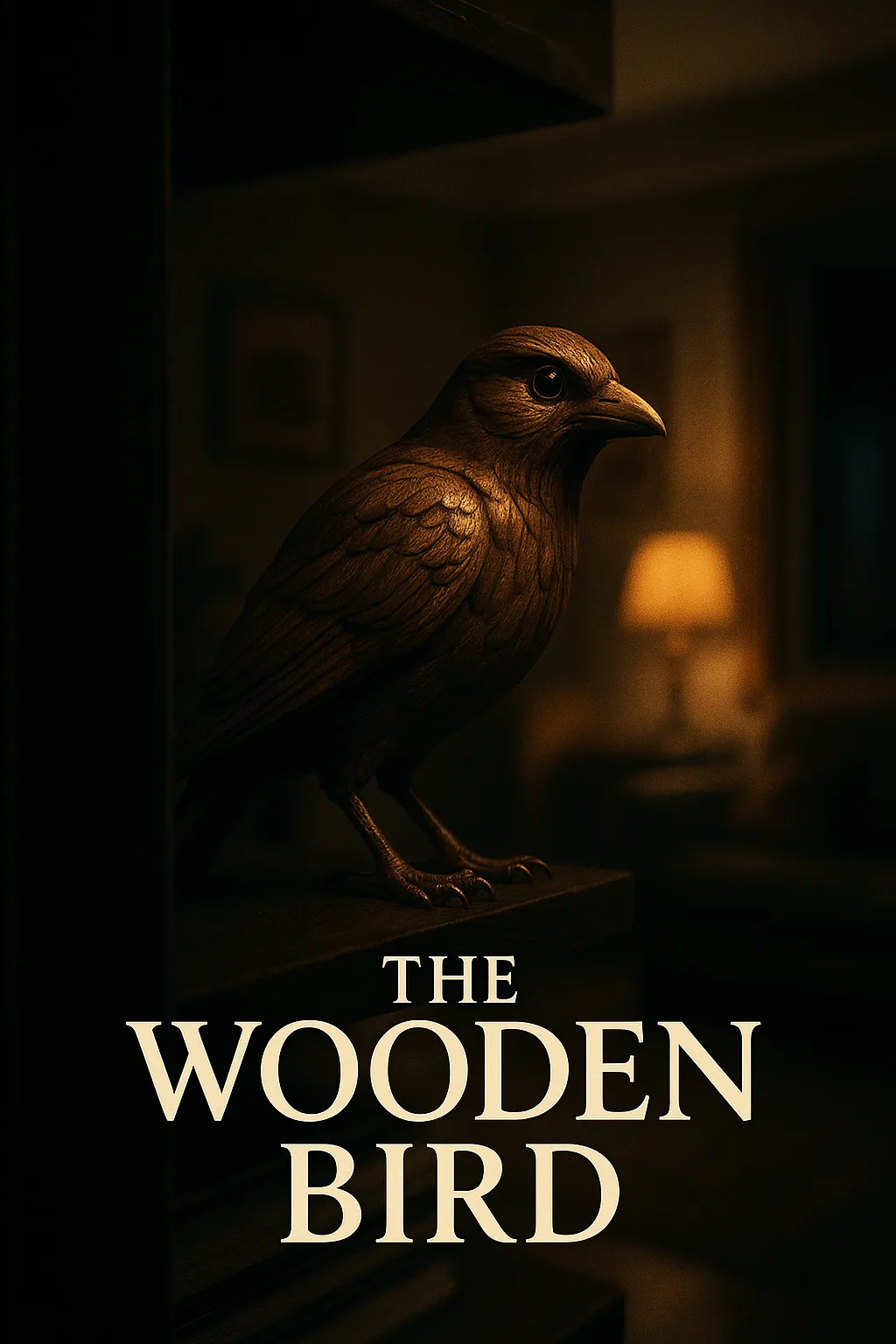
The Wooden Bird
The TV was on but Sam wasn't watching it. Some home renovation show, a couple arguing about backsplash tile like it mattered. The beer on the coffee table had gone warm twenty minutes ago. Outside, a siren dopplered past and faded into the ordinary Wednesday night sounds of the neighborhood.
The bird had been on the shelf for — what, three years? Four? Sam had picked it up at the Ashland flea market, a Sunday morning where the light was flat and gray and Dan was still talking to him. Dan had actually spotted it first, held it up and said it looked pissed off. Sam paid eight dollars for it. Carved from a single piece of dark wood, some kind of wren or sparrow, the size of a fist. It sat between a stack of paperbacks and a dead succulent Sam kept meaning to throw away.
Sam reached for the beer. Stopped.
The bird had moved. Not fallen — moved. It was facing him now, and he was certain, with the dumb animal certainty of a person who has sat in the same room with the same objects for years, that it had been facing the window before.
He stared at it. The bird stared back. Its eyes were just notches in the grain, but they held the light from the TV in a way that looked wet.
No.
The bird shifted its weight from one carved foot to the other — a tiny rocking motion that made no sound on the paperbacks but sent a faint vibration through the shelf, just enough to make the dead succulent wobble in its pot.
Sam didn't breathe. His hand was still hovering over the beer. The couple on TV wanted quartz countertops. The bird opened its beak, a creak of wood grain separating along a seam that shouldn't have been a seam, and nothing came out. No sound. Just the tiny dark hollow of a carved mouth, open, then closed.
Then it hopped — one small hop to the edge of the shelf, and the click of its feet against bare wood where the paperbacks ended was the worst part, because it was real. Not a sound Sam's brain was inventing. A physical object, with weight, making contact with a surface. He could feel it in his teeth.
Sam said it to the room, to the TV, to whatever part of his brain was supposed to be handling quality control.
The bird tilted its head. Slow. Like it was considering him. Like it had been considering him for three years on that shelf and had finally decided.
His phone buzzed on the couch cushion beside him. Jenny's name on the screen. He glanced at it and when he looked back the bird had gone still — perfectly, impossibly still, a carved thing on a shelf, angled toward him with its beak closed and its notch-eyes catching light. As if it had never moved at all. As if it were waiting for him to answer.
The phone buzzed again. The bird didn't move. But Sam could feel it not-moving the way you can feel someone standing behind you in a dark room.
He let the call go to voicemail.
Sam stood up. The beer bottle rocked on the coffee table and he didn't catch it, didn't care. Three steps to the shelf. The bird was still — carved thing, dark wood, dust in the grooves where the feathers were scored in — but it was facing him. It had not been facing him an hour ago.
He could hear himself breathing. The TV was off. He'd hit the remote at some point without thinking about it.
Up close the carving was rougher than he remembered. Tool marks along the breast where someone had gouged out the shape in quick strokes. A faint ring of dust on the shelf around its base, a perfect outline of where it had sat for three years without being picked up or cleaned or thought about much at all.
He wrapped his hand around it.
Warm. Not room-temperature warm. Warm the way a mug is warm after someone's been holding it. The grain pressed into his palm, ridged and alive, and under his thumb he felt a pulse — a rhythm, slow and deliberate, like breathing through wood.
He almost dropped it. His fingers tightened instead, some reflex that had nothing to do with wanting to hold on.
The bird moved in his grip. Not a struggle. It adjusted, the way a real bird settles into a hand — feet finding purchase on the heel of his palm, wings tucking tighter against its body. Its beak tapped once against his index finger. A tiny sound. Wood on bone.
Sam brought it down to chest height and opened his hand flat. The bird stood on his palm and he could feel each foot, three carved toes and a back spur, gripping with a pressure that was too specific to be anything but intention.
It oriented toward the couch. Toward his phone, still face-down on the cushion where Jenny's missed call was waiting.
Then it swiveled — whole body, not just the head — toward the dark hallway that led to the bedroom. It stayed like that. Pointed at the hallway like a compass needle that had found what it was looking for.
The pulse under his thumb had quickened.
The bird didn't move. But it was warm and it was breathing — or whatever the wood equivalent of breathing was — and it was pointing down the hall with every carved line of its body, and Sam's face ached from how hard he'd been clenching his teeth.
His phone lit up on the couch. Not a call this time — a voicemail notification. Jenny's voice would be on it, talking fast, asking if he'd eaten, asking if he was coming to Mom's on Saturday, filling every silence before it could become a question she didn't want to ask.
The bird went still in his hand. Not dead-still. Waiting-still. The warmth didn't leave. The pulse didn't stop. But it stopped moving, stopped pointing, became just a carved thing sitting on a man's open palm in a quiet apartment where the TV was off and the beer was warm.
Sam closed his fingers around it again, gently. Held it against his sternum. He could feel the pulse against his chest now, or maybe that was his own.
The hallway was dark. Sam walked it with the bird against his chest, and halfway down he felt the pulse quicken under his fingers — a stuttering acceleration, like a watch wound too tight.
The bedroom smelled like laundry he'd left in the machine too long. That sour smell, faintly sweet, that meant everything would need to be rewashed. Unmade bed, one pillow on the floor. The orange streetlight outside the window cut through the blinds and laid stripes across everything.
Sam opened his hand. The bird stepped off his palm onto the comforter and stood there, head low, body angled toward the closet. The sliding door was half-open the way it always was because the track was bent.
The closet. Really.
The bird didn't move. Its feet made small indentations in the fabric. Sam could hear the faint creak of its body — wood expanding, contracting, whatever it was doing to breathe.
He pulled the closet door the rest of the way open. Winter coats, a duffel bag he hadn't used since a camping trip two summers ago, a set of free weights he'd shoved in there when he stopped pretending he'd use them. On the floor behind the weights, a cardboard box with the flaps folded shut. No tape. No label.
Sam's hand stopped on the duffel bag strap. He knew what was in the box. He'd known since the bird pointed down the hall.
Dan had dropped it off eight months ago. Left it on the porch with no note, just knocked twice and was gone by the time Sam got to the door. Sam had carried it to the closet without opening it. He'd walked past it to get his winter coat and walked past it to shove the weights in, and each time the flaps stayed folded.
He pulled the box out. It was lighter than he remembered. He set it on the bed and the bird moved to it immediately, perching on the cardboard flap with its toes curling over the fold.
Behind him, his phone lit up in the living room. The bird didn't freeze this time. Sam noticed — a half-beat of wrongness, like a dog that doesn't bark. The bird stayed on the box, warm, present, its whole body oriented toward him.
Sam rubbed the back of his neck. His shoulders were up around his ears and he hadn't realized.
He opened the flaps.
A flannel shirt Sam had lent Dan and forgotten about. Underneath, a handful of photos — actual prints, the kind you get from a drugstore kiosk. A Swiss Army knife with a chipped blade that had been Sam's before it was Dan's before it became unclear whose it was. At the bottom, a sealed envelope with Sam's name on it in Dan's handwriting, the letters cramped and leaning left the way Dan wrote when he was trying to be careful.
The bird struck its beak against the envelope. A sharp crack of wood on paper, loud enough to make Sam flinch. Then it stepped back to the edge of the box and went still — a pulling-away, like it had shown him the door and wouldn't walk through it for him.
Sam picked up the photos first. Him and Dan at the river, squinting. Dan's old truck with the tailgate down. One of Sam asleep on a couch he didn't recognize, mouth open, a beer balanced on his chest — Dan must have taken it. Sam's thumb left a smudge on the glossy surface.
He put the photos down. Picked up the envelope. Held it with both hands. The bird watched him — or whatever it did with those notch-eyes in the orange light, the grooves along its breast thrown into deep shadow.
He didn't open it. He sat on the edge of the bed with the envelope in his lap and the bird three inches from his knee, and the apartment was so quiet he could hear the refrigerator cycling in the kitchen.
The bird leaned forward and tapped its beak against his kneecap. Once. Gentle. The sound of it was almost nothing.
Sam's voice came out strange. Thick.
The bird tapped his knee again. Same spot. Then it settled down on the comforter beside his thigh, tucking its body low, feet disappearing under it. It looked like a bird on a nest. It looked like it was willing to wait all night.
Sam picked up the envelope and held it a moment longer. Then he put it back in the box, face down. The photos went on top of it. The flannel shirt he laid over everything and smoothed flat, tucking the sleeves in.
He folded the flaps shut. Carried the box to the closet and set it behind the free weights. The flaps held. The closet door slid mostly closed on its bent track.
The bird was still on the comforter where he'd left it. It hadn't moved. But the pulse Sam could feel when he'd held it, that slow tide through the grain — he thought he could almost hear it now, a faint ticking, like a house settling.
Sam sat on the floor with his back against the closet door. He pulled his knees up and pressed his palms flat on the carpet, fingers spread, like he could hold himself to the floor of his own apartment by sheer surface area.
I'm not opening it.
The bird walked off the bed. A rolling gait, one foot and then the other, its whole body swaying like a drunk on a ship deck, and the sound of its carved feet on the carpet was a whisper Sam had to hold his breath to hear. It crossed the floor to where he sat and pressed itself against his ankle.
The pulse came through his sock. Slow and steady.
Sam let his head fall back against the closet door. The box was right behind him, a few inches of pressboard between his spine and whatever Dan had written in that cramped left-leaning hand.
He knocked twice. Did you know that? Twice, and then he was gone. Didn't wait ten seconds.
The bird shifted against his ankle. Its beak opened and closed — that creak of grain along a seam — and nothing came out. Sam watched the streetlight through the blinds paint its body in orange bars.
Yeah. Me neither.
He sat there. The refrigerator hummed in the kitchen. A car passed outside, headlights sweeping the ceiling and gone. The bird's pulse kept time against his ankle, patient and strange and impossible, and Sam's hands stayed flat on the carpet on either side of his legs, pressing down, pressing down, as if the floor might open.
His phone rang in the living room. Jenny again. He could hear the vibration traveling through the couch cushion, muffled and insistent. The bird didn't freeze. It stayed warm against him, breathing its wooden breath, and Sam thought that was worse — the bird deciding this mattered more than its own rules.
The ringing stopped. The apartment settled back into quiet. Sam's lower back ached from the door and he didn't move.
He said it to the ceiling, or to the bird, or to the box behind him.
Sam said he'd open it tomorrow. He sat there for maybe ten seconds.
Then he turned around and pulled the closet door open so hard it jumped the bent track and hung crooked. The free weights clanged against each other. The box was right where he'd left it, flaps folded, flannel shirt smoothed flat on top.
The bird stepped off his ankle.
Sam dragged the box out and sat back down on the carpet with it between his knees. His hands were shaking. He could see it — the tremor in his fingers as he unfolded the flaps, the flannel shirt, the photos he didn't look at this time, the knife he pushed aside. The envelope at the bottom, face down where he'd placed it.
He picked it up. Turned it over. His name in Dan's handwriting. He'd seen it a hundred times on birthday cards and IOUs scrawled on napkins, but here it looked like Dan had pressed so hard the pen almost tore through.
Sam tore the envelope open with his thumb. Ragged, no finesse. The paper inside was a single sheet, college-ruled, torn from a spiral notebook with the fringe still hanging off the left edge.
Dan had started writing in the middle of the page. The top half was blank. The bottom half held maybe four lines, and the rest was white space — all that room he'd left for things he couldn't get to.
Sam read it. His mouth moved but no sound came out, the same way the bird's beak opened on nothing.
He read it again.
The paper shook in his hands. He set it face-down on his thigh and pressed both palms over it, fingers spread. His shoulders came up and stayed up. The tears didn't build — they were just there, sliding down his face, and the sound he made was so small it barely qualified as breathing.
The bird crossed the carpet to him. That same rolling gait, one foot then the other, the whisper of carved wood on fibers. It climbed onto his knee — he felt each toe find grip through his jeans — and stood on the letter, on his hand, on the words underneath.
Sam curled his fingers around the bird. He didn't lift it. Just held it there on his thigh with the letter pressed between them, and this time the rhythm that came through wasn't separate from his own. His pulse in his palms. The bird's pulse in its body. The same tempo, or close enough that the difference stopped mattering.
He sat on the floor of his bedroom and cried without sound, shoulders rigid, tears falling because the muscles that should have stopped them had given out somewhere around the second read. The bird stayed on his hand. Its beak opened and closed once, that creak of grain, and this time Sam could have sworn he heard something — not a voice, not a word, but a vibration in the wood that traveled up through his wrist and settled in his chest like a low note struck on a piano in another room.
Sam's voice came out wrecked, barely there.
The bird pressed its body down against his hand. The full weight of it — a fist of dark wood, a few ounces.
Sam picked up his phone from where he'd left it in the hallway on the way back. Jenny's missed calls stacked on the screen. He didn't call Jenny. He scrolled past her name, past months of avoided notifications, until he found the contact he hadn't deleted.
Dan's number. Still there. The photo attached to it was from the river — sun in Dan's eyes, mid-laugh, the truck visible behind him.
Sam's thumb hovered. The bird was in his other hand, against his sternum, and it had gone completely still — not frozen, not waiting. Just still. Like it had done what it came to do and the rest was his.
He pressed call.
It rang. The apartment was dark except for the streetlight. The bird's body cooled in his hand. Not cold. Just settling toward the temperature of the room, the way any held object does when it stops generating its own heat.
The ringing stopped. A click. A breath on the other end that Sam recognized the way you recognize a room you used to sleep in.
It's me.
Silence on the line. Sam held the bird against his chest and waited. In his hand it was just wood now — dark, carved, the grain rough under his thumb. The pulse was gone. Or so faint he couldn't separate it from his own heartbeat, which was loud and fast and doing all the work the bird had carried for him across four hours and three rooms and three years of sitting on a shelf, waiting.
Dan said his name. Sam closed his eyes.
Sam didn't say anything. He sat on the bedroom floor with his back against the closet door and the phone pressed to his ear and he let the silence be what it was.
Dan was breathing on the other end. Through his nose, a little ragged, the way he breathed after he'd been working up to something. Sam had heard it a hundred times — before Dan asked to borrow money, before Dan admitted he'd dented Sam's bumper in the Safeway lot, before Dan said things that cost him.
I didn't think you'd call.
The bird sat in his lap, cupped in both hands, and it was just weight now — a few ounces of dark wood cooling against his palms. He could feel the grooves where the feathers were scored in, each one a tiny ridge under his fingertip, and none of them moved.
Sam?
I'm here.
Okay.
A sound on Dan's end — knuckles cracking, one at a time. Sam could see it without trying. Dan standing in whatever kitchen he had now, too wired to sit, working through his fingers because his hands needed a job his mouth couldn't do.
I wrote that letter a bunch of times. That was the short version, if you can believe it.
Sam's throat locked. He pressed his shoulders back against the closet door. Behind it the box sat with its flaps folded shut — the flannel, the photos, the knife still inside, the envelope torn open on the carpet beside his knee.
Eight months, Dan.
The line went quiet. Sam heard Dan exhale — long, unsteady.
Yeah, well. I know.
Sam didn't laugh. He looked down at the bird in his lap. Still. Just an object someone had carved with quick rough strokes, something he'd bought on a Sunday because Dan held it up and said it looked pissed off. He ran his thumb along its back. The wood was room temperature. Whatever had been inside it — whatever had walked across carpet and tapped his knee and pressed against his ankle — was gone, or sleeping, or had never been the kind of thing that explains itself.
How bad is it.
Dan cracked another knuckle. The sound was sharp through the phone speaker.
It's — I'm doing the chemo. Round three next week. They say it's responding but they say that like they're reading a menu, you know? Like they're telling you the specials.
Jesus.
Yeah.
Sam's eyes burned. The streetlight through the blinds had shifted — the bars of orange light had climbed halfway up the wall.
You don't have to — I'm not asking for anything. I just wanted you to know. That's what the letter was.
Shut up.
What?
I said shut up. You don't get to knock twice and leave and then tell me you're not asking for anything.
Silence. Sam could hear a faucet running on Dan's end, or a TV in another room. The ordinary sounds of someone's apartment at a late hour.
When Dan spoke again his voice had come apart.
Round three is next week?
Tuesday.
Where.
Providence. The cancer center off Division. It's — you don't have to come, Sam.
What time.
Dan told him. Sam repeated it back. Neither of them said the things that sat underneath the logistics — the three years of silence, the reasons for it, the box on the porch with no note. Those were still there. They'd be there Tuesday.
Sam.
Yeah.
Thanks for calling back.
The line went dead. Sam lowered the phone to the carpet beside him. He sat there with the bird in his lap and the torn envelope by his knee and the letter face-down on the carpet where he'd left it, Dan's handwriting pressed against the fibers.
He picked up the bird and set it on the carpet in front of him. It sat there the way it had always sat — slightly forward, beak angled down, looking pissed off. He let go and his hands felt empty.
Sam picked up his phone again. Scrolled to Jenny's missed calls — three of them, stacked like a small accusation. He pressed call. It rang twice.
Jenny picked up already mid-sentence, the way she did when she'd been waiting.
I'm okay. I'm — yeah. Hey, Jen?
What.
Do you remember Dan.
The bird sat on the carpet between his feet. The streetlight caught the groove where its beak met its skull — that bright line he'd noticed hours ago, when everything started. It didn't move. It didn't pulse. It was a carved bird on a bedroom floor in an apartment where the beer was warm and the closet door hung crooked on its track and a man was on the phone with his sister, saying a name he hadn't said out loud in three years.
Jenny didn't say anything for a second.
Dan.
Yeah.
What about Dan.
Sam leaned his head back against the closet door. The wood pressed into his skull. He could feel the edge of the track where the door had jumped.
Nothing on the line. He could hear the tiny intake of breath, the start of a word she swallowed.
How long have you known.
About an hour.
Sam.
He wrote me a letter. Eight months ago. I just opened it.
Jenny was quiet.
Are you okay?
No. But I called him. I'm going Tuesday.
She let out a breath. Long, shaky. When she spoke again her voice had the wobble in it that meant she was deciding not to cry.
I'm alright. I just needed to say it out loud to someone.
Yeah.
They stayed on the line for a few seconds without talking. The refrigerator hummed. A baseboard ticked somewhere in the hall.
Call me tomorrow?
I will.
He hung up. Set the phone on the carpet beside his knee.
The apartment was quiet in the way apartments are at one in the morning — not silent, just done with him. He sat there and let it be quiet.
After a while he picked up the bird from between his feet. Just wood. Cool, dry, lighter than he remembered. The notch-eyes held no light. He turned it in his hands and the dust ring on the shelf in the living room was waiting for it, a perfect outline of absence.
He carried it to the living room. Set it back on the shelf between the paperbacks and the dead succulent. Turned it so it faced the room.
He picked up Dan's letter from the bedroom floor. Folded it once, then again, and put it in his back pocket where he'd feel it when he sat down.
Tuesday was five days away. Sam stood in the hallway between the bedroom and the living room, his hand on the light switch, and didn't flip it. He stood there in the dark for a long time, not thinking about anything in particular, just standing there because his body had finally stopped bracing and he didn't know what to do with himself yet.