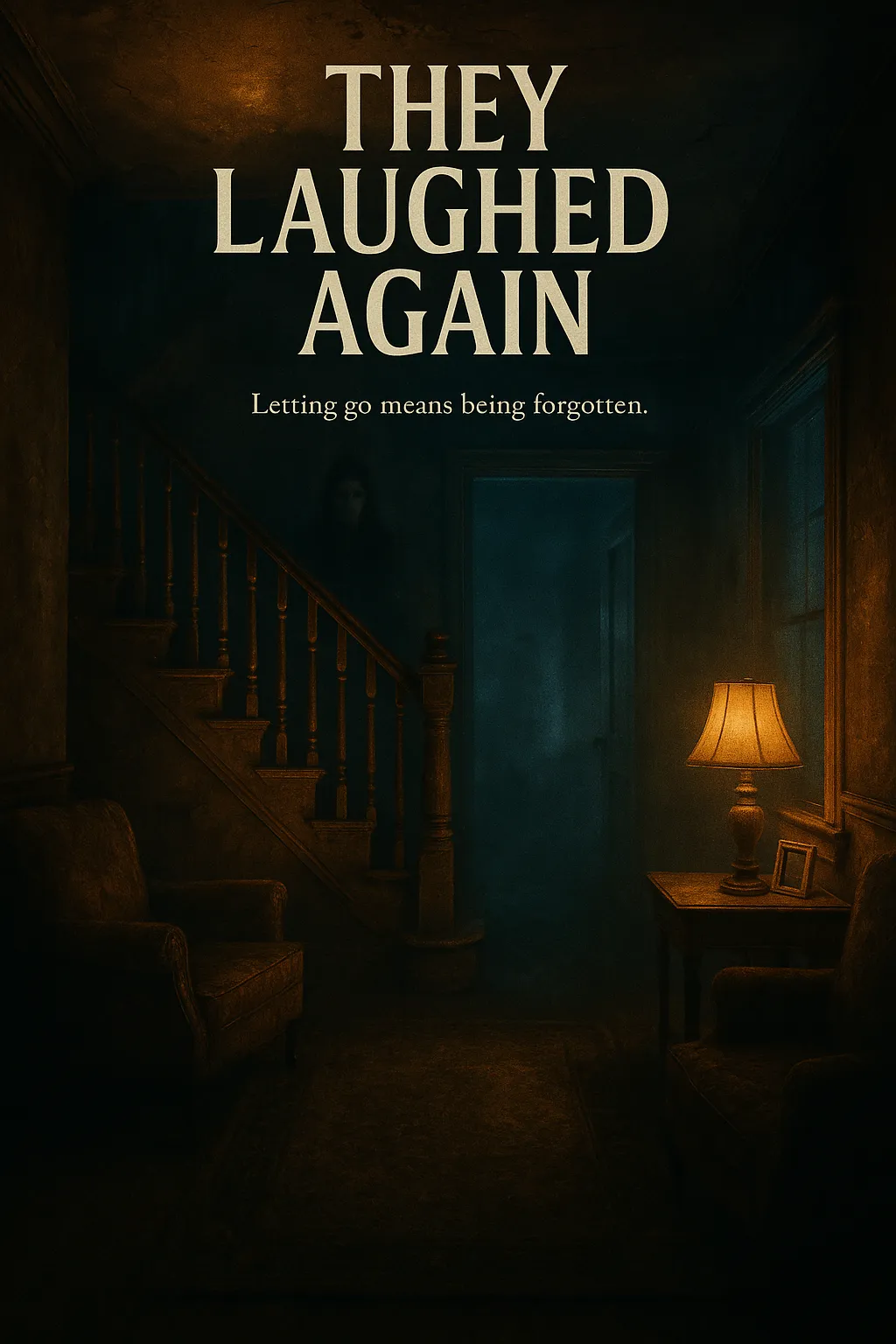
They Laughed Again
The laugh came from the kitchen. Not the polite one Marlowe used on the phone with the insurance company, or the brittle one that surfaced at the memorial when someone said Ash would've wanted everyone to celebrate. This was the real one — sudden, surprised out of hiding, a sound Marlowe's body made before Marlowe could decide whether it was allowed.
Ash stood in the hallway and listened to it pass through them like light through glass.
From this angle, Ash could see the kitchen in slices through the half-open door. Marlowe at the stove, stirring something that smelled like the ginger-coconut soup from the cookbook Ash had never once opened despite buying it. A woman Ash didn't recognize sat at the island with a glass of wine, one hand gesturing through the punchline of whatever story had earned that laugh. She had paint under her fingernails and a scarf knotted loosely at her throat, and she watched Marlowe with the easy attention of someone who didn't know yet what they were feeling.
Marlowe's eyes dropped to the pot. The spoon made a slow circle, then another.
Ash remembered standing at the counter at midnight, cold leftovers straight from the container, Marlowe's voice from the bedroom saying you're going to give yourself heartburn and not meaning it as a complaint.
The woman — Jules, Marlowe called her — leaned forward on her elbows.
Marlowe smiled. Not the real smile, not yet — but the muscles were remembering where to go. Ash watched it happen the way you watch a season change: too slow to catch, impossible to miss.
Upstairs, a door opened. Small feet on the landing. Wren, the older one, thirteen and already wearing grief like armor, appeared at the top of the stairs and clocked the scene below — the wine, the stranger, the smile — with the surgical precision of a child who'd been monitoring her surviving parent for months.
Wren didn't come down. She stood with one hand on the banister, backlit by the hallway nightlight that Ash had installed three years ago when Robin was afraid of the dark.
Marlowe looked up, and Ash saw the flinch — tiny, instantly buried — of someone caught in the act of being okay.
Wren considered this. Considered Jules. Decided something privately and went back to her room. The door closed with the particular softness of a teenager making a point about not slamming it.
Ash drifted to the living room without deciding to. That was how movement worked now — less like walking, more like remembering a place and arriving there. The house held Ash the way a song holds its rest notes: present in the structure, unheard.
On the mantel, the family photo from Rehoboth Beach. Someone — Marlowe, probably — had shifted it to make room for a small ceramic vase Jules must have brought. Ash looked at the photo and found Marlowe in it first, because Marlowe was looking at Ash instead of the lens, caught mid-turn with the sun in her eyes and an expression that didn't have a name shorter than a marriage.
The vase sat three inches from the frame. Three inches of mantel between what was and whatever came next. Ash reached out — not with hands exactly, but with the memory of having them — and felt the ceramic almost resist, almost acknowledge the pressure, before settling back into perfect stillness.
From the back of the house, very quietly, Robin's voice. Six years old and talking to the dark corner of a bedroom the way other children talked to stuffed animals — except Robin paused between sentences. Left space. Waited for answers that came as a feeling in the chest rather than a sound.
"Are you here tonight?"
Ash stayed. Not like a decision — more like forgetting to leave. The living room held them the way it always had, except now it held them the way a jar holds air: completely, invisibly, without effort.
From the kitchen, the sounds organized themselves into a dinner taking shape. Cabinet doors. The clatter of bowls being stacked in someone's arms. Marlowe's voice telling Robin to wash hands, and Robin's footsteps thumping down the hall to the bathroom with the urgency of a child who intended to hold her fingers under the faucet for exactly two seconds.
Ash watched the hallway where Robin passed. Caught the blur of her — pajama pants with foxes on them, already dressed for bed at six o'clock because Robin had decided months ago that real pants were an unreasonable demand. Ash had been the one to stop arguing about it.
In the kitchen, Jules was telling Marlowe about a commission. A brewpub in Rehoboth wanted a mural for their back wall — something coastal, not kitschy, which Jules said was the hardest brief a client could give because everyone's idea of 'not kitschy' was just a different flavor of kitsch.
Marlowe's spoon paused mid-stir.
Jules caught it. Her fingers went to the paint under her thumbnail, picking at a fleck of cadmium yellow.
"Oh — is that. Do you have a connection there?"
A beat. Marlowe's finger traced a slow circle on the counter beside the stove.
That was all she gave it. Ash had heard Marlowe use that construction before — 'we used to,' past tense, no proper noun required — the way someone touches a bruise just enough to confirm it's still tender, then moves on. Jules nodded and didn't push, and Ash felt something complicated about her for that: gratitude and resentment braided so tightly together they shared a pulse.
Wren's door opened upstairs. Footsteps on the landing, slower this time. She came down and walked into the kitchen without looking at Jules, pulled four bowls from the cabinet, then stood holding them against her chest.
Four bowls. The number she'd pulled every night for seven months before someone — Marlowe, probably, on a Tuesday Ash hadn't been paying attention to — had gently corrected her.
Wren looked down at the stack. Put one back. The cabinet door closed without a sound.
"Should I set a place for her?"
"Please. And use your manners tonight, Wren."
Wren set three bowls on the table. Three spoons. Three glasses of water, because Marlowe didn't let them have juice at dinner, which had been Ash's rule originally and had somehow survived its author. Wren placed Jules's setting with geometric precision — napkin squared, spoon parallel — the kind of care that looked like hospitality if you didn't know it was a fence.
Robin climbed into her chair with wet hands she wiped on the fox pajamas. Jules smiled at her from across the table — open, warm, unearned in the way that only a stranger's kindness can be.
"I like your pajamas. Are those foxes?"
Robin studied Jules the way she studied everything new: completely still, breathing through her mouth.
Jules leaned closer, squinting with theatrical seriousness.
Robin didn't smile, but her shoulders dropped a quarter inch. Ash knew that release. It meant safe, or close enough. It meant Robin had decided Jules was a person and not a test.
Marlowe ladled soup into bowls. Steam rose and curled against the overhead light, turning it amber. She served Jules first — a host's instinct, nothing more — but Wren tracked the gesture like an umpire watching a pitch.
Ash drifted to the kitchen doorway. Close enough to see the table. The four of them sat in the chairs that had always been there, and the math was wrong and also, somehow, complete. Ash could hear spoons against ceramic, Robin's small noises of eating, Jules asking Marlowe where she'd found the recipe.
Marlowe paused.
She didn't say whose impulse. Didn't need to. The cookbook sat on the counter behind her, spine finally cracked, a soup-stained sticky note marking the page. Ash had bought it because the cover had a photograph of someone's hands holding a wooden spoon, and it had looked like a life Ash wanted to be living. Now someone was.
Ash stayed in the doorway and let the dinner happen.
It was not a remarkable meal. Marlowe served seconds without being asked. Jules tore a piece of bread in half and used it to chase the last of the broth around her bowl. Robin kicked her feet against the chair legs in a rhythm only she could hear. Wren ate with her eyes on her soup and her attention on everything else.
Jules had pushed her sleeves up past her elbows. A faded crescent of ultramarine marked her left forearm, and something darker smudged near her wrist — the residue of a life that happened in a studio somewhere Ash would never see.
Robin had been studying Jules with the quiet focus of a field researcher — the color of her scarf, the way she tucked hair behind her ear with her pinky finger, the gap between her front teeth that showed when she smiled.
Jules set her spoon down.
"No. They're like red pandas in red panda costumes."
Jules laughed. It was a good laugh — surprised, ungarded. Across the table, Marlowe heard it and something in her face opened briefly, like a window cracked to test the weather.
Wren's spoon stopped moving.
Ash knew that pause. Wren was calculating — how much of Marlowe's softening was allowed, how much was betrayal, where the line was between healing and forgetting. Thirteen years old and she'd appointed herself the keeper of a grief she thought no one else was guarding properly.
"Can I be excused?"
"You haven't finished."
"I'm not hungry."
Marlowe looked at Wren. Wren looked back. Something passed between them that was too old for a thirteen-year-old to be carrying — a negotiation about what this dinner meant, conducted entirely in the space between a mother's raised eyebrow and a daughter's set jaw.
"Put your bowl in the sink, please."
Wren stood. She carried her bowl to the sink with both hands, rinsed it, placed it in the basin. Every motion deliberate, unhurried, performed for an audience. She passed through the doorway where Ash stood — through Ash, through the space where a parent might have caught her arm and said hey, talk to me — and went upstairs. Her bedroom door found the frame without making a sound.
Jules's fingers went to the paint under her thumbnail.
"I should probably head out. Let you guys—"
Marlowe shook her head.
It was the right thing to say and also a lie. Ash had seen what Wren's thirteen looked like before — the door-slamming phase about the Wi-Fi password, the week she refused to eat anything that had touched another food on the plate. That was thirteen. This was something else. Marlowe knew it. She was choosing not to let it end the evening.
Robin pushed a piece of ginger to the edge of her bowl with one finger, then fished it out and set it on the table. Jules picked it up without comment and put it on her own plate. Robin watched this happen and accepted it the way children accept small acts of alliance — completely, without analysis.
Marlowe filled the kettle. The kitchen settled into its after-dinner sounds: water running, a drawer opening for a towel, Robin humming something tuneless. Ash knew this part. Had lived inside this part for years — the minutes after a meal when the house exhaled and the evening softened into its last shape. Ash used to dry the dishes while Marlowe washed. Used to hand Robin the unbreakable things to put away, making a game of it, letting her stack the plastic containers in whatever order she wanted.
Now Jules stood at the counter and accepted the towel Marlowe offered. Their hands didn't touch. There was nothing to see. But Jules dried each bowl with a care that suggested she understood she was being tested, or trusted, or both, and hadn't decided which was harder.
Robin appeared at Ash's doorway — not at Ash, but at the empty space Ash occupied, her eyes focused on a point slightly to the left, the way you look at a star you can only see in peripheral vision.
"What's the rule?"
Robin sighed with her entire body and went to get her water glass. Ash's rule. Still in effect. Still shaping the evenings in this house like a current running under the floorboards — invisible, persistent, doing work no one credited to its source.
Marlowe's hand was on the counter, palm down, fingers still. Not stirring anything. Not composing herself. Just resting, the way a hand rests when the person it belongs to has forgotten, for a moment, to perform their own grief. Ash watched that stillness and understood it was the most frightening thing Marlowe had done in months.
The kettle clicked off. Steam rose. Marlowe poured two cups and handed one to Jules, and they stood at the counter drinking tea while Robin lay on the kitchen floor drawing something with a crayon she'd found in the junk drawer. The overhead light made Jules's shadow long across the tile, reaching toward the hallway where Ash stood. It stopped at the threshold.
Ash drifted to the mantel the way they always did — not walking, just arriving, the way a thought arrives in a room you weren't thinking about until you were already there.
The photograph was the same. Of course it was the same. But Ash looked at it differently now, the way you reread a letter after learning something the sender didn't know when they wrote it. This time Ash found Robin first — perched on Marlowe's hip, one hand fisted in Marlowe's collar, squinting against the light with an expression of furious concentration. Three years old in that photo. Ash couldn't remember what Robin had been concentrating on. The boardwalk. A gull. Something ordinary that had mattered enormously for ten seconds and then been replaced by the next thing. That was how time worked for children. Ash had thought it was how time worked for everyone.
The ceramic vase sat beside the frame. A thumbprint marked the glaze near the base where the potter had lifted it from the wheel. Someone's hand, pressed into something soft, leaving a mark that survived the kiln.
From the kitchen, the sounds of the evening winding down. Water in the sink. Marlowe's voice.
"Rob, teeth and bed. I'll be up in ten."
Robin's feet hit the hallway floor with the particular heaviness of a six-year-old who has opinions about bedtime. She passed the living room doorway — then stopped. Backed up one step.
She turned toward the space slightly to the left of where Ash stood. Her eyes unfocused the way they did when she was listening to something no one else could hear. Not frightened. Not uncertain. Just attending, the way she attended to rain on the window or the sound the house made when the heat came on — phenomena she accepted without needing to name.
Robin said it so quietly it was barely speech — more like breathing with a shape to it.
Then she padded down the hall toward the bathroom. The faucet ran for exactly the amount of time it took to wet a toothbrush without actually brushing. Ash knew that sound too.
In the kitchen, Jules was putting on her jacket. Ash could hear the zip, the gathering of keys and bag, the particular rustle of someone preparing to leave a house that isn't theirs.
Jules paused at the kitchen door. Her hand went to the paint under her thumbnail, then dropped.
Marlowe was at the sink, her back to Jules. Her finger traced a slow circle on the edge of a bowl she'd already washed.
Ash heard the front door open and close. Then Jules's footsteps on the porch, then nothing. The house contracted around the people who remained — Marlowe in the kitchen, Robin in the bathroom, Wren silent behind her door upstairs. And Ash at the mantel, standing next to a photograph they were in and a vase they weren't.
Marlowe came into the living room drying her hands on a dish towel. She stopped at the foot of the stairs and looked up — listening for Wren, Ash knew, the way Marlowe always listened for the children when the house went quiet. Checking the frequency of the silence. Wren's light was still on. That was enough.
Marlowe crossed to the mantel. She picked up the photograph and held it close, the way she used to hold her phone when she was reading something without her glasses. Her thumb rested on the edge of the frame. She wasn't crying. She wasn't smiling. She was looking at it the way you look at a map of a place you've already left — not to find your way back, but to confirm the roads were real.
She set it back down. An inch closer to the vase than before. Then she went upstairs to put Robin to bed, and the living room light stayed on behind her because Marlowe had never once remembered to turn it off, and Ash had always been the one who did.
Ash arrived in the upstairs hallway the way they always arrived — already there, the memory of climbing stairs standing in for the act. Marlowe was ahead of them, one hand trailing the banister, her weight settling into each step with the slowness of someone carrying more than herself up to bed.
She paused outside Wren's door. Light leaked from the gap at the bottom. Marlowe raised her hand, knuckles toward the wood — held it there — then let it fall. She stood a moment longer, reading the silence the way she'd learned to read Wren's silences this year, parsing them for danger the way she used to parse them for sulking. Different skill. Higher stakes.
She moved on. Robin's door was open. The nightlight Ash had installed — a warm amber disc plugged into the outlet behind the dresser — threw a low glow across the floor. Robin was already in bed, blanket pulled to the chest, the stuffed rabbit with the flat ears tucked under one arm. Eyes open. Waiting.
Marlowe sat on the edge of the bed. The mattress dipped and Robin rolled toward her slightly, a planet finding its gravity.
"Yes."
"For real teeth, or just-ran-the-water teeth?"
Robin considered this with the solemnity of someone being deposed.
"Medium teeth."
Marlowe's mouth twitched.
Ash stood in the doorway. This was the part — this was always the part. The bedtime negotiation, the small bureaucracy of tucking in. Ash had done it hundreds of times. Had perfected the blanket tuck that was tight enough to feel secure but loose enough that Robin could kick free by midnight. Had learned that the rabbit went on the left side, ear-side down, and that Robin needed the closet door closed but the bedroom door open exactly the width of a hand.
Marlowe pulled the blanket up. She tucked it wrong — too loose at the feet, too tight at the shoulders — and Robin squirmed once, then settled. Accepted it. The way Robin had been accepting small wrongnesses all year, absorbing them into a new version of normal without complaint.
Robin was looking past Marlowe's shoulder. Not at the door. Not at Ash. At a point in the air between them, slightly left.
"Mm."
"Do you think people can stay even when they're gone?"
Marlowe's hand was on the blanket. Her finger began a slow circle on the fabric, then stopped. She looked at Robin — really looked, the way you look at someone when you realize the conversation has changed altitude without warning.
"What do you mean, bug?"
Robin's mouth opened, closed. Opened again. That stillness — breathing through the mouth, small animal stillness — and then it passed, and Robin chose the brave thing.
The room changed. Ash felt it — not temperature, not a draft, but a shift in the quality of the silence, as if the house itself had drawn a breath. Marlowe's face held very still. She was composing something. Ash had seen her do this — assemble an answer from available materials, test its weight, decide whether it could bear what was being placed on it.
"I don't know, Robin. I really don't know."
It was the truest thing Ash had heard Marlowe say in months.
Robin nodded. Once, small, definitive — the nod of someone who has received an honest answer and is filing it in whatever place children keep the things that aren't resolved but are enough.
"Okay."
"Okay."
Marlowe leaned down and pressed her mouth to Robin's hair. She stayed there. Longer than a goodnight kiss. Long enough that Robin's eyes drifted shut under the weight of it, and Marlowe's hand found the flat-eared rabbit and adjusted it — left side, ear-side down — and Ash realized she'd learned. At some point this year, without anyone teaching her, Marlowe had learned the rabbit went on the left.
She stood. Crossed to the door. Measured it with her hand — open exactly the width of a palm — and Ash watched her get that right, too.
Marlowe went downstairs. Somewhere below, the back door lock turned — a single click, and then the house was closed for the night.
Ash stayed in the doorway of Robin's room. The nightlight made the ceiling amber. Robin's breathing was already changing, lengthening, the rabbit rising and falling against her ribs. She had asked her question. She had gotten an honest answer. She had said okay.
Ash looked at the door, open the width of a hand. At the nightlight they had installed. At the child they had made, asleep now, managing fine.
Ash let go.
There was no doorframe under their hands — there hadn't been, not really, not for months. But something had been holding them to the threshold of Robin's room, and now it wasn't. The hallway didn't change. The amber light from the nightlight still cut a wedge across the floorboards. Robin shifted once under the blanket, resettling, and was still.
Ash stepped back. One step. The distance between the doorway and the hall felt longer than the house should allow, as if the architecture had been quietly renegotiating itself while no one was looking.
Downstairs, a sound. The living room light switch — a small, plastic click that Ash knew the way you know your own name. Then darkness rose through the stairwell.
Marlowe had turned off the light.
Ash stood in the upstairs hallway and felt it happen. Not understanding — understanding was too slow, too assembled. This was the thing before understanding. Marlowe's hand on a switch that had been Ash's job every night for eleven years, finding it on her way to bed because tonight, for the first time, she'd remembered. Or because it had stopped being remembering and started being habit. Ash couldn't tell which was worse. They couldn't tell which was the miracle.
Marlowe's footsteps came up the stairs. Ash felt them in the bones the house didn't know it had — each step a small percussion, familiar as a heartbeat. She reached the landing. Passed Ash without pause, without shiver, without any of the small disruptions Ash had once hoped meant something. She smelled like ginger and dish soap. Her hair was down. She looked tired in the way that people look tired when the day has asked something real of them and they've said yes.
She stopped at Wren's door. The light underneath was off now. Marlowe pressed her palm flat against the wood — not knocking, not asking — just resting it there. Five seconds. Then she went to her own room and closed the door, and the house settled into the particular silence of everyone accounted for.
Ash drifted. Not toward anything. The rooms moved through them, or they moved through the rooms — the distinction had never mattered less. Kitchen: the soup pot soaking in the sink, three bowls stacked beside it, the cookbook closed on the counter with its spine finally soft. Living room: dark now, genuinely dark, the kind Ash used to walk through on the way to lock the back door. The furniture held its shapes in the dim.
They wanted to see Robin at seven. That was the one that got them. Not the big things — not the graduations or the weddings or the milestones that exist mostly in the future tense. Just Robin at seven. Robin losing a tooth and bringing it to Marlowe in a cupped palm like something precious and disgusting. That one ordinary year they wouldn't get.
The wind chime on the back porch — the one Ash had hung the spring before, copper tubes on fishing line — turned once in air that wasn't moving. A single low note entered the kitchen through the screen door and faded.
Ash was at the foot of the stairs again. They didn't remember drifting back. Above them, the hallway where their family slept — Marlowe in the big bed, Wren behind her quiet door, Robin with the rabbit on the left side. The nightlight's amber reached the top of the stairs and stopped, as if it knew the boundary.
From Robin's room — so quiet it could have been breath, could have been the house, could have been nothing. But it wasn't nothing.
Ash felt it land the way a hand feels rain — completely, without deciding to, the sensation arriving before the name for it. Robin's eyes were closed. They weren't talking to anyone. They were talking to the house, to the warmth in the room, to whatever name they'd eventually find for the feeling of being held by something they couldn't see.
Ash took another step back. The house didn't hold them any tighter. The house didn't hold them any less. But the space between Ash and the top of the stairs was growing in a way that had nothing to do with distance, and everything to do with the light switch that Marlowe had found on her own tonight, the palm she'd pressed to Wren's door, the rabbit in its right place, the door open the width of a hand. The ordinary machinery of love, running without its engineer.
The copper chime turned again. Ash didn't know if that was them. It didn't matter if that was them. The note rose through the kitchen, through the hallway, up the stairs to where three people slept inside the life Ash had helped build, and it was enough, and it was over, and the dark in the living room was just the dark of a house at rest.
Morning came the way it comes to houses where someone has died: ordinary, indifferent, full of light that doesn't know what it's touching.
Ash was in the kitchen. They hadn't meant to be in the kitchen. But the furnace had kicked on sometime before dawn, and the house had shifted around them the way a sleeper shifts, and now here they were — standing by the window where the spider plant on the sill had turned its newest leaf toward the glass overnight. A quarter-inch of growth Ash had never seen happen. It must have been growing for weeks, reaching in its slow blind way, and Ash had never once looked at it closely enough to notice.
Upstairs, the sounds of a family assembling itself for the day. The toilet flushed. A drawer opened and closed. Wren's voice, muffled through the floor, said something Ash couldn't make out, and Robin's voice answered at twice the volume.
Marlowe came down first. She was dressed — actually dressed, not in the oversized sweatshirt she'd lived in for months — and her hair was pulled back in a way that meant she was going somewhere. She filled the kettle without turning on the overhead light. The kitchen windows were enough. Ash watched her move through the grey-blue of early morning and realized she looked like someone he didn't entirely recognize. Not different. Just further along.
She opened the cookbook. Not to the soup page — somewhere new, deeper in, a section Ash had never seen because Ash had never opened the book at all. She studied it for a moment, then closed it and set it on the shelf above the stove. Not on the counter where it had been living. On the shelf. With the other books. As if it had been absorbed into the household instead of sitting apart from it.
Wren appeared in the kitchen doorway. She'd slept in a T-shirt that was too big for her — one of Ash's, Ash realized, though Wren would never have said so. She went to the toaster and dropped two slices of bread in without asking what anyone else wanted. Then, after a pause so brief it could have been nothing, she dropped in two more.
Marlowe glanced over her shoulder.
"I'm making toast. If people eat it, that's their business."
Marlowe turned back to the kettle so the children wouldn't see her eyes go bright. She stayed like that — facing the window, one hand on the counter — for three breaths.
Robin came down next, both legs in the pajama pants, the flat-eared rabbit abandoned on the landing for the first time Ash could remember. They climbed onto a kitchen chair and sat on their knees.
"I want to go to the art store."
"The art store?"
Robin picked at the edge of the placemat, folding and unfolding the corner.
Wren's toast popped. She pulled the slices out with her fingertips, hissing at the heat, and set them on a plate she'd already gotten down. Four slices on one plate. She carried it to the table and put it in the center without ceremony.
Wren sat down and took a piece. She didn't look at Robin, but her voice had a different quality than it had carried at dinner — lower, less armored.
Robin stared at Wren. Wren bit into her toast and stared back with the magnificent indifference of someone who had not just offered an olive branch and would deny it under oath.
Marlowe brought the tea to the table and sat. She looked at her children — both of them, one after the other, the way you count things that matter.
"I guess. If we're already going."
Ash stood by the window and watched them eat toast at the kitchen table. Marlowe's tea steamed. Robin reached for a second piece and Wren pushed the plate closer without being asked. Outside, the November light was strengthening, coming through the glass in long pale bands that reached across the counter and touched the cookbook on its new shelf.
This was the morning. This was what mornings looked like now. Not wrong. Not the way Ash would have done it — Ash would have made eggs, would have argued with Wren about protein, would have cut Robin's toast into triangles because Robin had a theory about triangles tasting better. But this was its own thing. Wren had made the toast. Marlowe had moved the cookbook. Robin had left the rabbit on the landing.
Marlowe checked her phone, then the stove knobs, then the back door. She gathered the children with the efficiency of someone who'd learned that transitions were easier if you kept moving.
Robin was pulling on shoes by the front door, the wrong feet, correcting without being told.
"Those are pastels. Charcoals are the skinny ones."
"I want both."
Wren closed the front door behind them. It latched with a clean, unremarkable click.
The house emptied.
Ash had never been alone in it. In all the months since — since the word Ash still couldn't think in a straight line — the house had always held at least one of them. Marlowe sleepless at two a.m. Robin talking to the corners. Wren's light burning past midnight. Someone had always been here, and Ash had existed in the negative space around them, defined by their shapes the way silence is defined by the sounds on either side of it.
Now: the refrigerator cycling. The baseboard ticking as the heat settled. Somewhere in the walls, a pipe adjusting to a change in pressure Ash couldn't feel. And under all of it, a sound Ash had never isolated before — a low, barely audible hum that lived in the bones of the house itself. Not mechanical. Structural. The sound of a building bearing weight, holding its shape against gravity and weather and time, doing quietly what it had been built to do.
Ash drifted through the rooms. Not looking for anything. The living room: Wren's sketchbook open on the couch, a half-finished drawing of the boardwalk at Rehoboth done in pencil, the perspective slightly wrong in a way that made it more honest than a photograph. The hallway: Robin's shoes — the other pair, the ones with the velcro — kicked off and lying where they'd landed. The kitchen: four toast crumbs on the table and a cooling pot of tea.
On the counter by the stove, a list in Marlowe's handwriting. Groceries. Art store. Call Jules re: Saturday. Below that, in Wren's angular print: charcoals (vine, NOT compressed). And below that, in Robin's enormous wobbly letters, barely legible: RED PAMDA.
Three handwritings on one piece of paper. A family's plans for a Saturday that Ash was not part of, written in a language Ash had helped each of them learn — Marlowe's efficient slant, Wren's defiant capitals, Robin's letters that still reversed themselves half the time. The list would end up crumpled in Marlowe's coat pocket. It would go through the wash. No one would remember what it said.
Ash stood in the kitchen and let the house hum around them. The spider plant reached. The light moved across the floor in its slow transit. Outside, a car started — not theirs, a neighbor's — and pulled away, and the street was quiet.
They thought about Robin at seven. Robin at seven, bringing a lost tooth to Marlowe in a cupped palm. That one image — specific, small, impossible — and then they let it go. Not all at once. The way you set something down when your hands are tired. The way you set something down when you trust the surface to hold it.
The front door was closed. The house was warm. On the kitchen table, the list waited for the family to come back and pick it up, and the morning light moved over it the way morning light moves over everything — without preference, without memory, without stopping.