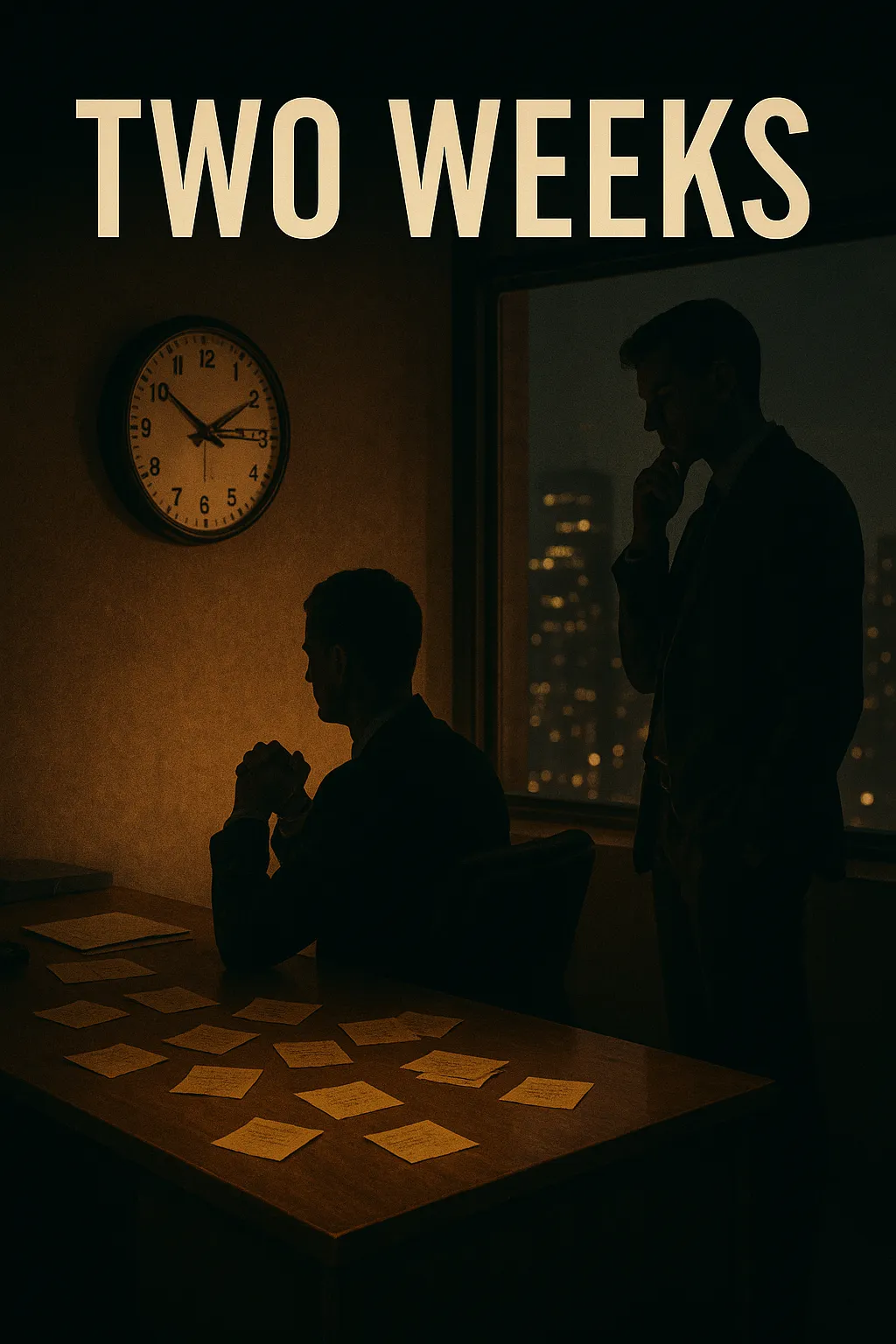
Two Weeks
Glen had taken down the photos first. The ones of him shaking hands at the regional awards, the team outing at Cedar Lake, the printout of his first error-free quarterly audit that he'd pinned to the corkboard as a joke seven years ago and then just never removed. The corkboard looked like a skin graft now — pale rectangles where the sun hadn't reached.
He'd left the stapler. Company property.
It was Monday. Ten days left, if you counted today, and Glen was counting today.
The kid showed up at 8:41, eleven minutes late, carrying a coffee he clearly hadn't bought from the break room. Some place with a logo Glen didn't recognize. He stood in the doorway like he needed permission to exist in it.
Hey — Glen? I'm Nate. Nate Russo. Laurie said I should just come find you.
He stuck his hand out. Big hand. The handshake was firm but not competitive.
Yeah. Have a seat.
There was only one other chair, pushed against the wall under a dead spider plant. Nate pulled it over without commenting on the plant. He sat down and put his coffee on the edge of Glen's desk, then seemed to think better of it and held it in his lap instead.
So Laurie give you the overview, or am I starting from scratch here.
She gave me the org chart and the vendor list. I read through the SOPs over the weekend — the ones on the shared drive, anyway. I had some questions about the Dayton routing but I figured I'd wait and ask you in person.
Glen looked at him. Over the weekend. The SOPs were four hundred pages. Glen had written most of them himself, over three years, updating them every quarter until they became the kind of thing people just assumed had always existed.
You read all of them?
Nate shrugged like it was nothing. Like four hundred pages of Glen's institutional knowledge was a podcast he'd half-listened to on a run.
Glen opened his laptop.
Let's start with the morning reports.
He walked Nate through the daily exception report — the flags, the escalation tiers, the judgment calls that didn't fit neatly into any SOP. Nate took notes in a small notebook with a pen that had some university's name on it. He asked two questions. Both were good. The second one was about a workaround Glen had built into the Dayton routing three years ago, and Nate had already half-figured out why it was there.
So you're basically triangulating the Dayton loads through Columbus to avoid the LTL surcharge on the regional carrier.
Took me about four months to figure that one out.
Nate looked up from his notebook.
Glen minimized the report. On his desktop wallpaper, the default blue hills stared back at him. He'd never bothered to change it.
Yeah. Anyway. Lunch is at noon, most people go to the place across the street. Don't eat the fish.
Nate laughed. It was a real laugh, not a work laugh.
Laurie's office had a vine on the windowsill that had grown long enough to touch the filing cabinet.
She was on the phone when he knocked. She waved him in, held up one finger, and kept talking to someone about a carrier contract renewal in a voice that made it sound like she was doing them a favor by letting them keep the business. Glen sat in the chair across from her desk and waited.
There was a sponge on the edge of her desk, the kind people use to wet stamps. It was dried out and curling at the edges. Next to it, a water bottle with the label intact.
She hung up and smiled at him. Not the wide one.
How's the first morning going?
He read the SOPs. All of them.
That's great. That's exactly what we were hoping for.
Glen watched her uncap the water bottle and take a small sip.
Two weeks is the plan. But ideally he's independent by the end of week two. Running the morning reports on his own, handling the carrier calls, all of it.
Independent.
I had three months of overlap when I started.
Laurie set the bottle down.
Neither of them said anything for a moment.
Glen, I want to make sure you know — what you've built here, the SOPs, the routing system, the vendor relationships — that doesn't go away because someone new is sitting in the chair.
Sure. Yeah.
Laurie's fingers found the edge of the water bottle label. She caught herself and folded her hands on the desk instead.
People have been asking me, you know. About why you're leaving. I've been saying what we discussed — mutual decision, new chapter, all of that. But if there's anything you want me to say differently—
No. That's fine.
Okay.
Mutual decision. That covers it.
He stood up. Laurie was already reaching for her phone, the next thing already queued up behind him.
He stopped in the doorway.
Laurie's smile widened just slightly. The wrong direction.
I know we did.
Glen walked back down the hall. Through his open office door, he could hear the rapid clicking of a pen.
Nate had pulled the chair up to the desk again. He was hunched forward, squinting at the morning exception report on Glen's monitor, pen going like a metronome against the spiral binding of his notebook.
Glen stood in the doorway for a second. His own office. He knocked on the frame anyway.
Nate startled and the pen went still.
Sorry — I was just trying to match the flag codes to what you showed me. I think I've got the tier ones but the escalation logic on the regionals is—
You're fine.
He came in and sat in his chair. The creak. He nodded at the notebook.
You always do that with the pen?
Nate looked down at his hand like it belonged to someone else.
Do what?
The clicking. You've been at it since I left.
Nate set the pen flat on the notebook.
Just checking it wasn't a bomb.
Nate laughed. That real laugh again. Glen pulled his keyboard closer and looked at the report over Nate's shoulder. The kid had already sorted the flags by carrier, which wasn't how Glen did it but wasn't wrong.
You re-sorted these.
By carrier instead of region. I figured if the surcharge patterns cluster by carrier, you'd want to see them grouped that way first. But if that's not how you—
No, it's — that's not a bad way to look at it.
It was a better way to look at it. Glen had sorted by region for six years because that's how the report came out of the system and he'd never thought to question the default.
There's stuff in these reports that's not in the SOPs, right? Like judgment calls. When to escalate versus when to just eat the cost and move on.
No. That's not written down.
Could we — would you be okay dictating some of it? I could type while you talk. Get it documented before you're, uh, before the transition.
Sure. Yeah. Let's do that.
Nate opened a blank document. He typed GLEN'S NOTES across the top in caps, then looked up, ready.
Glen leaned back. He started with the easy stuff — which carriers lied about appointment times, which warehouse managers you could push and which ones pushed back. Then the harder stuff. The things he'd learned by getting them wrong first. The time he'd held a load for two days betting on a rate drop that never came and had to explain the overage to Laurie with nothing but a hunch that didn't pan out. The three accounts that looked profitable on paper but bled money in accessorials if you didn't watch them weekly.
Nate typed fast. He didn't interrupt.
An hour in, the document was four pages long. Glen stopped talking. He looked at the screen over Nate's shoulder and saw six years of institutional knowledge laid out in bullet points, and it looked thin. It looked like something you could hand to anyone.
This is really good. Seriously. Half this stuff I never would have figured out on my own.
You would have. Just would've taken longer.
Nate saved the file.
Glen told Nate he was heading out early and not to wait. Nate nodded without looking up from the exception report.
The deli across the street was called Rosario's, though no one named Rosario had worked there in at least four years. Glen had eaten here three, sometimes four times a week since he'd started. The woman behind the counter — Meg, though the nametag still said Margaret — already had her hand on the rye bread before he reached the register.
Turkey club, no tomato.
Yeah.
He took the booth by the window. Same one. The vinyl had a crack along the left side and the foam padding was yellowed and coming through. Someone had stuck a piece of packing tape over it at some point but the tape had gone gummy and collected grit.
His phone buzzed. Text from Deb: Heard the new kid's already reorganizing your reports.
Glen typed Fine and then deleted it. He set the phone on the table, picked it up again, typed back: Who told you that?
Three dots. Then: Laurie mentioned it. Said he's sharp.
Glen set the phone face down on the table.
Meg brought the sandwich over herself instead of calling his number. She did that sometimes. She set it down and lingered.
You doing okay? You look tired.
Always.
She left him alone. The sandwich was good. It was always good. He ate it looking out the window at the parking lot, at his car in the third row, slightly left of center, close enough to the building that he didn't need an umbrella if he walked fast.
A guy in a blue polo walked across the lot carrying a box of files. The box was too full and the guy was holding the bottom with both hands, chin on top to keep the lid from sliding. Glen watched him make it all the way to the front door and try to badge in with his elbow.
His phone buzzed again. Deb: You there? Don't be weird about this.
Glen picked it up. Typed: I'm at Rosario's. Come if you want.
He waited. She didn't reply, which meant she was already grabbing her jacket.
Glen picked up the phone and typed: Never mind. Don't come.
He watched the message go blue. Then the three dots appeared. Disappeared. Appeared again.
His phone buzzed. Deb: Too late. Already downstairs.
Glen typed: I said never mind.
Deb: Crossing the street. You can watch me through the window if you want to lock the door.
He could, in fact, see her. She came out the front entrance and crossed without looking, bag over one shoulder, water bottle in hand.
The bell above the door rang. Meg glanced up.
Deb dropped into the booth across from him.
I changed my mind.
Yeah, well. I didn't.
She set the water bottle on the table.
You eat yet?
Glen pushed the plate toward the center of the table. A quarter of the sandwich gone.
That bad.
It's a fine sandwich.
Deb looked at him. She had a way of waiting that made you feel like you were already talking.
So what did Laurie say. The real version.
Your words or hers.
Hers. I'm just the messenger.
He re-sorted the exception reports by carrier. It does make more sense that way.
Stop that.
Stop what.
Being gracious. It's freaking me out.
Glen almost smiled. Didn't.
What do you want me to say? That I sorted those reports wrong for six years and a kid with a university pen figured it out in three hours?
There it was. Deb didn't flinch.
I want you to say whatever the actual thing is. Not the version you're rehearsing for the exit interview.
Glen looked out the window. The parking lot. His car sitting where it always sat.
He named the file Glen's Notes. All caps.
Deb waited.
I dictated everything I know. Everything that's not in the SOPs. Took an hour. Four pages.
He picked up the sandwich, took a bite, chewed it without tasting it.
Four pages, Deb.
Deb's thumb went to the water bottle label. This time she didn't stop. A long strip came away and she wrapped it around her index finger.
You know what I keep thinking about? He read four hundred pages over a weekend. And then the first thing he did was type your name at the top.
Glen didn't say anything. Outside, a horn honked in the parking lot.
How many days.
Nine. If you count today.
I'm counting today.
Meg appeared with a second plate. Turkey club, no tomato. She set it in front of Deb without being asked.
Deb looked down at it, then up at Meg, then at Glen.
Meg was already walking away.
They ate. Deb talked for a while about a carrier dispute she was handling, something about damaged pallets and a claims adjuster who kept losing paperwork. Glen half-listened. It wasn't interesting. She wasn't trying to make it interesting. She was just talking.
Glen held the door for Deb and they stood on the sidewalk outside Rosario's for a moment. The sun was out and it was warm for October.
Deb tilted her head toward the front entrance.
In a minute.
She looked at him.
Don't be gone too long. He'll reorganize your desk drawers.
She crossed the street without looking again. Glen turned left instead of right.
The long way around the building meant the loading dock, which meant the smell of diesel and hot concrete and the particular hum of the refrigeration units that he'd learned to sleep through during overnight inventory counts back when they still did those by hand. A pigeon sat on the railing by the dock, gray and fat and unbothered.
He kept walking. Past the dumpster enclosure where the latch had been broken since March. Past the HVAC unit on the north side with the dent in the housing from when a driver had clipped it backing in a fifty-three-foot trailer in the rain. Glen had talked that driver's dispatcher out of filing a damage claim by agreeing to hold their next three loads at a preferred rate. The dent stayed. The rate held for two years.
The driver's name was Carl Tremont. He drove for Heartland Regional out of Zanesville.
Glen stopped at the dent and put his hand on it. The metal was warm from the sun. He took his hand away.
His phone buzzed. He pulled it out. Nate: Hey, quick question on the Columbus LTL routing — is the surcharge threshold $350 or $500? Found two different numbers in the SOP.
It was three-fifty. Glen had negotiated it down from five hundred. That negotiation had taken him a week and two lunches with a carrier rep who chewed with his mouth open.
He typed: 350. Then deleted it. Typed: It's 350. I negotiated it down from 500 in 2019. Then deleted that too. Typed: Check with Laurie. Deleted that. Stood there with his thumb over the keyboard.
He typed: 350. Hit send.
Nate's reply came in four seconds: Got it. Thanks Glen
No period after Glen.
Glen locked the phone and leaned against the HVAC unit. He could walk to his car. He could drive somewhere — the Wendy's on Route 40, the library parking lot, anywhere. He could make today not count.
He pushed off the wall and walked back toward the front entrance. Past the dent. Past the dock. The pigeon was gone.
Glen walked back in through the front entrance. The security desk was empty — it was always empty after eleven — and the sign-in sheet had a coffee ring on it from someone who'd used it as a coaster. He stopped at the door to the hallway and stood there with his badge in his hand.
There was a bench against the wall by the elevator. He sat down on it.
His phone buzzed. Nate again: Sorry one more — the Dayton-thru-Columbus workaround, is that still active or did the rate change kill it?
Glen stared at the text. Four months he'd spent building that routing. Four months of pulling rate tables and running scenarios on his lunch breaks and calling a dispatcher in Dayton who kept putting him on hold to yell at her kids. Four months, and the kid was asking about it the way you'd ask about a coupon — is this still good?
He typed: Still active. Then he sat there with his thumb over the send button and didn't press it.
He deleted it. Typed: Why? Then deleted that.
He locked the phone and put it in his pocket.
The elevator dinged. Deb stepped out holding her water bottle. The label was half gone. She saw him on the bench and stopped.
You're sitting on the bench.
I'm sitting on the bench.
She sat down next to him. Not close. The bench was long enough for three people and she left the middle open.
He's in there looking for you. Came by my desk twice.
I know. He texted.
You text back?
Glen didn't answer.
Deb peeled another strip off the bottle. She rolled it between her fingers and dropped it on the bench between them.
Glen.
He wants to know about the Dayton routing. The workaround I built.
Okay.
He was looking at the hallway door. Through the narrow window he could see the corridor, the fluorescent light with the flicker they'd reported twice, the edge of his office doorframe.
Deb didn't say anything. Her eyes were red around the edges, the skin underneath gone thin and papery the way it got when she'd been staring at a screen too long without blinking.
He's better than me.
He said it to the hallway door. It was the first time he'd said it without the word 'sharp' or 'good one' or some other frame around it to make it about Nate instead of about himself.
Maybe at some of it.
That's the job, Deb.
No it isn't.
Glen pulled his phone out. Looked at Nate's text again.
You ever wonder if the reason they gave me three months of overlap was because I needed three months?
Deb looked at him. He could feel it but he didn't turn.
You're going to be a real asshole about this, aren't you.
Probably.
Okay.
She didn't push it. They sat on the bench. The HVAC cycled on somewhere behind the wall. A phone rang on the second floor. The muffled beep of a truck backing into the loading dock.
It wasn't mutual.
He said it flat. Like reading a number off a report.
Deb's hand stopped on the bottle.
The decision. It wasn't mutual. Laurie called me in six weeks ago and said they were restructuring the role. More analytical, more systems-focused. She said I could apply for the restructured position if I wanted.
Jesus.
I didn't apply.
The truck at the loading dock beeped twice more and went quiet.
Why not.
Because I would've had to interview. For my own job. With Laurie sitting across the table asking me about my proficiency in systems I've never used, and we'd both know how it was going to end, and she'd smile through the whole thing.
Deb set the water bottle on the floor.
So you just let them call it mutual.
It was easier.
For who.
Glen didn't answer that one either. He unlocked his phone. Nate's text sat there, patient, the cursor blinking in the empty reply field.
He typed: Still active. The rate held. Come find me and I'll walk you through it — it's easier on the whiteboard.
He hit send.
You're going to teach him the Dayton routing.
Yeah.
All of it.
All of it.
Deb picked the label strip off the bench and put it in her pocket. She stood up.
She said it with her back to him, already walking toward the elevator. Glen, for what it's worth — four pages is more than most people leave behind.
Glen sat on the bench. Through the hallway door's narrow window, he saw Nate appear at the far end of the corridor, phone in hand, reading the text. The kid looked up and started walking toward the lobby.
Glen stood up.