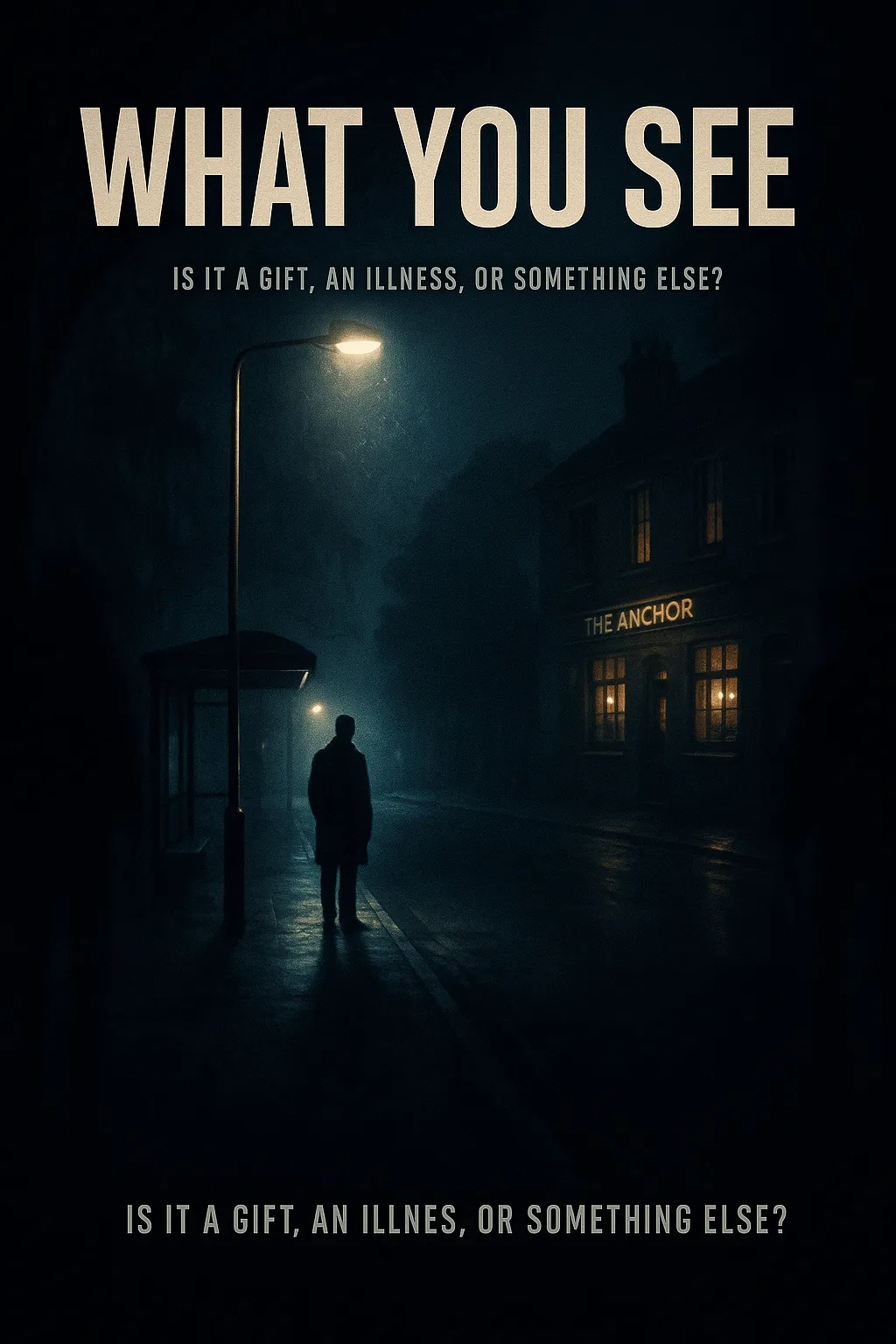
What You See
The kitchen light had been doing it again. A flicker, not quite a flicker — more like the room forgot itself for a fraction of a second and then caught up. Sam had started timing it three days ago without meaning to. Always between 6:40 and 6:45 in the morning. Always when the kettle was on.
Sam poured cold tea down the sink and watched it spiral. The mug had been sitting there since last night. There was a skin on the surface that broke apart in the drain.
Outside, a woman in a grey coat stood at the bus stop across the road. She'd been there yesterday too. And Thursday. Same spot, same coat, same way of standing with her weight on one leg like she was waiting for something other than a bus.
Sam put the kettle on. Leaned against the counter. Looked at the woman, then at the clock on the microwave. 6:41.
The light flickered.
Sam didn't look up. Just stood there with both hands flat on the counter, waiting for the kettle.
The phone was face-down on the table where Sam had left it. A notification hummed against the wood — short, blunt, the particular vibration of a text rather than an email. Sam left it.
The kettle clicked off. Sam made tea. Took it to the window.
The woman was gone. The bus stop was empty. No bus had come — Sam would have heard it, the 38 had a gearbox that sounded like someone dragging a fridge up stairs.
Normal morning. Normal sounds. The couple upstairs fighting about whose turn it was to buy milk. A dog barking three gardens over, the same dog that always barked, the one that went quiet whenever Sam actually tried to see it from the bathroom window.
Sam picked up the phone. Dave. Sent twelve minutes ago.
The message read:
The words were warm and the timing was wrong.
Sam read it again. Drank the tea standing up, looking at the empty bus stop. Put the mug in the sink with the other one. Got dressed. Checked the window one more time on the way out — just the bus stop, just the road, just a Tuesday in March.
The light flickered as Sam pulled the front door shut.
The front steps were wet from overnight rain. Sam took them two at a time, hands in jacket pockets, and turned left toward the station.
The bus stop was across the road. Sam didn't cross. Just walked, same side of the street, same route as every morning. But the eyes went there anyway — to the bench, the shelter, the patch of pavement where the woman had stood with her weight on one leg.
Empty now. The bench was dark with rain. An empty Lucozade bottle sat underneath it, label peeled halfway off. No cigarette ends. No sign anyone had waited there at all.
Sam kept walking. The 38 rattled past going the other direction, that gearbox sound like furniture being moved in a hurry. A woman got off at the next stop up — wrong coat, wrong posture, already on her phone.
Halfway to the station, Sam took out the phone. Dave's message was still there. Sam typed 'yeah ok,' looked at it, deleted it, typed 'sounds good — you pick actually, I don't mind,' and sent it.
The phone went back in the pocket.
At the corner, waiting for the light to change, Sam glanced back. The bus stop was maybe sixty metres behind now. From here, the flat was visible above the laundrette — kitchen window, second floor. The angle between the two was tight. Someone standing at the shelter could have been looking at the road, or the building, or nothing.
The light changed. Sam crossed.
Three pigeons fought over a chip on the kerb. A man in hi-vis held a coffee and stared at his own feet. The morning was ordinary and Sam walked through it.
On the platform, the phone screen lit up. Two messages from Dave, already waiting — must have come through while it was in the pocket.
Oh wow Sam letting ME pick? You must be dying
The Anchor. 7ish. I'll be the one who looks like he hasn't slept since 2019
Sam pocketed the phone without replying and watched the electronic board count down. The train was two minutes out. A woman further down the platform shifted her weight to one leg and Sam looked away fast — different woman, different coat, just someone standing the way people stand.
Sam got there at quarter to seven. The Anchor was the kind of pub that hadn't been renovated since the smoking ban — carpet that remembered everything, a fruit machine blinking to itself in the corner. Half the tables were taken by people who'd come straight from work and hadn't decided whether to stay.
Sam chose a table against the back wall, facing the door. Took off the jacket. Sat down. Didn't go to the bar yet.
Two men at the bar were talking about someone called Keith who'd done something unforgivable to a caravan. The door opened and closed. Sam watched each time.
Dave came in at ten past, arms slightly wide, that walk where his whole body was already performing before his mouth got the chance. He spotted Sam and pointed like he was identifying someone in a lineup.
Fucking hell, you beat me here? What happened, did you get fired?
Thought I'd see what being early felt like.
Dave was already moving toward the bar, talking over his shoulder.
He leaned on the counter and chatted to the bartender like they'd known each other for years. They hadn't. Dave just did that.
He came back with two pints and a bowl of chips he hadn't been asked for.
So the date. I have to tell you about the date.
The Hinge one?
Dave leaned forward, already laughing at his own story before he'd started it.
Sam laughed. A real one.
She blocked me, Sam. Blocked. Like I personally trained the dog.
For a few minutes it was easy. The way it used to be — chips going, Dave talking, Sam not having to perform anything. Dave asked about work and Sam gave the version that was true enough. The new project. The manager who replied to emails at midnight. Small stuff. Safe stuff.
Then Dave went quiet for a beat too long. He picked up a chip and put it back down.
So how are you actually doing?
There it was. Sam turned the pint glass a quarter turn on the table.
I'm alright.
Yeah?
Yeah. I mean — have you ever noticed something and then you can't stop noticing it? Like once you've seen it, it's just there every time.
Dave's fingers moved to the edge of his beer mat, tearing a small strip off the corner.
Sam opened his mouth. Closed it. Took a drink instead.
Doesn't matter. Just — patterns, I suppose. Probably just not sleeping enough.
Dave's shoulders dropped a fraction.
The door opened. A man came in alone. He stood just inside the threshold and didn't move for a moment — not the pause of someone looking for a friend, but the pause of someone reading a room. Tallish. Dark jacket, no bag. He looked at the bar, the exits, the corner where the corridor led to the toilets. His gaze passed over Sam's table without catching.
He went to the bar and waited. The bartender came over and he ordered something short — pointed at a tap, held up one finger, said nothing else. Paid with a card he already had in his hand.
Dave was saying something about his landlord. Sam was watching the man carry his half-pint to a table near the back. Not the nearest empty table. The one against the wall.
The man sat down and didn't take out his phone. He looked at his drink, then at the door, then at nothing in particular. He hadn't taken off his jacket.
Sam.
Sorry. Yeah. Mould.
Dave followed Sam's eyeline to the man and back.
No.
Right. So — the mould. You'll love this. He sends his mate round with a tin of white paint...
Sam tried to listen. Dave's story was funny in the way Dave's stories always were — the details stacked up, the punchline earned. But the man at the back table lifted his glass and paused before drinking, and his eyes moved to the door again when it opened. A couple walked in. He set the glass down.
Half the drink still in the glass. He stood up, put his card back in his pocket — it had been on the table the whole time — and walked out. Didn't look at anyone on the way.
Dave had stopped talking. He was watching Sam watch the door.
Sam looked at Dave. Dave's hand was flat on the table, the beer mat torn into three neat strips beside his glass.
Sam pushed back from the table. The chair legs caught on the carpet.
I need a minute. Just — air.
Dave looked at the torn beer mat strips, then at Sam, then at the door Sam was already heading for.
The cold hit like stepping into water. Sam stood on the pavement and looked left, then right. The street was empty in the way streets are empty at night — parked cars, lit windows, nobody walking.
Sam crossed the road. The man had turned toward the station — Sam had seen that much through the window. But the pavement curved past a row of shuttered shops and there was no one on it. No footsteps. No dark jacket disappearing around a corner.
Sam's hands were shaking. Not much. Enough to notice.
A woman came out of the kebab shop next to The Anchor, phone pressed to her ear, laughing at something. She walked past Sam without looking.
Sam stood there for probably thirty seconds. The pub door was right there, warm light through the frosted glass, Dave inside with his pint and his patience and his question that Sam had answered with a chair scraping back.
The phone buzzed in Sam's pocket. Sam took it out. Mum. Not a call — a text, which was unusual. Linda rang. She always rang. Wednesday evenings, Sunday mornings, the odd Tuesday if something had reminded her of something. She didn't text at half seven on a Thursday.
"Just checking in love. How are you sleeping? xx" The screen went dark before Sam could decide what to do with it.
Sam stared at the blank screen. The question wasn't the question. Linda didn't ask about sleep. Linda asked about work, about eating properly, about whether Sam had called the dentist. Sleep was a word that lived next to other words she'd used before. Anxiety. Overthinking. Your dad was the same.
The pub door opened behind Sam. Dave stood in the doorway holding both their jackets, Sam's draped over his arm like he'd already decided something.
He didn't come out with a joke.
Thanks.
Dave handed it over. Stayed in the doorway.
That bloke really rattled you.
Not a question. Sam put the jacket on. Zipped it halfway.
He reminded me of someone.
Who?
Sam almost said it — he reminded me of me. The way he watched the room. The way he left when it changed. But saying it out loud would make it a thing, and once it was a thing Dave would do what Dave did, which was care in the direction of fixing.
I don't know. Forget it.
Dave leaned against the doorframe. He waited instead of talked, which meant he was actually worried.
Sam. Come on.
Sam looked at the street. A car passed.
Yeah. All the time. That's called Tuesday.
Right.
What are you seeing that doesn't make sense?
The question sat there. Sam could feel the text from Linda still on the phone. How are you sleeping.
Probably nothing. That's the problem — it's probably nothing, and I can't stop probably-ing it.
Dave nodded slowly. He put his hands in his pockets and rocked back on his heels.
There it was. The gentlest possible version of the thing Sam had been waiting for since sitting down tonight. And it was kind.
Yeah. Maybe.
Come back inside. I'll get another round. We don't have to talk about anything. We can just sit there like two sad bastards and watch the football.
Sam looked down the street one more time. Toward the station. The pavement was empty.
I'm going to head off actually. Early start.
Dave didn't argue. He nodded and covered whatever he was thinking with a half-smile.
Text me when you're home, yeah?
Yeah.
Dave went back inside. Sam walked toward the station. The platform was empty when Sam got there. A crisp packet blew along the yellow line at the edge. On the electronic board, the next train was nine minutes out. Sam sat on the metal bench and looked at the street below and the street didn't do anything.
Sam stood up from the bench. The board said four minutes.
He walked back up the stairs, through the ticket hall, and out onto the street. The kebab shop was still open. A different woman behind the counter now. The Anchor's frosted windows glowed the same dull amber and Sam pushed through the door before he could talk himself out of it.
Dave was at the table. Same seat. He'd got a fresh pint and was sitting with both hands around it, thumbs pressed together, not drinking. He looked up when the door opened.
Can I sit back down.
Dave pulled Sam's chair out with his foot.
Sam sat. The pub had thinned out. The two men who'd been talking about Keith were gone. The fruit machine blinked at no one.
Thought you had an early start.
I lied.
Dave nodded slowly. He picked up his pint, took a drink, set it down.
There's a woman who stands at the bus stop across from my flat. Grey coat. She's been there three mornings in a row. Same time. She never gets on a bus.
Dave didn't interrupt.
I walked past the stop yesterday and there was nothing — wet bench, empty bottle, no sign anyone had been there. But the angle. If you stand at that shelter, you can see straight into my kitchen window. Second floor, above the laundrette. It's a direct line.
Okay.
And my kitchen light flickers. Every morning, same five-minute window. Only when the kettle's on. I've timed it.
Sam—
And that bloke tonight. The one who left. He sat the way I sit. Watched the door the way I watch the door. He left the second those people walked in, like the room changed and he felt it. I do that. I do exactly that.
Sam stopped. His hands were flat on the table.
Dave was very still.
Sam blinked. He'd been ready for the pivot — the gentle redirect, the professional help suggestion again. Not this.
I don't know. I've never seen her face properly. She's always turned slightly away. Like she knows which window is mine and doesn't want to be seen looking at it.
How old.
Could be forty. Could be sixty. The coat's too big for her. That's the thing I keep — it doesn't fit right. Like it's not hers.
The pub was quiet enough now that Sam could hear the glass washer running behind the bar. Dave looked at his pint, then at Sam, and his eyes were wet and he blinked it away fast.
And your mum texted you tonight.
Asked about my sleep. She never asks about my sleep. She rings on Wednesdays and Sundays and talks about the garden and whether I've been to the dentist. She doesn't text on a Thursday night asking how I'm sleeping.
Sam looked at his hands on the table.
She's been calling it anxiety since I was fourteen.
Dave opened his mouth. Closed it. Tried again.
I know.
But that's — I don't think that's what I should be asking.
He rubbed the back of his neck.
What do you actually need. Right now.
Sam looked at his pint. The foam had gone flat.
I need someone to not tell me it's nothing.
Dave picked up his glass. Held it out across the table. Waited.
To not nothing, then.
Sam looked at him. Then picked up his own glass and touched it to Dave's. The sound was small in the quiet pub.
They drank. Dave set his glass down and started telling the mould story again — the landlord, the tin of white paint, the mate with the van — quieter this time, not building to anything. Sam let him. The radiator behind Sam's chair ticked unevenly, the kind of ticking that didn't mean anything, just old pipes expanding.
Outside, through the frosted glass, a figure passed on the pavement. Dark jacket. Didn't stop. Sam watched the shape blur and dissolve in the glass and said nothing. Dave kept talking.
Sam set his glass down.
I went back yesterday. To the bus stop.
Dave's thumb stopped moving against the side of his glass.
There's a sightline. From the shelter — if you stand where she stands, you can see straight up to my kitchen window. Second floor, above the laundrette. It's a direct line.
Could be a coincidence. Bus stops face buildings.
Yeah.
The glass washer behind the bar clunked through its cycle.
And the light flickers at the same time she's there. Six forty to six forty-five. Every morning. Only when the kettle's on.
That's — okay, that's weird.
No bus comes. I'd hear it.
Dave tried a grin. It lasted about a second and then he just looked tired. He rubbed the back of his neck and left his hand there.
So she stands there. The light goes. No bus. And then what.
She's gone. Bench is empty. Wet. Like nobody was ever there.
Dave exhaled through his nose. He picked up his pint, put it down again without drinking.
Have you thought about — sorry. I'm not doing that.
What if I came. Tomorrow morning. Sat in your kitchen and watched the bus stop with you.
Sam looked at him.
I'm serious. Six forty, you said? I'll bring coffee. I'll be shit company but I'll be there.
You don't have to do that.
I know I don't have to.
The fruit machine cycled through its colours in the corner. Someone at the bar laughed at something on their phone.
Six forty. Kettle goes on, light starts.
Six forty.
Dave took out his phone and typed Sam's address into it, slowly, one thumb, like a man twice his age. He held the screen up to check.
Above the laundrette, yeah?
Yeah.
Dave pocketed the phone and picked up his pint properly this time. Drank. Set it down.
If she's there, we'll see her. If she's not — at least you'll have coffee.
They sat with it. The pub settled around them — someone pulling on a coat, a stool scraping, the bartender wiping down a tap. Sam finished his pint. The glass was warm where he'd been holding it too long.
Outside, through the frosted glass, the street was empty. Sam watched it anyway.
They walked out together. The cold was sharp after the pub's warmth and Sam zipped his jacket the rest of the way. Dave turned toward the high street. Sam turned toward the station.
Six forty. Don't be late.
When am I late.
Sam watched him go. Dave's hands were in his pockets and his shoulders were up around his ears against the cold and he didn't look back. He turned the corner and was gone.
The station was a five-minute walk. Sam took it slowly. Linda's text was still on the phone, still unanswered. He took it out, looked at the screen, and put it back.
On the platform, the bench was cold through his jeans. The board said seven minutes.
The key stuck the way it always did — a half-turn, then lift, then the rest. Sam stepped inside and closed the door quietly, as if someone were sleeping.
The flat was dark. He didn't turn on the hall light. His shoes came off by the door and his jacket went on the hook and he stood in the kitchen doorway for a moment, hands at his sides.
The window was right there. The bus stop below it, across the road, lit by the orange sodium lamp that buzzed faintly in summer but was silent now. The shelter. The bench.
Sam filled the kettle from the tap. Held it. The water sloshed against the sides.
He set it down on the counter without turning it on.
Poured himself a glass of water from the tap instead. Drank it standing at the sink. There was a brown stain on the grout between the counter tiles that had been there when he moved in. He'd tried bleach once. It didn't do anything.
His phone was on the counter where he'd put it. Linda's text still there. He picked it up, typed Sleeping fine mum x, and sent it.
He put the phone face down on the counter and turned away from the window.
In the bathroom, he brushed his teeth. The tap ran cold. He spat, rinsed, turned off the tap.
The bed was unmade from this morning. He got in without undressing past his t-shirt and boxers and pulled the duvet up and lay there. The ceiling had a crack that ran from the light fitting to the corner. He'd noticed it the week he moved in. It hadn't changed.
Six forty. Dave would be here. The kettle would go on and the light would do whatever it was going to do and someone else would be standing in this kitchen, seeing what Sam sees or not seeing it.
Sam closed his eyes. Sleep came eventually — not all at once, but in the slow, grudging way it had for weeks now.