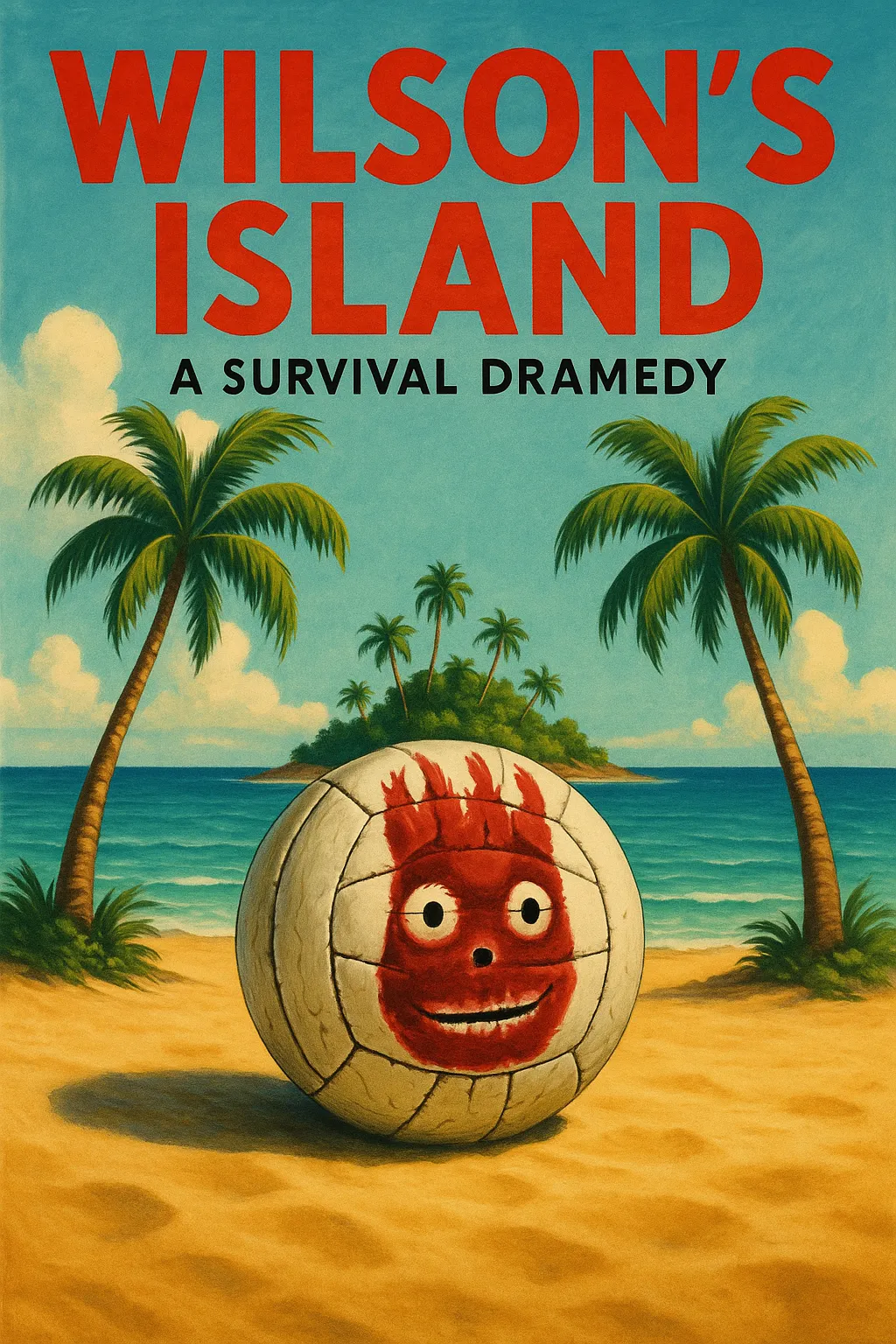
Wilson's Island
He lay face-down on a beach he didn't recognize, one arm twisted under his chest, the other flung out toward the waterline where the surf lapped at his fingers. His clothes were stiff with salt. His left shoe was gone. The sun was already brutal.
Thomas coughed, and the cough became a retch, and the retch produced a thin stream of seawater that pooled in the sand beneath his cheek. He blinked. Retched again. Pushed himself up onto his hands and knees and stayed there for a while, swaying, taking inventory of a body that felt like it had been run through an industrial washing machine.
Beach. Ocean. Sky. He turned his head slowly, scanning the tree line — dense, green, unhelpful. Behind him, the water stretched out in every direction with the flat indifference of something that had already forgotten him. No boat. No wreckage. No contrail in the sky.
Just waves, and light, and the particular silence of a place where no one was coming.
He sat back on his heels. Spat. Wiped his mouth with the back of his hand and noticed it was shaking. He didn't remember the boat going down. He didn't remember a boat at all, actually, which seemed like the kind of thing a person should remember.
Something nudged his ankle. He looked down. The surf was pulling back, and in its retreat it left behind a soccer ball — white and black, standard-issue, sitting on the wet sand like it had been gently placed there. The next wave pushed it against his leg again. Then pulled it back an inch. Then pushed it forward.
He picked it up. It was heavier than it should have been, the panels slightly tacky against his palms, and when he turned it over there was no brand logo, no manufacturer's mark — just the black-and-white pentagons, perfectly clean, as if the ocean hadn't touched it at all.
Thomas stared at the ball. The ball, obviously, did not stare back. He set it down on the sand beside him and looked out at the water again, trying to assemble the situation into something that made sense.
The voice came from his left. It was calm, conversational, and slightly nasal — the voice of someone settling into a bus seat for a long ride.
Thomas did not move. He sat very still, the way a person sits when they are deciding whether the sound they just heard was real or the first sign that something important has broken inside their head.
Thomas looked down at the soccer ball. It hadn't moved. It sat in its little depression in the sand, perfectly still, perfectly ordinary.
"What the fuck."
"Yeah, no, that's fair. Take your time with it."
Thomas picked the ball up again. Held it at arm's length. Turned it over. Shook it once, like a man trying to find the battery compartment on a toy he didn't buy. Nothing rattled. The ball was just a ball — scuffed panels, regulation size, the faint smell of rubber and salt. He set it back down.
"I have a head injury."
The voice was coming from the ball. Specifically from the ball. Thomas was certain of this in the way you could be certain of something while also being certain it was impossible.
"Balls don't talk."
"And yet here we are. I don't make the rules, Thomas. I'm just as surprised as you are."
Thomas opened his mouth. Closed it. Looked at the ocean, which offered nothing. Looked at the tree line, which also offered nothing. Looked back at the ball, which he was increasingly sure was waiting for him to say something.
"How do you know my name?"
A pause. The surf hissed against the sand. Somewhere in the trees, a bird called out once and didn't repeat itself.
"...Lucky guess?"
Thomas didn't pick the ball up. He leaned forward on his knees, close enough that his shadow fell across it, and stayed there.
"That wasn't a lucky guess."
"It might have been. You look like a Thomas. There's a whole vibe."
"What vibe."
"You know. Sturdy. Anglo-Saxon. The kind of name where the person definitely played a team sport at some point but wasn't, like, the star. No offense."
Thomas pressed his tongue against the roof of his mouth. His throat was raw, and the sun was doing something cruel to the back of his neck, and he was kneeling on a beach having a conversation with a ball about whether he looked like his own name. He dug his fingers into the sand on either side of his knees and felt the grit pack under his nails.
"I played JV soccer for three years. My left foot is above average."
"Okay. I don't love where this is going."
"So here's what's going to happen. I'm going to ask you how you know my name, and you're going to tell me, or I'm going to punt you into the tree line and go be crazy by myself. Because honestly? Hearing voices without the ball might be less disturbing than hearing voices with the ball."
The surf pulled back. Pushed forward. The ball sat in the sand, not moving, which was the only thing it had ever done and yet somehow now felt like a choice.
"Have you noticed the light here? The way it comes off the water? It's almost — "
"Ball."
"I don't know how to answer the question."
"Try."
A long pause. Somewhere behind him a wave broke wrong and made a sound like a door slamming. Thomas's hands were still buried in the sand, fingers curled, and he realized he was bracing himself — for what, he couldn't say. For the ball to say something that made this real. For the ball to say nothing, which would make it real in a different way.
"I knew it before you washed up. I knew you'd be here. I don't know how I knew that, or — look, there's a lot I don't have access to. I'm a ball. My whole situation is — I don't have a filing cabinet in here, Thomas. I just have... some things. Your name is one of them."
"You knew I'd be here."
"Yes."
"Before I washed up."
"Yes."
"How long before."
Nothing. The ball said nothing. Thomas waited, and the silence stretched past the point where it was a pause and into the territory where it was an answer.
"Jesus Christ."
He pulled his hands out of the sand and sat back. Brushed his palms against his salt-stiff pants, which accomplished nothing. His bare left foot was starting to blister where the sand had been baking in the sun, and he shifted it into the shadow of his own leg without thinking about it — the body solving problems the mind hadn't gotten to yet.
"For what it's worth, I'm glad you're here. That probably sounds insane given the circumstances. But it was quiet before."
"How long were you here alone?"
"You know what, the real priority is water. Freshwater. You're already dehydrated — your lips are cracking, and humans do that thing where they die after three days without water, which honestly seems like a design flaw, but —"
"You're doing it again."
"Doing what?"
"Changing the subject every time I get close to something."
The ball didn't respond. Thomas stared at it — this clean, unmarked, impossible thing sitting in the sand — and felt something shift in the back of his skull. Not understanding. Something before understanding. The recognition that there was a shape to what the ball wouldn't say, and that shape had edges he could feel even if he couldn't see them yet.
"The water thing is real, though. That part I'm not deflecting about."
Thomas looked at the tree line. Dense, tangled, the kind of green that could mean fresh water or could mean nothing. His tongue was thick in his mouth. The ball was right about the water, which was infuriating, because it meant he had to stop asking questions and start doing something, and the ball probably knew that too.
"This conversation isn't over."
"I didn't think it was."
"Good."
He bent down and picked the ball up. Tucked it under his arm without ceremony — the way a person carries something they're angry at but not willing to leave behind. Then he turned toward the jungle, one shoe on, one foot bare against the scorching sand, and started walking.
The tree line swallowed the light in about four steps. Thomas pushed through a wall of broad, waxy leaves that slapped at his chest and face, the ball wedged against his hip with one hand while the other shoved branches aside. The air changed immediately — heavier, wetter, humming with insects he couldn't see. His bare foot found root, then mud, then something sharp that made him hiss through his teeth.
"I want to state for the record that I think this is a bad idea."
"Noted."
"You don't have shoes. Well — you have a shoe. Singular. Which is almost worse than none, because it's giving you a false sense of —"
"I need to see what we're working with. Can't do that from the beach."
He found the tree about thirty yards in — a massive thing with pale, smooth bark and branches that started high and spread wide, the kind of tree that looked like it had been growing since before the island decided to exist. Its root buttresses fanned out in every direction, chest-high in places, creating little alcoves of shade and rot. Thomas set Ball down in one of them.
"Oh. So I just — I wait here. On the ground. In the dirt."
"I can't climb with you."
"No, I get it. Physically. I understand the mechanics. I'm just noting the experience of being put down in dirt while someone walks away from me."
"I'm climbing twelve feet above you. I'm not walking away."
"It's the principle."
Thomas grabbed the lowest branch and pulled himself up. His arms shook — he was weaker than he'd realized, the dehydration already settling into his muscles like sand in a gearbox. He got a knee over the branch, straddled it, breathed. Reached for the next one. The bark was slick in places and rough in others, and his bare foot scraped against it and came away bleeding in a thin line along the arch. He kept climbing.
"You're being very quiet up there. That's either focus or you've fallen and died and I'm about to have a real problem."
"Still here."
He climbed until the branches thinned and swayed under his weight, then hooked one arm around the trunk and looked out. The canopy opened up around him and the island unfolded in every direction, and for a moment he forgot about his bleeding foot and his cracked lips and the impossible thing waiting for him at the bottom of the tree. The island was beautiful. That was the first thing — stupidly, unhelpfully beautiful. Green hills rolling toward a spine of volcanic rock at the center, ringed by white sand and water so blue it looked artificial. A mile wide, maybe two miles long. Small enough to walk in a day. Small enough to feel like a cage once you knew.
He turned slowly, scanning. The eastern shore curved into a rocky point, and beyond it — he squinted, shifted his grip on the trunk — a freshwater stream cut through the green, catching sunlight where it broke from the tree cover and tumbled toward the beach. Water. Drinkable, probably. His throat clenched at the sight of it.
He kept turning. South was more beach, more jungle, more of the same. West was open ocean all the way to the horizon. And north — Thomas stopped. On the northern shore, half-hidden by the angle of a rocky outcrop, something sat at the waterline that wasn't sand or stone or tree. A shape. Angular. Too straight-edged to be natural. Dark against the white beach, partially buried or partially broken, he couldn't tell from here. But it was something built. Something that had been made by hands.
"Ball."
"Yeah?"
"There's a stream on the east side. Fresh water, maybe a twenty-minute walk."
"See? The tree thing paid off. I take back some of what I said."
"And there's something on the north shore. Some kind of wreckage."
Ball went quiet. Not the performative quiet of winding up for a complaint — actually quiet, in a way Thomas hadn't heard from it yet. The insects filled the space where its voice should have been.
"Wreckage like what."
"Can't tell. Something man-made. Could be a boat. Could be part of a structure. It's half-buried."
Another silence. Thomas waited, watching a bird wheel over the canopy below him, aware that he was holding his breath for the opinion of a soccer ball and unable to find that strange anymore.
"The water's closer."
"Yeah."
"And you need water. Today. That's not negotiable, that's biology."
"I know."
"So the wreckage can wait."
Thomas looked north again. The shape on the beach hadn't moved, obviously, but something about it pulled at him — the promise of an answer, or at least a better question. He looked east, toward the stream. His tongue was a dead thing in his mouth. His body had already made the decision; it was just waiting for his brain to stop arguing.
"You don't want me to go to the wreckage."
"I want you to not die of dehydration. Those are different things."
"Are they."
He climbed down. It was harder than going up — his arms had less to give, and twice his foot slipped on the bark and he caught himself with a grip that left his palms raw. When he dropped the last few feet to the ground, his knees buckled and he sat down hard against the roots. Blood from his foot had left faint prints on the pale bark above him, a dotted trail marking where he'd been.
Ball sat where he'd left it, perfectly still in its little alcove of shade. Thomas reached over and picked it up, held it in both hands in front of his face. The black-and-white panels were still impossibly clean. He could see his own reflection in the sheen — gaunt, sunburned, one eye slightly swollen. He looked like someone who'd argue with a ball.
"Water first. Then the wreckage."
"Sure. Yeah. Water first."
"And then you're going to tell me why you don't want me going north."
Ball said nothing. Thomas stood, cradled it against his chest with one arm — the way you'd carry something you were protecting, or something you were keeping close so it couldn't get away — and started east through the trees, limping, leaving a trail of blood and bare footprints in the soft earth behind him.
Thomas didn't get up. He sat against the root buttress with his legs stretched out in front of him, his bare left foot throbbing in a way that had its own pulse, separate from his heartbeat and slightly faster. The bark pressed into his back through his salt-stiff shirt. Above him, the canopy shifted and reformed, letting through coins of light that moved across his legs like something searching.
He set Ball down beside him in the dirt. Didn't tuck it anywhere careful. Just set it down, the way you put a coffee mug on a table when you're too tired to care about coasters.
"So we're just — sitting."
"We're sitting."
"Okay. I can do that. I've been sitting for — well, for a very long time, actually, so I'm something of an expert. You picked the right —"
"Ball."
"Yeah."
"Quiet for a minute. Please."
Ball went quiet. Thomas closed his eyes. He tried to take stock — not of the island, which he'd already mapped from the tree, but of himself. The inventory was short and bad. Dehydrated. One shoe. Palms raw from the bark, the skin on his right hand split along the heel where he'd caught his weight on the climb down. A sunburn that had moved past the stinging phase into something deeper, a heat that felt like it lived under the skin now. His left foot was the worst of it — the blister on the arch had opened during the climb and the exposed skin underneath was bright and wet, collecting grit every time he shifted.
He pressed his fingers to his collarbone. He didn't know why. Some muscle-memory gesture, checking for — a necklace? A chain? There was nothing there. But his hand knew to look.
"I know I hate cilantro."
"What?"
"Things I remember. I'm making a list. I hate cilantro. I know my mom's laugh — this big, stupid, honking thing that embarrassed me in movie theaters. I have a scar on my right knee from something. I know what a collarbone fracture feels like, so I must have broken one. And that's — that's about where the shelf ends."
He opened his eyes. The canopy hadn't changed. The island didn't care about his list.
"She's —"
Thomas turned his head.
"She's what."
"I was going to say, she sounds like a fun person. Your mom. Based on the laugh thing."
"You were going to say something else."
"I really wasn't."
"You started with 'she's.' That's not 'she sounds like.' That's 'she is' something. Or 'she isn't' something. Which one."
Ball said nothing. A bird moved through the canopy above them, branch to branch, quick and purposeful and completely indifferent to the conversation below. Thomas's hands had stopped trembling. He noticed that — the stillness in his fingers, sudden and total.
"Do you know my mother."
"Thomas, I'm a soccer ball. I don't know anyone's mother. I don't have a social circle. I don't have a Rolodex. I have — look, I have some things in here that I can't explain, and sometimes they come out sideways, and I'm sorry about that, but it's not — it doesn't mean what you think it means."
"What do I think it means."
"Can we talk about the water? The stream is twenty minutes east and your lips look like a dried riverbed, and I mean that with compassion."
Thomas leaned his head back against the root. His jaw was working — not chewing, just the slow grind of a man pressing his teeth together to keep from saying something he couldn't take back. He stared up through the branches at the sky, which was the same stupid blue it had been all day, relentless and clear and empty of anything useful.
"I'm scared."
He said it without looking at Ball. The word just fell out, the way things fall when you're too exhausted to hold them.
"I know."
"Not of dying. I mean — yeah, of dying, obviously. But more of the — I can't remember how I got here. I can't remember where I live. I know cilantro and my mom's laugh and a broken collarbone, and everything else is just —"
He made a gesture with his hand. Opening a box and finding it empty.
"It might come back."
"And I'm talking to a ball. And the ball knows things about me that I don't know about myself. And I can't tell if that's real or if I cracked my head on a reef and I'm lying on this beach dying and none of this is happening."
"For what it's worth, I think it's real. But I understand that my testimony is — compromised. On account of being the hallucination, if I am one."
Thomas almost laughed. It came out as a breath through his nose, barely there, but it loosened something in his chest.
"Yeah. That's the problem with you."
He sat there a moment longer. The shade was doing something for his sunburn, and the insect noise had settled into a steady drone that was almost pleasant if he didn't think about it. His bare foot pulsed. His palms stung. His throat was a narrow, dry passage that was getting narrower. The stream was twenty minutes east. The wreckage was north. Both were pulling at him, and he was too tired to move toward either, and for thirty seconds he let that be okay.
"When we get to the water. After I drink. You're going to tell me what you almost said about my mother."
"Thomas —"
"That's not a negotiation."
He picked Ball up with his less damaged hand and got to his feet. His knees protested. His foot found the ground and the ground found the open blister and they had a brief, searing conversation about it. He shifted his weight to his shoed foot and stood there, swaying slightly, holding a soccer ball against his ribs with one arm. Through the trees to the east, if he listened past the insects and past his own breathing, he thought he could hear water moving over rocks. Close enough to be real. Maybe close enough to reach.
Thomas didn't move. He stood there with Ball against his ribs, one foot bare on the root-knotted ground, the other in its salt-stiffened shoe, and he felt the sentence he was about to say building in his chest like a cough he couldn't suppress.
"No."
"No what?"
"No, we're not walking to the stream first. You almost said something about my mother. You caught yourself. I watched you catch yourself — which is a thing I just said about a ball, and I'm going to deal with that later, but right now you're going to finish the sentence you started."
He didn't hold Ball up to his face. He didn't cradle it or shake it or do any of the things he'd been doing with it since the beach. He just stood still, Ball pinned under his arm like a package he was tired of carrying, and waited.
"Thomas, you need water. That's not me changing the subject, that's me pointing out that your body is actively shutting down and this is maybe not the time for —"
"Finish the sentence."
"I don't remember what I was going to say."
"You said 'she's.' Two letters. One contraction. You know exactly what came next."
The insects droned. A branch somewhere above them creaked and settled. Thomas's throat was closing around itself — he could feel the dehydration narrowing the passage, his swallows coming dry and painful — and he didn't care. He would stand here until his kidneys quit.
"She's alive."
Thomas's hand tightened on Ball. Not a squeeze — more like the involuntary grip of a man who's just stepped off a ledge and found something to hold.
"Say that again."
"Your mother is alive. She's — I don't know where, I don't have an address, I don't have a phone number, I don't have any of the useful things. But she's alive and she's worried about you. That's in here. That's one of the things I have."
Thomas sat down. Not deliberately — his knees just stopped working and the ground was there. He sat in the dirt between the root buttresses with Ball in his lap and his back against the pale bark and he breathed. The open blister on his foot pressed into the soil and he didn't register it. His hands were shaking again. Not from dehydration this time.
He tried to picture her. The laugh was there — the big, honking, theater-disrupting laugh — but the face around it was fog. A shape where a person should be. He pressed the heel of his split palm against his eye socket and held it there.
"How long has she been worried about me."
"I don't know."
"How long have I been gone."
"I don't know that either. I'm sorry. I know that's not —"
"What else do you know about her."
"That's it. That's the whole file. She's alive, she's worried, and she has a laugh that embarrasses people in movie theaters. Which I got from you, so it doesn't even count."
Thomas dropped his hand from his face. His eye was wet and he didn't wipe it. He stared at the canopy above him — the shifting green, the coins of light, all of it exactly as indifferent as it had been thirty seconds ago when he didn't know his mother was alive. The island hadn't flinched. Nothing had changed except the thing inside his chest that was either breaking or reassembling, and he couldn't tell which.
A long time passed. Maybe a minute. Maybe five. The insects didn't care.
"The wreckage."
"Thomas —"
"You went quiet when I mentioned it from the tree. You steered me toward the stream. You're doing the thing you do — the deflection thing — except with the wreckage you don't even deflect, you just go silent. Which is worse. That's the tell, Ball. The silence is worse than the bullshit."
Ball didn't talk faster. Didn't pivot to the scenery or the weather or Thomas's cracked lips. It just sat in his lap, perfectly clean and perfectly still, and for the first time since the beach it felt heavy in a way that had nothing to do with weight.
"The wreckage scares me."
"You're a ball. What scares a ball."
"I don't know. That's the honest answer. I don't know what it is or what's in it, but when you said you saw it from up there, something in here went — cold. Or whatever the ball equivalent of cold is. I don't have skin, Thomas. I don't have nerve endings. But something happened and I didn't like it and I wanted you to go the other direction. That's all I've got."
Thomas looked down at Ball. The panels caught the filtered light and threw it back dull and mottled — no reflection this time, just the surface of a thing that claimed to be afraid. He ran his thumb across one of the black pentagons. The rubber was smooth and warm from sitting against his body.
"You knew I was coming. You know my mother's alive. And something on the north shore of this island makes you go cold. Those three things are connected."
"Maybe."
"Not maybe."
"Probably."
"And you're not going to tell me how."
"I'm not sure I can. I'm not being cute. I'm not deflecting. I think if I try to look at it directly, it — moves. Like something in peripheral vision. I can feel the shape of it but I can't turn my head. Which I also don't have."
Thomas leaned his head back against the bark. Closed his eyes. His throat clicked when he swallowed — dry on dry, the sound of a body running out of patience with its owner. Through the trees to the east, the faint sound of water over rocks. Real water. Close water. His body was pulling toward it with a gravity that was getting harder to override.
"Here's what's going to happen. We get water. I drink until I can think straight. And then we go north."
"Thomas."
"That's not a negotiation either."
"I know."
Neither of them moved for a while. Thomas sat in the dirt with a soccer ball in his lap and listened to the water he couldn't yet reach and thought about a woman whose face he couldn't remember worrying about a man she couldn't find. His bare foot throbbed. The jungle ticked and hummed around them. Somewhere north, past the volcanic spine of the island, something man-made sat half-buried in sand, waiting with the particular stillness of a thing that had been waiting long before Thomas arrived to find it.
"For what it's worth. I'm glad I told you about her."
"Yeah."
He didn't get up. Not yet. He sat there and let the shade do what little it could, and he held Ball in his lap with both hands resting on it the way a person rests their hands on a table when they've run out of things to do with them.
Thomas closed his eyes. He put his hands flat on Ball's surface, the split palm stinging against warm rubber, and went looking.
The kitchen came first. It always started with the kitchen — the yellow tile, the window over the sink, the dish towel with strawberries printed on it hanging from the oven handle. He could smell garlic and something sweet underneath it, maybe onions going soft in a pan. He could hear the laugh. That big, honking, unself-conscious laugh that filled rooms and made strangers in restaurants turn around. He followed the laugh like a hallway, turning corners, trying to get to the room where it was coming from.
There was a shape at the stove. Hands. He could see hands — short fingers, a ring, something silver catching the light from the window. The hands moved with confidence, stirring, adjusting heat, reaching for a spice rack that he could see in perfect detail: oregano, cumin, the paprika she bought in bulk from somewhere specific, a place with a name he almost had. Her hands were right there. He followed them up the arms and hit fog.
Not blankness. Fog. Active, shifting interference, like a signal being jammed. The laugh was still playing — he could feel it vibrating in the kitchen tiles under his feet — but the face above those hands was a smear. He pushed harder. Jaw? Oval? Round? He was grabbing at smoke.
Something else surfaced instead. Uninvited. A hallway, not the kitchen — narrow, institutional lighting, the smell of floor wax and something chemical underneath. His hand on a metal railing. His feet moving fast. Someone calling his name behind him, not his mother's voice, a man's voice, and the feeling in his chest wasn't grief, it was —
He opened his eyes. His breath was coming fast and shallow, and his face was wet. His nose had closed up on one side. He didn't wipe any of it.
"Thomas."
"I can see her hands. I can see the kitchen. I can see the goddamn dish towel with the strawberries on it. But her face is just — it's not missing. It's been taken out. Everything around her is in high definition and she's a hole in the middle of it."
He said it flat. Reporting damage.
"What about the hallway?"
Thomas went still. His thumbs stopped moving on Ball's surface.
"I didn't say anything about a hallway."
"You — no. No, you did. You were talking and you mentioned —"
"I had my eyes closed. I didn't say a word."
The jungle hummed around them. A millipede traced a slow path across the root beside Thomas's knee, unbothered by anything happening above it. Ball sat in his lap, warm from the heat of his legs, and said nothing. Not the deflective nothing. Not the winding-up-for-a-pivot nothing. A caught nothing. A cornered nothing.
"You saw it. You were in there with me. You saw the hallway."
"I don't — that's not how I would describe it."
"How would you describe it."
"Sometimes when you're — when you go somewhere in your head, I get the edges of it. Like hearing a conversation through a wall. I got fluorescent lights. Floor wax. Someone running. That's all. I swear that's all."
Thomas stared down at Ball. The panels caught nothing now — just flat black and white under the filtered green light. He became aware of his own heartbeat in his ears, and of the sound of the stream to the east, and of how both of those things had been there the whole time, patient and indifferent, while something fundamental rearranged itself between him and the object in his lap.
"You're inside my head."
"I'm not. That's not —"
"You're a ball that knows my name, knows my mother is alive, gets scared of wreckage you've never seen, and can pick up my memories when I close my eyes. What part of that isn't inside my head."
"The part where I was here before you. I sat on this island alone, Thomas. For a long time. I felt rain on me and I couldn't move out of it. I watched crabs walk over me. Whatever I am, I was it before you showed up, and that means I'm not just something your brain is doing to cope. Unless your coping mechanism predates you, which would be — I mean, that would be impressive, honestly, from a psychological standpoint —"
"Stop."
Ball stopped.
Thomas lifted Ball out of his lap and set it on the ground between the roots. Not gently, not roughly. The way you put something down when you need your hands to be empty so you can think. He pressed both palms flat against the dirt — the split one protested, bright and sharp — and he breathed.
The hallway was still there behind his eyes. Floor wax. Metal railing. The man's voice calling his name. And the feeling in his chest — not grief, not fear. Urgency. The feeling of someone leaving a place fast because staying was worse.
"The hallway wasn't a hospital."
"No."
"How do you know that."
"I don't know. The same way I know any of it. The shape without the details. It wasn't a hospital."
Thomas pulled his hands off the ground and looked at them. Dirt in the raw places. Blood drying brown along the heel of his right palm. Hands that had gripped a metal railing in a hallway that wasn't a hospital, running from or toward something he couldn't see, and a man's voice behind him that he could almost — almost —
Gone. The memory sealed itself shut like a door on a spring.
"I think something happened to me. Before the island. Something bad. And I think you know what it was."
"I think something happened to both of us."
Thomas looked at Ball sitting in the dirt between the roots. A soccer ball with no brand markings, perfectly clean after God knows how long on an island, claiming to have feelings and fears and the edges of someone else's memories. He waited for the part of his brain that should be screaming — the part that should be telling him he'd lost it, that none of this was real, that he was dehydrated and sunstroked and hallucinating a relationship with sporting equipment. It didn't come. Either that part had already broken, or it had looked at the evidence and arrived at the same conclusion he had: whatever this was, it was the only thing he had.
"When we go north. You're going to try to look at it directly. The thing in your peripheral vision. Even if it moves."
"What if I don't like what's there."
"Then we won't like it together. That's the deal."
Ball didn't answer. Thomas reached for it — then stopped. His hand hung in the air between them. For the first time, he wasn't sure Ball wanted to be picked up.
"You coming?"
A pause. The stream to the east. The wreckage to the north. The jungle breathing around them, green and wet and utterly unconcerned.
"Yeah. I'm coming."
Thomas picked it up. They went east.
The stream was smaller than it had looked from the tree. Ankle-deep, maybe two feet across, running over volcanic rock worn smooth and dark. It came out of the jungle interior through a channel it had cut for itself over decades or centuries, unhurried, and emptied into a tidal pool near the eastern shore where the sand turned from white to gray.
Thomas knelt beside it and drank. He didn't cup his hands — his palms were too raw for that. He put his face in the water and drank like an animal, his lips cracked and stinging against the cold, his throat opening in spasms as his body tried to take in more than the passage could handle. He coughed, inhaled water, coughed again, and kept drinking. The cold of it reached his stomach and sat there, heavy and foreign. He drank until his vision stopped pulsing at the edges, and then he drank more.
Ball sat on a flat rock beside the stream where Thomas had set it down. The water threw moving light across its panels.
"Slower. You're going to make yourself sick."
Thomas sat back on his heels. Water ran down his chin and dripped onto his salt-stiff shirt, darkening it in streaks. His hands were trembling — not from fear this time, just the full-body shake of a system coming back online after running on nothing. He wiped his mouth with the back of his wrist and breathed.
"Danny Reeves."
"What?"
"Kid I went to school with. Danny Reeves. He had a lazy eye and he could do this thing where he'd pop his thumb out of the socket and back in. Grossed everyone out at lunch. He sat behind me in — something. A class with windows on the left side. I can see him perfectly. Every freckle."
He dipped his hands in the stream and let the cold work into the raw places. The split along his right palm went white at the edges where the water touched it.
"Chelsea Moreno. She had braces with green bands and she lent me a pencil once and I never gave it back. I can see her face like she's standing in front of me."
"Thomas —"
"I can see Danny Reeves's freckles and Chelsea Moreno's braces and the strawberries on my mother's dish towel, but I can't see my mother's face. Explain that."
Ball didn't talk faster. Didn't pivot to the quality of the water or the color of the rocks. It sat on its flat stone by the stream and the light moved across it and it was quiet in a way that felt like it was actually trying.
"I can't explain it. I don't think it's random. But I can't explain it."
"You said you get the edges. When I go looking. You feel the shape of things."
"Yeah."
"So what shape is the thing around my mother's face? The thing that's blocking it."
A long pause. The stream ran over its rocks. Somewhere in the canopy, two birds were having an argument about territory or food or whatever birds argued about. Thomas waited. He was getting better at waiting — or worse at everything else.
"A wall."
"A wall."
"Not like a gap. Not like something missing. Like something built. That's what it feels like from the edges. Something put there on purpose."
Thomas pulled his hands out of the water and pressed them against his thighs. The cold lingered in his fingers. He looked at Ball — really looked at it, the way he'd been avoiding since the hallway revelation. A soccer ball with no markings, sitting on volcanic rock beside a stream on an island neither of them could name, telling him that something had been built inside his head to keep his mother's face from him.
"By who."
"I don't know. Maybe you."
Thomas looked away. Downstream, where the water met the tidal pool, something small and dark — a crab, maybe — moved sideways across the wet sand and disappeared under a rock. He thought about what it would mean if he'd done this to himself. Bricked up the one face that mattered. He thought about the hallway — floor wax, metal railing, the man's voice — and the urgency in it, the feeling of leaving fast, and he wondered what a person would have to be running from to wall off their own mother on the way out.
He didn't chase it. He drank from the stream again, slower this time, and the cold spread through him like something returning to a house that had been empty too long.
"Okay."
"Okay what?"
Thomas stood. His balance caught for a second — the world tilting as blood redistributed — and he widened his stance until it passed. He picked Ball up with his left hand, the less damaged one, and held it at his side.
"Okay, I'm not ready to look at that yet. And I think that's allowed."
He turned north. Through the trees, the ground rose toward the island's volcanic spine, dark rock showing through the green where the soil thinned. The wreckage was on the other side. Ball went heavy in his hand — not physically, but in the way a room goes heavy when someone's about to say the thing everyone's been avoiding.
"I want you to know that this part was real. The water. The talking. Whatever I am and whatever happened before — this part, right now, with you drinking out of a stream like a golden retriever and me sitting on a rock unable to help — this was real."
"You're doing the thing where you say something meaningful because you think something bad is about to happen."
"Yes. I am absolutely doing that."
Thomas's mouth twitched. Not a smile. The ghost of one, maybe. The memory of the muscle movement.
"If the wreckage kills me, you're going to sit on this island alone again. Watching crabs."
"I'm aware."
"So maybe stop hoping I don't go and start hoping it's not that bad."
"I can do both. I'm very talented. Mentally. Not physically. Physically I'm a sphere with no limbs, which I feel like we've covered."
Thomas started walking. The ground was softer here near the stream, the soil dark and giving under his feet, and his open blister found less to argue with. He climbed the first rise through a stand of palms that thinned as the soil turned rocky, and at the top he could see the northern shore below — a crescent of pale sand backed by a tumble of volcanic rock, and there, half-buried where the outcrop met the beach, the wreckage.
It was bigger than it had looked from the tree. Metal, mostly — a section of hull or fuselage, curved and corroded, with something that might have been a number stenciled on its side, too weathered to read from this distance. Sand had buried the lower third. Vegetation had started to climb the upper edge. It had been here a long time. Longer than Thomas. Maybe longer than Ball, though Ball's silence on the subject made that hard to confirm.
"There it is."
Ball said nothing. Thomas could feel it against his ribs — the same temperature as his body now, indistinguishable from his own skin — and for a moment he wasn't sure if the heartbeat he felt was his or something impossible happening inside a soccer ball.
"You still with me?"
A pause that lasted long enough to mean something.
"Yeah. I'm still with you."
Thomas went down the slope toward the wreckage. His bare foot found every sharp thing the hillside had to offer — volcanic scree, a root like a cable, the edge of a rock that drew a thin line of red across his sole — and he kept going. Behind him, the stream kept running toward the eastern shore, patient and indifferent, filling the tidal pool for the crabs and the birds and whatever came after. Ahead of him, the metal caught the late afternoon sun and threw it back dull and orange, and somewhere inside the wreckage or underneath it or buried in the sand beside it was the thing Ball couldn't look at directly. The shape in the peripheral vision. The answer to the hallway, the kitchen, the missing face, the clean ball on a dirty island, all of it.
He reached the sand. His feet sank. Ball was warm against his ribs and silent in a way that felt like holding its breath, if it had breath to hold.
Thomas walked toward the wreckage, and he did not look back.