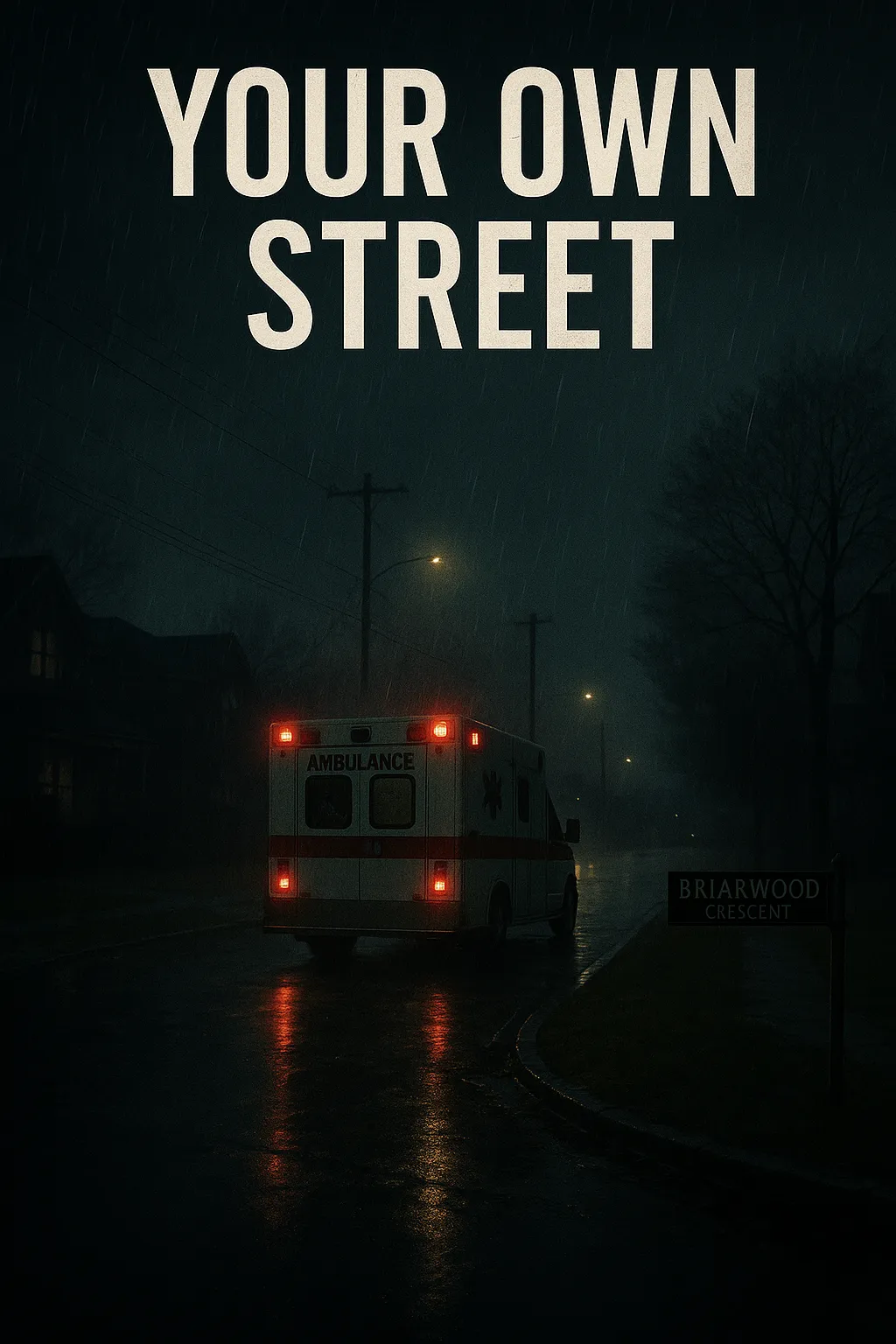
Your Own Street
The call came in at 19:47. Cardiac query, possible fall. Luke copied the address off the MDT screen while Dee pulled out of the station bay, and for three seconds it was just another job — gloves from the box, run sheet on the clipboard, the diesel settling into its highway register.
Then the street name landed.
Briarwood Crescent. His street. His postcode. The house number on the screen was smudged by a rendering lag, half-loaded, and he stared at it like staring would make the pixels resolve faster.
Dee's hands were at ten and two. She hadn't said anything. She hadn't moved — not her head, not her shoulders, nothing. She drove the way she always drove on a blue-light run, smooth and quick, but the rest of her had gone completely still.
Luke looked back at the screen. The number had loaded. 34. He lived at 42. Sam lived at 38. The Pooles were at 36. Old Mrs. Adeyemi at 34 —
No. Thirty-four was Sam's mother-in-law's place. She'd moved in last autumn. Or was it the Kaurs at 34? He couldn't think. He'd walked past these houses a thousand times and now the numbers were sliding around like tiles in a puzzle.
"Thirty-four Briarwood. That's — do we have a name on the call?"
Dee's jaw tightened. One small movement in all that stillness.
"Caller gave a name. Control's confirming."
She knew. The dispatch details hit her screen first — they always did, driver's side loaded the full packet while the attendant got the summary. She'd had the caller's name for forty seconds already, and she was choosing not to say it.
Luke turned away from her and opened the run bag. Laryngoscope: charged. BVM: sealed. Gauze rolls, four-by-fours, the Combat Application Tourniquet with its red tip and aluminium windlass. He checked the oxygen cylinder — full — and palmed the pulse oximeter out of its cradle. His hands did the inventory while the rest of him burned.
The radio clicked.
"Ambulance Seven, update on your call. Reclassified from cardiac query to hemorrhage. Significant blood loss from upper extremity wound. Caller reports patient conscious but altered. Over."
Luke's hand stopped on the tourniquet. Cardiac to hemorrhage. That wasn't a drift — that was a completely different animal. Someone had called in thinking heart attack, and now there was arterial blood. A fall didn't do that. A cardiac event didn't do that. His mind was already running the differential and he shut it down because the differential was taking him somewhere he didn't want to go, not on this street, not at a house he could almost see from his front window.
"Received, Control. ETA four minutes. Hemorrhage protocol, we'll need the name and age of the patient. Over."
The radio hissed. A pause that lasted one breath too long.
Dee took the roundabout at speed, both hands locked on the wheel, and the blue light swept across a row of parked cars. They were close now. Luke could feel the geography in his body — the way the road dipped before the railway bridge, the left curve past the church. Two minutes, maybe less.
He didn't look at her. He asked it to the windscreen.
She didn't answer. Her body was a statue behind the wheel — hands, arms, spine, all locked in the same position as if any movement would crack something open. The siren filled the silence between them.
"I need you on this job, Luke."
He pulled a second pair of nitrile gloves from the box and stuffed them in his chest pocket. Backup pair. Protocol.
Through the windscreen, the railway bridge rose into view. His street was the second left after the bridge. Forty-five seconds. He could see the blue wash of their own lights bouncing off the bridge abutment, and beyond it, at the far end of Briarwood Crescent, a figure standing on the pavement in a way that nobody stands unless something has gone very wrong — arms at their sides, face turned toward the sound of the siren, waiting.
Luke leaned forward against the harness and watched the figure resolve as the ambulance cleared the railway bridge. The blue lights swept the pavement in strobing arcs, and with each pass the shape gained detail — height, build, the way the weight sat on one hip. Male. Slight. No coat. Tracksuit bottoms and bare feet on the tarmac, arms hanging loose, face locked on the approaching siren.
Sam. Two doors down from thirty-four, and he'd come out without shoes.
Luke's chest unlocked by exactly one degree. Not Sam's house. Not forty-two. Whatever had happened, it had happened at thirty-four, and Sam was outside because he'd heard it or been called, not because it was his. Luke pressed his hands flat against the run bag and held them there until the shaking stopped.
Dee braked for the turn onto Briarwood Crescent. Her shoulders, her elbows, her spine — nothing shifted. She held the wheel the way a person holds a railing over a long drop: locked, deliberate, every joint committed to the single task of not moving.
"That's Sam. On the pavement. He lives at thirty-eight."
Dee said nothing. The siren dopplered off the terraced fronts and came back at them doubled.
"Thirty-four. That's — the Kaurs moved out last year. Sam's mother-in-law took it. Priya. She's sixty-two, sixty-three. On warfarin, I think. Dee, if she's on blood thinners and this is an upper extremity bleed—"
"I know."
Two words, and they confirmed everything. She'd had the name. She'd had it since the dispatch loaded and she had sat there in all that stillness and let him burn. Luke looked at the side of her face and understood exactly why she'd done it, and it didn't help at all.
The radio clicked.
"Ambulance Seven, patient is Priya Kaur-Morrison, female, sixty-three. Caller is a male juvenile, identified as grandson. Wound is to the left forearm. Caller reports towels soaked through. Patient responsive but confused. How copy."
Male juvenile. Grandson. Luke's hands went still on the run bag. Sam's kid. Fifteen, maybe sixteen now — the one Sam talked about in that careful voice parents use when the news isn't good and they're trying not to make it anyone's business. The one who'd been struggling.
Towels soaked through. Left forearm. Conscious but altered. Radial or ulnar, maybe brachial if it was deep enough. On warfarin, the blood wouldn't clot — it would just keep coming, sheeting off the skin, pooling faster than gauze could hold it. A litre already on the floor, maybe more. The differential tried to form and Luke killed it again, harder this time, because the shape it was taking had Sam's kid at the centre of it and a wound that didn't sound like an accident.
Luke keyed the handset. His hands were steady now. That was the worst part — how fast the training took over, how smoothly the professional slid in front of the person.
Through the windscreen, the crescent opened up. Terraced houses, wheelie bins, the streetlamp outside number forty with its orange flicker he'd reported to the council twice. Home. And ahead, at thirty-four, the front door standing wide open and light spilling across the path in a yellow rectangle, and Sam rooted to the pavement two houses up with his bare feet on the cold tarmac, already starting toward them before Dee had killed the siren.
Luke pulled on nitrile gloves. Left, then right. Tourniquet in his thigh pocket. Pulse oximeter — already in his jacket from the earlier check. Haemostatic gauze, two packets, stuffed into the run bag's outer pouch where he could reach them without looking. He did all of this in the time it took Dee to bring the ambulance to a stop, and none of it required him to think, which was good, because the thinking part of him was standing in Sam's kitchen six months ago listening to Sam talk too fast about counsellors and waiting lists and a kid who wouldn't come out of his room.
Dee pulled the handbrake. For the first time since the call came in, she moved — turned her whole body toward him, unlocking joint by joint as if coming out of a cast.
He was already opening the door.
Luke's boots hit the tarmac and the cold air found him immediately — February, after dark, the kind of damp that settled into everything. The ambulance's blue lights were still cycling, throwing the terrace into a stuttering slideshow: wheelie bins, privet hedges, the number on the nearest gate. Home. He could see the light in his own kitchen four houses up, the one he'd left on for no reason that morning.
Sam was already moving toward him. Not running — something worse than running. A kind of locked, lurching walk, arms tight at his sides, voice arriving before the rest of him.
"Luke — thank God. Thank God. Listen, it's Priya, she's in the front room, Callum came to our door about ten minutes ago, maybe fifteen, I don't know, he was — he had blood on his hands and I went straight over and she was on the floor by the sofa and I got towels, the blue ones from the bathroom, and I tried to hold pressure but it just kept — it wouldn't —"
Luke put his hand on Sam's shoulder. Firm. The kind of grip he used on strangers in shock, except this wasn't a stranger and the grip had to do twice the work.
Sam's mouth opened and closed once before the words caught.
Behind Luke, the ambulance door opened and closed. Dee moved past them both toward number thirty-four carrying the trauma bag in one hand and the suction unit in the other. No pause, no glance, no acknowledgement of the conversation happening on the pavement — just the efficient transfer of equipment from vehicle to scene, her body reduced to logistics.
"How much blood, Sam. Best guess. What you saw on the floor."
Sam's hands came up in front of him, palms out, and Luke saw the blood on them for the first time. Dried brown in the creases, still wet at the edges. Sam looked at his own hands as if he'd forgotten they were there.
"Warfarin. I know. Sam — where's Callum now."
Something moved through Sam's face. A sentence forming and collapsing before it reached his mouth. His jaw worked. His eyes went to the open door of number thirty-four and came back.
"He's upstairs. In her back bedroom. I told Jen to sit with him. Luke, he was — when he came to the door he wasn't —"
Luke squeezed Sam's shoulder once and let go.
He turned toward number thirty-four. The front door stood wide open, hallway light pouring across the front path. On the threshold, a partial footprint — small, bare, pointing outward. Luke stepped over it.
The hallway was narrow and smelled like iron and something floral underneath — air freshener, the kind that came in a plug-in. A framed photo on the wall: a woman in a sari at what looked like a graduation, smiling, one arm around a younger Sam. Coats on hooks. A pair of reading glasses on the telephone table. The living room door was open at the end of the hall and he could hear Dee's voice already, calm and measured, asking questions he couldn't make out.
Luke pulled the haemostatic gauze from the run bag's outer pouch without looking. The packet was foil-wrapped and rigid in his fingers. Tourniquet confirmed in his thigh pocket. Pulse oximeter in his jacket. He moved down the hallway toward the sound of Dee's voice and the smell of blood that thickened with every step.
The front room was small and too warm. A two-bar electric fire glowed orange in the hearth. The sofa had been shoved back at an angle it wasn't meant to sit at, one leg off the rug, and between it and the fireplace Priya lay on the carpet in a nest of soaked towels. Blue towels, like Sam said. Not blue anymore.
Dee was already kneeling at Priya's right side, gloves on, scissors out. She'd cut the left sleeve of Priya's cardigan from cuff to shoulder and folded it back. The wound was visible — a deep laceration on the inside of the left forearm, two inches above the wrist, running diagonal across the tendons. The edges gaped. Blood sheeted steadily from it despite the wadded towel Sam had left in place, dark and unrelenting in the way that only anticoagulated blood could be.
A mug of tea sat on the side table, still steaming.
Luke dropped to his knees on the carpet. It was warm and wet under him. He clipped the pulse oximeter onto Priya's right index finger and tore the foil packet of haemostatic gauze open with his teeth.
Priya's eyes were open. She turned her head toward him slowly, as if the room were moving and she was trying to hold still inside it.
"Priya, it's Luke. From up the road. I'm a paramedic and I'm going to look after you. Can you tell me where you are?"
Her grip on his wrist was weak — barely there, fingers cold.
Luke lifted the soaked towel away. The bleeding pulsed, not spurting but flowing fast, pooling in the crease of her elbow and running down onto the carpet. He packed the haemostatic gauze directly into the wound, pressing hard with the heel of his hand. Priya made a sound — not a scream, something smaller and more broken — and her fingers spasmed once against his wrist and then went slack.
"I know it hurts. I'm sorry. I need to keep pressure on this. Dee — what's the sat?"
Dee read the oximeter without looking up from the IV kit she was laying out on the spread plastic sheet. No fumbling, no wasted motion, no pause between one component and the next. She didn't wince at the wound. She didn't exhale when the numbers came up.
Too fast, too low. Luke cinched the tourniquet above her elbow and cranked the windlass until the flow under his hand slowed to a seep. Priya's breath hitched. Her left hand, below the tourniquet, was already pale and cool. He marked the time on the back of his glove with a Sharpie — 19:58 — because the tourniquet gave them minutes, not hours, and the clock was the only thing that didn't care how he felt.
"Priya. Stay with me. Can you squeeze my hand?"
She tried. He felt it — a tremor more than a squeeze, her fingers barely closing. Her lips moved but nothing came out. Then her hand opened and dropped to the carpet, and her head rolled to the side, eyes losing the room.
Dee had the cannula ready. She tied the tourniquet on Priya's right arm, found the vein on the first pass, and connected the saline bag in a single unbroken sequence. The fluid started running.
A single beat of eye contact between them. Then they were past it — Dee reaching for the radio, Luke holding pressure with both hands now, the gauze darkening but slower than before.
Dee keyed the radio with her elbow, her hands occupied with taping the cannula in place.
The radio crackled. Control's voice came back stripped of everything — no inflection, no cadence, just data shaped like words.
Luke looked down at Priya. Her mouth was still moving. Her eyes had gone somewhere far away, fixed on a point above his left shoulder.
Twelve minutes. The saline would buy time but it wasn't blood — it was volume without oxygen, a stopgap, a lie the body would believe for a while and then wouldn't. Under his hands the gauze held. The tourniquet held. Everything that could be done in this room with what they carried had been done, and now the job was waiting, which was the part of the job that killed you.
From upstairs, through the ceiling, a floorboard creaked. Then nothing. The silence had a weight to it — the specific gravity of a teenager sitting in a room directly above the woman he'd hurt, close enough to hear everything and unable to come down.
Priya's lips moved again. This time the sound came — barely, a breath with consonants in it.
Luke kept pressure. The carpet was warm under his knees. The electric fire ticked. Somewhere in the room a clock was running that he couldn't see, and he held the gauze against the wound and did not look at the ceiling.
Luke keyed the radio with his left hand, his right still pressing the gauze flat against the wound. The haemostatic agent had done its work — the bleeding had slowed to a dark seep that stained the edges but no longer pooled. Priya's breathing was shallow and fast, each exhale carrying a faint sound, not quite a word.
"Control, Ambulance Seven. Requesting update on HEMS ETA. Patient deteriorating. GCS has dropped — eye response to voice only, verbal confused, motor localising. That puts her at eleven. Sats holding at eighty-nine on high-flow. Over."
A pause. The flat hum of the open channel. Then Control's voice came back stripped of everything — no cadence, no colour, each word delivered at the same pitch and interval as if read from a teleprompter by a machine.
"Seven, HEMS is airborne from Redhill. Revised ETA nine minutes. Enhanced care team carrying packed red cells and TXA. Confirm tourniquet time for handover. Over."
"Tourniquet nineteen fifty-eight. That's —"
He checked the time on the back of his glove where the Sharpie numbers were already smudging. Twenty-oh-seven. Nine minutes on the tourniquet. Nine more until HEMS landed. Eighteen total. The tissue below the cuff could tolerate two hours, but Priya's blood volume couldn't tolerate eighteen more minutes of waiting for what saline couldn't replace.
"Nine minutes on the tourniquet. Saline's running but she needs blood. Nine minutes is a long time, Control. Over."
"Understood, Seven. HEMS aware of anticoagulant status. They're carrying four units. Standby for further. Over."
The radio clicked off. Four units. It might be enough. It might not. Luke settled back onto his heels and looked at what he had: a tourniquet holding, gauze packed tight, saline running from the bag on the coat hook — less than half left now, the plastic crinkling as it emptied. Dee was across from him rechecking the IV site in Priya's right arm, taping the cannula down with the kind of unhurried precision that meant she was working fast. No wasted gesture. No sigh, no grimace, no adjustment of her position. Just hands doing exactly what hands needed to do and nothing else.
Priya's right hand opened and closed against Luke's forearm. The grip was weaker than before — he could feel the difference, the tendons working without purchase, fingers that intended to hold but couldn't complete the action.
"He's upstairs, Priya. He's safe. Jen's with him."
Her hand relaxed. Then tightened again — a spasm this time, involuntary, her whole forearm going rigid under his palm before releasing. Her skin was cool. Not cold yet, but the warmth was leaving her in a slow tide that Luke could feel through the nitrile.
Luke breathed out. One breath. His hands didn't move on the gauze.
Priya's eyes found his face and held there with a clarity that hadn't been present thirty seconds ago — a window opening in the fog, brief and unearned and probably closing soon.
"I hear you, Priya. I hear you. That's what I'll tell them."
Above them, the floorboard creaked.
Dee didn't look up. She was swapping the empty saline bag for the second unit from the trauma kit, her movements continuous, hands threading the new line onto the hook without pause. But between one action and the next — between unclipping the spent bag and hanging the fresh one — she stopped. A half-second where her hands were in the air and the rest of her was stone. Then the new bag was up and running and she was Dee again.
Luke moved his fingers to Priya's right wrist without releasing pressure on the wound. He found the pulse — faint, rapid, slipping away under his fingertips like something trying not to be caught. One-twenty. Maybe higher. Her body was pulling blood to the core now, abandoning the periphery, doing the brutal arithmetic of survival that the brainstem performed without consulting anyone.
"Priya. Can you tell me your name."
Her mouth opened. Her eyes moved to a point somewhere past his shoulder — not tracking him, not tracking anything in the room. Her fingers curled once against his arm and then were still.
"Callum."
"Dee. GCS is dropping. Eye response to voice only. Verbal — she's producing words but not oriented. Motor still localising. I'm calling that a ten."
Dee reached for the radio. Her thumb found the button on the first try.
"Received, Seven. HEMS confirms seven minutes. Landing site is the green at the top of Briarwood Crescent. Can you confirm access for the team. Over."
"Front door is open. Straight through the hall. They'll see us. Over."
Seven minutes. Luke looked down at Priya. Her chest rose and fell in quick, shallow cycles. Her left hand below the tourniquet was white and still — the fingers slightly curled, the nails blanching past pale into blue. Her right hand lay open on the carpet where it had fallen from his arm, palm up, the pulse oximeter still clipped to her index finger. Eighty-seven now. Dropping.
From outside, Sam's voice — too fast, indistinct, the words tumbling into each other. He was talking to someone on the pavement. Or talking to no one. Filling the air with sound because the silence was a shape he couldn't fit inside.
From upstairs, nothing. The silence held.
Luke adjusted the gauze. Checked the tourniquet. Checked the time — twenty-twelve. Fourteen minutes on the cuff. The saline bag on the hook swayed gently with each drip, catching the light from the hallway.
He looked at her across Priya's body. Dee was on her knees, hands resting on her thighs, and for the first time since the call came in she wasn't doing anything. Every task that could be performed had been performed. The kit was open, the lines were running, the tourniquet was holding, and they were two paramedics in a warm room with a woman whose blood was thinner than water, waiting for a helicopter that was seven minutes away, and the seven minutes were the whole world.
"She's going to make it to handover."
It wasn't a question. It wasn't a reassurance. It was Dee deciding what was true and saying it out loud so the room would hear it, and Luke held the gauze against the wound and chose to believe her because the alternative was a thing he could not afford.
Priya's chest rose. Fell. Rose.
Priya's eyes drifted to the ceiling. Her lips moved — shaping the same name, over and over, the sound barely leaving her throat. Her right hand lay open on the carpet, the pulse oximeter glowing red on her index finger. Eighty-six.
He kept his right hand flat on the gauze and leaned in close enough that she couldn't miss him, even with her focus sliding.
Her eyes found him. For a moment she was there — fully, completely present, the confusion burning off like fog lifting from a single point.
"You promise."
"I promise."
Her fingers found his forearm and rested there. They didn't tighten. They settled.
The saline bag on the coat hook crinkled — nearly empty, the plastic folding in on itself. Dee reached up and swapped it without a word, hands threading the new line through with no pause between disconnect and reconnect. No exhale. No glance at Luke. Just the task.
"Sats eighty-six. Pulse one-thirty. Luke."
He checked the Sharpie on his glove. 19:58. The clock on the mantelpiece read 20:14. Sixteen minutes on the tourniquet. The tissue could wait. The blood volume couldn't.
The living room window rattled in its frame. A deep percussive thudding rolled down through the roof tiles and into the walls — the helicopter, settling onto the green at the top of the crescent. The lampshade swayed once and was still.
The voice came through stripped clean — no cadence, no inflection, each word delivered at identical pitch.
"Received, Control. Front door open. Straight through the hall. Tourniquet time nineteen fifty-eight, sixteen minutes. Patient GCS ten, sats eighty-six, pulse one-thirty. Anticoagulated on warfarin. Over."
Priya's breathing had changed. Faster. Shallower. Each inhale barely lifting her ribs before the next one chased it. Her lips were still moving — Callum's name, or something shaped like it — but the sound had stopped. Her fingers stayed on Luke's forearm, light and cool and present.
The words came out clear. One lucid sentence dropped into the confusion like a stone into still water.
"He won't. I promised you."
Boots on the front path. Fast, heavy, purposeful. Voices in the hallway — two, maybe three — and then the front room filled with people in orange flight suits carrying rigid bags and a cooler marked with a red cross. The lead medic dropped beside Dee and she began the handover without preamble, her voice the same flat efficiency it had been since the dispatch loaded: patient details, medications, interventions, times. Every number clean. Every action accounted for.
Luke lifted his hands from the gauze as the HEMS medic's gloved hands replaced them — the transfer seamless, pressure maintained, not a second of exposure. He sat back on his heels. His hands were dark with blood to the wrists. Underneath, when he peeled the nitrile off — left then right, rolling them inside out — his skin was clean and steady.
The cooler opened. Packed red cells, cold from transit. The HEMS paramedic spiked the first unit and ran it into Priya's right arm while the lead medic drew TXA into a syringe. The room had changed — no longer two people holding the line, but a full team with blood products and drugs that could do what saline couldn't. The pulse oximeter on Priya's finger read eighty-eight. Then eighty-nine. Then ninety.
She was standing by the doorway. Her hands hung at her sides. For one half-second she was completely still — not working, not moving, just stopped, as if every system in her had paused at once. Then she tilted her head toward the hallway.
He understood. The HEMS team had the patient. Priya was their job now. And upstairs, in a back bedroom with a thin line of light under the door, a fifteen-year-old boy sat in silence with his grandmother's blood dried under his fingernails.
Luke stood. His knees ached from the carpet and there was a dark wet patch on both legs where he'd been kneeling in Priya's blood. He looked down at her once more — her chest rising and falling, the HEMS medic's hands where his had been, the first unit of blood running into her arm, red replacing clear. Her lips were still moving.
He stepped into the hallway. The iron smell was fainter here. The framed photo on the wall — Priya at the graduation, her arm around a younger Sam — watched him pass. At the foot of the stairs he stopped. The landing above was dark except for a band of light beneath a closed door at the far end. No sound came from behind it.
Dee's hand touched his shoulder. Two seconds. Then gone.
He went up.
The stairs were narrow and carpeted in dark brown — the colour that hid everything. Halfway up, a handprint on the wallpaper at hip height, rust-coloured, four fingers and a palm. Small. Luke climbed past it without stopping.
The landing smelled like carpet cleaner and warm dust. A radiator ticked against the wall beside the bathroom door, its paint yellowed and peeling at the edges. Luke stopped and pressed his back against it. The heat came through his shirt and into the muscles along his spine and he let it.
The closed door at the end of the landing had light underneath it. No sound came from behind it. He could hear the HEMS team working below — clipped instructions, the rattle of packaging, Dee's voice threading through it all with the handover details she could recite in her sleep. Priya's sats had been ninety when he left. Ninety was not safe. Ninety was alive.
Luke knocked. Two knocks, quiet, the way he knocked on his own door when he came home from a night shift and didn't want to wake anyone.
The door opened six inches. Jen stood in the gap. Her hand gripped the doorframe — knuckles bloodless, tendons standing out, the wood taking all the weight her legs wouldn't. She was breathing in small controlled sips, each one measured out as if rationed.
Her voice was barely above a whisper.
"I know. Can I come in?"
Jen stepped back. The room was small — a single bed pushed against the wall, a wardrobe with a mirror on the door, a reading lamp on the bedside table casting a yellow circle on the ceiling. Priya's room. A cardigan hung over the back of a chair. A library book lay face-down on the pillow, spine cracked to hold its place.
Callum sat on the floor between the bed and the wardrobe. Knees drawn up. Fists at his sides, thumbnails pressed white into his palms. He was looking at a point on the carpet approximately two feet in front of him. He did not look up when Luke entered.
Luke lowered himself to the floor and sat with his back against the bed frame, close enough that Callum could reach him if he wanted to, far enough that he didn't have to. The carpet was clean up here. Warm. His knees ached when he bent them and the wet patches on his trousers pressed cold against his skin.
Jen hovered in the doorway, one hand still on the frame.
She looked at Callum. Then at Luke. Then she let go of the doorframe and left, her footsteps quick and light on the stairs.
The room settled. Below them, muffled by carpet and floorboard and plaster, the work continued — a voice calling numbers, the heavy zip of a bag. The reading lamp hummed faintly. Callum's breathing was almost inaudible.
Luke did not speak. He sat on the floor of Priya's bedroom and he waited, because waiting was the only thing he had left to offer and it was the thing the boy needed most — someone who would stay in the silence without trying to fill it.
When it came, the voice was small and stripped of everything.
"No. She's not dead. There are doctors with her right now and they're giving her blood and her numbers are coming up. She's alive, Callum."
Callum's jaw tightened. His whole body braced as if against an impact that hadn't arrived yet.
"She told me what happened. The glass broke and you tried to catch her. That's what she said. That's what happened."
Nothing. The fists stayed. The carpet held his gaze. Luke could feel the boy's stillness like a physical thing — not calm but locked, every muscle committed to the project of not breaking apart.
"She told me to tell you she's not angry. She wanted me to come up here and say that to you before anything else. That was the thing that mattered to her. Not the doctors, not the helicopter. You."
Callum's face changed. His mouth pulled tight and his chin dropped and his eyes closed, and his face did something that wasn't crying but was the moment before crying.
The words came out broken, barely voiced.
"You ran to Sam's house. You got help. That's exactly right. That's what saved her."
Callum's fists opened. Slowly, finger by finger, as if releasing something he'd been holding for a very long time. The white crescents where his nails had been were filling with colour.
From below, the front door opened wider — boots on the path, voices coordinating, the measured urgency of a patient being moved. The helicopter's rotors began to spool up, the sound climbing through the walls and into the floor beneath them. Priya was going to hospital. Priya was alive.
Callum's shoulder touched Luke's arm. Not leaning — just contact, the smallest possible proof that another person was there. Luke didn't move. Didn't speak. The helicopter climbed away over the rooftops and thinned to silence.
He stayed.